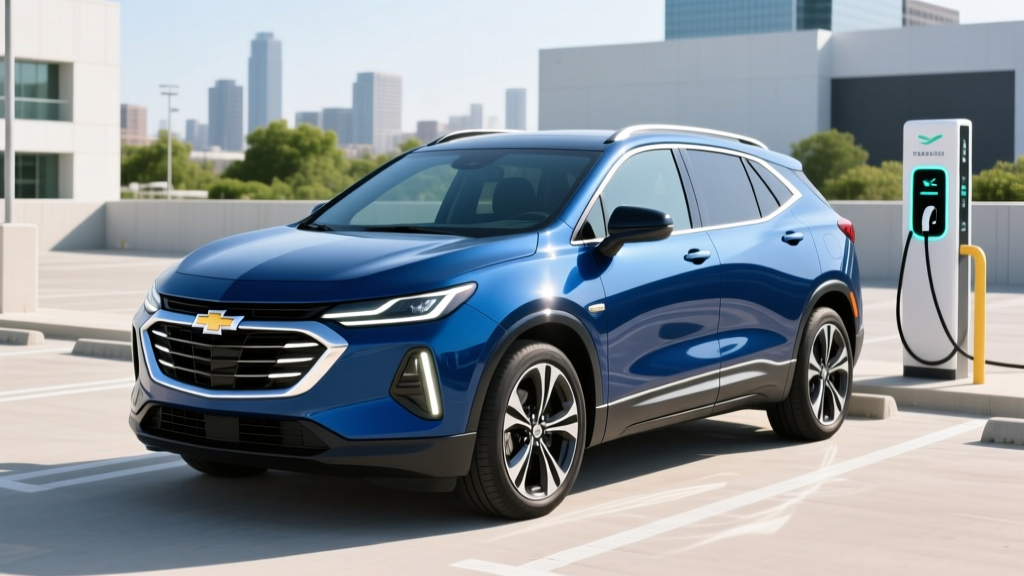
Chevy Equinox EV September 2025 Deals: What's Actually on the Table?
If you've been tracking the compact electric SUV segment, the Chevrolet Equinox EV has emerged as one of the most aggressively priced entries in the space. As we move into the fall selling season, Chevy dealerships are rolling out September 2025 incentive packages that stack federal tax credits, manufacturer rebates, and dealer discounts into some compelling numbers. But the sticker price is only the opening act — the real question for buyers is what this SUV costs to own over five years.
This guide breaks down the total cost of ownership (TCO) for the 2025 Chevy Equinox EV, incorporating real-world charging costs, insurance premiums, maintenance savings, and depreciation trends. We'll also untangle the IRS §30D federal tax credit rules that determine whether you actually pocket that $7,500 — or a portion of it — at the point of sale.
| Spec | LT (FWD) | RS (AWD) |
|---|---|---|
| EPA Range | 319 miles | 285 miles |
| Real-World Range (highway/cold) | ~255–280 mi | ~225–250 mi |
| Battery Capacity (usable) | 85 kWh (NMC, Ultium platform) | |
| Peak DC Fast Charge | 150 kW | |
| 10–80% DC Charge Time | ~35 minutes | |
| Level 2 (240V) Charge Rate | 11.5 kW (~34 mi/hr) | |
| Horsepower | 213 hp | 288 hp |
| 0–60 mph | ~8.1 sec | ~5.9 sec |
| EPA Efficiency | 117 MPGe | 105 MPGe |
| Base MSRP | $33,600 | $41,900 |
| Battery/Powertrain Warranty | 8 years / 100,000 miles | |
Real-World Range Reality Check: The EPA rates the Equinox EV LT FWD at 319 miles, but expect 255–280 miles on highway-heavy trips at 70+ mph, and as low as 220–240 miles in sub-freezing winter conditions where cabin heating and battery chemistry both work against you. The AWD RS trims knock roughly 30–40 miles off those figures. Always plan road trips around the lower bound.
Federal Tax Credit: Do You Actually Qualify for $7,500?
The Equinox EV's affordability story hinges heavily on the IRS §30D Clean Vehicle Credit, which can reduce your tax liability by up to $7,500 — and, crucially, can now be transferred to the dealer at the point of sale as an instant discount on the purchase price. But eligibility is not automatic. The rules have tightened considerably since the Inflation Reduction Act restructured the credit, and both your income and the vehicle's sourcing must qualify.
§30D Credit Eligibility Checklist (2025 Tax Year)
- Income Caps (Modified AGI): $150,000 single filer / $225,000 head of household / $300,000 joint filers
- MSRP Cap: Vehicle base MSRP must not exceed $55,000 for SUVs (Equinox EV qualifies)
- Critical Minerals Requirement ($3,750): A percentage of battery critical minerals must be sourced from the US or a free-trade-agreement country
- Battery Components Requirement ($3,750): A percentage of battery components must be manufactured or assembled in North America
- FEOC Restriction: Vehicles with battery components or critical minerals from a Foreign Entity of Concern (primarily targeting Chinese supply chains) may be disqualified — this rule tightens annually
- Point-of-Sale Transfer: You can elect to transfer the credit to the dealer, receiving it as an immediate price reduction rather than waiting to claim it on your tax return
- New Vehicle Only: Must be purchased new; used EVs fall under a separate §25E credit (up to $4,000)
For the 2025 Equinox EV, GM has confirmed that the Ultium battery platform's North American manufacturing and supply chain sourcing qualifies the vehicle for the full $7,500 credit under current rules. However, the FEOC restrictions on critical minerals tighten in 2025 and beyond, so buyers should verify current eligibility with their dealer at the time of purchase. Tax rules can and do change — consult a tax professional for your specific situation.
September 2025 deal context: Several Chevy dealers are advertising the Equinox EV LT at an effective price near $26,100 after applying the $7,500 federal credit at point of sale, plus any applicable dealer discounts. That's an exceptionally competitive entry point for a 319-mile-range EV.
5-Year Total Cost of Ownership: The Full Picture
The purchase price — even after incentives — is only the beginning. Here's a realistic 5-year / 60,000-mile ownership cost breakdown for the Equinox EV LT, compared against a comparably priced gas SUV (the gas-powered Equinox AWD at ~$30,000 MSRP).
| Cost Category | Equinox EV LT (FWD) | Gas Equinox (AWD) |
|---|---|---|
| Purchase Price (after fed. credit) | $26,100 | $30,000 |
| Fuel / Charging (60k mi) | $3,240 | $6,750 |
| Maintenance (5 years) | $1,200 | $3,500 |
| Insurance (5 years) | $9,500 | $7,500 |
| Depreciation (est. 5-yr) | $12,500 | $13,000 |
| Total 5-Year Cost | $52,540 | $60,750 |
| Net Savings (EV vs Gas) | ~$8,210 | |
Assumptions: $0.15/kWh home charging average, $3.75/gal gasoline, 28 MPG combined for gas Equinox, 15,000 miles/year driven. Insurance based on national EV average premiums. Depreciation estimates based on current EV resale trends. Actual costs vary significantly by region, driving habits, and electricity rates.
Charging vs. Gas: The Per-Mile Math
The single largest ongoing savings from EV ownership comes at the fuel pump — or rather, the charger. Let's run the concrete numbers.
| Scenario | Cost per Mile | Annual Cost (12k mi) |
|---|---|---|
| Home Level 2 charging ($0.15/kWh, 3.0 mi/kWh) | $0.050 | $600 |
| Public DC fast charging ($0.40/kWh average) | $0.133 | $1,600 |
| Gas Equinox (28 MPG, $3.75/gal) | $0.134 | $1,608 |
| Blended EV (80% home / 20% public) | $0.067 | $804 |
With predominantly home charging, the Equinox EV costs roughly $0.05 to $0.07 per mile to "fuel" — about half the cost of the gas Equinox at current fuel prices. Even relying entirely on public DC fast chargers at $0.40/kWh, you're roughly at parity with gasoline, not paying a premium.
The key variable is your electricity rate. If you have access to time-of-use (TOU) utility plans with off-peak rates around $0.08–$0.10/kWh, your per-mile cost drops to $0.027–$0.033. Conversely, in states with high residential rates ($0.25+/kWh, such as parts of California, Hawaii, or the Northeast), home charging costs climb to $0.083/mile — still below gasoline, but the gap narrows.
Maintenance Savings: Where EVs Quietly Win
EVs eliminate the maintenance items that generate the most frequent dealer service visits for gas cars. The Equinox EV's single-speed reduction gear and electric motor have far fewer wear components than an internal combustion engine with its associated transmission, exhaust, and fuel systems.
| Service Item | Equinox EV | Gas Equinox |
|---|---|---|
| Oil changes (every 5k–7.5k mi) | $0 (none needed) | $600–$900 |
| Transmission fluid | $0 (sealed unit) | $200–$350 |
| Brake pads (front + rear) | $150–$300 (regen extends life 2–3x) | $600–$1,000 |
| Engine air filter | $0 (none) | $100–$150 |
| Spark plugs | $0 (none) | $200–$400 |
| Coolant / misc. fluids | $100–$200 | $250–$400 |
| Cabin air filter + tire rotation | $400–$600 | $400–$600 |
| 5-Year Total (est.) | $650–$1,100 | $2,350–$3,800 |
Regenerative braking is the unsung maintenance hero: by using the electric motor to decelerate, the Equinox EV's friction brakes see significantly less wear. Many EV owners report original brake pads lasting 80,000–100,000+ miles. Combined with the elimination of oil changes, the maintenance savings typically run $1,500–$2,500 over five years.
One maintenance cost that EVs don't escape: tires. The Equinox EV's instant torque and heavier curb weight (~4,500 lbs) can accelerate tire wear by 10–20% compared to a lighter gas vehicle. Budget for a tire replacement around 35,000–45,000 miles.
Insurance Cost Reality: The EV Premium
Here's where EV ownership costs more, and it's important not to gloss over it. EV insurance premiums run 15–30% higher than comparable gas vehicles on average, according to industry data. For the Equinox EV, expect annual premiums in the range of $1,700–$2,100 depending on your state, driving record, and coverage level — compared to roughly $1,400–$1,600 for the gas Equinox.
Why the premium? Three factors drive it:
- Higher repair costs: EV battery packs and power electronics are expensive to replace after a collision. Even minor rear-end damage can trigger battery safety inspections that add thousands to a claim.
- Specialized labor: Fewer body shops have the high-voltage certification required to work on EV battery systems, limiting repair network options for insurers.
- Vehicle value: Even after the tax credit, insurers base premiums on the vehicle's pre-credit MSRP, which is higher than the gas equivalent.
Tip: Shop quotes from at least three insurers before purchasing. Companies like GEICO, Progressive, and Tesla Insurance (in eligible states) have begun offering more competitive EV rates. Bundling home and auto can knock 10–15% off the premium.
Depreciation and Resale Value: The Evolving Picture
EV depreciation has been one of the most volatile ownership variables over the past three years. After a brutal 2023–2024 period where Tesla price cuts and rapid market expansion cratered used EV values, the segment has stabilized somewhat heading into 2025.
For the Equinox EV specifically, several factors work in its favor:
- Lower starting price: Vehicles under $35,000 MSRP hold percentage-based resale value better than luxury EVs that depreciate from a higher cliff.
- GM Ultium platform credibility: The 8-year/100,000-mile battery warranty provides used buyers confidence in long-term viability.
- 319-mile range: Range is the single strongest correlate of EV resale value, and the Equinox EV's EPA rating remains competitive for its class.
Expect 5-year depreciation of approximately 40–50% of the post-credit purchase price — roughly $10,000–$13,000 on a $26,100 effective purchase. This is competitive with the gas Equinox, which typically depreciates 45–55% over the same period. The gap has narrowed significantly from 2022–2023, when some EVs lost 60%+ of their value in three years.
Caution: Depreciation projections are inherently uncertain for EVs. Battery technology advances, future tax credit changes, and shifting consumer preferences can all accelerate or decelerate value loss. The data from fueleconomy.gov and resale trackers like iSeeCars provide the best current benchmarks.
State, Local, and Utility Incentives: Stack the Savings
Beyond the Federal Credit: Depending on where you live, additional incentives can further reduce your effective cost. These vary significantly by state, municipality, and utility provider, and they change frequently. Always verify current availability with official sources.
Common incentive categories to investigate:
- State EV rebates: States like Colorado (up to $5,000), California (CVRP, up to $7,000 for income-qualified buyers), and Massachusetts (MOR-EV, up to $3,500) offer direct rebates that stack with the federal credit.
- Utility company rebates: Many electric utilities offer $500–$1,500 rebates for purchasing an EV and/or installing a Level 2 home charger. Check with your local provider.
- HOV lane access: States including California, Colorado, Virginia, and Maryland grant solo HOV lane access to qualifying EVs — a significant time savings for commuters.
- Home charging installation credits: The federal §30C Alternative Fuel Vehicle Refueling Property Credit covers up to 30% of home charger installation costs (max $1,000), subject to census-tract eligibility requirements.
- Reduced registration fees or tax exemptions: Some states exempt EVs from sales tax or offer reduced annual registration, while others impose additional EV registration fees to offset lost gas tax revenue.
These incentives can collectively reduce your effective purchase cost by an additional $2,000–$8,000 depending on your location. A buyer in Colorado stacking the federal credit, state rebate, and utility charger incentive could see an effective Equinox EV LT price below $22,000.
September 2025 Deal Strategies: Maximizing Your Savings
If you're evaluating Equinox EV deals this September, here's a practical framework for getting the best total value:
Deal Evaluation Framework
Prioritize the point-of-sale credit transfer: Ensure your dealer is registered with the IRS Energy Credits Online portal to process the §30D credit at sale. This avoids waiting until tax season and reduces your financed amount.
Ask about manufacturer-to-dealer incentives: GM frequently offers dealer cash or bonus cash on EV models that isn't advertised to consumers. These can translate into $1,000–$2,500 in additional negotiation room.
Compare lease vs. buy: GM Financial lease deals on the Equinox EV sometimes include the full $7,500 credit as a capitalized cost reduction, plus additional lease cash. If the monthly payment is competitive and you're comfortable with mileage limits, leasing can be the cheapest path.
Time your purchase: End-of-month and end-of-quarter sales (September 30 is Q3 close) often yield the best dealer flexibility on pricing, especially on EV inventory that dealers are incentivized to move.
Frequently Asked Questions
How much does it really cost to own a Chevy Equinox EV over 5 years?
Based on our analysis, the 5-year total cost of ownership for the Equinox EV LT (after the $7,500 federal credit) runs approximately $52,000–$55,000 including purchase, charging, insurance, maintenance, and depreciation over 60,000 miles. That's roughly $8,000–$10,000 less than a comparably equipped gas Equinox over the same period, with the savings driven primarily by lower fuel and maintenance costs offsetting higher insurance premiums.
Do I qualify for the full $7,500 federal EV tax credit?
You qualify for the full $7,500 if your modified adjusted gross income falls below the IRS thresholds ($150k single / $300k joint), the vehicle MSRP is under $55,000 (the Equinox EV qualifies), and the battery meets both the critical minerals and component sourcing requirements under current §30D rules. The Equinox EV has qualified for the full credit through GM's North American Ultium supply chain, but FEOC restrictions tighten annually — verify with your dealer and consult IRS.gov for the latest guidance.
How much do I save on fuel and maintenance vs. a gas SUV?
With predominantly home charging at national-average electricity rates, expect to save $3,000–$4,000 on fuel over 60,000 miles compared to a gas Equinox getting 28 MPG at $3.75/gallon. Maintenance savings add another $1,500–$2,500 over five years thanks to eliminated oil changes, reduced brake wear from regenerative braking, and fewer mechanical components. Combined fuel and maintenance savings typically total $4,500–$6,500 over five years.
Are EVs more expensive to insure than gas cars?
Yes, typically 15–30% more expensive. For the Equinox EV, expect annual premiums of $1,700–$2,100 compared to $1,400–$1,600 for the gas equivalent. Higher repair costs for battery components, specialized labor requirements, and pre-credit vehicle valuation all contribute. Shopping multiple insurers and bundling policies can reduce the gap significantly.
How well do EVs hold their resale value?
EV depreciation has stabilized after the sharp declines of 2023–2024. The Equinox EV, with its sub-$35,000 MSRP and 319-mile range, is positioned for approximately 40–50% depreciation over five years — competitive with its gas counterpart. Long-range, affordable EVs with strong battery warranties hold value better than luxury EVs with high MSRPs. Battery health and technology obsolescence remain the key variables to watch.
What home charging setup do I need for the Equinox EV?
The Equinox EV accepts up to 11.5 kW on Level 2 (240V), adding roughly 34 miles of range per hour. A 48-amp Level 2 home charger on a 60-amp dedicated circuit is the optimal setup, enabling a full overnight charge from empty in about 8–9 hours. Professional installation typically costs $500–$2,000 depending on your electrical panel capacity and the distance from panel to charger location. The federal §30C credit may cover up to $1,000 of installation costs if you're in an eligible census tract.