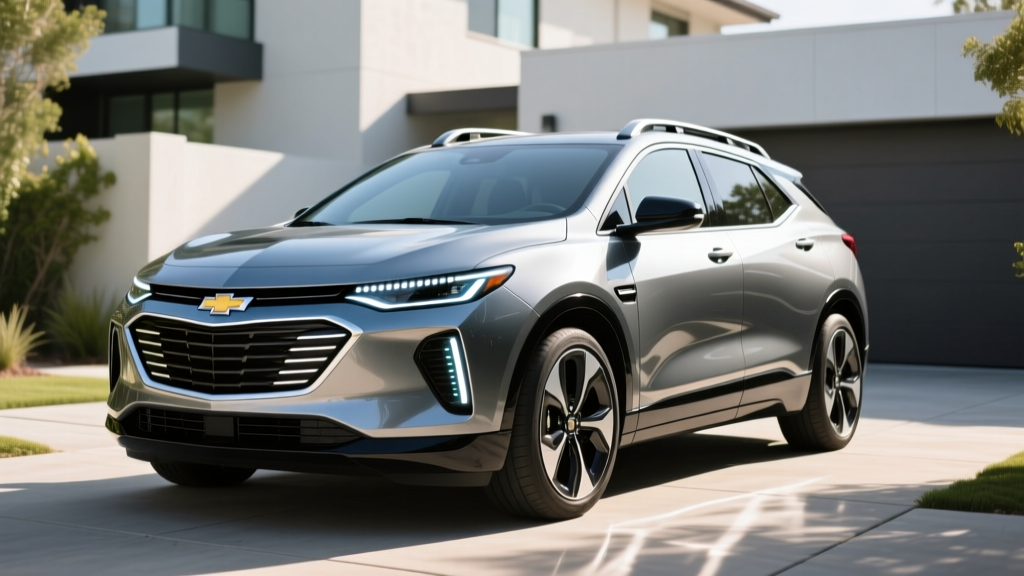
The Chevrolet Equinox EV has become one of the most talked-about affordable electric crossovers on the market, and its sales trajectory through mid-2025 reflects growing mainstream buyer interest. As Chevy Equinox EV sales in July 2025 continue to climb — driven by aggressive pricing, a usable 300+ mile range, and federal tax credit eligibility — we're putting the 2025 model under the microscope to see if the numbers hold up beyond the showroom floor.
This isn't a spec-sheet regurgitation. We're looking at real-world range expectations, charging-curve behavior, the nuances of the §30D tax credit, and how the Equinox EV stacks up against the Hyundai Ioniq 5, Tesla Model Y, and Ford Mustang Mach-E for buyers who need a practical daily driver, not a status symbol.
Range and Efficiency: 319 Miles EPA, But What Will You Actually See?
Real-World Expectation: ~260–290 miles in mixed driving; ~240–260 miles sustained highway at 70+ mph; ~200–230 miles in sub-30°F cold weather without preconditioning.
The Equinox EV's headline number is its EPA-estimated 319 miles on the FWD LT and RS trims, courtesy of GM's Ultium platform with an 85 kWh (usable) lithium-ion battery pack using NMC (nickel manganese cobalt) chemistry. The AWD RS trim drops to an EPA-estimated 285 miles due to the additional front motor and weight.
Efficiency on the FWD model lands at approximately 3.0–3.2 kWh/mile, translating to roughly 114 MPGe combined per fueleconomy.gov. That's competitive with the Tesla Model Y Long Range but slightly behind the Hyundai Ioniq 5's efficiency figures.
In practice, expect highway driving at 75 mph to consume closer to 3.5 kWh/mile, bringing real-world range to around 245–260 miles before you'll want to find a charger. Cold weather is the bigger penalty: without consistent use of the Equinox EV's heat pump (standard on all trims), range can dip to 200–230 miles in freezing conditions. Preconditioning the battery while plugged in mitigates some of this loss and is essential for optimizing DC fast-charge speeds in winter.
Battery, Charging Speed, and the 150 kW Reality Check
| Metric | Value |
|---|---|
| Battery Capacity (Usable) | 85 kWh (NMC chemistry) |
| Max DC Fast-Charge Rate | 150 kW (peak) |
| 10–80% DC Fast Charge Time | ~35 minutes (estimated) |
| Level 2 Home Charging Rate | 11.5 kW (48A) |
| Level 2 Miles Added Per Hour | ~34 miles/hr |
| Level 1 (120V) Rate | ~1.4 kW (~4 miles/hr) |
| Charge Port | CCS1 (NACS adapter available 2025+) |
The Equinox EV's 150 kW peak DC fast-charge rate is its most debated specification. For context, the Hyundai Ioniq 5 peaks at 240 kW and the Tesla Model Y at 250 kW on V3 Superchargers. The Equinox EV will not win any charging-speed contests, but the question is whether 150 kW is adequate for its use case.
On a 350 kW Electrify America or EVgo station, expect the Equinox EV to sustain roughly 130–150 kW from 10% to approximately 40% state of charge, then taper progressively. The 10–80% charge takes roughly 35 minutes — acceptable for a road-trip lunch stop but noticeably slower than the Ioniq 5's ~18-minute 10–80% time. If your typical DC fast-charge session is a 20-minute top-up from 30% to 60%, the Equinox EV adds roughly 100–120 miles in that window, which is practical enough.
Home Level 2 charging at 11.5 kW is where this vehicle shines for daily use. A full overnight charge from 20% to 100% takes approximately 7 hours, meaning you'll wake up to a full battery every morning if you install a 48-amp Level 2 charger on a 60-amp circuit. This is the charging pattern that makes EV ownership effortless — and it's where the Equinox EV's 34 miles-per-hour Level 2 rate works perfectly for a 319-mile battery.
GM has confirmed that NACS (Tesla-style) adapter compatibility is available for 2025 Equinox EV models, enabling access to Tesla Supercharger stations. This significantly expands the public charging network, though charge speeds at Superchargers will still be limited by the Equinox EV's 150 kW onboard maximum.
Performance: Adequate, Not Aspirational
| Trim | Drivetrain | Horsepower | Torque (lb-ft) | 0–60 mph |
|---|---|---|---|---|
| LT (FWD) | Single Motor, FWD | 213 hp | 236 | ~7.8 sec |
| RS (FWD) | Single Motor, FWD | 213 hp | 236 | ~7.8 sec |
| RS (AWD) | Dual Motor, AWD | 288 hp | 355 | ~6.3 sec |
The Equinox EV is not positioned as a performance vehicle, and the numbers reflect that. The single-motor FWD trims deliver 213 horsepower and a 0–60 mph time around 7.8 seconds — perfectly adequate for highway merging and daily commuting but noticeably behind the Model Y Long Range (5.0 seconds) and Ioniq 5 RWD (7.4 seconds with 225 hp).
The dual-motor AWD RS bumps output to 288 horsepower and drops the 0–60 time to approximately 6.3 seconds. This makes it the most engaging version to drive, with confident all-weather traction and passing power. Regenerative braking is adjustable through the infotainment system and includes a one-pedal driving mode that's effective in city traffic.
Ride quality leans toward comfort over sportiness, with a well-damped suspension that absorbs highway imperfections. Road noise is low — a benefit of the absence of an internal combustion engine and GM's attention to acoustic insulation.
Interior, Cargo, and Daily-Use Practicality
The Equinox EV's interior is a significant step up from the gas Equinox, anchored by a 17.7-inch diagonal infotainment touchscreen running GM's latest Ultifi software platform. The interface is responsive and supports wireless Apple CarPlay and Android Auto. A 11-inch digital driver display replaces traditional gauges.
Passenger space is generous for the compact crossover segment:
- Front legroom: 43.1 inches
- Rear legroom: 37.8 inches
- Front headroom: 40.0 inches
- Rear headroom: 38.3 inches
Cargo volume measures 26.4 cubic feet behind the rear seats and 57.2 cubic feet with the rear seats folded flat. There is no front trunk (frunk) — a notable omission compared to the Ioniq 5 and Model Y, both of which offer modest front storage. The Equinox EV also lacks vehicle-to-load (V2L) capability, which the Ioniq 5 provides for powering external devices.
Pricing, Trim Levels, and Federal Tax Credit Eligibility
| Trim | Base MSRP | Est. §30D Credit | Effective Price (if eligible) |
|---|---|---|---|
| LT (FWD) | $33,600 | Up to $7,500 | ~$26,100 |
| RS (FWD) | $43,400 | Up to $7,500 | ~$35,900 |
| RS (AWD) | $46,300 | Up to $7,500 | ~$38,800 |
The Equinox EV LT at $33,600 MSRP (including destination) is one of the most affordable 300+ mile EVs available in 2025. The RS FWD starts at $43,400, and the range-topping RS AWD comes in at $46,300. All trims fall well under the IRS §30D MSRP cap of $80,000 for SUVs.
- Vehicle MSRP must not exceed $80,000 (SUVs/trucks) — Equinox EV qualifies
- Buyer AGI must not exceed $150,000 (single) / $300,000 (joint) / $225,000 (head of household)
- Battery components must meet critical-mineral and battery-component sourcing thresholds (phased requirements per IRS guidance)
- Credit is available as a point-of-sale transfer to the dealer, reducing purchase price directly
- Credit amount depends on battery sourcing compliance — full $7,500 requires meeting both critical-mineral ($3,750) and battery-component ($3,750) requirements
The Equinox EV's eligibility for the full $7,500 credit depends on battery-sourcing compliance, which GM has been actively working to satisfy through North American supply chain development. Buyers should verify current eligibility on the IRS clean vehicle list before purchasing, as sourcing requirements tighten annually. The point-of-sale transfer option means eligible buyers can apply the credit directly at the dealership rather than waiting for a tax refund.
Driver Assistance and Safety Technology
The Equinox EV comes equipped with Chevy Safety Assist as standard, which includes automatic emergency braking, forward collision alert, lane keep assist, following distance indicator, and IntelliBeam automatic high beams. This is a Level 1 driver-assist suite per SAE classification.
Available Super Cruise — GM's hands-off, eyes-on highway driving system — elevates the Equinox EV to a more advanced Level 2 system on compatible mapped highways (over 750,000 miles of roads in North America as of 2025). Super Cruise is optional on RS trims and represents one of the most capable Level 2 systems available, though it requires continuous driver attention and does not constitute autonomous or self-driving capability.
The Equinox EV earned strong safety ratings, and buyers can check the latest results at NHTSA.gov and IIHS.org for crash-test scores as they become available.
Warranty Coverage and Long-Term Ownership
| Coverage | Term |
|---|---|
| Battery & Propulsion (Limited) | 8 years / 100,000 miles |
| Battery Capacity Retention Threshold | 60% of original capacity |
| Bumper-to-Bumper (Limited) | 3 years / 36,000 miles |
| Powertrain (non-EV components) | 5 years / 60,000 miles |
| Corrosion Protection | 6 years / 100,000 miles |
| Roadside Assistance | 5 years / 60,000 miles |
GM's 8-year/100,000-mile battery warranty is industry-standard and matches competitors like Tesla, Hyundai, and Ford. The 60% capacity-retention threshold is also typical, though some buyers may wish for a more aggressive 70% threshold as seen on certain European brands. NMC chemistry in the Equinox EV will experience gradual degradation — expect approximately 8–12% capacity loss over the first 100,000 miles based on industry averages for liquid-cooled NMC packs. Keeping charge between 20% and 80% for daily use and limiting DC fast-charging frequency will help preserve long-term battery health.
Pros, Cons, and the Competition
Pros
- 319-mile EPA range (FWD) at a sub-$34,000 starting MSRP
- Federal §30D tax credit eligible (verify sourcing compliance)
- Spacious interior with 37.8" rear legroom
- 11.5 kW Level 2 charging — excellent home charging speed
- Available Super Cruise (Level 2) for highway driving
- Heat pump standard on all trims for cold-weather efficiency
- NACS adapter access to Tesla Supercharger network
Cons
- 150 kW peak DC charge rate is slower than Ioniq 5 (240 kW) and Model Y (250 kW)
- No front trunk (frunk)
- No V2L (vehicle-to-load) capability
- FWD trims feel underpowered (7.8 sec 0–60)
- Real-world highway range drops significantly from EPA estimate
- Base LT trim has fewer premium features; RS trims push price above $43K
Against the Hyundai Ioniq 5, the Equinox EV wins on starting price and EPA range but loses decisively on DC charging speed and tech features like V2L. The Tesla Model Y offers faster charging, a Supercharger-native experience, and more cargo space but at a higher starting price. The Ford Mustang Mach-E provides sportier performance but with less range at comparable pricing.
Who Should Buy the Chevy Equinox EV?
- You primarily charge at home (Level 2 overnight) and rarely need DC fast charging
- You want a 300+ mile EV under $35,000 (after tax credit)
- You value a comfortable, spacious crossover over sporty performance
- You drive in cold climates and want a standard heat pump
- Highway Super Cruise capability matters to you
- You road-trip frequently and want the fastest possible DC charging (consider Ioniq 5 or Model Y)
- You need V2L capability for camping or power outages
- You want a frunk for additional storage
- You want sub-6-second 0–60 performance in a base trim
Frequently Asked Questions
What is the real-world range of the Chevy Equinox EV?
The FWD Equinox EV carries an EPA-estimated 319 miles, but expect 260–290 miles in mixed real-world driving, 240–260 miles on sustained highway trips, and 200–230 miles in freezing temperatures. The AWD RS is rated at 285 miles EPA with proportionally lower real-world numbers.
How fast does the Equinox EV charge at home and on DC fast chargers?
At home on a Level 2 (240V, 48A) charger, the Equinox EV charges at 11.5 kW, adding roughly 34 miles of range per hour and fully recharging overnight in about 7 hours. On DC fast chargers, it peaks at 150 kW, with a 10–80% charge taking approximately 35 minutes — slower than key competitors but adequate for planned road-trip stops.
How much does the Equinox EV cost after the federal tax credit?
The base LT FWD starts at $33,600 MSRP. If you qualify for the full $7,500 §30D credit (meeting income, MSRP, and battery-sourcing requirements), the effective price drops to approximately $26,100. The RS AWD at $46,300 would come to roughly $38,800 after credit. Eligibility is not guaranteed — verify battery-sourcing compliance on the IRS clean vehicle list before purchase.
Does the Chevy Equinox EV qualify for the $7,500 federal tax credit?
The Equinox EV qualifies on MSRP ($33,600–$46,300, well under the $80,000 SUV cap) and buyer income limits apply ($150K single / $300K joint). The full $7,500 credit requires meeting both critical-mineral and battery-component sourcing thresholds per IRS §30D rules. Check the current IRS clean vehicle eligibility list, as sourcing compliance can change by model year and production batch. The credit can be transferred at point of sale to reduce your purchase price directly.
Is the Equinox EV worth buying over the Hyundai Ioniq 5 or Tesla Model Y?
It depends on your priorities. The Equinox EV offers the lowest entry price and strong EPA range for home-charging-dominant buyers. The Ioniq 5 charges significantly faster on DC (240 kW vs 150 kW) and offers V2L, making it better for road trippers. The Model Y has the largest charging network and more cargo space but costs more. If your budget is firm around $30K after credits and you charge at home nightly, the Equinox EV is a compelling choice.
Does the Equinox EV have Super Cruise?
Super Cruise is available as an option on RS trims. It is an SAE Level 2 hands-off, eyes-on highway driving system that operates on over 750,000 miles of mapped roads in North America. It requires continuous driver attention and is not autonomous driving.