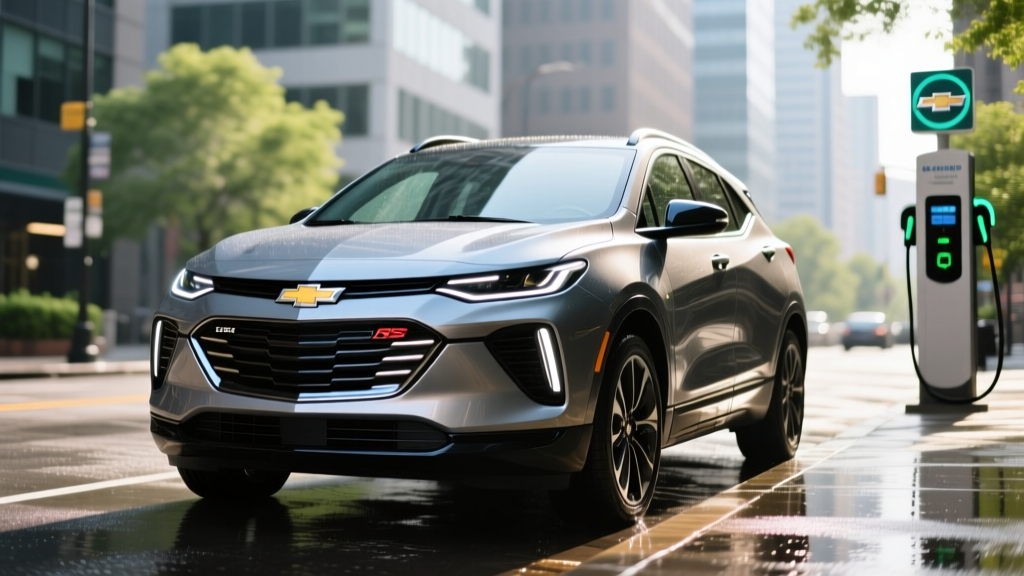
The Chevrolet Equinox EV has quickly become one of the most talked-about mainstream electric crossovers, and the sporty RS trim sits at the top of the lineup. With a 319-mile EPA range, aggressive styling, and a starting price that undercuts many rivals by thousands, the Equinox EV RS aims to prove that you don't need a luxury badge to get a compelling daily-driver EV. But how does it perform when you push past the brochure numbers? We break down every spec that matters — from real-world highway range to DC fast-charging taper — so you can decide if this is the right electric SUV for your garage.
Quick Verdict: Who Is the Equinox EV RS For?
The Equinox EV RS is best suited for value-conscious families and commuters who want 300+ miles of range, modern tech, and sporty aesthetics without crossing the $45,000 threshold. It excels as a daily driver and road-trip companion for those with reliable home charging access. It's less ideal for buyers who prioritize razor-sharp driving dynamics, ultra-fast charging, or premium interior materials — for those, the Hyundai Ioniq 5 or Tesla Model Y remain strong alternatives.
Look elsewhere if: You need 200+ kW DC charging speeds, a minimalist interior, or the most refined ride quality in the segment.
Range, Battery & Efficiency: The Numbers That Matter
| Spec | 2026 Equinox EV RS |
|---|---|
| EPA Range (FWD) | 319 miles |
| EPA Range (AWD) | 285 miles |
| Battery Capacity | 85 kWh usable (NMC chemistry) |
| Efficiency (FWD) | 113 MPGe / 30 kWh/100 mi |
| Efficiency (AWD) | 99 MPGe / 34 kWh/100 mi |
| Drivetrain | Single-motor FWD (213 hp) or Dual-motor AWD (288 hp) |
| 0–60 mph (FWD) | ~8.0 seconds |
| 0–60 mph (AWD) | ~5.9 seconds |
The Equinox EV RS uses GM's Ultium platform with an NMC (nickel manganese cobalt) lithium-ion battery. Unlike some competitors offering LFP (lithium iron phosphate) options — which trade energy density for longevity and lower cost — the NMC chemistry here prioritizes range. The 85 kWh usable capacity is competitive with the Hyundai Ioniq 5 (77.4 kWh) and significantly larger than the base Tesla Model Y's pack.
According to fueleconomy.gov, the FWD Equinox EV achieves 113 MPGe combined, translating to roughly 30 kWh per 100 miles. That's solid efficiency for a 4,400-pound crossover, though the Ioniq 5 RWD edges ahead at 114 MPGe with a smaller battery. The AWD variant drops to 99 MPGe — a meaningful difference if you do mostly highway commuting.
Charging Speeds: DC Fast, Level 2 & What to Expect
| Charging Level | Power / Rate | What You Get |
|---|---|---|
| DC Fast Charge (Peak) | 170 kW max | 10–80% in ~42 minutes |
| DC Fast Charge (Sustained Avg) | ~120 kW (10–80%) | ~190 miles added in 30 min |
| Level 2 (Home 240V, 48A) | 11.5 kW | ~34 miles of range per hour |
| Level 2 (Home 240V, 32A) | 7.7 kW | ~23 miles of range per hour |
| Level 1 (120V Standard Outlet) | ~1.4 kW | ~4 miles of range per hour |
The Equinox EV RS peaks at 170 kW on a DC fast charger, which is respectable but trails the Hyundai Ioniq 5 (240 kW on its 800V architecture) and the Tesla Model Y (~250 kW on V3 Superchargers). On a 350 kW Electrify America or EVgo station, you'll see the charge rate taper significantly above 60% state of charge — a common characteristic of NMC batteries managed for longevity.
The 10–80% charge time of approximately 42 minutes means road trips require more planning than in an Ioniq 5 (18 minutes) or Model Y (~25 minutes). For most owners, this matters primarily on trips exceeding 250 miles. Day-to-day, the 11.5 kW Level 2 onboard charger is excellent: a full charge from 10% takes about 7.5 hours on a 48-amp home charger, easily covering overnight replenishment.
Home charging setup note: The Equinox EV RS uses the NACS (North American Charging Standard) connector starting with the 2025 model year, meaning native access to Tesla Superchargers with an adapter. For home Level 2 installation, budget $800–$2,000 for a quality 48-amp charger plus electrician labor, depending on your panel capacity and run distance. Always consult a licensed electrician for a site-specific quote.
Performance & Driving Impressions
The FWD Equinox EV RS delivers 213 horsepower and 236 lb-ft of torque from a single front-mounted motor — adequate for daily driving but not thrilling. The 0–60 mph time of roughly 8.0 seconds puts it in line with a Toyota RAV4 Hybrid. Opt for the dual-motor AWD configuration and output jumps to 288 hp and 334 lb-ft, dropping the 0–60 sprint to about 5.9 seconds. That's quick enough for confident highway merging and passing.
Ride quality is tuned for comfort over sportiness. The RS trim's unique suspension tuning and 21-inch wheels (optional) add a firmer edge, but this is still a family crossover first. Road noise is well-managed at city speeds but becomes more noticeable above 70 mph — a trade-off of the aerodynamic shaping. The regenerative braking system offers multiple levels of aggressiveness via steering wheel paddles, though it doesn't quite achieve true one-pedal driving at its strongest setting.
GM's Super Cruise hands-free driver assistance is available on the RS trim (standard on higher-equipped models, optional on others). It's a SAE Level 2 system — meaning the driver must remain attentive and ready to take over at all times. On mapped divided highways, Super Cruise delivers smooth lane-keeping and adaptive cruise performance, but it does not handle construction zones, unmapped roads, or complex urban environments. It's a genuine fatigue-reducer on road trips, not a replacement for an engaged driver.
Interior, Cargo & Tech: Space Meets Screens
The Equinox EV RS cabin is defined by its 17.7-inch diagonal infotainment touchscreen — one of the largest in any vehicle at this price point — paired with an 11-inch digital driver display. The Google Built-in infotainment system includes native Google Maps, Google Assistant, and Play Store apps. Wireless Apple CarPlay and Android Auto are standard. Physical climate controls are minimal; most functions route through the touchscreen, which some drivers find distracting.
| Dimension | Measurement |
|---|---|
| Front Headroom | 40.9 inches |
| Front Legroom | 43.3 inches |
| Rear Legroom | 37.8 inches |
| Cargo Volume (behind rear seats) | 26.4 cu ft |
| Cargo Volume (rear seats folded) | 57.2 cu ft |
| Frunk (Front Trunk) | Not available |
Passenger space is generous, particularly in the rear seat where 37.8 inches of legroom outpaces the Tesla Model Y and matches the Hyundai Ioniq 5. Cargo capacity at 26.4 cu ft behind the second row is competitive, expanding to 57.2 cu ft with seats folded. Notably, there is no front trunk (frunk) — a missed opportunity given the Ultium platform's packaging flexibility. Competitors like the Ioniq 5 and Ford Mustang Mach-E offer small frunks for charging cables or groceries.
The RS trim adds sport-specific touches: a flat-bottom steering wheel, red interior accent stitching, RS-badged seats with Evotex upholstery, and unique exterior styling with a blacked-out roof and 21-inch wheel option. Build quality is solid for the price point, though hard plastics appear on lower door panels and the center console — a reminder that this is a mainstream, not luxury, vehicle.
Pricing, Trims & Federal Tax Credit Eligibility
| Trim | MSRP | Est. After §30D Credit* |
|---|---|---|
| Equinox EV LT (FWD) | $33,600 | ~$26,100 |
| Equinox EV RS (FWD) | $43,400 | ~$35,900 |
| Equinox EV RS (AWD) | $46,700 | ~$39,200 |
*Federal tax credit estimates assume full eligibility. Actual credit depends on individual tax liability and vehicle qualification. See details below.
The Equinox EV RS FWD starts at $43,400 (including destination), with the AWD variant at $46,700. A well-equipped RS with the Active Safety Package 2, panoramic-style fixed glass roof, and 21-inch wheels can approach $49,000 before incentives. All Equinox EV trims fall well under the §30D MSRP cap of $80,000 for SUVs.
Federal EV Tax Credit (§30D) Eligibility
- MSRP Cap: Vehicle must have MSRP ≤ $80,000 (SUVs/vans/pickups). All Equinox EV trims qualify. ✓
- Buyer Income Cap: Modified AGI must not exceed $150,000 (single), $225,000 (head of household), or $300,000 (joint filers).
- Battery Sourcing: Critical minerals and battery components must meet phased-in percentages from US/free-trade-agreement partners. GM has worked to localize Ultium supply chains; check the latest fueleconomy.gov credit listings for the current model year's qualification status.
- Point-of-Sale Transfer: Eligible buyers can transfer the credit to the dealer at purchase, reducing the purchase price directly rather than waiting for a tax refund.
- Assembly: Vehicle must undergo final assembly in North America. The Equinox EV is built in Ramos Arizpe, Mexico — which qualifies. ✓
Critical caveat: Battery-sourcing requirements tighten annually. Always verify current-year eligibility on irs.gov or fueleconomy.gov before purchasing. Tax professionals can confirm your personal eligibility based on income and tax liability. The credit is non-refundable — you must owe at least the credit amount in federal taxes to benefit fully (unless using the point-of-sale transfer, which functions as a price reduction).
Warranty & Long-Term Ownership
Chevrolet covers the Equinox EV with a competitive warranty package:
- Battery & Powertrain: 8 years / 100,000 miles (whichever comes first), with a guaranteed capacity retention threshold of 70% of original capacity.
- Bumper-to-Bumper: 3 years / 36,000 miles
- Corrosion: 6 years / 100,000 miles
- Roadside Assistance: 5 years / 60,000 miles
The 70% battery capacity retention guarantee is industry-standard, matching Tesla, Hyundai, and Ford. In practice, GM's Ultium NMC batteries with active liquid thermal management are expected to retain 85–90% capacity after 100,000 miles based on early Bolt EUV data and industry degradation curves. Replacement cost for an Ultium pack is estimated at $12,000–$18,000 out of warranty — a significant expense, but one most owners are unlikely to face within the vehicle's typical ownership period.
Equinox EV RS vs. Key Competitors
| Spec | Equinox EV RS (FWD) | Hyundai Ioniq 5 SEL (RWD) | Tesla Model Y LR (AWD) |
|---|---|---|---|
| EPA Range | 319 mi | 303 mi | 311 mi |
| Battery (usable) | 85 kWh NMC | 77.4 kWh NMC | ~75 kWh NMC |
| DC Fast Charge (Peak) | 170 kW | 240 kW (800V) | ~250 kW |
| 10–80% DC Time | ~42 min | ~18 min | ~27 min |
| Horsepower | 213 hp | 168 hp | 384 hp |
| 0–60 mph | ~8.0 sec | ~7.4 sec | ~5.0 sec |
| Cargo (rear seats up) | 26.4 cu ft | 27.2 cu ft | 30.2 cu ft |
| Base MSRP | $43,400 | $45,850 | $47,990 |
The Equinox EV RS wins on price and EPA range — 319 miles for $43,400 is hard to beat. The Ioniq 5 counters with dramatically faster DC charging (18 vs 42 minutes, 10–80%) thanks to its 800V architecture, making it the better road-trip choice. The Model Y leads in performance, cargo space, and Supercharger network access, but costs $4,500+ more before incentives and offers a stiffer, more minimalist experience.
Pros, Cons & Final Take
- 319-mile EPA range (FWD) is class-leading for the price
- Spacious rear seat and competitive cargo volume
- Massive 17.7-inch infotainment screen with Google Built-in
- Super Cruise available for hands-free highway driving
- Falls well under §30D MSRP cap; point-of-sale transfer eligible
- Comfortable ride quality for daily commuting
- 170 kW peak DC charging is slowest in its class
- No front trunk (frunk) for cable storage
- AWD range drops to 285 miles EPA
- Hard plastics in lower cabin areas
- Minimal physical buttons — touchscreen-dependent controls
- 21-inch wheels (optional) reduce range and ride comfort
The 2026 Chevrolet Equinox EV RS delivers where mainstream EV buyers care most: range, space, and value. If your driving is predominantly local with occasional road trips — and you have reliable home charging — the RS FWD at ~$35,900 after the federal credit is one of the best deals in the electric crossover segment. If DC charging speed is a priority for frequent long-distance travel, the Ioniq 5's 800V architecture is worth the premium.
Frequently Asked Questions
What is the real-world range of the Equinox EV RS?
The FWD Equinox EV RS is EPA-rated at 319 miles. In real-world highway driving at 70+ mph, expect approximately 260–280 miles. In cold weather (below 30°F), plan for 240–270 miles. The AWD version is EPA-rated at 285 miles; expect ~235–255 miles on the highway.
How fast does the Equinox EV RS charge?
On a DC fast charger, it peaks at 170 kW and charges from 10–80% in approximately 42 minutes. At home on a 48-amp Level 2 charger (11.5 kW), it adds about 34 miles of range per hour, fully charging from 10% in roughly 7.5 hours.
How much does the Equinox EV RS cost after the federal tax credit?
The RS FWD starts at $43,400. Eligible buyers who qualify for the full $7,500 §30D credit can bring the effective price to approximately $35,900 via the point-of-sale transfer option. Eligibility depends on buyer income, tax liability, and the vehicle's battery-sourcing compliance for the current model year.
Does the Equinox EV RS qualify for the $7,500 federal EV tax credit?
The Equinox EV meets the MSRP cap ($80,000 for SUVs) and North American final assembly requirements. However, battery critical-mineral and component sourcing rules change annually. Verify current-year qualification on fueleconomy.gov or irs.gov before purchasing, and confirm your personal income eligibility with a tax professional.
Is the Equinox EV RS worth buying over the Tesla Model Y or Hyundai Ioniq 5?
If you prioritize low purchase price and maximum EPA range for commuting, the Equinox EV RS is a strong value. If fast DC charging matters for road trips, the Ioniq 5 is superior. If performance, cargo space, and Supercharger network access are priorities, the Model Y justifies its higher price. Each excels in different areas.
Does the Equinox EV RS have a frunk?
No. Unlike the Ioniq 5, Mach-E, and Model Y, the Equinox EV does not include a front trunk. All storage is in the rear cargo area (26.4 cu ft behind rear seats, 57.2 cu ft with seats folded).
What is the battery warranty on the Equinox EV?
Chevrolet covers the battery and powertrain for 8 years or 100,000 miles, whichever comes first, with a guaranteed capacity retention of at least 70% of original capacity during that period.