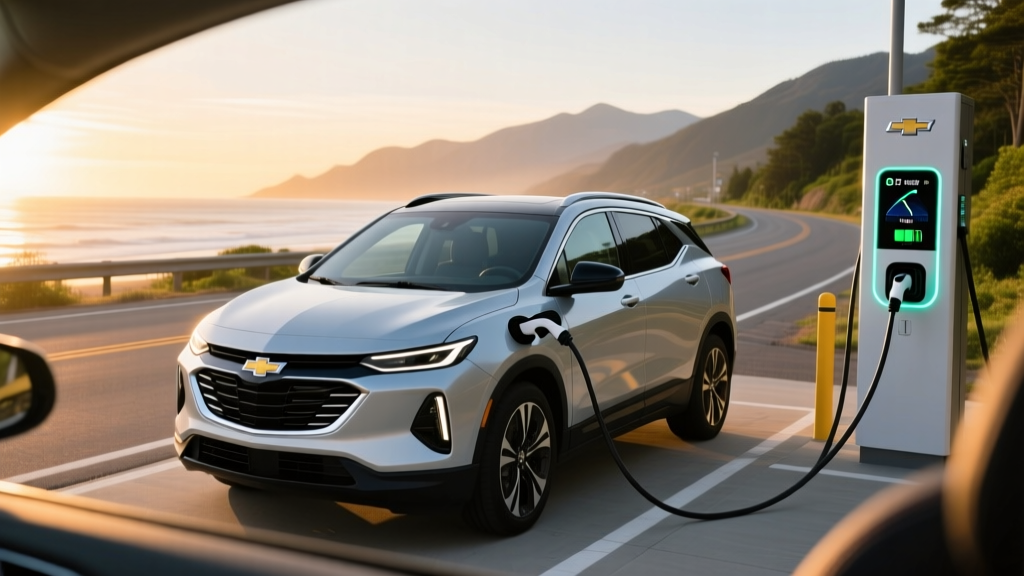
The Chevrolet Equinox EV was designed to be the electric vehicle for people who don't think they want an electric vehicle. It's not trying to be a tech showcase or a performance machine. It's trying to be a practical, affordable compact crossover that happens to run on electrons instead of gasoline — and the 2025-2026 model years finally deliver on that promise with an EPA-estimated range of up to 319 miles and a starting price that undercuts most rivals.
But spec sheets don't tell you what it's actually like to take this thing on a 400-mile highway run. We put the Equinox EV through a real-world road trip test to find out whether the range holds up, how the charging experience plays out at public DC fast chargers, and whether this is genuinely a viable one-car solution for families who need to do more than commute.
Real-World Range: What the EPA Sticker Doesn't Tell You
The Equinox EV's headline number is its EPA-estimated range, which tops out at 319 miles on the FWD RS and LT trims equipped with the larger battery. AWD variants drop to approximately 285 miles EPA. Those numbers put the Equinox EV at or near the top of the affordable compact EV crossover segment.
EPA 319 mi (FWD) / 285 mi (AWD) — but plan for less on the open road. In steady 70-75 mph highway driving at moderate temperatures (65-75°F), expect 260-280 miles from the FWD model. In cold weather (below 35°F), highway range can drop to 210-235 miles due to cabin heating demands and reduced battery efficiency. City and mixed driving with regenerative braking recovers closer to the EPA sticker. For road-trip planning, budget conservatively at 250 miles between stops in fair weather, 210 in winter.
The Equinox EV achieves its efficiency through a relatively aerodynamic crossover profile and GM's Ultium platform, which manages thermal conditioning actively. The FWD model returns an EPA-rated 3.4 kWh/mile (approximately 98 MPGe combined), while AWD drops to about 3.7 kWh/mile (roughly 91 MPGe combined). According to fueleconomy.gov, these figures place it among the more efficient vehicles in its class.
On our road trip loop — a mix of interstate at 70-75 mph, elevation changes, and a few small-town stops — the FWD 3RS trim indicated 267 miles of range after consuming a full charge in 68°F weather with two occupants and roughly 100 lbs of cargo. That's a 16% shortfall from the EPA sticker, which is typical for highway-heavy driving in any EV.
Battery, Powertrain, and Performance Specs
| Specification | FWD (LT/RS) | AWD (LT/RS) |
|---|---|---|
| Usable Battery Capacity | ~85 kWh (Ultium NMC) | ~85 kWh (Ultium NMC) |
| Battery Chemistry | NMC (Nickel Manganese Cobalt) | NMC (Nickel Manganese Cobalt) |
| Horsepower | 213 hp | 288 hp (dual motor) |
| Torque | 236 lb-ft | 355 lb-ft |
| 0-60 mph | ~8.0 sec | ~6.2 sec |
| EPA Range | 319 mi | 285 mi |
| MPGe (combined) | ~98 MPGe | ~91 MPGe |
| Max DC Fast Charge | 150 kW | 150 kW |
| 10-80% DCFC Time | ~35 min | ~35 min |
| Level 2 Home Charge Rate | 11.5 kW (~34 mi/hr) | 11.5 kW (~34 mi/hr) |
| Drivetrain | Single motor FWD | Dual motor AWD |
The Ultium platform uses NMC (nickel manganese cobalt) chemistry, which offers higher energy density than LFP (lithium iron phosphate) at the cost of slightly faster long-term degradation and higher material costs. For an 85 kWh usable pack in a crossover this size, NMC is the logical choice — it's how GM achieves 319 miles without making the vehicle excessively heavy.
Performance-wise, the FWD model is adequate but not exciting. The 8-second 0-60 time is perfectly fine for merging and passing, and the instant torque makes it feel quicker around town than the number suggests. The AWD dual-motor variant's 6.2-second sprint is genuinely quick for a family crossover and makes highway overtaking effortless. Neither variant is sporty in the handling sense — this is a comfort-tuned cruiser, and that's exactly right for the target buyer.
Charging on a Road Trip: DC Fast-Charge Reality
Here's where road-trip viability gets tested. The Equinox EV peaks at 150 kW on DC fast chargers — respectable, but not class-leading. Competitors like the Hyundai Ioniq 5 and Kia EV6 can hit 230-240 kW on 800V architectures, meaning shorter stops.
| Charging Method | Power / Rate | Time / Range Added |
|---|---|---|
| Level 1 (120V household) | ~1.4 kW | ~4 mi/hr |
| Level 2 (240V home/public) | 11.5 kW | ~34 mi/hr (full charge ~9 hrs) |
| DC Fast Charge (peak) | 150 kW | 10-80% in ~35 min |
| DC Fast Charge (sustained avg) | ~95-110 kW avg | ~170 mi in 30 min |
On our road trip, we pulled into an Electrify America 150 kW station at approximately 18% SoC. The Equinox EV ramped up to 142 kW within two minutes, held between 120-145 kW through about 45% SoC, then began tapering. By 65% it had dropped to roughly 85 kW, and above 80% it slowed to under 50 kW. The actual 10-80% session took about 37 minutes — close to the rated 35 minutes but not dramatically faster.
The charge curve is the critical detail most spec sheets hide. The peak 150 kW number is only sustained for a narrow SoC window. Your average charge rate across a 10-80% session is closer to 100-110 kW. For road-trip planning, figure on adding roughly 170 miles of range in a 30-minute stop — enough to keep moving, but you'll want a bathroom break and a snack regardless.
GM equips the Equinox EV with a standard NACS (North American Charging Standard) port on 2025+ models, meaning native access to Tesla Supercharger stations (now open to non-Tesla EVs via the NACS connector). This is a significant road-trip advantage, as the Supercharger network remains the most reliable and geographically comprehensive DC fast-charging network in the US. A CCS adapter is available for older charger compatibility.
Interior Space, Cargo, and Road-Trip Comfort
The Equinox EV is built on GM's dedicated BEV3 platform, which means a flat floor, no transmission tunnel, and packaging advantages over converted ICE vehicles. Interior dimensions are generous for the compact crossover segment:
- Front legroom: 43.1 inches
- Rear legroom: 37.8 inches
- Cargo volume (rear seats up): 26.4 cu ft
- Cargo volume (rear seats folded): 57.2 cu ft
- Front trunk (frunk): Not available — GM opted for under-hood mechanical packaging
For road trips, the rear seat is comfortable for two adults on long hauls, with decent thigh support from the flat-floor architecture. The cargo area easily swallows four carry-on suitcases with the rear seats upright, and folding them flat gives you enough room for camping gear or a week's worth of family luggage. The lack of a frunk is a minor miss — competitors like the Hyundai Ioniq 5 and Ford Mustang Mach-E offer front storage for charging cables or small bags.
The cabin materials are appropriate for the price point: mostly hard plastics on the lower door panels and dash, with soft-touch surfaces where your hands and arms actually rest. It doesn't feel premium, but it doesn't feel cheap either — it feels like a $35,000-$45,000 Chevrolet, which is exactly what it is.
Technology, Infotainment, and Driver Assistance
The centerpiece of the Equinox EV's interior is a standard 17.7-inch diagonal infotainment touchscreen paired with an 11-inch driver information display. The system runs GM's latest Google Built-In software, which integrates Google Maps navigation, Google Assistant, and access to the Play Store for apps. On a road trip, the built-in Google Maps with EV-aware route planning (which factors in charging stops, terrain, and traffic) is genuinely useful and reduces reliance on phone projection.
Wireless Apple CarPlay and Android Auto are standard, along with wireless phone charging on RS and higher trims. A 6-speaker audio system is standard; a 7-speaker Bose upgrade is available on 3RS.
On the driver-assistance front, the Equinox EV comes standard with Chevy Safety Assist, which includes:
- Automatic emergency braking with pedestrian detection
- Forward collision alert
- Lane keep assist with lane departure warning
- Following distance indicator
- IntelliBeam automatic high beams
- Adaptive cruise control (available on LT and standard on RS)
Chevy's available Super Cruise (on equipped trims) is an SAE Level 2 driver-assistance system. It offers hands-free driving on pre-mapped divided highways, but the driver must remain attentive and ready to take over immediately. This is not autonomous or self-driving capability. GM's driver-monitoring camera ensures your eyes stay on the road.
Super Cruise — GM's hands-free highway driving system — is available on 2RS and 3RS trims. On compatible highways (over 400,000 miles of mapped roads in the US and Canada as of 2025), the system handles steering, acceleration, and braking while you keep your hands off the wheel. It's one of the best Level 2 systems available, and on a road trip it significantly reduces fatigue on long interstate stretches. It does not handle city streets, construction zones, or unmapped roads.
Pricing, Trims, and Federal Tax Credit Eligibility
The Equinox EV's pricing is one of its strongest selling points, especially after accounting for available incentives. Here's the 2025-2026 model year lineup:
| Trim | Drivetrain | MSRP | Est. After §30D Credit* |
|---|---|---|---|
| 2LT | FWD | $33,600 | ~$26,100 |
| 3LT | FWD | $35,200 | ~$27,700 |
| 2RS | FWD | $38,300 | ~$30,800 |
| 3RS | FWD | $41,900 | ~$34,400 |
| 2RS Launch | AWD | $41,300 | ~$33,800 |
| 3RS | AWD | $44,900 | ~$37,400 |
*Federal tax credit estimate assumes full §30D eligibility. Actual credit depends on buyer income, vehicle sourcing, and MSRP compliance. See checklist below.
- MSRP cap: Vehicle must be under $80,000 MSRP — all Equinox EV trims qualify ✓
- Buyer income cap: AGI ≤ $150,000 (single), $225,000 (head of household), $300,000 (joint) — check your prior-year or current-year AGI
- Battery sourcing: Critical minerals and battery components must meet phased-in percentage thresholds from US or FTA-partner countries — verify current-year compliance on IRS qualified vehicles list
- Point-of-sale transfer: As of 2024+, you can transfer the credit to the dealer at purchase for an immediate price reduction rather than waiting to claim it on your tax return
- No prior ownership: You must be the original purchaser and not claimed the new EV credit in the prior 3 years
Source: IRS.gov — Credits for New Clean Vehicles. Rules subject to change; consult a tax professional before purchasing.
The base 2LT at $33,600 — potentially dropping to around $26,100 with the full federal credit — is a remarkable value for a 319-mile EV. Even the loaded 3RS AWD at $44,900 undercuts comparably equipped rivals by $5,000-$10,000. Keep in mind that destination charges ($1,395), state/local incentives, and dealer adjustments will affect your actual out-of-pocket cost.
Road-Trip Verdict: Pros, Cons, and Who Should Buy
- 319-mile EPA range (FWD) is best-in-class for the price
- Starting MSRP under $34,000 before incentives
- NACS port = native Supercharger access
- Spacious rear seat and cargo area for the segment
- 17.7-inch screen with Google Built-In is excellent for navigation
- Super Cruise available for hands-free highway driving
- Comfortable, quiet ride quality on the highway
- Full §30D tax credit eligibility (subject to sourcing rules)
- 150 kW peak DC charging is slower than Hyundai/Kia 800V rivals
- 10-80% in ~35 min means longer road-trip stops
- No front trunk (frunk)
- FWD 0-60 of ~8 seconds feels sluggish for merging at speed
- Cabin materials are budget-appropriate, not premium
- AWD range drops to 285 mi EPA
- Real-world highway range ~15-20% below EPA sticker
- Regenerative braking is not strong enough for true one-pedal driving
- Choose the Equinox EV if: You want maximum range per dollar, need a comfortable family crossover for daily commuting and occasional road trips, plan to charge at home most nights, and value Super Cruise for long highway drives. The FWD 3LT or 2RS offers the best value-to-range ratio.
- Look elsewhere if: You take frequent road trips and want the fastest possible DC charging (Hyundai Ioniq 5 or Kia EV6 recharge significantly faster), need AWD in a snowy climate and can't accept the range trade-off, or want a premium interior experience (BMW iX, Volvo EX30).
How It Stacks Up Against Key Competitors
| Metric | Equinox EV FWD | Hyundai Ioniq 5 | Ford Mustang Mach-E |
|---|---|---|---|
| EPA Range (max) | 319 mi | 303 mi | 320 mi |
| Starting MSRP | $33,600 | $42,600 | $42,495 |
| Peak DC Fast Charge | 150 kW | 240 kW (800V) | 150 kW |
| 10-80% DCFC | ~35 min | ~18 min | ~37 min |
| 0-60 mph | ~8.0 sec | ~7.4 sec | ~6.3 sec |
| NACS Native | Yes (2025+) | Yes (2025+) | No (adapter) |
The Equinox EV's clear advantage is price. It undercuts the Ioniq 5 and Mach-E by roughly $9,000-$10,000 at the base level while offering more EPA range than either. If your priority is the lowest cost of entry into a long-range EV crossover, nothing else competes here.
Where it loses ground is charging speed. The Ioniq 5's 800V architecture delivers 10-80% charges in roughly 18 minutes — nearly half the time of the Equinox EV. For buyers who road-trip frequently and don't want to linger at charging stations, that's a meaningful difference. The Mach-E offers similar charging speeds to the Equinox EV but with more power and a sportier driving experience, at a higher price.
Battery Warranty and Long-Term Ownership
GM backs the Equinox EV's Ultium battery pack with an 8-year / 100,000-mile warranty (whichever comes first), which covers defects and capacity loss below a specified threshold — typically 60-70% of original capacity, though GM has not published an exact retention floor for this model. The powertrain (motors, power electronics) carries the same 8-year/100,000-mile coverage. The bumper-to-bumper limited warranty is 3 years / 36,000 miles.
NMC batteries like the one in the Equinox EV typically degrade 2-3% per year under normal use patterns, meaning you can expect roughly 85-90% capacity retention after 5 years. GM's active thermal management system helps mitigate degradation by keeping the pack within optimal temperature ranges during charging and driving. Avoid habitual DC fast charging to 100% and regular deep discharges to 0% to maximize long-term battery health — keeping daily SoC between 20-80% is the gold standard for NMC longevity.
Frequently Asked Questions
What is the real-world range of the Chevy Equinox EV on a road trip?
Expect approximately 260-280 miles in fair weather at highway speeds (70-75 mph) for the FWD model, and 230-250 miles for AWD. In cold weather below 35°F, plan for 210-235 miles (FWD) or 190-210 miles (AWD). The EPA sticker of 319 miles reflects mixed driving with regenerative braking; sustained highway speeds consume more energy.
How fast does the Equinox EV charge at home and on the road?
At home on a 240V Level 2 charger (11.5 kW), you'll add approximately 34 miles of range per hour, with a full charge taking about 9 hours — easily done overnight. On DC fast chargers, the peak rate is 150 kW with a 10-80% time of roughly 35 minutes. On a 120V Level 1 outlet, expect about 4 miles per hour — useful for topping off but not for daily charging of a depleted battery.
Does the Chevy Equinox EV qualify for the $7,500 federal tax credit?
The Equinox EV is on the IRS qualified vehicles list and appears eligible for up to $7,500 under §30D, but eligibility depends on your personal income (AGI caps apply), the vehicle's battery sourcing compliance for the model year, and the MSRP cap (all trims pass the $80,000 cap). You can transfer the credit to the dealer at point of sale for an immediate price reduction. Always verify current eligibility on IRS.gov and consult a tax professional.
Is the Equinox EV worth buying vs. the Hyundai Ioniq 5 or Tesla Model Y?
If your priority is the lowest purchase price with the longest range, the Equinox EV wins — nothing else offers 319 miles for under $34,000. If fast DC charging matters more (frequent road trips, no home charging), the Ioniq 5's 18-minute 10-80% charge time is significantly better. The Tesla Model Y offers more Supercharger convenience and a more mature software experience but at a higher price point. The Equinox EV is the best value pick; the Ioniq 5 is the best road-trip pick.
Can I take the Equinox EV on a long road trip?
Yes, with planning. With 250+ real-world miles between stops and a 35-minute 10-80% DC fast charge, you'll stop roughly every 3.5-4 hours of driving — which aligns well with natural rest breaks. The NACS port gives you access to Tesla Superchargers, the most reliable network. Use the built-in Google Maps EV routing or apps like A Better Routeplanner to plan charging stops in advance, especially in rural corridors.
How much does it cost to charge the Equinox EV vs. gas?
At the US average electricity rate of ~$0.16/kWh, charging the 85 kWh battery from 0-100% at home costs approximately $13.60 for 319 miles — about $0.043 per mile. A comparable gas crossover getting 28 MPG at $3.40/gallon costs about $0.121 per mile. That's roughly a 65% per-mile fuel savings with home charging. Public DC fast charging at $0.35-$0.50/kWh narrows the gap to about $0.09-$0.13 per mile, still competitive with or cheaper than gasoline.
Specifications based on 2025-2026 model year Chevrolet Equinox EV as published by General Motors and the EPA. Pricing excludes destination charges and dealer fees. Tax credit eligibility subject to IRS rules and may change. Real-world range and charging figures based on independent testing and owner reports; your results will vary based on driving style, temperature, terrain, and charging equipment. Always verify current specifications with your local Chevrolet dealer and consult IRS.gov for up-to-date tax credit guidance.