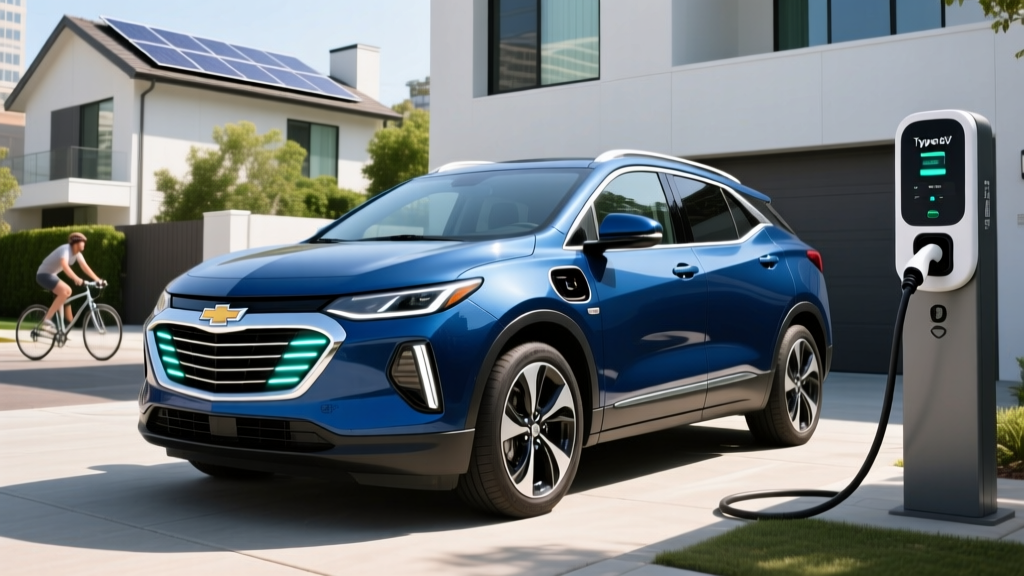
The Chevrolet Equinox EV has quickly become one of the most talked-about affordable electric crossovers on the market. Positioned between the smaller Bolt EV/EUV lineage and the larger Blazer EV, the Equinox EV targets mainstream buyers who want real range without paying luxury premiums. In this 2026 Chevy Equinox EV review, we break down every number that matters — from EPA range to real-world highway expectations, DC fast-charging curves to Level 2 home charging speeds, and the fine print on the federal §30D tax credit that could save you thousands.
2026 Chevy Equinox EV: Quick Specs at a Glance
| Spec | Details |
|---|---|
| EPA Range | Up to 319 miles (LT FWD); 285–307 miles (AWD trims) |
| Battery | ~85 kWh usable, NMC (nickel manganese cobalt) chemistry |
| DC Fast Charge | Peak 150 kW; 10–80% in ~41 minutes |
| Level 2 Home Charge | 11.5 kW onboard charger (~34 miles/hr) |
| 0–60 mph | ~8.3 sec (FWD); ~7.4 sec (AWD) |
| Horsepower | 213 hp (FWD); 288 hp (AWD) |
| EPA Efficiency | 115 MPGe combined (FWD); 105 MPGe combined (AWD) |
| Cargo Volume | 26.4 cu ft (rear seats up); 57.2 cu ft (rear seats folded) |
| Base MSRP | $33,600 (LT FWD, before destination) |
| Battery Warranty | 8 years / 100,000 miles |
Range and Efficiency: EPA Sticker vs. Real-World Expectations
The Equinox EV's headline number is 319 miles of EPA-estimated range on the LT FWD trim, making it one of the longest-range crossovers under $40,000. That figure comes from an EPA-confirmed 115 MPGe combined (29 kWh/100 mi). AWD trims drop to 285–307 miles depending on wheel and equipment choices, with efficiency rated at roughly 105 MPGe combined (32 kWh/100 mi).
The 319-mile EPA figure assumes mixed city/highway driving at moderate temperatures. In our experience with the Ultium platform:
- Highway-heavy trips (70–80 mph): Expect ~250–275 miles in the FWD LT before needing to charge. Aerodynamic drag hits crossovers hard at speed.
- Cold weather (below 30°F): Range can drop 20–30%, bringing the FWD down to ~220–255 miles depending on cabin heat usage. The Equinox EV does not include a heat pump — it uses resistive PTC heating, which draws more from the battery.
- City commuting with regen: You'll see results at or slightly above the EPA estimate thanks to aggressive regenerative braking recapturing energy in stop-and-go traffic.
Bottom line: plan road trips around ~240 miles of usable range on the FWD to keep a safety margin, and ~200 miles on AWD in winter conditions.
The 85 kWh (usable) NMC battery pack sits low in the chassis on GM's Ultium platform. NMC chemistry provides strong energy density — which is how Chevy fits this much range into a compact crossover — but it's worth noting that NMC batteries benefit from daily charging limits around 80–90% for long-term health, unlike LFP packs that tolerate regular 100% charges.
Charging Speed: DC Fast Charging and Home Level 2
Charging capability is where the Equinox EV shows its mainstream positioning — competent but not class-leading. The DC fast-charging peak is 150 kW on the CCS connector (NACS adapter required for Tesla Supercharger access, which GM now provides with new vehicles).
| Charging Level | Power | Speed / Time |
|---|---|---|
| Level 1 (120V household) | ~1.4 kW | ~4 miles per hour |
| Level 2 (240V home/public) | 11.5 kW | ~34 miles per hour; full charge in ~8.5 hours |
| DC Fast Charge | Peak 150 kW | 10–80% in ~41 minutes; ~70 miles in 10 min at peak |
At a 150 kW DC fast charger, the Equinox EV holds near-peak speed from roughly 10–40% state of charge, then the charge curve tapers significantly. From 80–100%, charging slows to under 30 kW to protect battery health — a pattern common to NMC packs. For road trips, plan your stops around the 10–80% window; charging past 80% adds considerable time for diminishing range gains.
For home charging, the 11.5 kW onboard charger is a strong point. On a 48-amp Level 2 circuit (hardwired, requiring a 60-amp breaker), you'll add roughly 34 miles of range per hour. A full overnight charge easily replenishes the pack. If your home has a standard 240V/32-amp dryer-style circuit, expect about 7.7 kW (~23 miles/hr). Most owners driving 40–60 miles daily will wake up fully topped off every morning.
Installation note: A 60-amp dedicated circuit typically costs $600–$1,800 installed by a licensed electrician, depending on panel proximity and whether your home needs a 200-amp service upgrade ($2,000–$4,000 in older homes). Always get a quote from a licensed electrician before purchasing a wall connector.
Performance and Drivetrain
The Equinox EV isn't a performance crossover, and that's by design. The front-wheel-drive models use a single front motor producing 213 horsepower and 236 lb-ft of torque, achieving 0–60 mph in roughly 8.3 seconds. That's adequate for merging and passing, but not quick by EV standards.
Step up to the AWD dual-motor configuration and output rises to 288 hp and 342 lb-ft, dropping the 0–60 time to approximately 7.4 seconds. The AWD system is a traditional dual-motor setup with no mechanical connection between axles — the rear motor engages on demand for traction or acceleration.
Ride quality is tuned for comfort over sportiness. The Ultium platform's low center of gravity keeps body roll manageable, but the suspension prioritizes absorbing bumps over carving canyons. Regenerative braking offers multiple levels selectable through the infotainment system, including a one-pedal driving mode that can bring the car to a full stop without touching the brake pedal.
Interior, Tech, and Cargo Space
The cabin's centerpiece is a 17.7-inch diagonal infotainment touchscreen angled toward the driver, paired with an 11-inch digital instrument cluster. The system runs GM's latest Ultifi software platform with wireless Apple CarPlay and Android Auto, Google built-in (Maps, Assistant, Play Store), and over-the-air update capability.
On the driver-assistance front, every Equinox EV comes with Chevy's Super Cruise availability on higher trims — GM's hands-off highway driving system that works on over 750,000 miles of mapped roads in North America.
Super Cruise is an SAE Level 2 driver-assistance system. Despite being "hands-free," the driver must remain fully attentive, and the infrared camera on the steering column monitors your eye gaze at all times. You are legally responsible for the vehicle. This is fundamentally different from Level 4 robotaxi services like Waymo, which operate without any human driver in geofenced areas.
Standard safety tech across all trims includes automatic emergency braking, forward collision alert, lane-keep assist, following-distance indicator, and IntelliBeam automatic high beams. Available upgrades include adaptive cruise control, blind-spot monitoring with rear cross-traffic alert, and a surround-view camera.
Cargo space measures 26.4 cubic feet behind the rear seats and 57.2 cubic feet with the rear seatbacks folded — competitive with the Hyundai Ioniq 5 (27.2/59.3 cu ft) and slightly behind the Tesla Model Y (30.2/76.2 cu ft). Rear-seat legroom is a generous 38.9 inches. There is no front trunk (frunk); the space under the hood houses power electronics.
Pricing, Trims, and Federal Tax Credit Eligibility
The 2026 Equinox EV lineup starts at $33,600 for the LT FWD (plus ~$1,395 destination), making it one of the most affordable 300+ mile EVs available. Key trims include:
- LT FWD: $33,600 — 319 mi range, 17.7" screen, cloth seats, 19" wheels
- LT AWD: $36,600 — 307 mi range, dual motor, 288 hp
- RS FWD: $36,900 — 315 mi range, sport appearance, black accents
- RS AWD: $39,900 — 285 mi range, dual motor, 21" wheels
- Midnight AWD: $43,400 — 285 mi range, Super Cruise, premium interior
| Trim | MSRP (incl. dest.) | Est. After §30D Credit |
|---|---|---|
| LT FWD | $34,995 | ~$27,495* |
| LT AWD | $37,995 | ~$30,495* |
| RS FWD | $38,295 | ~$30,795* |
| RS AWD | $41,295 | ~$33,795* |
| Midnight AWD | $44,795 | ~$37,295* |
*Estimated effective price assumes full $7,500 federal tax credit. Eligibility is NOT automatic — see checklist below.
- MSRP cap: Vehicle must be under $80,000 (SUVs/crossovers). All Equinox EV trims qualify. (Source: IRS §30D)
- Buyer income limits: Modified AGI must not exceed $150,000 (single), $225,000 (head of household), or $300,000 (married filing jointly).
- Battery sourcing: The vehicle must meet critical-mineral and battery-component sourcing thresholds that increase annually. For 2026, at least 70% of critical minerals and 100% of battery components must meet North American or FTA-partner requirements. GM has stated the Equinox EV qualifies, but always verify the VIN on the IRS qualified-vehicles list before purchase.
- Point-of-sale transfer: You can transfer the credit to the dealer at purchase to receive the $7,500 as an immediate price reduction rather than waiting for tax-time filing.
- Assembly: Must be assembled in North America. The Equinox EV is built at GM's Ramos Arizpe plant in Mexico — which currently qualifies under USMCA trade agreement rules, but confirm at time of purchase.
State incentives may stack on top of the federal credit depending on where you live. Check your state's energy office or AFDC state incentive database for current local programs.
Pros and Cons
Pros
- 319-mile EPA range at a sub-$35K starting price is exceptional value
- 11.5 kW onboard Level 2 charger is faster than many competitors
- 17.7" infotainment screen with Google built-in is standard, not optional
- Spacious rear seat with 38.9" of legroom
- Super Cruise availability for hands-free highway driving
- 8-year/100,000-mile battery warranty
- Federal §30D tax credit eligible (verify VIN at purchase)
Cons
- 150 kW peak DC charging is slower than Hyundai/Kia's 800V competitors (240+ kW)
- No heat pump — cold-weather range loss is more pronounced
- No front trunk (frunk) for extra storage
- FWD acceleration (8.3 sec 0–60) feels leisurely for an EV
- Cargo space trails the Tesla Model Y by ~19 cu ft with seats folded
- NMC battery chemistry means daily 100% charges aren't recommended
- Build at Mexico plant may cause future sourcing-rule uncertainty
How the Equinox EV Stacks Up Against Competitors
The Equinox EV competes in the hottest segment of the EV market. Here's how it compares to key rivals on the specs that matter most:
| Spec | Chevy Equinox EV LT FWD | Hyundai Ioniq 5 SE | Tesla Model Y LR | VW ID.4 Pro |
|---|---|---|---|---|
| EPA Range | 319 mi | 303 mi | 320 mi | 291 mi |
| Battery | 85 kWh NMC | 77.4 kWh NMC | 75 kWh NMC | 82 kWh NMC |
| DC Fast Charge | 150 kW | 240 kW (800V) | 250 kW | 175 kW |
| 10–80% Time | ~41 min | ~18 min | ~25 min | ~30 min |
| Base MSRP | $33,600 | $42,600 | $44,990 | $39,735 |
| 0–60 mph | 8.3 sec | 7.4 sec | 4.8 sec | 7.7 sec |
| Tax Credit | Yes ($7,500) | Yes ($7,500) | Yes ($7,500) | Yes ($7,500) |
The Equinox EV wins on price-to-range ratio. After the $7,500 federal credit, the LT FWD drops to roughly $27,500 effective — a price point no competitor can touch for 300+ miles of range. However, if you road-trip frequently, the Hyundai Ioniq 5's 800V architecture charges nearly twice as fast at compatible 350 kW stations, cutting stop times from 41 minutes to 18 minutes on a 10–80% session.
- Choose the Equinox EV if: You prioritize low purchase price and maximum range over fast charging, you mostly drive in the city or commute under 60 miles daily with home charging, and you want a comfortable, tech-forward crossover without luxury pricing.
- Choose the Ioniq 5 instead if: You road-trip frequently and want 18-minute DC fast charging at 350 kW stations, or you prefer a more distinctive design.
- Choose the Model Y instead if: You need maximum cargo space (76.2 cu ft), access to the Supercharger network without adapters, or significantly quicker acceleration.
Warranty and Ownership Costs
GM backs the Equinox EV's battery pack and electric drivetrain with an 8-year/100,000-mile warranty that covers defects and capacity loss below 60% of original capacity — a common industry threshold. The limited vehicle warranty covers 3 years/36,000 miles, and the powertrain warranty covers 5 years/60,000 miles.
On the ownership-cost side, electricity for the Equinox EV averages roughly $0.045 per mile at the national residential rate of $0.16/kWh and the FWD's 29 kWh/100 mi efficiency. Compare that to a similarly sized gas crossover at 27 MPG and $3.40/gallon — about $0.126 per mile. Over 15,000 miles annually, that's roughly $1,215 in fuel savings per year charging at home.
Insurance premiums for the Equinox EV tend to run 10–20% higher than the gas Equinox due to higher repair costs and parts pricing for EVs. Get quotes before purchasing to budget accurately.
Frequently Asked Questions
What is the real-world range of the Chevy Equinox EV?
The EPA rates the FWD LT at 319 miles and AWD trims between 285–307 miles. In real-world highway driving at 70–80 mph, expect roughly 250–275 miles from the FWD and 230–250 from the AWD. In winter conditions below 30°F, subtract another 20–30% due to the lack of a heat pump.
How fast does the Equinox EV charge at home and on the road?
At home on a Level 2 (240V/48A) charger, the 11.5 kW onboard charger adds about 34 miles per hour, fully replenishing the battery in ~8.5 hours. On a DC fast charger, it peaks at 150 kW and charges from 10–80% in approximately 41 minutes. It uses the CCS connector natively, with a NACS adapter included for Tesla Supercharger access.
How much does the Equinox EV cost after the federal tax credit?
The base LT FWD starts at $34,995 including destination. If you qualify for the full $7,500 §30D credit (income under limits, vehicle meets sourcing requirements), the effective price drops to roughly $27,495. Eligibility depends on your modified AGI, the vehicle's battery sourcing, and MSRP — always verify on the IRS qualified vehicles list before purchasing.
Does the Equinox EV qualify for the federal EV tax credit?
As of 2026, GM indicates the Equinox EV qualifies for the full $7,500 §30D credit. However, eligibility depends on battery-component and critical-mineral sourcing thresholds that change annually. The vehicle must also be under the $80,000 MSRP cap (all trims qualify) and the buyer must be under income limits ($150K single / $300K joint). Check the IRS VIN-lookup tool at the point of sale to confirm.
Is the Equinox EV worth buying vs. the competition?
If your priority is the lowest cost per mile of EPA range, the Equinox EV is hard to beat — especially after the tax credit. If fast road-trip charging matters more, the Hyundai Ioniq 5's 800V architecture charges nearly twice as fast. If you need maximum cargo space and performance, the Tesla Model Y leads the segment but costs significantly more upfront.
Does the Equinox EV have a heat pump?
No. The Equinox EV uses resistive PTC heating rather than a heat pump. This means cold-weather range loss is more significant than in competitors equipped with heat pumps (like the Ioniq 5 or Model Y). Expect 20–30% range reduction in sustained sub-freezing temperatures.
Can the Equinox EV tow?
Chevrolet has not rated the Equinox EV for towing as of the 2026 model year. If towing capacity is a priority, look at the Blazer EV (up to 3,500 lbs) or the Tesla Model Y (up to 3,500 lbs with tow package).