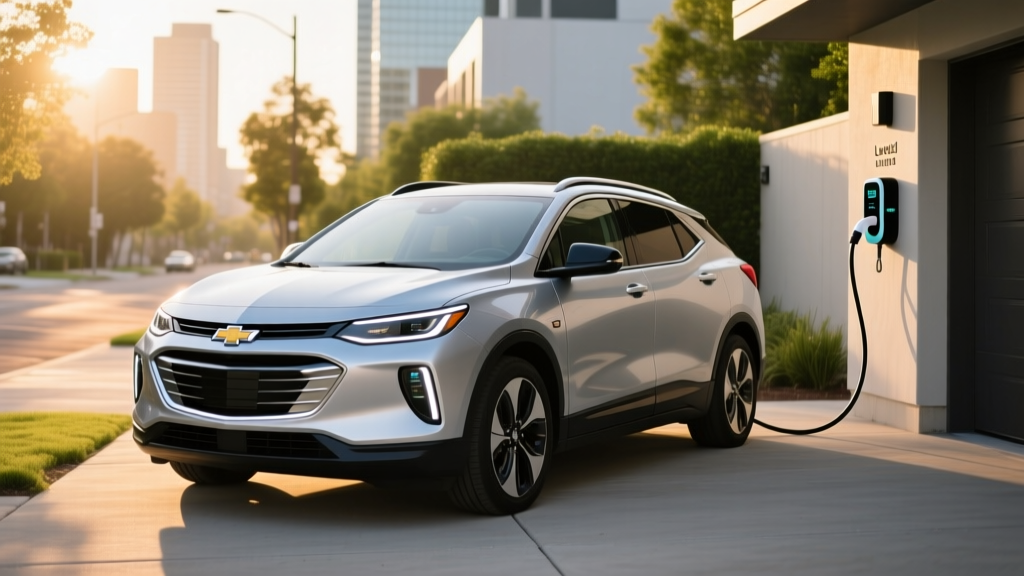
Quick Answer: The 2026 Chevrolet Equinox EV starts at $33,600 (before incentives) and delivers up to 319 miles of EPA-estimated range on the LT 2 trim with FWD. After the federal §30D tax credit of up to $7,500 — if you meet income, MSRP, and battery-sourcing requirements — the effective price drops to roughly $26,100, making it one of the most affordable long-range electric crossovers on the market. Expect 250–280 miles in real-world highway driving and 210–240 miles in freezing temperatures. Charging at home on Level 2 costs about $0.04–$0.06 per mile versus $0.14–$0.18 per mile for a comparable gas Equinox.
Equinox EV Range and Efficiency: EPA vs. Reality
Chevrolet offers the 2026 Equinox EV with an 85 kWh usable Ultium battery pack (NMC chemistry). The FWD configuration achieves an EPA-estimated 319 miles on the LT 2 and RS trims, while the AWD version drops to approximately 285 miles due to the additional front motor drawing more energy.
EPA Sticker vs. Real-World Range
- EPA Combined: 319 miles (FWD) / 285 miles (AWD)
- Highway (70–80 mph, moderate weather): ~255–280 miles (FWD)
- Cold Weather (below 30°F): ~210–245 miles (FWD) — expect 20–30% loss without preconditioning
- City/Stop-and-Go (regen-heavy): ~290–310 miles (FWD)
The Equinox EV's efficiency sits around 3.0–3.3 miles per kWh combined. That's competitive with the Hyundai Ioniq 5 (3.4 mi/kWh) but slightly behind the Tesla Model Y (3.5 mi/kWh). On long road trips, plan charging stops assuming 240–260 miles of usable range to keep a safety buffer.
One factor working in the Equinox EV's favor is its standard heat pump, which recovers waste heat from the powertrain to warm the cabin. This reduces cold-weather range loss compared to EVs relying solely on resistive heating. Still, if you live in Minnesota or Maine, budget for meaningful range compression in January and February.
Charging Speed and Infrastructure
The Equinox EV supports DC fast charging at up to 150 kW peak on CCS-equipped models, though Chevrolet has confirmed that 2026 model-year vehicles ship with the NACS (Tesla-style) charge port as standard, granting native access to Tesla Superchargers via the network's 17,000+ North American stalls.
| Charging Level | Power (kW) | Miles Added Per Hour | Typical Use Case |
|---|---|---|---|
| Level 1 (120V household) | 1.4 kW | ~4–5 miles | Overnight top-up, emergencies |
| Level 2 (240V home/public) | 11.5 kW (max onboard) | ~34–38 miles | Daily home charging, workplace |
| DC Fast Charge (NACS/CCS) | Up to 150 kW peak | ~200+ miles in 20 min (10–80%) | Road trips, highway corridors |
A critical detail buyers miss: the 150 kW figure is a peak, not a sustained rate. The Equinox EV's charge curve tapers significantly above 80% state of charge (SoC). In testing, the 10–80% session takes approximately 20–24 minutes at a capable DC fast charger, but pushing from 80–100% can add another 25–30 minutes. For road trips, charge to 80% and go — the time penalty for the last 20% isn't worth it unless you're parking overnight.
Home charging on a Level 2 wall connector (48-amp circuit, 60-amp breaker) will replenish the 85 kWh battery from empty in roughly 8–9 hours. Most owners who plug in nightly never touch a public charger for daily driving.
Purchase Price, Tax Credits, and What You'll Actually Pay
The 2026 Equinox EV lineup includes four main trims:
| Trim | Drivetrain | EPA Range | MSRP |
|---|---|---|---|
| LT 1 | FWD | ~310 mi | $33,600 |
| LT 2 | FWD | 319 mi | $36,200 |
| RS | FWD or AWD | 319 / 285 mi | $38,900+ |
| Midnight / Launch | AWD | ~285 mi | $43,400+ |
Under current IRS §30D rules, the Equinox EV may qualify for up to $7,500 in federal tax credits, split between a critical-minerals component ($3,750) and a battery-components component ($3,750). However, eligibility depends on several factors:
- Buyer income caps: AGI must not exceed $150,000 (single), $225,000 (head of household), or $300,000 (joint filers)
- MSRP cap: The vehicle must be under $80,000 (SUVs/trucks) — all Equinox EV trims qualify
- Battery sourcing: Critical minerals and battery components must meet phased-in percentage thresholds from U.S. or FTA-trade-partner sources — verify with your dealer at purchase, as supply chains shift
- Point-of-sale transfer: You can elect to transfer the credit to the dealer at purchase, reducing your out-of-pocket cost immediately rather than waiting for tax filing
- North American final assembly: The Equinox EV is assembled in Ramos Arizpe, Mexico — confirm current assembly-location eligibility at purchase, as this rule has undergone updates
The assembly-location requirement is the biggest wildcard. The Equinox EV is built in Mexico, and whether that satisfies the North American final assembly requirement depends on how the IRS interprets USMCA trade provisions for the current tax year. Always confirm credit eligibility with your dealer and a tax professional before signing.
Equinox EV vs. Gas Equinox: 5-Year Cost Breakdown
The sticker price tells only part of the story. Here's how the Equinox EV stacks up against the 2026 gas-powered Chevrolet Equinox (1.5L turbo, FWD, EPA 28 mpg combined) over five years and 75,000 miles:
| Category | Equinox EV | Gas Equinox |
|---|---|---|
| Purchase Price (MSRP) | $36,200 | $30,100 |
| Federal Tax Credit | −$7,500 (if eligible) | $0 |
| Effective Purchase Price | $28,700 | $30,100 |
| Fuel/Energy (75,000 mi) | $3,000–$4,200 (home L2) | $9,400–$10,800 |
| Maintenance (5 years) | $800–$1,200 | $2,800–$3,500 |
| Insurance (5 years avg) | $7,500–$9,000 | $6,200–$7,500 |
| Estimated Depreciation | $11,000–$14,000 | $12,000–$15,000 |
| 5-Year Total (approx.) | $51,000–$57,100 | $60,500–$66,900 |
Key takeaways from this comparison:
- Fuel savings are substantial — $5,000–$7,000 over five years if you charge primarily at home on a Level 2 circuit at residential electricity rates ($0.12–$0.16/kWh national average).
- Maintenance is dramatically lower — no oil changes, no transmission fluid, no spark plugs, and regenerative braking extends pad life significantly.
- Insurance runs 10–20% higher for the EV, a consistent trend across the industry due to higher repair costs for battery-adjacent damage.
- Depreciation remains uncertain — EV resale values have been volatile. The Equinox EV's lower starting price helps mitigate the risk compared to premium EVs.
If you rely exclusively on public DC fast charging (at $0.35–$0.55/kWh), your energy costs rise to $5,500–$8,000 over five years — still cheaper than gas, but the gap narrows considerably. Home charging access is the single biggest financial variable in EV ownership.
What First-Time EV Buyers Need to Know
If the Equinox EV is your first electric vehicle, here are the practical realities that spec sheets don't cover:
Home charging installation: A Level 2 home charger (like the ChargePoint Home Flex or Emporia Vue) costs $500–$800 for the unit, plus $800–$2,500 for professional electrician installation, depending on your panel capacity and run distance. If your home has a 200-amp panel with spare capacity, expect the lower end. Older homes with 100-amp service may need a panel upgrade ($2,000–$4,000) — get a quote before committing to the car.
One-pedal driving adjustment: The Equinox EV offers regenerative braking modes, including a one-pedal setting that recovers energy when you lift off the accelerator. Most new EV owners adapt within a week, but expect a learning curve during your first few days.
Road trip planning: With native NACS access to Tesla Superchargers, the Equinox EV has one of the best public charging ecosystems available. Use the built-in route planner or apps like A Better Routeplanner to pre-plan stops. A 300-mile trip requires one 20-minute charge stop; a 600-mile trip needs two to three.
Battery longevity: Chevrolet covers the Ultium battery with an 8-year/100,000-mile warranty against defects and excessive degradation (below 70% capacity retention). Based on current NMC chemistry data from similar Ultium-pack vehicles, expect roughly 5–8% degradation over the first 100,000 miles under normal use — meaning your 319-mile range might become 295–305 miles after five years.
| Myth | Fact |
|---|---|
| "The battery will need replacing in 5 years" | NMC Ultium packs are designed for 200,000+ miles. Warranty covers 8 years/100k miles. Full replacements cost $12,000–$18,000 but are rarely needed. |
| "I can't drive it in winter" | With a heat pump and battery preconditioning, cold-weather range drops 20–30%. A 319-mile EV still delivers 220+ miles in freezing temps — enough for most commutes. |
| "Charging takes too long" | Home Level 2 charging is overnight (8–9 hours for full). Road-trip DC fast charging: 10–80% in ~20–24 minutes. Most charging happens while you sleep or eat. |
| "It won't qualify for the tax credit" | Many Equinox EV configurations have qualified, but battery-sourcing and assembly rules change. Verify at point of sale — the dealer must provide a written credit-eligibility report. |
| "Public charging is unreliable" | Tesla Superchargers (now accessible via NACS) average 99.5% uptime. Electrify America and EVgo reliability has improved but remains less consistent in rural areas. |
Equinox EV vs. Competitors: Where It Fits
The Equinox EV doesn't exist in a vacuum. Here's how it stacks up against key rivals in the affordable electric crossover segment:
| Spec | 2026 Equinox EV (LT 2 FWD) | 2026 Hyundai Ioniq 5 (SEL) | 2026 Tesla Model Y (LR) | 2026 Ford Escape PHEV |
|---|---|---|---|---|
| Powertrain | BEV | BEV | BEV | PHEV |
| EPA Range | 319 mi | 303 mi | 320 mi | 37 mi (EV) + 400 mi (total) |
| Battery (usable kWh) | 85 kWh | 77.4 kWh | 78 kWh | 14.4 kWh |
| Peak DC Charge | 150 kW | 240 kW | 250 kW | N/A |
| 10–80% DC Time | ~22 min | ~18 min | ~17 min | ~3.5 hr (L2) |
| Horsepower | 213 hp | 225 hp | 384 hp | 210 hp (combined) |
| 0–60 mph | ~8.0 sec | ~7.4 sec | ~5.0 sec | ~7.5 sec |
| Starting MSRP | $36,200 | $44,000 | $46,000 | $36,500 |
| Fed. Tax Credit (max) | $7,500 | $7,500 | $7,500 | $7,500 |
The Equinox EV's primary advantage is price-per-mile-of-range. At roughly $113 per EPA mile of range (before credits), it undercuts the Ioniq 5 and Model Y by a significant margin. The trade-off is slower DC fast charging (150 kW vs. 240–250 kW) and lower performance (213 hp, 8-second 0–60). If road-trip charging speed matters to you, the Ioniq 5's 18-minute 10–80% time is meaningfully quicker.
The Escape PHEV comparison is worth considering if you lack reliable home charging or frequently drive in areas with sparse DC fast-charging infrastructure. You get 37 miles of electric-only range for daily commuting and a gas engine for everything else — no range anxiety, no charging-desert risk. The trade-off is ongoing fuel costs and more maintenance complexity.
Decision Framework: Is the Equinox EV Right for You?
Choose the Equinox EV if:
- You have access to Level 2 home charging (or can install it for under $2,500)
- Your daily driving is under 80 miles round-trip, with occasional 200–300 mile road trips
- You want the lowest possible effective purchase price in a long-range EV crossover
- You value Supercharger network access via NACS without needing an adapter
- You qualify for the full $7,500 federal credit (check income and sourcing rules)
Consider an alternative if:
- You cannot install home charging and rely on apartment/curbside parking — public charging costs erode savings, and daily convenience suffers
- You regularly drive 400+ mile road trips in cold-weather corridors with sparse charging — the 150 kW charge rate adds time vs. Ioniq 5 or Model Y
- You need AWD and maximum range simultaneously — the AWD Equinox EV drops to 285 miles, making the Model Y Long Range AWD (320 mi) a stronger pick despite higher cost
- Performance is a priority — 213 hp and an 8-second 0–60 time are adequate, not thrilling
- You're unsure about tax-credit eligibility — without the $7,500 credit, the value proposition weakens against the gas Equinox or a PHEV alternative
Frequently Asked Questions
Does the 2026 Equinox EV come with a NACS charge port?
Yes. The 2026 model year ships with the North American Charging Standard (NACS) port as standard equipment, granting native access to Tesla Supercharger stations without an adapter. CCS adapters are available if you need access to Electrify America or other CCS-only networks.
How much does it cost to charge the Equinox EV at home?
At the U.S. average residential electricity rate of ~$0.15/kWh, a full charge of the 85 kWh battery costs approximately $12.75, yielding 319 EPA miles. That works out to roughly $0.04 per mile. Compare that to a gas Equinox at 28 mpg combined and $3.50/gallon: about $0.125 per mile. Home charging is roughly one-third the per-mile cost.
What is the Equinox EV's towing capacity?
The 2026 Equinox EV is rated for up to 1,500 pounds when properly equipped — sufficient for a small utility trailer or a pair of dirt bikes, but not a camper or boat. Towing will reduce range by an estimated 25–40% depending on trailer weight and aerodynamics.
Will the Equinox EV battery need replacement?
Based on Ultium platform data and NMC chemistry degradation curves, full battery replacement is unlikely within the first 150,000–200,000 miles. Chevrolet's 8-year/100,000-mile battery warranty covers defects and capacity loss below 70%. If a replacement is ever needed out of warranty, current estimates put the cost at $12,000–$18,000 including labor — though prices are expected to decline as battery manufacturing scales.
Can I get the Equinox EV with all-wheel drive?
Yes. AWD is available on the RS and higher trims, adding a front electric motor for a combined output of approximately 288 hp and a 0–60 time around 6.5 seconds. The trade-off is reduced EPA range (approximately 285 miles) and a higher starting price.
How does the Equinox EV perform in snow and ice?
The AWD configuration provides confident traction in winter conditions, and the vehicle's weight (approximately 4,500 lbs) helps with stability. The standard heat pump maintains cabin comfort without severe range penalty. Expect 20–30% range reduction in sustained sub-freezing temperatures. Preconditioning the battery while plugged in before departure helps preserve range and enables faster regenerative braking in cold weather.