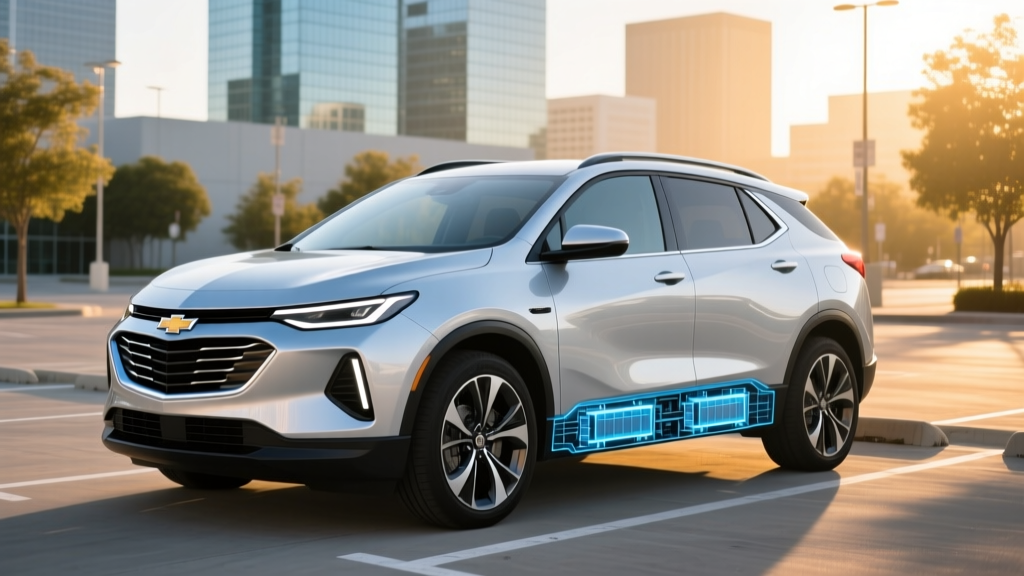
The compact electric SUV segment has no shortage of contenders, but the 2026 Chevrolet Equinox EV continues to carve out a distinct niche by pairing crossover practicality with one of the longest EPA range estimates in its class. For buyers researching everything from cargo capacity to the Chevy Equinox EV length before committing to a garage-friendly footprint, this review breaks down every spec that matters — from real-world range to federal tax credit eligibility under current IRS §30D rules.
Dimensions and the Chevy Equinox EV Length Explained
At 185.9 inches long, the Equinox EV slots into the compact crossover category alongside rivals like the Hyundai Ioniq 5 and Ford Mustang Mach-E. That length is roughly 4 inches shorter than the midsize Chevy Blazer EV, making the Equinox easier to park in tight urban garages while still preserving a 110.2-inch wheelbase that translates to generous rear-seat legroom.
| Dimension | Measurement |
|---|---|
| Overall Length | 185.9 in |
| Wheelbase | 110.2 in |
| Width (excl. mirrors) | 74.4 in |
| Height | 65.7 in |
| Front Legroom | 43.1 in |
| Rear Legroom | 37.7 in |
| Cargo Volume (rear seats up) | 26.4 cu ft |
| Cargo Volume (rear seats folded) | 57.2 cu ft |
The 185.9-inch length matters for more than parking. It places the Equinox EV in the sweet spot between subcompacts like the Volvo EX30 (174.7 in) and midsize options like the Hyundai Ioniq 5 (182.7 in) — actually slightly longer than the Ioniq 5, giving it a cargo edge. The 26.4 cu ft behind the second row swallows a full week's groceries or two large suitcases, and the flat load floor with seats folded accommodates a full-size bicycle without removing the front wheel.
Range, Battery, and Real-World Efficiency
The Equinox EV rides on GM's Ultium platform and packs an 85 kWh usable lithium-ion battery (NMC chemistry — nickel manganese cobalt). The front-wheel-drive 3RS trim achieves an EPA-estimated 319 miles of range, while the eAWD (dual-motor) variant drops to approximately 285 miles due to the added weight and mechanical drag of the rear motor.
EPA Sticker: 319 mi (FWD 3RS) / 285 mi (eAWD)
Highway driving (70-75 mph): Expect ~255–275 mi. EVs lose efficiency at sustained highway speeds because there's no regenerative braking to recapture energy.
Cold weather (below 30°F): Plan for a 20–30% reduction, dropping effective range to ~200–240 mi. The Equinox EV's standard heat pump mitigates cabin-heating losses but battery chemistry still slows in the cold.
City/mixed commuting: 290–310 mi is achievable with regular regen use.
Efficiency lands at approximately 115 MPGe combined (roughly 29 kWh/100 mi) for the FWD model, per fueleconomy.gov. That's competitive with the segment but trails the Ioniq 5's slightly lighter platform. The NMC chemistry offers strong energy density (hence the 319-mile figure in this footprint), though buyers who prioritize maximum cycle life over range may prefer LFP-equipped competitors.
Charging Speed: DC Fast Charging and Home Level 2
Charging speed remains a critical ownership variable, and the Equinox EV delivers respectable — though not class-leading — numbers.
| Charging Level | Power / Rate | Time / Speed |
|---|---|---|
| Level 1 (120V household) | ~1.4 kW | ~3–4 mi/hr added |
| Level 2 (240V home, 48A) | 11.5 kW | ~34 mi/hr; 0–100% in ~9.5 hrs |
| DC Fast Charge (peak) | 150 kW | 10–80% in ~30 min |
| DC Fast Charge (sustained avg) | ~110–120 kW | Charge curve tapers above 60% SoC |
The Equinox EV uses the NACS (Tesla-style) connector as standard on 2026 models, giving native access to Tesla Supercharger stations — a significant network advantage over CCS-equipped rivals. GM's Ultium battery management system preconditioning kicks in automatically when you navigate to a charger via the built-in Google Maps infotainment system, warming the pack for optimal charge acceptance.
A critical ownership note: the 150 kW peak rate is not sustained through the full session. Expect the charge curve to taper significantly above 60% state of charge, which is why the 10–80% time sits at roughly 30 minutes rather than the sub-20-minute marks posted by 800V architectures like the Ioniq 5. For road trips, plan 25–30-minute stops and charge to 80% rather than topping off, where the taper makes the final 20% painfully slow.
Performance, Drivetrain, and Driving Impressions
The FWD 3RS produces 213 horsepower and 236 lb-ft of torque from a single front-mounted Ultium drive unit. The optional eAWD dual-motor configuration bumps output to 288 hp and 338 lb-ft, dropping the 0–60 mph time from roughly 7.8 seconds (FWD) to approximately 6.2 seconds (eAWD).
Ride quality is tuned for comfort over sportiness — the Equinox EV absorbs highway expansion joints and potholes with composure, though the steering lacks the precision of the Ford Mustang Mach-E. The standard one-pedal driving mode with aggressive regen enables near-complete stop-and-go traffic management without touching the brake pedal. Towing is rated at 1,500 lbs with the available trailering package — enough for a small utility trailer or two jet skis, but not a camper.
Pricing, Trims, and Federal Tax Credit Eligibility
The 2026 Equinox EV lineup keeps things relatively simple with two main trim levels, both available in FWD or eAWD.
| Trim | MSRP | Est. After §30D Credit* |
|---|---|---|
| LT (FWD) | $34,900 | ~$27,400 |
| LT (eAWD) | $38,200 | ~$30,700 |
| 3RS (FWD) | $41,900 | ~$34,400 |
| 3RS (eAWD) | $45,200 | ~$37,700 |
*Federal tax credit estimate assumes full $7,500 eligibility. Actual credit depends on buyer income, battery sourcing, and MSRP caps per IRS §30D rules. See irs.gov for current requirements.
All Equinox EV trims fall well under the $80,000 MSRP cap for SUVs, so the vehicle-side requirement is satisfied. Buyer-side, the income caps remain $150,000 single / $225,000 head of household / $300,000 joint filers. The critical-mineral and battery-component sourcing requirements continue to tighten annually — as of 2026, a growing share of GM's Ultium cells are assembled with North American-sourced materials, but confirm the specific VIN's eligibility with your dealer and cross-reference the IRS qualified-vehicles list before signing. The §30D credit can now be transferred at point of sale, reducing your purchase price directly rather than waiting for tax-season filing.
Tech, Safety, and Driver Assistance
The cabin centers on a 17.7-inch diagonal infotainment touchscreen running Google Built-In (Maps, Assistant, Play Store) alongside wireless Apple CarPlay and Android Auto. A 11-inch digital driver display replaces traditional gauges. The 3RS adds a head-up display, heated/ventilated front seats, and a panoramic fixed glass roof.
Chevy Safety Assist 2.0 is standard across all trims and includes:
- Automatic emergency braking with pedestrian detection
- Lane keep assist with lane departure warning
- Adaptive cruise control (stop-and-go capable)
- Rear cross-traffic alert with braking
- HD surround vision camera
Available Super Cruise (GM's hands-off-wheel Level 2 system) operates on over 750,000 miles of mapped highways in the US and Canada. Per IIHS testing protocols, this remains a Level 2 driver-assist system — the driver must remain attentive and ready to resume control at all times. It is not autonomous driving.
Warranty and Ownership Costs
GM backs the Equinox EV with a competitive warranty package:
- Bumper-to-bumper: 3 years / 36,000 miles
- Powertrain: 5 years / 60,000 miles
- Battery (Ultium): 8 years / 100,000 miles (capacity retention threshold: 70%)
The 8-year/100,000-mile battery warranty is the federal minimum standard for EVs and matches most competitors. GM's 70% capacity-retention threshold means the warranty triggers if your usable range drops below ~223 miles (from 319 EPA) within the coverage period. Real-world degradation data from early Ultium vehicles suggests most owners will retain 85–90% capacity at 100,000 miles under normal use — well above the warranty floor.
Pros, Cons, and Who Should Buy
- 319-mile EPA range (FWD) — longest in compact EV SUV class
- Native NACS connector = direct Supercharger access
- Comfortable ride, spacious rear seat for the 185.9-in footprint
- Sub-$35K starting price before tax credits
- Super Cruise availability on mapped highways
- 150 kW DC peak charge rate trails 800V rivals (Ioniq 5: 240 kW)
- FWD base motor feels sluggish at highway merge speeds
- No front trunk (frunk) — Ultium packaging uses that space
- NMC chemistry may degrade faster than LFP over 10+ years
- 1,500-lb tow rating is low for SUV buyers with boats/campers
Look elsewhere if: You need ultra-fast DC charging for frequent long-distance travel (consider Ioniq 5 or EV6), want LFP chemistry for maximum battery longevity, or require a higher tow rating (Rivian R2 or Blazer EV).
Frequently Asked Questions
What is the real-world range of the 2026 Chevy Equinox EV?
The EPA rates the FWD model at 319 miles and eAWD at 285 miles. Real-world highway driving at 70+ mph yields approximately 255–275 miles, while cold weather below 30°F can reduce range by 20–30%. City commuters using regen braking regularly will see figures closer to the EPA sticker.
How fast does the Equinox EV charge?
DC fast charging peaks at 150 kW, delivering a 10–80% charge in about 30 minutes. Home Level 2 charging at 11.5 kW adds roughly 34 miles per hour, fully replenishing the 85 kWh battery in about 9.5 hours. The 2026 model uses the NACS connector natively.
Does the Equinox EV qualify for the $7,500 federal tax credit?
All trims fall under the $80,000 MSRP cap for SUVs. Eligibility depends on buyer income (capped at $150K single / $300K joint), battery critical-mineral sourcing, and North American battery-component requirements. The credit can be transferred at point of sale. Verify your VIN on the IRS qualified-vehicles list at irs.gov before purchasing.
How does the Equinox EV length compare to competitors?
At 185.9 inches, it's slightly longer than the Hyundai Ioniq 5 (182.7 in) and Ford Mustang Mach-E (186.7 in — nearly identical), but shorter than the Chevy Blazer EV (191.8 in). This makes it garage-friendly while preserving compact-SUV cargo volume.
Is the Equinox EV worth buying over the Hyundai Ioniq 5?
The Equinox EV wins on range (319 vs 303 miles EPA) and starting price, while the Ioniq 5 dominates in DC charging speed (240 kW vs 150 kW) and interior design. Choose the Equinox for budget and range; choose the Ioniq 5 if you road-trip frequently and need faster charge stops.
What battery chemistry does the Equinox EV use?
The Ultium pack uses NMC (nickel manganese cobalt) chemistry, which prioritizes energy density for maximum range in a compact footprint. LFP (lithium iron phosphate) batteries offer longer cycle life and can be charged to 100% regularly without degradation concerns, but are heavier and less energy-dense.