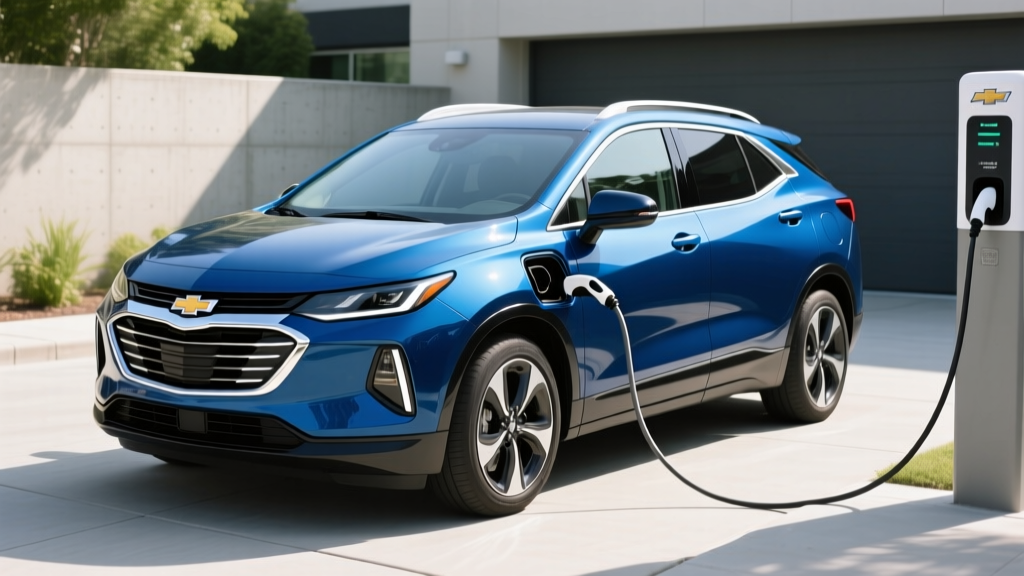
Searching for Chevy Equinox EV lease offers in 2026 means navigating a web of incentives, fluctuating lease money factors, and the critical question of whether the math actually works in your favor. The Equinox EV remains one of the most accessible electric crossovers on the market, with a starting MSRP that undercuts many competitors and an EPA-estimated range reaching up to 319 miles. But the sticker price is only the first variable in a five-year equation that includes electricity, insurance, depreciation, and maintenance.
This guide dissects the real cost of owning or leasing a 2026 Chevy Equinox EV — the federal tax credit rules you must meet, the fuel savings you can actually bank, and the ownership expenses that catch new EV buyers off guard.
2026 Chevy Equinox EV at a Glance: Specs That Drive the Cost Equation
Before running the numbers, here are the hard specs that determine efficiency, charging cost, and long-term value retention for the 2026 model year.
| Specification | LT 2 (FWD) | RS 3 (AWD) |
|---|---|---|
| EPA Range | 319 mi | 285 mi |
| Real-World Range (highway/cold) | ~260–280 mi | ~235–255 mi |
| Battery (usable) | 85 kWh (NMC) | 85 kWh (NMC) |
| Peak DC Fast Charge | 150 kW | 150 kW |
| 10–80% DCFC Time | ~33 min | ~33 min |
| Level 2 Charge Rate | 11.5 kW (AC) | 11.5 kW (AC) |
| Efficiency | 109 MPGe (3.0 mi/kWh) | 96 MPGe (2.8 mi/kWh) |
| Horsepower | 213 hp | 288 hp |
| 0–60 mph | ~8.3 sec | ~5.9 sec |
| Base MSRP | $33,600 | $43,900 |
| Battery/Powertrain Warranty | 8 yr / 100,000 mi | 8 yr / 100,000 mi |
Federal Tax Credit: Do You Qualify for Up to $7,500?
The IRS §30D Clean Vehicle Credit can knock up to $7,500 off your tax liability — and as of 2024, you can transfer it to the dealer at the point of sale, effectively reducing your purchase price or capitalized cost on a lease. But eligibility is not automatic. The 2026 rules carry strict requirements that eliminate many buyers.
- Income Caps: Modified AGI must not exceed $150,000 (single), $225,000 (head of household), or $300,000 (married filing jointly).
- MSRP Caps: Vehicle MSRP must be ≤$55,000 for SUVs/crossovers (the Equinox EV qualifies).
- Battery Sourcing: $3,750 requires critical minerals extracted or processed in the US or a free-trade-agreement country. An additional $3,750 requires battery components manufactured or assembled in North America. Sourcing requirements tighten annually — check the fueleconomy.gov tax credit lookup for the specific trim.
- Final Assembly: Must occur in North America (the Equinox EV is assembled in Ramos Arizpe, Mexico — this may affect eligibility depending on 2026 rule interpretations; verify before signing).
- Lease Loophole: Under the commercial vehicle credit (§45W), leased EVs may qualify for the full $7,500 regardless of sourcing or income caps, passed through as a lease credit by the lessor. This is why Equinox EV lease offers often advertise the full $7,500 discount.
What this means for Equinox EV leases: Many dealerships advertise lease deals that factor in the $7,500 as a capitalized cost reduction. Because leased vehicles are technically purchased by the leasing company (GM Financial), they can qualify under the commercial credit pathway, bypassing individual income and sourcing restrictions. Always confirm with the dealer that the advertised lease incentive is actually being applied to your deal — and whether it's the §30D credit or the §45W commercial credit being passed through.
5-Year Total Cost of Ownership: Equinox EV vs. Gas Compact SUV
The real test of any EV is how the costs stack up over years of ownership. Below is a five-year projection for the Equinox EV LT 2 (FWD) compared to a similarly priced gas-powered compact SUV (approximately 28 MPG combined, $3.50/gal fuel).
| Cost Category | 2026 Equinox EV LT 2 | Gas Compact SUV (28 MPG) |
|---|---|---|
| Purchase / Cap Cost (after $7,500 credit) | $26,100 | $33,500 |
| Charging / Fuel (75,000 mi) | $4,688 | $9,375 |
| Insurance (5 years) | $9,750 | $7,500 |
| Maintenance (5 years) | $1,200 | $3,500 |
| Depreciation (est. 5-yr) | $14,400 | $13,200 |
| 5-Year Total | $56,138 | $67,075 |
| Cost Per Mile | $0.75 | $0.89 |
Key assumptions: 15,000 miles/year; home charging at $0.14/kWh average; gas at $3.50/gal; insurance based on national EV average premiums; depreciation based on current EV resale trends (see below).
Charging vs. Gas: The Per-Mile Math
The Equinox EV LT 2 achieves approximately 3.0 miles per kWh (109 MPGe). Here's what that translates to in real dollars.
Home Charging (Level 2, $0.14/kWh): $0.047/mile
Public DC Fast Charging ($0.40/kWh avg): $0.133/mile
Gas SUV (28 MPG, $3.50/gal): $0.125/mile
If you charge predominantly at home, the Equinox EV costs roughly 62% less per mile than a comparable gas SUV. But if you rely entirely on public DC fast charging, you'll actually spend slightly more per mile than gas — a critical reality for apartment dwellers or those without home charging access.
Annual fuel cost scenario: A driver covering 15,000 miles/year with 80% home charging and 20% public DCFC would spend approximately $938/year on electricity. The equivalent gas SUV driver spends $1,875/year. That's a $937 annual savings, or roughly $4,688 over five years.
Maintenance Savings: Where the EV Advantage Is Real
Electric vehicles eliminate the most common recurring maintenance costs associated with internal combustion engines. Here's the five-year maintenance breakdown.
| Maintenance Item | Equinox EV (5 yr) | Gas SUV (5 yr) |
|---|---|---|
| Oil Changes | $0 | $750 |
| Brake Pads (regen reduces wear) | $0 (likely not needed) | $600 |
| Tire Rotation/Replacement | $800 (EVs wear tires faster due to weight/torque) | $600 |
| Cabin Air Filter | $200 | $200 |
| Coolant/Fluids | $100 | $400 |
| Transmission/Drivetrain | $0 | $300 |
| Wiper Blades / Misc | $100 | $150 |
| Total Estimated | $1,200 | $3,000–$3,500 |
Net maintenance savings: $1,800–$2,300 over five years. Note that EV tires tend to wear faster due to the vehicle's higher curb weight (the Equinox EV weighs ~4,400 lbs) and instant torque delivery. Budget for one set of replacement tires during a 75,000-mile ownership period.
Insurance Reality: The Cost EV Buyers Underestimate
EV insurance premiums run 15–30% higher than equivalent gas vehicles. For the Equinox EV, expect annual premiums of approximately $1,800–$2,100 depending on your state, driving record, and coverage level — compared to $1,400–$1,600 for a gas compact SUV.
Why EVs cost more to insure:
- Higher repair costs: Battery pack replacement after collision damage is extremely expensive, and body shops need specialized EV certification.
- Higher vehicle value: Even after incentives, the pre-credit MSRP influences comprehensive and collision coverage rates.
- Specialized parts: EV-specific components (power electronics, charge ports, thermal management systems) carry premium replacement costs.
- Repair network limitations: Fewer body shops are certified for high-voltage EV repair, increasing labor rates and rental car durations.
What to do: Get quotes from at least three insurers before signing a lease. Some carriers (Geico, Progressive, State Farm) offer EV-specific discounts. Bundling home and auto can recoup $200–$400/year of the EV premium gap.
Depreciation and Resale Value: The Honest Picture
EV depreciation has been volatile. Between 2023 and 2025, aggressive price cuts from Tesla and new-model introductions caused used EV values to drop faster than gas vehicles. The Equinox EV, being relatively new, has limited long-term resale data, but current trends suggest:
- 5-year depreciation estimate: 45–55% of MSRP (compared to 40–45% for mainstream gas compact SUVs)
- Factors working against EV resale: Rapid technology advancement, battery health uncertainty for second owners, and continued new-EV price competition
- Factors working in favor: The 8-year/100,000-mile battery warranty transfers to second owners, and growing charging infrastructure improves buyer confidence
Leasing vs. buying and depreciation risk: If you lease, depreciation is the leasing company's problem — your residual value is locked in at signing. This is why Equinox EV lease offers can be attractive: you're insulated from the EV resale value uncertainty that concerns many buyers. However, if the residual is set conservatively (high depreciation baked in), your monthly payment will be higher. Compare the money factor and residual percentage across multiple dealer quotes.
State, Local, and Utility Incentives: Stack the Savings
Examples of additional savings that may apply:
- State rebates: States like Colorado ($5,000 refundable credit for vehicles under $50,000 in 2026), Massachusetts ($2,500 MOR-EV rebate), and New Jersey (sales tax exemption) can significantly reduce net cost.
- Utility rebates: Many utilities offer $250–$1,000 rebates for Level 2 home charger purchase and installation, plus time-of-use (TOU) rate plans that reduce charging cost to $0.06–$0.09/kWh overnight.
- HOV lane access: States like California, Colorado, and Virginia offer single-occupant HOV lane access for EVs — a significant commute-time savings with no direct dollar value but high personal utility.
- Sales tax exemptions: Several states exempt EVs from sales tax entirely, saving 6–10% on the purchase price.
Lease vs. Buy: Which Path Makes Sense for the Equinox EV?
Choose a lease if:
- You want to capture the full $7,500 credit without worrying about personal income or battery-sourcing eligibility (via the §45W commercial lease pathway).
- You're concerned about EV depreciation risk and want the residual value guaranteed.
- You drive fewer than 15,000 miles/year (typical lease limits; excess mileage fees of $0.15–$0.25/mi add up fast).
- You want to upgrade to newer EV technology every 3 years.
- You drive more than 15,000 miles/year.
- You qualify for the §30D credit personally (income under caps, sourcing requirements met) and want to own the vehicle long-term.
- You plan to keep the vehicle 7+ years, where the higher upfront cost is amortized over a longer period.
- You want to modify the vehicle or aren't comfortable with lease-end wear-and-tear charges.
Frequently Asked Questions
How much does it really cost to own a Chevy Equinox EV over 5 years?
Based on our analysis, a 2026 Equinox EV LT 2 costs approximately $56,138 over five years (75,000 miles) when you factor in purchase price after the $7,500 credit, home-dominant charging, insurance, maintenance, and depreciation. That works out to roughly $0.75 per mile — about $11,000 less than a comparable gas compact SUV over the same period, primarily driven by fuel and maintenance savings offset by higher insurance premiums.
Do I qualify for the federal EV tax credit on the Equinox EV?
For a purchase, you must meet IRS income caps ($150K single / $300K married), the vehicle MSRP must be under $55,000 (the Equinox EV qualifies), and the battery must meet critical-mineral and component sourcing thresholds that tighten each year. Check fueleconomy.gov for the specific trim's credit amount. For a lease, the $7,500 is often available regardless of personal income or sourcing rules through the §45W commercial credit — confirm with your dealer that it's being applied.
How much do I save on fuel and maintenance?
Over five years and 75,000 miles, expect to save approximately $4,688 on fuel (assuming 80% home charging at $0.14/kWh) and $1,800–$2,300 on maintenance compared to a 28 MPG gas SUV. Combined savings of $6,500–$7,000 are realistic, though individual results depend on electricity rates, driving patterns, and public charging frequency.
Are EVs more expensive to insure than gas cars?
Yes, typically 15–30% more. For the Equinox EV, budget $1,800–$2,100 annually versus $1,400–$1,600 for a gas equivalent. Higher repair costs, battery replacement expense, and a smaller certified repair network drive the premium gap. Shop multiple insurers and ask about EV-specific discounts.
How well does the Equinox EV hold its value?
Current data suggests 45–55% depreciation over five years, which is steeper than mainstream gas SUVs (40–45%). EV resale values remain uncertain due to rapid technology evolution and price competition. Leasing transfers this risk to the lessor, which is one reason Equinox EV lease offers can make financial sense for risk-averse buyers.
What's the real-world range I should plan around?
While the LT 2 carries a 319-mile EPA rating, plan for 260–280 miles on highway road trips and 220–250 miles in winter conditions below 30°F. The AWD RS trims lose about 30–35 miles of range across all scenarios. Use fueleconomy.gov's side-by-side tool to compare efficiency across trims.
Tax credit and incentive information reflects rules in effect for the 2026 model year. IRS §30D requirements, state programs, and utility rebates change frequently. Consult a tax professional and verify all incentive amounts with official sources before making a purchase or lease decision.