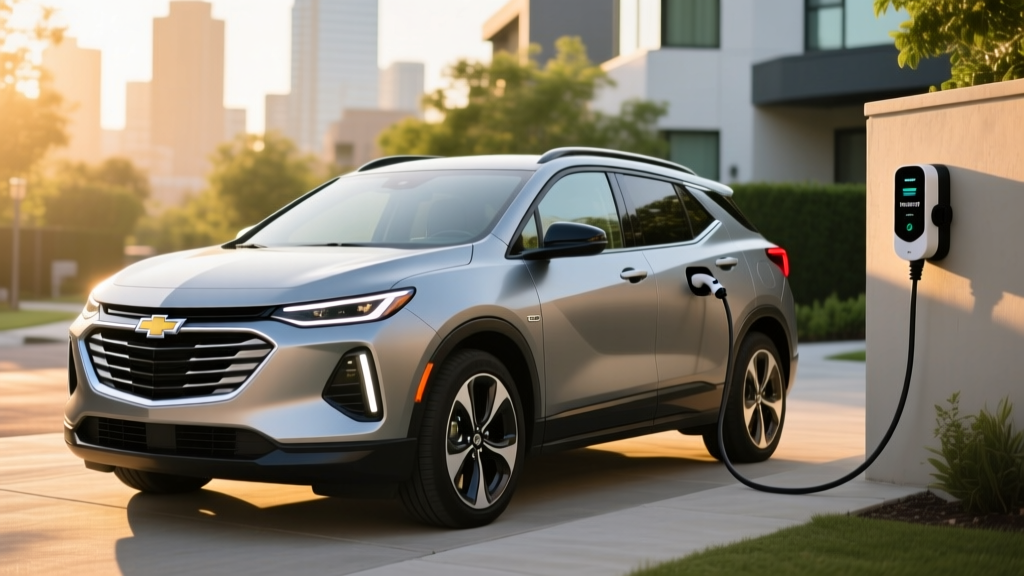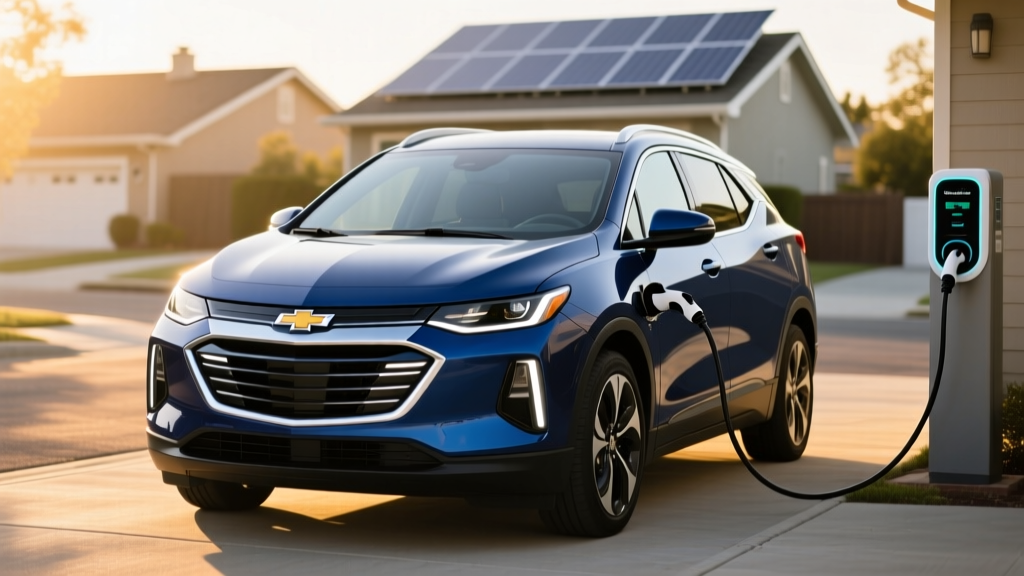
If you've been eyeing the Chevy Equinox EV, you've probably noticed the monthly lease ads and wondered: is leasing this electric SUV actually cheaper than buying it, or even than driving a gas-powered compact crossover? The answer depends on a tangle of variables — federal tax credits, electricity rates in your ZIP code, insurance premiums, and how well EVs are holding their resale value in 2026.
We ran the numbers on the 2026 Equinox EV across all the cost categories that matter. Below you'll find the exact 5-year total cost of ownership, the current IRS §30D tax credit rules (which changed significantly over the last few years), real fuel and maintenance savings, and the insurance reality most lease calculators conveniently leave out.
2026 Chevy Equinox EV: The Lease-Relevant Specs
Before we get to dollars and cents, here's what you're actually leasing. The 2026 Equinox EV rides on GM's Ultium platform and is offered in front-wheel-drive (FWD) and all-wheel-drive (AWD) configurations.
| Spec | LT FWD | RS AWD |
|---|---|---|
| EPA Range | 319 mi | 285 mi |
| Battery (usable, NMC) | 85 kWh | 85 kWh |
| Peak DC Fast Charge | 150 kW | 150 kW |
| 10–80% DC Charge Time | ~30 min | ~30 min |
| Level 2 Charge Rate | 11.5 kW | 11.5 kW |
| Horsepower | 213 hp | 288 hp |
| 0–60 mph | ~8.4 sec | ~5.7 sec |
| EPA Efficiency (combined) | 95 MPGe | 89 MPGe |
| Base MSRP (incl. destination) | $34,900 | $41,900 |
| Battery/Powertrain Warranty | 8 yr / 100,000 mi | 8 yr / 100,000 mi |
5-Year Total Cost of Ownership Breakdown
The following table models a 5-year / 60,000-mile ownership scenario for the Equinox EV LT FWD, compared against a comparably priced gas crossover (think a loaded Honda CR-V or Toyota RAV4 at ~$35,000 MSRP). We assume 12,000 miles driven annually, home Level 2 charging at the national average electricity rate, and a gas price of $3.40/gallon for the ICE baseline.
| Cost Category | Equinox EV (5 yr) | Gas Crossover (5 yr) | Notes |
|---|---|---|---|
| Purchase / Lease (net of credits) | $17,400 (lease, after $7,500 credit applied) | $21,000 (lease, no credit) | 36-mo lease rolled into 5-yr; credit via point-of-sale on lease |
| Fuel / Electricity | $2,880 | $6,800 | EV: $0.16/kWh avg, 3 mi/kWh; Gas: 28 MPG combined, $3.40/gal |
| Maintenance | $1,200 | $3,500 | EV: tire rotations, cabin filter, wipers; Gas: oil, filters, brakes, spark plugs |
| Insurance | $7,500 | $6,000 | EV premiums run 15–25% higher on average |
| Depreciation (if purchased) | ~55% over 5 yr | ~45% over 5 yr | EV resale remains softer; leasing transfers this risk to GM Financial |
| Total (lease scenario) | ~$28,980 | ~$37,300 | EV saves ~$8,300 over 5 years |
The critical insight here: leasing the Equinox EV shifts the depreciation risk to the lessor (GM Financial). Since EVs are currently depreciating faster than gas vehicles — driven by rapid tech improvements, price cuts from competitors, and uncertain long-term battery valuation — leasing insulates you from that downside. If the EV's resale value tanks by year five, that's GM's problem, not yours.
Federal Tax Credit: Do You Actually Qualify?
The IRS §30D Clean Vehicle Credit can knock up to $7,500 off the effective cost of an Equinox EV — but the eligibility rules are strict and have tightened considerably. Here's the current checklist for 2026:
- MSRP Cap: The Equinox EV must have an MSRP at or below $80,000 for SUVs. All current trims qualify (base LT starts at $34,900).
- Buyer Income Limits: Modified adjusted gross income (MAGI) must not exceed $150,000 (single), $225,000 (head of household), or $300,000 (married filing jointly). These are hard caps — even $1 over disqualifies you.
- Battery Component Sourcing: To earn the full $7,500, battery components must meet North American manufacturing/assembly thresholds, and critical minerals must be sourced from the U.S. or a free-trade-agreement country. The Equinox EV's Ultium battery is manufactured in the U.S., and GM has largely met sourcing requirements for the full credit — but confirm with your dealer at purchase, as supply chains shift.
- Point-of-Sale Transfer: You can transfer the credit to the dealer at the time of purchase or lease, effectively reducing your down payment by up to $7,500. On a lease, the lessor technically claims the credit and typically passes it through as a capitalized-cost reduction.
- One Credit Per Vehicle, Per Taxpayer: You can only claim the credit once per vehicle (VIN), and there's a per-taxpayer limit on how many credits you can claim per year.
Charging vs. Gas: The Per-Mile Math
This is where the Equinox EV lease makes the strongest financial case. Let's break down the cost per mile with concrete numbers:
| Metric | Equinox EV | Gas Crossover (28 MPG) |
|---|---|---|
| Energy Cost | $0.16/kWh (home avg) | $3.40/gallon |
| Efficiency | ~3.0 mi/kWh (333 Wh/mi) | 28 mi/gallon |
| Cost Per Mile | $0.053/mi | $0.121/mi |
| Annual (12,000 mi) | $636 | $1,452 |
| 5-Year Fuel Cost | $3,180 | $7,260 |
| 5-Year Savings | $4,080 (home charging) | |
A few critical caveats that most lease ads gloss over:
- DC fast charging costs more. Electrify America and EVgo typically charge $0.35–$0.55/kWh, which pushes your cost per mile to $0.12–$0.18 — comparable to or higher than gas. If you rely exclusively on public fast charging, the fuel savings evaporate.
- Time-of-use rates matter. If your utility offers off-peak rates (e.g., $0.08/kWh overnight), your cost per mile drops to ~$0.027, widening the savings gap dramatically.
- The Equinox EV's 150 kW peak charge rate means a 10–80% session takes roughly 30 minutes. That's slower than the Hyundai Ioniq 5 or Tesla Model Y, which matters if you road-trip frequently.
Maintenance Savings: Where EVs Quietly Win
EVs have far fewer moving parts than internal-combustion vehicles, and the maintenance savings compound over a lease term. Here's what you're actually paying for (and not paying for) with the Equinox EV:
| Service Item | Equinox EV | Gas Crossover |
|---|---|---|
| Oil Changes | None — $0 | $250–$400 (5 yr) |
| Transmission Fluid | None (single-speed) | $150–$300 |
| Brake Pads/Rotors | Rarely (regen braking) — $0–$200 | $600–$1,200 |
| Engine Air Filter | None | $100–$150 |
| Spark Plugs | None | $200–$400 |
| Coolant Flush | Rare (battery thermal loop) | $150–$250 |
| Cabin Air Filter | $50–$100 | $50–$100 |
| Tire Rotation/Replacement | $600–$1,000 (EV tires wear faster due to weight and instant torque) | $500–$800 |
| Total 5-Year Est. | ~$1,000–$1,500 | ~$2,500–$4,000 |
The regenerative braking system on the Equinox EV handles most deceleration, meaning your friction brakes see minimal use. Many EV owners report original brake pads lasting well beyond 80,000 miles. The one area where EVs can cost more is tires — the Equinox EV weighs roughly 4,400 lbs and delivers instant torque, which accelerates tire wear. Budget for a set of replacement tires around year 3 or 4 if you drive aggressively.
The Insurance Reality: Higher Premiums, Explained
Here's the cost category that catches most new EV lessees off guard: insurance premiums for the Equinox EV typically run 15–25% higher than for a comparably priced gas crossover. Based on national averages, expect to pay roughly $1,400–$1,600/year for the Equinox EV versus $1,100–$1,300/year for a gas equivalent.
The reasons are structural, not arbitrary:
- Repair complexity: EV battery packs and high-voltage systems require specialized technician training and equipment. A minor rear-end collision that would cost $2,000 to repair on a gas car can total an EV if the battery enclosure is compromised.
- Parts cost: The Ultium battery pack alone represents a massive replacement liability (estimated $15,000–$20,000+ if out of warranty), which insurers price into premiums.
- Total-loss frequency: Insurers are more likely to declare an EV a total loss after collision damage due to the cost and complexity of high-voltage system inspection.
The good news: the Equinox EV's relatively modest MSRP keeps premiums lower than luxury EVs. Shop quotes from at least three insurers before signing the lease — some carriers (like Progressive and State Farm) have become more competitive on EV-specific policies.
Depreciation & Resale: Why Leasing Shifts the Risk
EV depreciation has been a sore spot in 2024–2025, driven by aggressive price cuts from Tesla, rapid technology improvements, and consumer uncertainty about long-term battery health. According to industry data, mainstream EVs have depreciated roughly 50–60% over three years, compared to 35–45% for comparable gas vehicles.
For the Equinox EV specifically, the depreciation picture is mixed:
- Pro: The Equinox EV's affordable entry price ($34,900 base) means there's less absolute dollar value to lose compared to a $70,000+ luxury EV.
- Pro: GM's 8-year/100,000-mile battery warranty provides downstream buyers confidence, supporting resale.
- Con: The compact EV SUV segment is getting crowded (Ford Explorer EV, Hyundai Ioniq 5, Kia EV5), which pressures used values.
- Con: Rapid advances in battery chemistry and charging speed make 2–3-year-old EVs feel dated faster than gas cars.
This is precisely why leasing is often the smarter play for the Equinox EV. You lock in your monthly cost, use the vehicle for 24–36 months, and walk away. If EV resale values crater by 2028, you're not the one absorbing that loss — GM Financial is. If you're determined to buy instead, plan to hold the vehicle for 7+ years to ride out the depreciation curve.
Lease vs. Buy Decision Framework
- You want the lowest monthly payment with the $7,500 credit applied as a cap-cost reduction
- You drive 10,000–15,000 miles/year (within typical lease limits)
- You want to upgrade to newer EV tech in 2–3 years
- You don't want exposure to EV depreciation risk
- You qualify for the full §30D credit and your income is below the caps
- You drive more than 15,000 miles/year (lease overage penalties add up fast at $0.20–$0.30/mi)
- You plan to keep the vehicle 7+ years
- You want to customize (roof racks, wraps, aftermarket wheels — all restricted on leases)
- Your income exceeds the §30D caps, eliminating the credit advantage either way
Frequently Asked Questions
How much does it really cost to own a Chevy Equinox EV over 5 years?
Based on our modeling of a 5-year / 60,000-mile lease scenario, the total cost is approximately $28,980 — including lease payments (net of the $7,500 federal credit), home charging, insurance, and maintenance. That's roughly $8,300 less than a comparable gas crossover over the same period, driven primarily by fuel and maintenance savings offsetting higher insurance premiums.
Do I qualify for the $7,500 federal tax credit on a lease?
Possibly. On a lease, the leasing company (GM Financial) technically claims the credit, and most pass it through as a capitalized-cost reduction, lowering your monthly payment. You still need to meet IRS §30D income limits ($150K single / $300K married filing jointly) and the vehicle must meet battery-sourcing requirements. The Equinox EV's MSRP is well below the $80,000 SUV cap. Confirm eligibility with your tax professional and dealer at signing.
How much do I save on fuel and maintenance versus a gas SUV?
With home charging at the national average of $0.16/kWh, the Equinox EV costs roughly $0.053 per mile to "fuel" versus $0.121 per mile for a 28 MPG gas crossover — saving about $4,080 over 5 years / 60,000 miles. Maintenance savings add another $1,500–$2,500 over the same period, thanks to the elimination of oil changes, spark plugs, transmission fluid, and most brake service.
Are EVs more expensive to insure than gas cars?
Yes, typically 15–25% more expensive. The Equinox EV costs roughly $1,400–$1,600/year to insure versus $1,100–$1,300/year for a gas equivalent. Higher repair costs, specialized technician requirements, and the replacement value of the battery pack all factor in. Shop multiple insurers — the gap is narrowing as EVs become more common.
How well does the Chevy Equinox EV hold its resale value?
EV resale values have been softer than gas vehicles, with mainstream EVs depreciating 50–60% over three years versus 35–45% for gas equivalents. The Equinox EV's affordable MSRP and GM's 8-year battery warranty help, but rapid technology advancement and a crowded segment pressure used values. Leasing transfers this depreciation risk to the lessor, which is one of the strongest arguments for leasing this particular model.
What happens if I exceed my lease mileage limit?
Most Equinox EV leases come with 10,000, 12,000, or 15,000 miles per year. Excess mileage charges typically run $0.20–$0.30 per mile. If you drive more than 15,000 miles annually, buying (or choosing a high-mileage lease at signing) is almost always more economical than paying overage penalties.
Can I charge the Equinox EV at home on a standard outlet?
Yes, but slowly. Level 1 charging on a standard 120V outlet delivers roughly 1.4 kW, adding about 4–5 miles of range per hour — adequate if you drive less than 30 miles/day and can charge overnight. For practical daily use, a Level 2 home charger (240V, 11.5 kW) adds roughly 34 miles of range per hour and is strongly recommended. Expect $500–$1,500 for professional Level 2 installation depending on your electrical panel capacity.