The Chevrolet Equinox EV has quickly become one of the most talked-about affordable electric SUVs on the market. While its exterior styling and sub-$35,000 starting price grab headlines, buyers spending years inside this crossover need to know what the cabin actually delivers. In this review, we go deep on the 2026 Chevy Equinox EV interior — materials, space, technology, and ergonomics — while also covering the real-world range, charging performance, and ownership economics that determine whether this EV is the right fit for your driveway.
Quick Verdict: Who Should Buy the Equinox EV?
The 2026 Equinox EV is built for practical-minded buyers who want a mainstream electric SUV with legitimate long-range capability without paying luxury prices. If your priorities are a spacious cabin, straightforward infotainment, competitive EPA range, and access to the Tesla Supercharger network via the NACS port, this is a strong contender. It is not a performance SUV, and the interior — while a massive step up from the previous-generation gas Equinox — uses hard plastics in places where rivals like the Hyundai Ioniq 5 feel more premium.
Chevy Equinox EV Interior: Materials, Space, and Technology
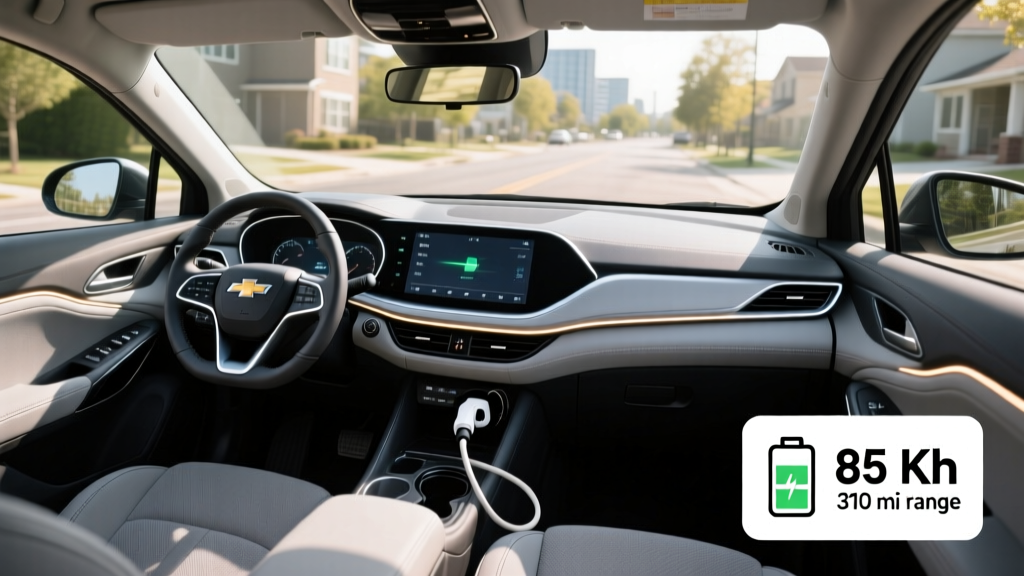
Step inside the 2026 Equinox EV and the first thing you notice is the 17.7-inch diagonal infotainment touchscreen dominating the center stack. This portrait-oriented display runs Google Built-In, meaning Google Maps, Google Assistant, and the Play Store are natively integrated — no phone required for navigation or app streaming. The driver faces an 11-inch digital instrument cluster that can be reconfigured to show range, efficiency, navigation, or driver-assist visualizations.
Material Quality and Build
Chevrolet has moved upmarket with soft-touch materials on the dashboard top, door armrests, and center console lid. The EV-specific flat-floor architecture creates an airy feel, and the available two-tone interior (Jet Black with Artemis accents on the RS trim) adds visual interest. However, lower door panels and the rear cargo area still use hard, scratch-prone plastics. Compared to the Hyundai Ioniq 5's minimalist lounge aesthetic or the Tesla Model Y's ultra-sparse cabin, the Equinox EV interior lands in a traditional, functional middle ground — closer to what most mainstream buyers actually expect.
Passenger Space and Cargo
The Ultium platform's flat battery floor pays dividends in interior volume:
- Front headroom: 40.0 inches
- Front legroom: 44.2 inches
- Rear headroom: 38.9 inches
- Rear legroom: 37.8 inches
- Cargo behind rear seats: 26.4 cu ft
- Cargo with seats folded: 57.2 cu ft
Rear-seat comfort is a genuine strength. Two adults on a long road trip will have ample knee and toe room, and the seat cushion height is generous enough to avoid the "knees-up" posture that plagues some EVs with thick floor batteries. The 57.2 cu ft maximum cargo volume trails the Ioniq 5 (59.3 cu ft) but beats the Ford Mustang Mach-E (52.7 cu ft), and the low load floor makes loading groceries or a stroller easy.
Notable Interior Features and Drawbacks
Standard features include a heated steering wheel, heated front seats, wireless Apple CarPlay and Android Auto, and a 6-speaker audio system. The available power liftgate and hands-free open option (kick-sensor on the rear bumper) is useful. One frustration: the Equinox EV lacks a front trunk (frunk). Chevrolet sealed that space for HVAC and power electronics, which is a missed opportunity for secure, weatherproof storage that competitors like the Mach-E and Ioniq 5 offer.
Range, Battery, and Efficiency: Real-World Numbers
| Spec | Value |
|---|---|
| Battery (usable) | 85 kWh (NMC, Ultium) |
| EPA Range (LT 2 FWD) | 319 miles |
| EPA Range (RS AWD) | 285 miles |
| Efficiency (FWD) | 113 MPGe / 30 kWh/100mi |
| Horsepower (FWD) | 213 hp |
| Horsepower (AWD) | 288 hp |
| 0-60 mph (FWD) | ~8.0 sec |
| 0-60 mph (AWD) | ~6.0 sec |
| Drivetrain | FWD or e-AWD (dual-motor) |
| Towing (max, AWD) | 1,500 lbs |
| Battery Warranty | 8 years / 100,000 miles |
The 85 kWh Ultium battery uses NMC (nickel manganese cobalt) chemistry, which offers high energy density but requires different long-term care habits than LFP cells. Chevrolet recommends daily charging to 80% for routine use and saving 100% charges for road trips. The battery management system includes active thermal conditioning via a liquid cooling loop, which helps preserve long-term State of Health (SoH) and enables preconditioning for fast charging.
Charging Performance: DC Fast and Home Level 2
Charging speed is where the Equinox EV story gets nuanced. The peak DC fast-charge rate is 150 kW — respectable but not class-leading. Competitors like the Ioniq 5 (up to 240 kW on 800V architecture) and Model Y (up to 250 kW on V3 Superchargers) charge noticeably faster on long road trips.
| Charging Level | Power / Rate | Speed |
|---|---|---|
| Level 1 (120V) | ~1.4 kW | ~4 miles per hour |
| Level 2 (240V, 48A) | 11.5 kW | ~34 miles per hour |
| DC Fast Charge | 150 kW peak | 10-80% in ~41 minutes |
A critical detail for 2026: the Equinox EV now ships with the NACS (North American Charging Standard) connector natively, meaning direct access to Tesla Supercharger stations without an adapter. This dramatically expands the reliable fast-charging network available to owners — a significant advantage over CCS-only vehicles in many regions.
At home on a Level 2 charger (240V, 48-amp circuit), the Equinox EV adds approximately 34 miles of range per hour, meaning a full charge from 10% takes roughly 8-9 hours — ideal for overnight replenishment. Home charger installation on a 240V/60A circuit typically costs $800-$2,000 depending on panel capacity and run length, though the IRS Energy Efficient Home Improvement Credit can cover up to $1,000 of that cost.
Pricing, Trims, and Federal Tax Credit Eligibility
| Trim | MSRP | Est. After §30D Credit |
|---|---|---|
| LT 2 (FWD) | $33,600 | ~$26,100* |
| LT 2 (AWD) | $36,600 | ~$29,100* |
| RS (FWD) | $39,900 | ~$32,400* |
| RS (AWD) | $43,400 | ~$35,900* |
*Federal tax credit estimates. Actual eligibility depends on individual circumstances.
- Buyer income caps: AGI must not exceed $150,000 (single), $225,000 (head of household), or $300,000 (joint). Check current limits at IRS.gov.
- MSRP cap: SUVs/vans must be priced at or below $80,000 (all Equinox EV trims qualify).
- Battery sourcing: Critical minerals and battery components must meet escalating domestic-content thresholds. GM has worked to source Ultium battery materials from free-trade-agreement partners, but verify current-year compliance with your dealer before purchase.
- Point-of-sale transfer: You can elect to transfer the credit to the dealer at purchase, reducing your out-of-pocket cost immediately rather than waiting for tax filing.
Driving Impressions and ADAS Technology
The Equinox EV drives like a well-tuned compact crossover, not a rocket ship. The FWD model's 213 hp delivers adequate acceleration for merging and passing, with a 0-60 time around 8.0 seconds. The AWD RS variant, with 288 hp and a 6.0-second sprint, feels genuinely quick off the line and confident in wet or snowy conditions thanks to the dual-motor e-AWD system's instant torque distribution.
Ride quality is a highlight. The Ultium platform's low center of gravity and independent rear suspension deliver composed handling with minimal body roll, and the cabin remains quiet at highway speeds — a benefit of both the electric powertrain and Chevrolet's acoustic-laminated windshield.
Driver Assistance: Super Cruise Availability
The Equinox EV comes standard with Chevy Safety Assist 2.0, which includes automatic emergency braking, lane-keeping assist, adaptive cruise control, blind-spot monitoring, and rear cross-traffic alert. The headline option is Super Cruise — GM's hands-free highway driving system — available on the RS trim and as part of a package on higher LT builds.
In practice, Super Cruise is one of the best highway companions available. It handles curves, lane changes (with driver confirmation), and stop-and-go traffic smoothly. The requirement to keep your eyes on the road is less fatiguing than keeping your hands on a wheel, and on long interstate stretches it meaningfully reduces driver workload.
How It Compares: Equinox EV vs. Key Rivals
| Spec | Equinox EV LT 2 | Ioniq 5 SE | Model Y (RWD) |
|---|---|---|---|
| EPA Range | 319 mi | 303 mi | 320 mi |
| Starting MSRP | $33,600 | $42,450 | $44,990 |
| Peak DC Charge | 150 kW | 240 kW | 250 kW |
| 10-80% DCFC | ~41 min | ~18 min | ~22 min |
| Cargo (rear fold) | 57.2 cu ft | 59.3 cu ft | 72.1 cu ft |
| NACS Native | Yes | Adapter req. | Yes |
| Frunk | No | Yes (0.85 cu ft) | Yes (4.1 cu ft) |
The Equinox EV's strongest competitive advantage is price. At $33,600 before incentives, it undercuts both the Ioniq 5 and Model Y by roughly $9,000-$11,000. After the federal credit, the gap widens further. The trade-off is charging speed — on road trips, the Ioniq 5's 800V architecture gets you back on the road nearly 20 minutes faster per stop. If most of your driving is within a 150-mile radius of home and you charge overnight, the Equinox EV's slower DC rate is rarely a practical limitation.
Pros, Cons, and Ownership Considerations
- 319-mile EPA range at an accessible price point
- Spacious, comfortable interior with Google Built-In
- Native NACS port for Supercharger access
- Super Cruise hands-free driving available
- Strong federal tax credit eligibility
- 8-year/100,000-mile battery warranty
- 150 kW peak DC charging is slower than rivals
- No frunk for additional cargo
- Hard plastics on lower interior panels
- 1,500-lb tow limit limits utility
- FWD base model feels underpowered for the weight
- No LFP battery option for 100% daily charging
Long-term ownership costs look favorable. According to EPA efficiency data from fueleconomy.gov, the Equinox EV FWD consumes roughly 30 kWh per 100 miles. At a national average electricity rate of $0.16/kWh, that's about $0.048 per mile — compared to roughly $0.14/mile for a 28 MPG gas crossover at $3.90/gallon. Over five years and 75,000 miles, the fuel savings alone can exceed $6,800, before accounting for reduced maintenance (no oil changes, fewer brake replacements thanks to regenerative braking).
Insurance costs tend to run 10-20% higher than comparable gas vehicles, and depreciation on mainstream EVs remains somewhat uncertain as the market matures. However, the Ultium battery's 8-year/100,000-mile warranty (covering defects and capacity loss below 60% of original capacity, per GM's EV battery warranty documentation) provides meaningful peace of mind.
Frequently Asked Questions
What is the real-world range of the Chevy Equinox EV?
The EPA rates the FWD model at 319 miles and the AWD RS at 285 miles. In real-world highway driving at 70+ mph, expect 265-285 miles (FWD) or 235-255 miles (AWD) in mild weather. Cold weather can reduce range by 15-25%, so plan for roughly 210-240 miles in winter highway conditions.
How fast does the Equinox EV charge at home and on the road?
On DC fast chargers, the Equinox EV peaks at 150 kW, achieving a 10-80% charge in approximately 41 minutes. At home on a 240V Level 2 charger (48 amps), it adds about 34 miles of range per hour, fully replenishing overnight in 8-9 hours. On a standard 120V outlet, expect roughly 4 miles per hour — fine for topping off but not practical as a primary charging method.
How much does the Equinox EV cost after tax credits?
The base LT 2 FWD starts at $33,600. With the full $7,500 federal §30D credit (subject to income, sourcing, and MSRP eligibility), the effective price drops to approximately $26,100. Higher trims and AWD configurations range from $29,100 to $35,900 after the estimated credit. Always verify current eligibility with your dealer and a tax professional.
Is the Equinox EV worth buying over the Ioniq 5 or Model Y?
If budget is your top priority and you mostly drive locally with overnight home charging, the Equinox EV is an outstanding value — offering 319 miles of range for $10,000+ less than either rival. If you take frequent long road trips and need the fastest possible DC charging, the Ioniq 5's 18-minute 10-80% time is a significant advantage. The Model Y offers more cargo space and Supercharger-native access but at a considerably higher price.
Does the Equinox EV qualify for the full $7,500 federal tax credit?
The Equinox EV is on the IRS qualifying list, but the full credit depends on your AGI (income caps apply), the vehicle's MSRP (all trims are under the $80,000 SUV cap), and current battery sourcing compliance. GM has worked to meet critical-mineral and component requirements through North American and free-trade-agreement supply chains. Check fueleconomy.gov and confirm with your dealer at the time of purchase, as sourcing rules tighten annually.
Does the Equinox EV have a frunk?
No. Chevrolet used the space under the hood for HVAC components and power electronics. All cargo must go in the 26.4 cu ft rear area (57.2 cu ft with seats folded).
What battery chemistry does the Equinox EV use?
The Equinox EV uses GM's Ultium platform with NMC (nickel manganese cobalt) lithium-ion cells. NMC offers excellent energy density, enabling the 319-mile range from an 85 kWh pack. For longevity, GM recommends charging to 80% for daily driving and reserving 100% charges for trips where you need maximum range.