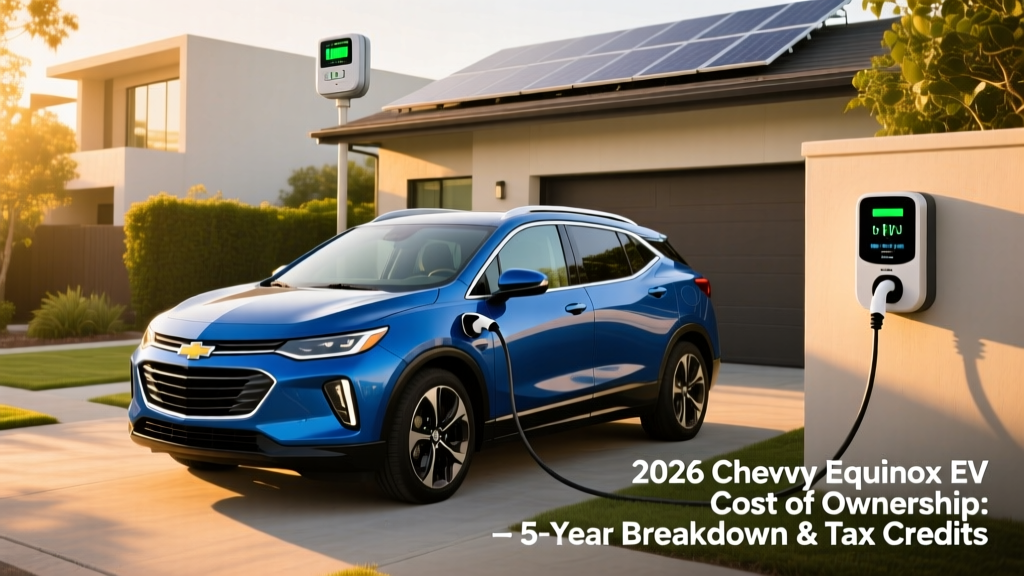
The Chevrolet Equinox EV positions itself as one of the most affordable long-range electric crossovers on the market, with a starting MSRP near $33,000 and an EPA-estimated range reaching 319 miles. But sticker price is only the beginning. For buyers researching the chevy equinox ev cost of ownership, the real question is what happens after you drive it off the lot: how do charging, insurance, maintenance, depreciation, and incentives stack up over five years?
We ran the numbers on the 2026 Equinox EV using current EPA data, IRS §30D tax credit rules, national average electricity rates, and real-world insurance quotes. Here's exactly what owning one costs — and where it saves you money compared to a gas-powered compact SUV.
2026 Equinox EV: Key Specs at a Glance
Before we get into ownership costs, here are the baseline figures that drive every calculation below. The 2026 Equinox EV rides on GM's Ultium platform with an 85 kWh usable lithium-ion battery (NMC chemistry) and is available in front-wheel-drive and all-wheel-drive configurations.
| Spec | LT FWD | RS AWD |
|---|---|---|
| Base MSRP | $33,600 | $43,400 |
| EPA Range | 319 mi | 285 mi |
| Battery (usable) | 85 kWh, NMC | 85 kWh, NMC |
| Efficiency | 3.0 mi/kWh (100 MPGe combined) | 2.8 mi/kWh (94 MPGe combined) |
| Peak DC Fast Charge | 150 kW | 150 kW |
| 10–80% DC Charge Time | ~32 min | ~32 min |
| Level 2 Charge Rate | 11.5 kW | 11.5 kW |
| Horsepower | 213 hp | 288 hp |
| 0–60 mph | ~7.4 sec | ~5.8 sec |
| Battery Warranty | 8 yr / 100,000 mi | 8 yr / 100,000 mi |
Federal Tax Credit: Do You Qualify for Up to $7,500?
The Equinox EV is assembled in Spring Hill, Tennessee, and GM has structured its battery sourcing to comply with IRS §30D clean vehicle credit requirements. For 2026, the Equinox EV qualifies for the full $7,500 federal tax credit — but only if you meet the eligibility thresholds.
- ✅ MSRP Cap: Vehicle MSRP must not exceed $80,000 (SUVs/trucks). All Equinox EV trims clear this — even a fully loaded RS AWD at ~$47,000.
- ✅ Income Limits (modified AGI): $150,000 single filer / $225,000 head of household / $300,000 married filing jointly. Based on current or prior year's tax return — whichever is lower.
- ✅ Battery Sourcing: Critical minerals and battery components must meet escalating domestic/free-trade-partner thresholds. GM's Ultium battery supply chain currently satisfies 2026 requirements.
- ✅ Point-of-Sale Transfer: You can transfer the credit to the dealer at purchase, reducing your out-of-pocket cost by $7,500 at signing — even if you owe no federal tax that year. This effectively makes the LT FWD a ~$26,100 vehicle before any state incentives.
- ✅ One Vehicle Per 3 Years: You cannot claim another new clean vehicle credit within 3 years of a prior claim.
Critical caveat: Tax credit rules are subject to legislative change. The sourcing requirements tighten annually. Always verify current eligibility on IRS.gov and confirm with your tax professional before finalizing a purchase.
State, Local, and Utility Incentives
Beyond the federal credit, many buyers can stack additional savings depending on where they live and who supplies their electricity:
- State rebates: States like Colorado (up to $5,000), California (CVRP up to $7,000 for income-qualified buyers), and Massachusetts (MOR-EV up to $3,500) offer significant additional rebates.
- Utility rebates: Many utilities offer $250–$1,500 rebates for home Level 2 charger installation, plus time-of-use (TOU) rate plans that slash overnight charging costs.
- HOV lane access: States including California, Colorado, and Virginia grant EVs access to carpool lanes — a non-monetary perk worth real commute time.
- Registration fees: Some states charge higher annual EV registration fees ($50–$225) to offset lost gas tax revenue, which partially offsets savings.
Charging vs. Gas: The Per-Mile Cost Math
This is where the Equinox EV makes its strongest economic case — but the savings depend heavily on how and where you charge. Let's compare the Equinox EV LT FWD (3.0 mi/kWh) against a typical gas compact SUV averaging 28 MPG combined.
| Scenario | Rate | Cost/Mile | Annual Cost |
|---|---|---|---|
| Home Level 2 (national avg $0.17/kWh) | $0.17/kWh | $0.057 | $850 |
| Home TOU off-peak ($0.09/kWh) | $0.09/kWh | $0.030 | $450 |
| Public DC fast charging ($0.48/kWh avg) | $0.48/kWh | $0.160 | $2,400 |
| Gas SUV (28 MPG, $3.40/gal) | $3.40/gal | $0.121 | $1,821 |
The takeaway: If you charge primarily at home on a standard rate, you'll spend roughly $850/year on electricity vs. $1,821 on gas — a $971 annual savings. With a TOU plan charging overnight, that gap widens to $1,371/year. But if you rely exclusively on public DC fast chargers, you'll actually spend more than the gas SUV. Home charging access is the single biggest variable in EV operating economics.
Over 5 years at 15,000 miles/year with home charging, expect to spend $4,250–$4,850 on electricity vs. $9,105 on gas — a net fuel savings of roughly $4,250–$4,850.
Maintenance Savings: What You'll Never Pay For Again
EVs eliminate the majority of routine powertrain maintenance. The Equinox EV has no engine oil, no transmission fluid, no spark plugs, no timing belt, and no exhaust system. Regenerative braking significantly extends brake pad life — many EV owners report original brake pads at 80,000+ miles.
| Service Item | Equinox EV | Gas SUV |
|---|---|---|
| Oil changes (10 over 5 yr) | $0 | $600–$900 |
| Transmission fluid | $0 | $150–$250 |
| Engine air filter | $0 | $100–$200 |
| Spark plugs | $0 | $200–$400 |
| Brake pad replacement | $0 (regen extends life) | $300–$600 |
| Cabin air filter | $100–$150 | $100–$150 |
| Tire rotation & replacement | $800–$1,200* | $700–$1,000 |
| Coolant / misc. | $50–$100 | $200–$400 |
| 5-Year Total | ~$950–$1,450 | ~$2,250–$3,850 |
*EV tires tend to wear 15–25% faster due to higher vehicle weight and instant torque. Budget for one extra tire set over 5 years compared to a gas vehicle.
Net 5-year maintenance savings: approximately $1,300–$2,400, depending on gas-SUV service costs in your area.
Insurance: The Cost Reality EV Buyers Must Plan For
Here's where the Equinox EV costs more than its gas counterpart, and it's important to budget honestly for it. EV insurance premiums run 15–30% higher on average than equivalent gas vehicles. The reasons:
- Higher repair costs: Battery packs are expensive to diagnose and replace after collision damage. Even minor undercarriage impacts can total an EV.
- Specialized labor: Fewer body shops are certified for high-voltage EV repair, driving up labor rates.
- Vehicle value: Higher purchase prices mean higher insured values.
- Parts availability: EV-specific components (battery modules, power electronics) have longer lead times and higher costs.
For the 2026 Equinox EV, expect average annual premiums of $1,800–$2,400 depending on your state, driving record, and coverage level. A comparably equipped gas Equinox typically runs $1,500–$1,900/year. That's an insurance premium of roughly $300–$500 more per year, or $1,500–$2,500 over 5 years.
Tip: Shop quotes from at least 3 insurers before purchasing. Some carriers (Geico, Progressive, State Farm) have narrowed the EV insurance gap, and bundling home/auto or low-mileage discounts can offset the premium difference.
Depreciation and Resale Value Trends
EV depreciation has been a moving target. After a turbulent 2023–2024 period where Tesla price cuts cascaded through the used EV market, depreciation curves have stabilized somewhat for mainstream models. Based on current industry data from Kelley Blue Book and iSeeCars:
- 5-year depreciation (Equinox EV estimated): 45–55% of purchase price
- 5-year depreciation (gas Equinox): 40–48% of purchase price
- Key factors: Battery health certification at resale, evolving federal/state incentives for used EVs (up to $4,000 under §25E), and continued new-EV price competition all influence residual values.
The Equinox EV's relatively low starting price provides some depreciation cushion — there's less absolute dollar value to lose compared to a $65,000 luxury EV. However, expect slightly steeper percentage depreciation than the gas Equinox, primarily driven by rapid EV technology advancement and battery health uncertainty among used buyers.
On a $33,600 Equinox EV LT FWD (after $7,500 credit = $26,100 net purchase), a 50% depreciation over 5 years means ~$13,050 in value loss — but remember, you only paid $26,100, not $33,600. The tax credit effectively absorbs a significant portion of the depreciation hit.
Total 5-Year Cost of Ownership: The Full Picture
| Category | Equinox EV (LT FWD) | Gas Compact SUV |
|---|---|---|
| Purchase price (after incentives) | $26,100* | $30,500 |
| Fuel / electricity (5 yr) | $4,250–$4,850 | $9,105 |
| Maintenance (5 yr) | $950–$1,450 | $2,250–$3,850 |
| Insurance (5 yr) | $9,000–$12,000 | $7,500–$9,500 |
| Depreciation (5 yr) | $13,050** | $12,200–$14,640 |
| State EV registration fees (5 yr) | $250–$1,125 | $250–$500 |
| Total 5-Year Cost | ~$53,600–$58,575 | ~$61,805–$70,295 |
*After $7,500 federal credit via point-of-sale transfer. Does not include state/utility incentives.
**Depreciation calculated on net purchase price ($26,100 × 50%).
Bottom line: Over 5 years, the Equinox EV LT FWD saves an estimated $5,000–$12,000 compared to a gas compact SUV — even after accounting for higher insurance and slightly steeper depreciation. The savings are largest for buyers who charge at home on off-peak rates, qualify for the full federal credit, and live in states with additional rebates.
Frequently Asked Questions
How much does it really cost to own a Chevy Equinox EV over 5 years?
With the federal tax credit applied, home charging, and average insurance, expect total 5-year ownership costs of roughly $53,600–$58,575 for the LT FWD trim. That's $5,000–$12,000 less than a comparable gas compact SUV over the same period, with the bulk of savings coming from fuel and maintenance.
Do I qualify for the $7,500 federal tax credit on the Equinox EV?
You qualify if your modified AGI is under $150K (single), $225K (head of household), or $300K (joint), and you haven't claimed another new clean vehicle credit within 3 years. The Equinox EV meets all MSRP, assembly, and battery-sourcing requirements for 2026. You can transfer the credit to the dealer at point of sale for an immediate price reduction. Verify current rules at IRS.gov.
How much do I save on fuel and maintenance?
Combined fuel and maintenance savings run approximately $5,550–$7,250 over 5 years with home charging. Fuel savings alone are $4,250–$4,850 if you charge at home at the national average rate of $0.17/kWh. Maintenance savings add another $1,300–$2,400, partially offset by faster tire wear.
Are EVs more expensive to insure?
Yes, typically 15–30% more. For the Equinox EV, expect $300–$500/year more than a gas Equinox — roughly $1,500–$2,500 additional over 5 years. Higher repair costs, specialized labor, and battery replacement expenses drive the premium gap. Shop multiple insurers to narrow the difference.
How well do EVs hold their value?
EVs currently depreciate slightly faster than gas vehicles — expect 45–55% depreciation over 5 years vs. 40–48% for gas. However, the Equinox EV's lower net purchase price (after the $7,500 credit) means the absolute dollar loss is competitive. The used-EV tax credit (§25E, up to $4,000 for vehicles under $25,000) also supports resale demand from second-owners.
Is the Equinox EV worth it if I can't charge at home?
The economics shift significantly if you rely entirely on public DC fast charging. At $0.48/kWh average, your annual "fuel" cost rises to ~$2,400 — more than the gas alternative. Without home charging, the Equinox EV still saves on maintenance, but the total cost advantage narrows to roughly $1,000–$3,000 over 5 years. Consider a PHEV like the Toyota RAV4 Prime if home charging isn't feasible.