The Chevrolet Equinox EV has rapidly become one of the most talked-about affordable electric crossovers on the market, and for good reason. With an EPA-estimated range topping 319 miles, a spacious cabin, and a starting price that undercuts many rivals, it targets the exact buyer who wants electric without stretching their budget. But beyond the headline specs, buyers are also asking a surprisingly common question: what are the available Equinox EV colors, and how do they pair with the trim lineup? This review covers the full paint palette alongside the hard numbers — range, charging speed, battery chemistry, pricing, and tax credit eligibility — so you can spec your Equinox EV with confidence.
2026 Equinox EV Colors and Exterior Design
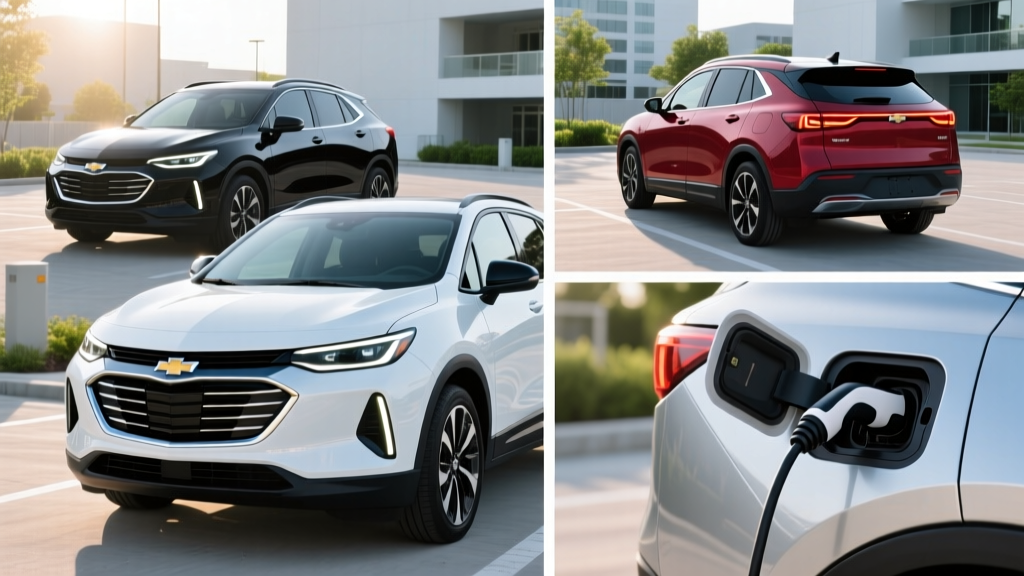
Chevrolet offers the 2026 Equinox EV in a curated selection of exterior paints that vary slightly by trim level (LT and RS). The color lineup balances mainstream appeal with a few bolder choices that suit the EV's modern crossover proportions.
Available Exterior Colors
- Summit White — A clean, bright tri-coat white available across all trims. Pairs well with both black and two-tone roof options.
- Sterling Gray Metallic — A sophisticated mid-tone gray with metallic flake. Popular on LT trims for a premium look.
- Riptide Blue Metallic — A vibrant, saturated blue that stands out in the compact EV segment. Available on both LT and RS.
- Radiant Red Tintcoat — A deep, rich red with a tinted clearcoat. Typically a premium-color upcharge on RS trims.
- Iridescent Pearl Tricoat — A pearlescent white with warm undertones that shift in different light. Premium option, RS-focused.
- Black — A classic solid black that emphasizes the RS trim's blackout accents and dark wheels.
- Habenero Orange — RS-exclusive. A bold, attention-grabbing orange that's become a signature color for Chevy's performance-oriented EV trims.
- Galaxy Gray Metallic — A darker, stealthier gray than Sterling, leaning toward charcoal. Available on RS.
The RS trim also offers an available two-tone roof option (typically a black roof paired with select body colors), which adds visual contrast and a sportier profile. LT trims stick with body-color roofs across all paint choices.
Range, Battery, and Efficiency Specs
The Equinox EV rides on GM's Ultium platform, sharing architecture with the Blazer EV and Cadillac Lyriq but tuned for the affordability end of the market. Here are the core powertrain specifications:
| Specification | 2026 Equinox EV LT | 2026 Equinox EV RS |
|---|---|---|
| EPA Estimated Range | 319 miles (FWD) | 285 miles (AWD) |
| Usable Battery Capacity | ~85 kWh | ~85 kWh |
| Battery Chemistry | NMC (Nickel Manganese Cobalt) | NMC |
| Drivetrain | FWD (single motor) | AWD (dual motor) |
| Horsepower | 213 hp | 288 hp |
| Torque | 236 lb-ft | 343 lb-ft |
| 0–60 mph | ~8.4 seconds | ~6.8 seconds |
| Efficiency (MPGe) | 115 MPGe combined | 101 MPGe combined |
| Efficiency (kWh/100 mi) | ~29 kWh/100 mi | ~33 kWh/100 mi |
The FWD LT's 319-mile EPA estimate is among the best in its price class. The RS with AWD sacrifices some range for the additional traction motor and performance output, landing at 285 miles — still competitive with rivals like the Ford Mustang Mach-E Select AWD and Hyundai Ioniq 5 AWD.
Charging Speed: DC Fast, Level 2, and Level 1
Charging capability is where the Equinox EV makes practical sense for most buyers. It supports the CCS1 connector standard for DC fast charging, though GM has announced future transition plans to the NACS (Tesla-style) connector for upcoming model years. For 2026, CCS1 remains the native port, with adapters available for Tesla Supercharger access.
| Charging Level | Power / Voltage | Speed (Miles per Hour) | Notes |
|---|---|---|---|
| Level 1 (120V household) | ~1.4 kW | ~4 mi/hr | Emergency / trickle only |
| Level 2 (240V home) | 11.5 kW (48A) | ~34 mi/hr | Full charge in ~8.5 hours |
| DC Fast Charge | Up to 150 kW peak | — | 10–80% in ~32 minutes |
The 150 kW peak DC fast-charge rate is the Equinox EV's most notable limitation relative to competitors. The Hyundai Ioniq 5 and Kia EV6, built on 800V architectures, can peak above 230 kW and hit 10–80% in roughly 18 minutes. The Equinox EV's 400V architecture means a 10–80% session takes approximately 32 minutes at a capable charger.
On the DC fast-charging curve, the Equinox EV sustains near-peak rates (130–150 kW) from roughly 10% to 40% State of Charge, then tapers progressively. From 60% to 80%, expect speeds closer to 70–90 kW. This taper is normal for 400V NMC packs but means the back half of a charging session takes noticeably longer. For road trips, plan stops around the 20–80% window to minimize time at the charger.
At home, the 11.5 kW Level 2 onboard charger is a strong point. It replenishes the 85 kWh battery from empty in about 8.5 hours, meaning a standard overnight session easily fills the pack. This requires a 240V/60A circuit with a hardwired Level 2 EVSE (such as a ChargePoint Home Flex or Emporia Level 2). A NEMA 14-50 outlet on a 50A circuit will deliver closer to 9.6 kW, extending full-charge time to roughly 10 hours — still manageable for overnight use.
Interior Space, Cargo, and Technology
The Equinox EV's cabin is one of its strongest selling points for families and daily commuters. The flat floor (a benefit of the dedicated Ultium EV platform) creates generous rear legroom and a usable center storage area.
Dimensions and Cargo
- Front legroom: 42.8 inches
- Rear legroom: 37.2 inches
- Cargo volume (behind rear seats): 26.4 cu ft
- Cargo volume (rear seats folded): 57.2 cu ft
- Frunk (front trunk): Not available — the Equinox EV does not include a front cargo compartment
The lack of a frunk is a missed opportunity that some rivals (the Ioniq 5, Ford Mustang Mach-E) address. However, the rear cargo area is well-shaped and competitive with gas-powered compact crossovers.
Infotainment and Driver Assistance
Every 2026 Equinox EV features a 17.7-inch diagonal infotainment touchscreen — one of the largest in the segment — paired with an 11-inch digital instrument cluster. The system runs GM's latest Google Built-in software, supporting Google Maps navigation, Google Assistant voice control, and access to the Google Play Store for in-car apps. Wireless Apple CarPlay and Android Auto are standard.
On the driver-assistance side, Chevy Safety Assist comes standard and includes:
- Automatic Emergency Braking with pedestrian detection
- Lane Keep Assist with Lane Departure Warning
- Following Distance Indicator
- Forward Collision Alert
- Intelligent Speed Assist
- Rear Parking Sensors with Rear Cross Traffic Alert
Available Super Cruise — GM's hands-free Level 2 driver-assistance system — is offered on higher trims and provides hands-free driving on over 750,000 miles of mapped highways in the US and Canada. Note: Super Cruise is a SAE Level 2 system, meaning the driver must remain attentive and ready to take control at all times. It is not autonomous driving.
Pricing, Trims, and Federal Tax Credit
The Equinox EV's pricing positions it as one of the most affordable long-range electric crossovers available. Here is the 2026 trim breakdown:
| Trim | Drivetrain | Base MSRP | Est. After §30D Credit* |
|---|---|---|---|
| LT 2LT (FWD) | FWD | $33,600 | ~$26,100 |
| LT 2LT (AWD) | AWD | $36,100 | ~$28,600 |
| RS (FWD) | FWD | $36,600 | ~$29,100 |
| RS (AWD) | AWD | $39,100 | ~$31,600 |
| RS Launch Edition (AWD) | AWD | $41,900 | ~$34,400 |
*Tax credit figures assume full $7,500 eligibility under IRS §30D. Actual credit depends on buyer income, vehicle MSRP caps, battery sourcing requirements, and tax liability. See eligibility details below.
- MSRP cap: The Equinox EV is classified as an SUV, with an MSRP cap of $80,000. All trims qualify on price.
- Buyer income limits: Modified AGI must not exceed $150,000 (single), $225,000 (head of household), or $300,000 (joint filers).
- Battery sourcing: The credit is split into two $3,750 halves — one for critical minerals sourcing and one for battery component manufacturing. The Equinox EV's Ultium battery is assembled in the US (Spring Hill, Tennessee), but critical-mineral sourcing requirements are subject to annual tightening. Verify current-year eligibility on IRS.gov's qualified vehicle list.
- Point-of-sale transfer: As of 2024, buyers can transfer the credit to the dealer at purchase, reducing the out-of-pocket price immediately rather than waiting for tax filing.
- Tax liability: The credit is non-refundable. If transferred at point of sale, the dealer receives the credit regardless of your tax liability — making the POS transfer advantageous for most buyers.
Warranty and Long-Term Ownership
Chevrolet backs the Equinox EV with competitive warranty coverage:
- Battery warranty: 8 years / 100,000 miles (whichever comes first), covering defects and capacity loss below 70% of original capacity
- Powertrain warranty: 5 years / 60,000 miles
- Bumper-to-bumper: 3 years / 36,000 miles
- Roadside assistance: 5 years / 60,000 miles
The 70% capacity retention threshold on the battery warranty is industry-standard, matching what Ford, Hyundai, and most other manufacturers offer. Real-world NMC degradation data from the broader Ultium fleet suggests typical capacity loss of 5–8% over the first 50,000 miles, with degradation slowing significantly thereafter. For most owners, the battery should retain well above 85% capacity at the 8-year mark under normal use patterns (avoiding frequent DC fast charging to 100% and prolonged storage at extreme SoC levels).
For long-term ownership peace of mind, GM's Ultium battery replacement costs are estimated between $12,000–$18,000 out of warranty (based on current module pricing), though this figure is expected to decline as battery costs continue their downward trend and third-party repair networks mature.
How It Compares to Key Competitors
The Equinox EV competes in a crowded segment of compact electric crossovers. Here is how it stacks up on the numbers that matter most:
| Spec | Chevy Equinox EV LT FWD | Hyundai Ioniq 5 SE Std Range | Ford Mustang Mach-E Select RWD | Volkswagen ID.4 Pro |
|---|---|---|---|---|
| EPA Range | 319 mi | 240 mi | 250 mi | 291 mi |
| Battery (usable kWh) | ~85 kWh | 58 kWh | 70 kWh | 77 kWh |
| Peak DC Fast Charge | 150 kW | 150 kW (Std) / 235 kW (LR) | 150 kW | 175 kW |
| 10–80% DC Time | ~32 min | ~18 min (LR 800V) | ~35 min | ~29 min |
| Starting MSRP | $33,600 | $42,450 | $39,995 | $39,735 |
| Horsepower | 213 hp | 168 hp (Std) | 266 hp | 282 hp |
| Cargo (rear seats up) | 26.4 cu ft | 27.2 cu ft | 29.7 cu ft | 30.3 cu ft |
The Equinox EV's clear advantage is range-per-dollar. No competitor in this price bracket offers 300+ miles of EPA range. Its weaknesses are peak charging speed (the Ioniq 5's 800V system is significantly faster) and cargo volume (slightly behind the Mach-E and ID.4). For buyers who prioritize maximum range at the lowest entry price, the Equinox EV LT FWD is difficult to beat. For road-trippers who value the fastest possible DC charging stops, the Ioniq 5 Long Range remains the segment benchmark.
Pros, Cons, and Final Verdict
Pros
- 319-mile EPA range at $33,600 — best range-per-dollar in segment
- Massive 17.7-inch infotainment screen standard
- 11.5 kW Level 2 onboard charger (faster than many rivals)
- Available Super Cruise hands-free driving
- Qualifies for full $7,500 §30D credit (subject to sourcing rules)
- Spacious rear seat with 37.2 inches of legroom
- Attractive color palette including RS-exclusive Habanero Orange
Cons
- 150 kW peak DC charging is slower than 800V competitors
- No front trunk (frunk) for additional cargo
- AWD RS drops to 285 miles of range
- FWD LT's 213 hp is adequate but not quick
- Cargo volume (26.4 cu ft) trails Mach-E and ID.4
- Super Cruise limited to mapped highways
- CCS1 connector (NACS adapter required for Tesla Superchargers)
Who Should Buy the Equinox EV?
Ideal for: Budget-conscious commuters and small families who want maximum electric range without paying a premium. The LT FWD at ~$26,100 after the federal credit is an exceptional value for daily driving, suburban errands, and occasional road trips. The bold color options (especially Riptide Blue and Habanero Orange on the RS) also appeal to buyers who want their EV to have personality.
Look elsewhere if: You frequently take 400+ mile road trips and need the fastest possible DC charging (the Ioniq 5 Long Range or Kia EV6 with 800V architecture will save 10–15 minutes per stop). You also may want more cargo space (Mach-E, ID.4) or if you need a frunk for charging cables and gear.
Frequently Asked Questions
What is the real-world range of the Equinox EV?
The FWD LT achieves 319 miles EPA-estimated. In real-world highway driving at 70–75 mph, expect 260–280 miles. In cold weather (below 30°F), range drops to approximately 240–270 miles. The AWD RS rates at 285 miles EPA, with real-world highway figures closer to 230–250 miles.
How fast does the Equinox EV charge at home and on the road?
At home on a 240V Level 2 charger, the Equinox EV accepts up to 11.5 kW, adding about 34 miles of range per hour and fully charging in ~8.5 hours. On DC fast chargers, it peaks at 150 kW and charges from 10–80% in approximately 32 minutes.
Does the Equinox EV qualify for the $7,500 federal tax credit?
Yes, the Equinox EV qualifies for the full $7,500 §30D credit for eligible buyers, subject to income limits ($150K single / $300K joint), MSRP caps ($80K for SUVs — all trims pass), and battery critical-mineral sourcing requirements that tighten annually. The credit can be transferred to the dealer at point of sale. Verify current eligibility on IRS.gov.
What Equinox EV colors are exclusive to the RS trim?
Habanero Orange is exclusive to the RS trim and has become a signature color for Chevy's sportier EV offerings. Iridescent Pearl Tricoat and Galaxy Gray Metallic are also RS-focused options. The two-tone roof (black roof with select body colors) is an RS-only option.
Is the Equinox EV worth buying over the Ioniq 5 or Mach-E?
If your priority is maximum range at the lowest price, the Equinox EV LT FWD (319 miles, ~$26,100 after credit) is the clear winner. If fast DC charging matters more for your road-trip habits, the Ioniq 5 Long Range (800V, ~18-minute 10–80%) is the better choice despite its higher price. The Mach-E offers more cargo space and a sportier drive but at a higher entry point with less range.
Does the Equinox EV have a frunk?
No. Unlike the Mustang Mach-E and Ioniq 5, the Equinox EV does not include a front trunk. All cargo storage is in the rear hatch area (26.4 cu ft behind rear seats, 57.2 cu ft with seats folded).
What is the battery chemistry, and how long will it last?
The Equinox EV uses an NMC (nickel manganese cobalt) lithium-ion battery on the Ultium platform with approximately 85 kWh of usable capacity. GM warranties the battery for 8 years/100,000 miles against defects and capacity loss below 70%. Based on current Ultium fleet data, expect 5–8% degradation over 50,000 miles under normal use, with the battery retaining well above 85% at the 8-year mark.