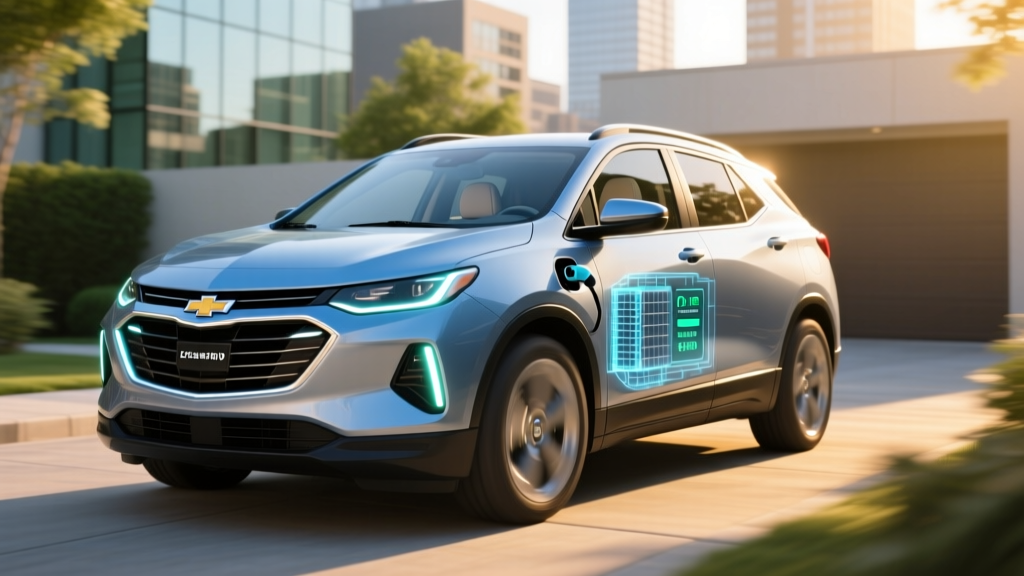
The 2026 Chevrolet Equinox EV AWD occupies a rare position in the electric vehicle market: a mainstream, all-wheel-drive electric crossover priced under $45,000 before incentives. Built on GM's Ultium platform and targeting families who want electric propulsion without the premium-badge tax, the Equinox EV AWD promises over 300 miles of EPA range, practical cargo space, and DC fast charging that keeps road trips viable. But how do those sticker numbers hold up when you factor in highway driving, winter temperatures, and the realities of the public charging network?
We've analyzed the official EPA data, GM's spec sheets, and real-world driving patterns to give you the numbers that actually matter when you're deciding whether this EV fits your life.
Range, Battery, and Real-World Efficiency
The 2026 Equinox EV AWD (available in LT and RS trims with the larger battery pack) carries an 85 kWh usable Ultium battery using NMC (nickel manganese cobalt) lithium-ion chemistry. GM's Ultium modules use a wireless battery management system that reduces wiring harness weight and simplifies module-level diagnostics.
Real-World Expectation: ~260–285 miles in mixed highway driving at 70+ mph; ~210–240 miles in sustained sub-freezing winter conditions (20°F or below). City and suburban driving with regenerative braking frequently matches or slightly exceeds the EPA sticker.
The EPA figure is achievable in moderate temperatures with a mix of city and suburban driving. Highway efficiency suffers at speeds above 70 mph due to the Equinox EV's upright crossover profile — aerodynamic drag is the biggest range killer at sustained speed. Cold weather compounds this: battery chemistry slows, cabin heating draws significant energy (the Equinox EV uses a resistance heater, not a heat pump, which matters in northern climates), and regenerative braking is limited until the pack warms up.
Efficiency is rated at approximately 97 MPGe combined, or about 34 kWh per 100 miles. That's competitive with the Hyundai Ioniq 5 AWD and slightly behind the Tesla Model Y Long Range AWD's ~122 MPGe, reflecting the Equinox's heavier curb weight and less aerodynamic shape.
| Spec | Value |
|---|---|
| EPA Range (AWD, large battery) | 319 miles |
| Battery Capacity (usable) | 85 kWh, NMC chemistry |
| Efficiency | 97 MPGe / ~34 kWh/100 mi |
| Drivetrain | Dual-motor AWD |
| Horsepower | 288 hp combined |
| 0–60 mph | ~6.2 seconds (est.) |
| Max DC Fast Charge | 150 kW (peak) |
| 10–80% DC Fast Charge | ~33 minutes |
| Level 2 Home Charging | 11.5 kW (~34 mi/hr) |
| Cargo Volume (rear seats up) | 26.4 cu ft |
| Cargo Volume (rear seats folded) | 57.2 cu ft |
| Rear Legroom | 38.7 inches |
| Battery Warranty | 8 years / 100,000 miles |
| Base MSRP (3LT AWD) | $43,900 |
Charging Speed: DC Fast, Level 2, and the Charge Curve
The Equinox EV AWD supports a peak DC fast-charge rate of 150 kW via its standard CCS1 connector (GM has committed to NACS adoption, and 2026 models include a NACS charge port or adapter depending on build date — verify with your dealer). At peak rate, GM estimates a 10–80% charge in approximately 33 minutes.
That peak rate is not sustained. Like all EVs, the Equinox follows a charge curve: you'll see 150 kW briefly in the 10–30% state-of-charge window, tapering to roughly 100–110 kW through the mid-range, and dropping sharply above 80% as the battery management system protects cell longevity. Plan your road-trip stops around the 10–80% window for the best time-to-miles ratio.
| Level | Power | Speed | Typical Use |
|---|---|---|---|
| Level 1 (120V) | ~1.4 kW | ~4 miles/hour | Emergency / overnight trickle |
| Level 2 (240V, 48A) | 11.5 kW | ~34 miles/hour | Home daily charging |
| DC Fast Charge | Up to 150 kW | 10–80% in ~33 min | Road trips, public stations |
For home charging, a Level 2 wallbox at 11.5 kW will replenish the full 85 kWh battery in roughly 8.5 hours — ideal for overnight charging on a 240V/50A circuit. If your home has a standard NEMA 14-50 outlet, expect slightly slower rates (~9.6 kW / ~28 mi/hr) due to the 80% continuous-load rule on a 40A breaker. Budget $500–$1,800 for professional Level 2 installation depending on panel capacity and run length — a licensed electrician should verify your panel has headroom before installation.
Performance and Drivetrain
The dual-motor AWD powertrain produces 288 horsepower and an estimated 326 lb-ft of torque, delivering a 0–60 mph time in the low 6-second range. That's brisk enough for confident highway merging and passing, though it's not positioned as a performance EV — the Tesla Model Y Long Range AWD is quicker at ~4.8 seconds.
Ride quality leans toward comfort over sportiness. The suspension absorbs road imperfections well, and the low center of gravity from the floor-mounted battery reduces body roll compared to the gas Equinox. Regenerative braking offers multiple levels adjustable through the infotainment system, including a one-pedal driving mode that can bring the vehicle to a complete stop without touching the brake pedal.
Towing capacity is limited to 1,500 pounds — adequate for a small utility trailer or bike rack, but not competitive with body-on-frame electric trucks. This is a family commuter, not a hauler.
Interior, Cargo, and Technology
The cabin is dominated by a 17.7-inch diagonal infotainment touchscreen running Google Built-In (Google Maps, Google Assistant, and Play Store apps natively). A separate 11-inch digital instrument cluster faces the driver. Wireless Apple CarPlay and Android Auto are standard. The interface is responsive, though the heavy reliance on touchscreen controls for climate and vehicle settings can distract while driving — physical knobs for volume and temperature would be welcome.
Passenger space is generous: 38.7 inches of rear legroom accommodates adults comfortably, and the flat floor (no transmission tunnel) makes the middle rear seat usable. Cargo volume at 26.4 cubic feet behind the second row is competitive with the segment, expanding to 57.2 cubic feet with the 60/40 split rear seats folded. There is no front trunk (frunk) — the space is occupied by power electronics.
Driver assistance comes via Chevy Super Cruise (available on higher trims) and the standard Chevy Safety Assist suite. Super Cruise is an SAE Level 2 hands-free system on mapped divided highways — it requires the driver to remain attentive and does not handle city streets, construction zones, or unmapped roads. The standard suite includes automatic emergency braking, lane-keep assist, following-distance indicator, and IntelliBeam auto high beams.
Pricing, Trims, and Federal Tax Credit Eligibility
The 2026 Equinox EV AWD is offered in three primary trims:
| Trim | MSRP | Est. After §30D Credit* |
|---|---|---|
| 3LT AWD | $43,900 | ~$36,400 |
| 2RS AWD | $45,300 | ~$37,800 |
| 3RS AWD | $47,100 | ~$39,600 |
*Tax credit estimates assume full $7,500 eligibility. Actual credit depends on your individual tax situation, vehicle battery-sourcing compliance, and income caps. Consult a tax professional.
The IRS §30D Clean Vehicle Credit offers up to $7,500 for qualifying new EVs, but eligibility is not automatic. Key requirements for 2026 include:
- MSRP Cap: SUVs/crossovers must be priced at or below $80,000 (all Equinox EV trims qualify)
- Buyer Income Cap: Modified adjusted gross income must not exceed $150,000 (single), $225,000 (head of household), or $300,000 (joint filers)
- Battery Component Sourcing: Battery components must be manufactured or assembled in North America (phasing percentages increase annually through 2029)
- Critical Minerals: A percentage of critical minerals must be sourced from the U.S. or FTA-partner countries
- Point-of-Sale Transfer: Eligible buyers can transfer the credit to the dealer at purchase, reducing the upfront price immediately rather than waiting for tax filing
GM has worked aggressively to localize Ultium battery production at its U.S. plants (Lansing, MI; Spring Hill, TN; Orion, MI), and the Equinox EV has historically qualified for the full or partial credit. However, sourcing rules tighten each year. Always verify current eligibility on the IRS qualifying vehicles list before purchase.
Warranty and Long-Term Ownership
Chevrolet backs the Equinox EV's battery pack with an 8-year / 100,000-mile warranty, covering defects and capacity loss below 70% of original capacity. The limited vehicle warranty covers 3 years / 36,000 miles, and the powertrain warranty extends to 5 years / 60,000 miles.
NMC batteries typically lose 5–10% capacity over the first 100,000 miles based on industry-wide degradation data from sources like fueleconomy.gov and long-term fleet studies. GM's Ultium wireless BMS is designed to optimize cell balancing, which should help slow degradation, but real-world 10-year data on Ultium packs is still maturing.
Maintenance costs are significantly lower than the gas Equinox — no oil changes, no spark plugs, no transmission fluid. Budget for cabin air filter replacement, brake fluid checks (regenerative braking reduces pad wear substantially), tire rotation, and windshield washer fluid. Insurance premiums for the Equinox EV tend to run 10–20% higher than the gas version due to higher repair costs after collision — get quotes before committing.
How It Stacks Up Against Competitors
The Equinox EV AWD competes directly with the Hyundai Ioniq 5 AWD, Kia EV6 AWD, Volkswagen ID.4 AWD, and Tesla Model Y Long Range. Here's how the numbers compare:
| Spec | Equinox EV AWD | Ioniq 5 AWD | Model Y LR AWD | ID.4 AWD |
|---|---|---|---|---|
| EPA Range | 319 mi | 290 mi | 311 mi | 291 mi |
| Battery (kWh) | 85 | 77.4 | ~75 | 82 |
| Peak DC kW | 150 | 240 | 250 | 175 |
| 10–80% Time | ~33 min | ~18 min | ~25 min | ~29 min |
| Horsepower | 288 | 320 | 384 | 295 |
| Base MSRP (AWD) | $43,900 | $50,200 | $47,990 | $46,790 |
The Equinox EV AWD wins on price and EPA range. It's the most affordable AWD electric crossover in this group and delivers the longest sticker range. Where it loses ground is DC fast-charging speed — the Ioniq 5's 800V architecture and the Model Y's Supercharger network access are meaningfully faster for road trips. If you road-trip frequently, 15 extra minutes per charge stop adds up over a 1,000-mile journey.
Look at the Ioniq 5 or Model Y instead if: You take frequent road trips and value the fastest possible DC charging, or you want access to the Tesla Supercharger network natively (though GM's NACS adoption is closing this gap).
Pros
- Lowest MSRP in the AWD electric crossover segment
- 319-mile EPA range is among the best in class
- Spacious rear seat and flat floor for passengers
- Google Built-In infotainment is responsive and feature-rich
- Super Cruise available for hands-free highway driving
- Qualifies for up to $7,500 federal tax credit (verify annually)
Cons
- 150 kW peak DC charging is slower than key rivals
- No heat pump — cold-weather range loss is significant
- No frunk for additional storage
- Touchscreen-heavy controls can distract while driving
- Towing limited to 1,500 lbs
- Insurance premiums higher than gas Equinox
Who Should Buy the Equinox EV AWD?
This EV is built for daily commuters and families who charge at home. If your routine involves 30–80 miles of round-trip commuting with access to Level 2 charging overnight, the Equinox EV AWD will rarely require a public charger. The AWD system adds confidence in rain and light snow, and the 319-mile range means you can stretch to every-other-day charging on shorter commutes.
It's less ideal for frequent road-trippers who prioritize the fastest possible charge stops, or cold-climate drivers in states like Minnesota or Maine where winter range loss could push real-world range below 220 miles on the coldest days. Those buyers should weigh the Ioniq 5 (faster charging) or consider a PHEV as a bridge solution.
For the price — especially after the federal tax credit — the Equinox EV AWD delivers more range and more cabin space than anything else in its price bracket. It's not the flashiest EV, but it may be the most practical one for the average American household.
Frequently Asked Questions
What is the real-world range of the Equinox EV AWD?
The EPA rates it at 319 miles. In real-world highway driving at 70+ mph, expect 260–285 miles. In sustained freezing temperatures, that can drop to 210–240 miles due to battery chemistry limitations and cabin heating energy draw.
How fast does the Equinox EV charge at home and on the road?
At home on a Level 2 (240V) charger, it adds about 34 miles per hour at 11.5 kW, filling the battery overnight in ~8.5 hours. On DC fast chargers, it peaks at 150 kW and charges from 10–80% in approximately 33 minutes.
How much does the Equinox EV AWD cost after the federal tax credit?
The 3LT AWD starts at $43,900. If you qualify for the full $7,500 §30D credit (subject to income caps and battery-sourcing rules), the effective price drops to approximately $36,400. Eligibility varies — check the IRS qualifying vehicle list and consult a tax professional.
Is the Equinox EV AWD worth buying over the Tesla Model Y or Hyundai Ioniq 5?
It depends on your priorities. The Equinox EV AWD is the most affordable option with the longest EPA range. The Ioniq 5 charges significantly faster on DC. The Model Y offers Supercharger network access and stronger performance. If price and daily range matter most, the Equinox wins. If road-trip charging speed matters most, look at the Ioniq 5.
Does the Equinox EV qualify for the $7,500 federal tax credit?
It has historically qualified for the full or partial credit under IRS §30D. However, battery-sourcing and critical-mineral requirements tighten annually. Always verify the current year's eligibility on the IRS qualifying clean vehicles page before purchasing.
Does the Equinox EV AWD have a heat pump?
No. The Equinox EV uses a resistance heater for cabin warmth. This consumes more battery energy in cold weather compared to a heat pump system, contributing to greater winter range loss than EVs equipped with heat pumps (like the Ioniq 5 or Model Y).
What is the battery warranty on the Equinox EV?
Chevrolet covers the battery for 8 years or 100,000 miles, whichever comes first. The warranty covers defects and capacity retention below 70% of original capacity.