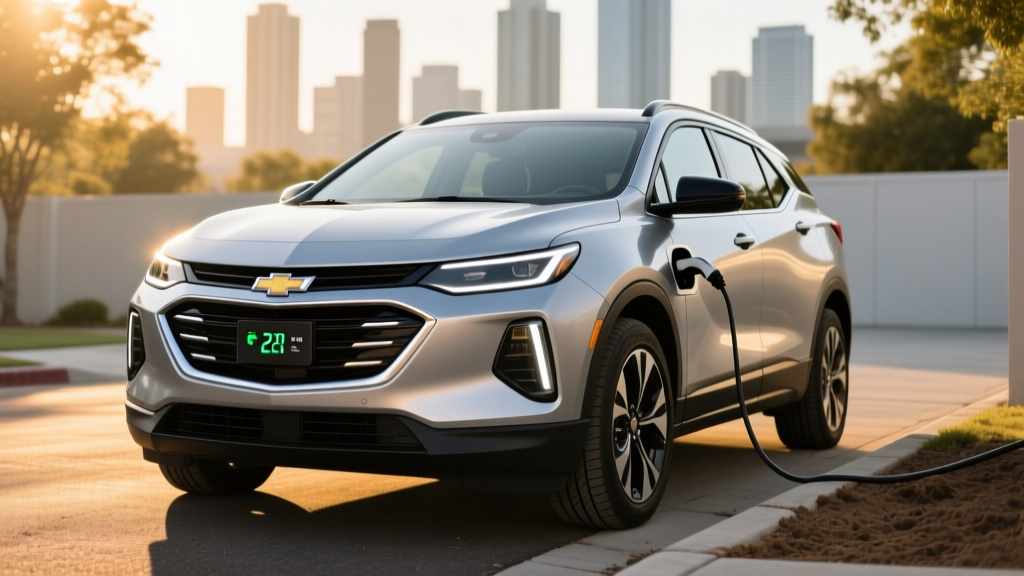
The Chevrolet Equinox EV has quickly become one of the most talked-about electric crossovers in the compact SUV segment, largely because it pairs an accessible starting price with a battery large enough to crack 300 miles of EPA-estimated range. But for buyers cross-shopping the Equinox EV against rivals like the Hyundai Ioniq 5, Ford Mustang Mach-E, or Tesla Model Y, straight-line performance and daily drivability matter just as much as sticker price. In this review, we put the Chevy Equinox EV 0-60 time under the microscope while covering everything else you need to know: real-world range, DC fast-charging behavior, home charging logistics, interior space, and whether it qualifies for the federal EV tax credit under current IRS §30D rules.
Chevy Equinox EV at a Glance: Core Specs
Before we get into the driving impressions and ownership math, here is a consolidated spec sheet for the 2025–2026 Chevy Equinox EV lineup. Specs vary by trim and drivetrain, so we have broken them out where they diverge.
| Spec | LT / RS (FWD) | RS Launch / AWD |
|---|---|---|
| EPA Range | Up to 319 mi (LT 2LT) | 285 mi (AWD RS Launch) |
| Battery (usable) | ~85 kWh, NMC | ~85 kWh, NMC |
| Horsepower | 213 hp | 288 hp (dual-motor) |
| Torque | 236 lb-ft | 333 lb-ft |
| 0-60 mph | ~8.4 sec | ~7.6 sec |
| Drivetrain | FWD (single motor) | AWD (dual motor) |
| Max DC Fast Charge | 150 kW | 150 kW |
| 10-80% DCFC Time | ~35 min | ~35 min |
| Level 2 Home Charge | 11.5 kW (~34 mi/hr) | 11.5 kW (~34 mi/hr) |
| MPGe (combined) | ~106 MPGe | ~95 MPGe |
| Cargo (rear seats up) | 26.4 cu ft | 26.4 cu ft |
| Cargo (seats folded) | 57.2 cu ft | 57.2 cu ft |
| Base MSRP | ~$33,600 (LT 2LT) | ~$43,400 (RS Launch) |
| Battery Warranty | 8 yr / 100,000 mi | 8 yr / 100,000 mi |
The Chevy Equinox EV 0-60 Story: Quick Enough, Not a Hot Hatch
If you arrived here searching for chevy equinox ev 0 60 times, the short answer is that the Equinox EV is not trying to win drag races. The front-wheel-drive LT and RS trims put down 213 horsepower and 236 lb-ft of torque from a single front-mounted motor, yielding a 0-60 mph time in the 8.4-second range. That puts it on par with a well-equipped Toyota RAV4 Hybrid and comfortably ahead of most gas-powered compact crossovers in the same price bracket, but it trails the dual-motor variants of the Ioniq 5 and Model Y by a noticeable margin.
Step up to the dual-motor AWD RS Launch Edition and you get 288 hp and 333 lb-ft of torque, dropping the 0-60 sprint to approximately 7.6 seconds. The extra torque is immediately evident in highway merging and passing maneuvers, and the dual-motor setup provides meaningful traction benefits in snow and rain. However, the AWD system costs you roughly 34 miles of EPA range and adds to the purchase price.
What matters more in daily driving than the 0-60 number is the instant throttle response that all EVs deliver. Around town, the Equinox EV feels punchier than its 0-60 time suggests because electric torque is available from zero RPM — there is no transmission downshift delay. The single-pedal driving mode with aggressive regenerative braking also makes stop-and-go traffic effortless once you adjust to it.
Real-World Range: What the EPA Sticker Does Not Tell You
EPA estimate: Up to 319 miles (LT 2LT FWD) / 285 miles (RS Launch AWD)
Real-world highway (70 mph, 72°F): Expect ~250–275 miles (FWD), ~225–250 miles (AWD)
Cold-weather (below 32°F, mixed driving): Expect 20–30% reduction — roughly 200–240 miles (FWD)
Key factors: The Equinox EV lacks a standard heat pump on all trims, which can increase cabin-heating energy draw in cold climates. Highway driving at 75+ mph and aggressive acceleration will also pull range below the EPA sticker.
The Equinox EV's ~85 kWh (usable) Ultium battery pack uses NMC (nickel manganese cobalt) chemistry, which offers higher energy density than LFP cells but follows the typical NMC charging recommendation: daily charging to 80–90% for longevity, with 100% reserved for road trips. According to fueleconomy.gov, the LT 2LT FWD achieves up to 319 miles EPA — a class-leading figure at this price point. The combined efficiency rating sits around 106 MPGe, which translates to roughly 32–34 kWh per 100 miles depending on conditions.
In real-world mixed driving, most owners report landing in the 270–290 mile range during mild weather. Highway-heavy trips at sustained speeds above 70 mph push consumption higher — aerodynamic drag is the enemy of EV efficiency, and the Equinox EV's crossover profile is less slippery than a sedan. If you live in a cold climate where temperatures regularly drop below freezing, budget for a meaningful range reduction and plan charging stops accordingly on longer trips.
Charging Speed: DC Fast Charging and Home Level 2
Charging speed is where the Equinox EV shows one of its more notable limitations compared to rivals. The maximum DC fast-charge rate is 150 kW, which means a 10–80% session takes approximately 35 minutes under ideal conditions at a capable charger. That is adequate for road-trip comfort — you will grab a coffee and a snack and be back on the road — but it trails the Hyundai Ioniq 5's 800-volt architecture (240 kW peak, ~18 min 10–80%) and the Tesla Model Y's ~250 kW peak on V3 Superchargers.
The charge curve matters as much as the peak number. The Equinox EV holds near its peak rate through roughly 40–50% state of charge before tapering, and charging slows considerably past 80% as the battery management system protects cell longevity. On a road trip, plan your stops around the 10–80% window to minimize time plugged in.
| Level | Power | Connector | Speed / Time |
|---|---|---|---|
| Level 1 (120V) | ~1.4 kW | J1772 / NACS | ~4 mi/hr (full charge: 60+ hrs) |
| Level 2 (240V home) | 11.5 kW | J1772 / NACS | ~34 mi/hr (full charge: ~9.5 hrs) |
| DC Fast Charge | Up to 150 kW | CCS / NACS | 10–80% in ~35 min |
At home on a Level 2 charger (240V, 48-amp circuit), the Equinox EV accepts up to 11.5 kW, adding roughly 34 miles of range per hour. A full overnight charge from near-empty to 100% takes about 9.5 hours — perfectly suited to a morning-ready full battery if you plug in when you get home. Most daily commuters driving 30–50 miles round-trip will only need to top up for 1–2 hours each evening.
GM has adopted the NACS (Tesla-style) connector for new Equinox EV models, granting access to Tesla Supercharger stations with an adapter or natively on newer vehicles. This dramatically expands the public fast-charging network available to Equinox EV owners compared to the CCS-only era. Check your specific model year and build for the exact port configuration, as transition-year vehicles may ship with CCS and include a NACS adapter.
Pricing, Trims, and Federal Tax Credit Eligibility
The Equinox EV's pricing is its strongest competitive weapon. The base LT 2LT starts around $33,600 before destination, making it one of the most affordable 300+ mile EVs on the market. Higher trims — the sportier RS and the fully loaded RS Launch Edition with AWD — climb to the $43,000–$46,000 range, which is still competitive with similarly equipped rivals.
| Trim | Base MSRP | Est. After §30D Credit* | Eligible? |
|---|---|---|---|
| LT 2LT (FWD) | ~$33,600 | ~$26,100 | Yes (if sourcing/income rules met) |
| RS (FWD) | ~$38,600 | ~$31,100 | Yes (if sourcing/income rules met) |
| RS Launch (AWD) | ~$43,400 | ~$35,900 | Yes (if sourcing/income rules met) |
*Federal tax credit estimates assume full $7,500 under IRS §30D. Actual eligibility depends on buyer income caps, vehicle MSRP caps, battery component and critical mineral sourcing requirements, and point-of-sale transfer rules. Always verify current eligibility on irs.gov or with a tax professional before purchasing.
The Equinox EV qualifies for the §30D federal clean vehicle credit (up to $7,500) for eligible buyers, subject to several important conditions:
- MSRP cap: The vehicle must be priced at or below $80,000 for SUVs — all Equinox EV trims clear this easily.
- Buyer income caps: Modified adjusted gross income must not exceed $150,000 (single), $225,000 (head of household), or $300,000 (joint filers).
- Battery sourcing: Required percentages of battery components and critical minerals must be manufactured or assembled in North America or free-trade-agreement countries. GM has been working to secure compliant supply chains, but verify the specific VIN's eligibility at the point of sale.
- Point-of-sale transfer: Eligible buyers can transfer the credit to the dealer at purchase, reducing the out-of-pocket price immediately rather than waiting for a tax refund.
Interior, Cargo Space, and Technology
Inside, the Equinox EV is dominated by a massive 17.7-inch diagonal infotainment touchscreen that runs Google Built-In (on higher trims), providing native access to Google Maps, Google Assistant, and the Play Store. A 11-inch digital driver display sits behind the steering wheel. The interface is responsive and modern, though some users report that the sheer screen size creates glare in direct sunlight — an anti-glare screen protector or strategic sunshade use helps.
Passenger space is generous for the compact crossover segment. Rear-seat legroom measures approximately 38.0 inches, comfortably fitting adults on longer trips. Cargo volume behind the rear seats is 26.4 cubic feet, expanding to 57.2 cubic feet with the 60/40 split rear seats folded flat. There is no front trunk (frunk) — the space under the hood houses power electronics and the HVAC system, which is a missed opportunity compared to the Ioniq 5 and F-150 Lightning.
On the driver-assistance front, the Equinox EV comes with Chevy Safety Assist as standard, including automatic emergency braking, forward collision alert, lane keep assist, following distance indicator, and IntelliBeam auto high beams. Available Super Cruise (GM's hands-free highway driving system) is offered on select trims and represents an SAE Level 2 system — it handles steering, acceleration, and braking on pre-mapped divided highways, but the driver must remain attentive and the system monitors engagement via a driver-facing camera. Super Cruise is one of the most capable Level 2 systems available, but it is not autonomous driving.
Super Cruise and Chevy Safety Assist are SAE Level 2 driver-assistance systems. The driver must remain engaged, hands on or near the wheel (or eyes monitored for Super Cruise), and ready to take over at any moment. These systems do not handle construction zones, unmapped roads, severe weather, or unpredictable traffic scenarios. You are always the responsible driver.
Pros and Cons: The Honest Scorecard
Pros
- Class-leading EPA range (319 mi) at an accessible price point
- Spacious rear seat and competitive cargo volume
- Standard 11.5 kW Level 2 onboard charger
- NACS connector access opens Tesla Supercharger network
- Available Super Cruise hands-free highway driving
- Federal §30D tax credit eligible (verify VIN/income)
- Smooth, quiet ride quality for the segment
Cons
- 150 kW DC fast-charge peak trails Ioniq 5, Model Y
- No front trunk (frunk) for extra storage
- FWD 0-60 of ~8.4 sec is adequate but not exciting
- No standard heat pump on all trims (cold-weather range hit)
- 17.7-inch screen can produce glare in bright sunlight
- AWD availability limited to higher-priced trims
- Some interior materials feel budget-tier at the RS price
How It Stacks Up Against Key Competitors
The Equinox EV occupies a specific lane: maximum range per dollar in a practical crossover package. Here is how it compares to the rivals you are probably cross-shopping.
| Spec | Chevy Equinox EV (FWD) | Hyundai Ioniq 5 (RWD) | Tesla Model Y (LR) | Ford Mustang Mach-E (ER RWD) |
|---|---|---|---|---|
| EPA Range | 319 mi | 303 mi | 310 mi | 320 mi |
| 0-60 mph | ~8.4 sec | ~7.0 sec | ~5.0 sec | ~6.1 sec |
| DCFC Peak | 150 kW | 240 kW | ~250 kW | ~150 kW |
| 10-80% Time | ~35 min | ~18 min | ~22 min | ~38 min |
| Base MSRP | ~$33,600 | ~$42,600 | ~$44,990 | ~$42,995 |
| Frunk | No | Yes (0.85 cu ft) | Yes (4.1 cu ft) | Yes (4.7 cu ft) |
The Equinox EV wins decisively on price and ties or wins on EPA range. Where it loses ground is in charging speed — the Ioniq 5's 800V architecture nearly halves your road-trip charging stops, and the Model Y's Supercharger integration remains the gold standard for seamless long-distance travel. If road trips are a regular part of your life, the charging speed gap is worth factoring into your decision.
Decision Framework
Choose the Equinox EV if: You prioritize the lowest cost per mile of EPA range, mostly drive locally or on moderate-length commutes, want access to Superchargers via NACS, and don't road-trip more than a few times per year.
Look at the Ioniq 5 or Model Y if: You take frequent road trips and want faster DC charging, you value a frunk for extra cargo flexibility, or you want a more performance-oriented driving experience.
Consider the Mach-E if: You prefer a sportier driving feel and don't mind similar charging speeds to the Equinox EV at a higher price point.
Warranty and Long-Term Battery Confidence
Chevrolet backs the Equinox EV's battery pack and electric powertrain with an 8-year / 100,000-mile limited warranty, which is the industry standard for EV battery coverage. The warranty covers defects and excessive capacity loss — GM typically defines the threshold at around 60–70% of original capacity before a warranty claim is triggered, though you should confirm the exact retention percentage in your purchase documents.
NMC batteries in the Ultium platform have shown promising early degradation data, with most GM EV owners reporting less than 5% capacity loss in the first two years of ownership. Following best practices — avoiding frequent 100% charges, minimizing DC fast-charging when Level 2 is available, and preconditioning the battery before fast-charging in cold weather — will help maximize long-term state of health. According to Chevrolet's official Equinox EV page, the Ultium platform was engineered with thermal management to mitigate degradation across diverse climates.
Frequently Asked Questions
What is the real-world range of the Chevy Equinox EV?
The EPA rates the FWD LT 2LT at up to 319 miles, but in real-world highway driving at 70+ mph, expect 250–275 miles. In cold weather below freezing, plan for 200–240 miles. The AWD RS Launch Edition is rated at 285 miles EPA and delivers roughly 225–250 miles in real-world conditions.
How fast does the Equinox EV charge at home and on the road?
On a Level 2 home charger (240V, 48A), the Equinox EV charges at up to 11.5 kW, adding about 34 miles of range per hour — a full charge takes roughly 9.5 hours. On a DC fast charger, it peaks at 150 kW, reaching 10–80% in approximately 35 minutes under ideal conditions.
Does the Chevy Equinox EV qualify for the $7,500 federal tax credit?
The Equinox EV is eligible for the §30D federal clean vehicle credit (up to $7,500) for buyers who meet income caps ($150K single / $300K joint) and whose vehicle meets battery component and critical mineral sourcing requirements. The credit can be transferred at the point of sale. Always verify eligibility for your specific VIN on irs.gov before finalizing a purchase.
Is the Equinox EV worth buying over the Tesla Model Y or Ioniq 5?
It depends on your priorities. The Equinox EV offers the best range-per-dollar in the segment and a spacious interior, making it ideal for budget-conscious commuters and families. The Model Y and Ioniq 5 charge faster on road trips, offer frunk storage, and deliver stronger performance — but at a significantly higher price. If price and range are your top factors, the Equinox EV is the segment leader.
What is the Chevy Equinox EV's 0-60 time?
The front-wheel-drive Equinox EV reaches 0-60 mph in approximately 8.4 seconds with 213 hp. The dual-motor AWD RS Launch Edition does it in about 7.6 seconds with 288 hp. Both figures are adequate for daily driving and highway merging, though neither qualifies as performance-oriented.
Does the Equinox EV have a heat pump for cold weather?
Heat pump availability varies by trim and model year on the Equinox EV. Without a heat pump, cabin heating draws more energy from the battery in cold weather, contributing to the 20–30% range reduction typical of EVs in freezing temperatures. Check the specific trim's equipment list if cold-weather efficiency is a priority for you.