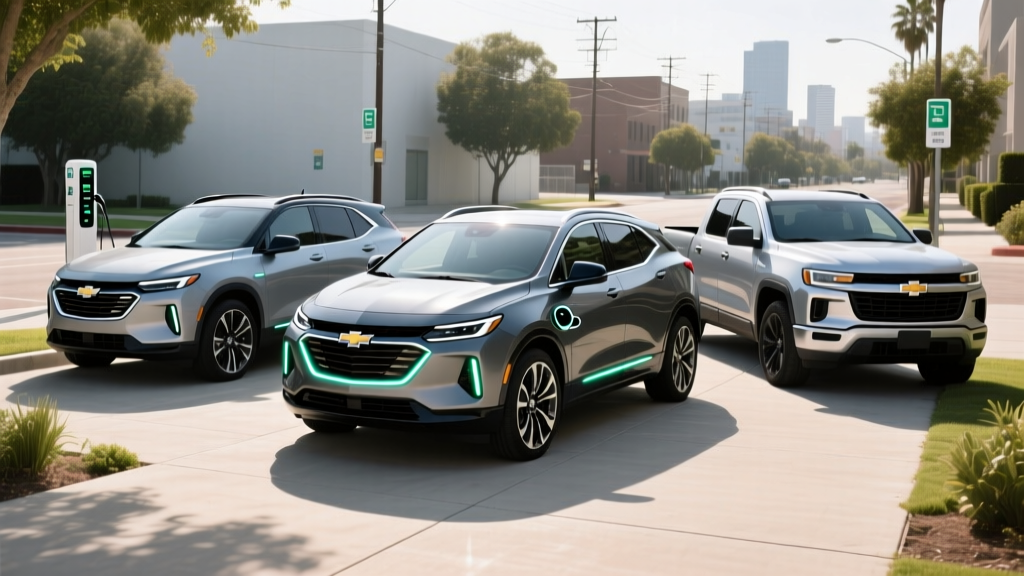
If you're researching Chevy electric cars in 2026, General Motors now offers three distinct battery-electric models built on its Ultium platform: the compact Equinox EV (starting around $33,600, up to 319 miles EPA), the midsize Blazer EV (from ~$44,600, up to 324 miles EPA), and the full-size Silverado EV (from ~$57,900, up to 440 miles EPA). All three use GM's NMC-based Ultium battery architecture, support DC fast charging up to 190 kW (Equinox) or 200 kW (Blazer/Silverado), and come with an 8-year/100,000-mile battery warranty. The Equinox EV qualifies for the full $7,500 federal tax credit under current IRS §30D rules for many buyers, while Blazer and Silverado eligibility depends on trim, sourcing, and your income. Below, we break down real-world range, charging reality, total ownership costs, and a decision framework to help you choose.
Quick Answer: Which Chevy EV Is Right for You?
Equinox EV — Best value for commuters and small families; lowest price, strong range, full tax-credit eligibility on qualifying trims.
Blazer EV — Best for buyers wanting a sportier, roomier crossover with AWD options and faster charging.
Silverado EV — Best for truck buyers needing towing (up to 10,000 lbs), a large bed, and maximum range — at a premium price.
2026 Chevy EV Lineup: Spec Comparison
| Spec | Equinox EV | Blazer EV | Silverado EV |
|---|---|---|---|
| Body Style | Compact SUV | Midsize SUV | Full-Size Pickup |
| EPA Range (max) | 319 mi (LT FWD) | 324 mi (RS RWD) | 440 mi (4WT) |
| Battery (usable) | 85 kWh (NMC) | 102 kWh (NMC) | 200 kWh (NMC) |
| Peak DC Fast Charge | 190 kW | 200 kW | 200 kW |
| 10–80% DCFC Time | ~30 min | ~28 min | ~42 min |
| Level 2 Rate (kW) | 11.5 kW | 11.5 kW | 19.2 kW (optional) |
| Horsepower | 213 hp (FWD) | Up to 557 hp (SS AWD) | Up to 754 hp (4WT) |
| 0–60 mph | ~7.7 sec | ~4.0 sec (SS) | ~4.5 sec (4WT) |
| Cargo Volume | 26.4 cu ft (rear seats up) | 43.8 cu ft (rear seats up) | 60.1 cu ft (bed + frunk) |
| Towing Capacity | 1,500 lbs | 3,500 lbs | 10,000 lbs |
| Base MSRP | $33,600 | $44,600 | $57,900 |
| Battery Warranty | 8 yr / 100,000 mi | 8 yr / 100,000 mi | 8 yr / 100,000 mi |
Sources: fueleconomy.gov, Chevrolet EV lineup. Specs reflect 2026 model year where published; confirm with your dealer for trim-specific figures.
Real-World Range vs. EPA Stickers
EPA vs. Reality: What to Expect
Equinox EV 3LT (319 mi EPA): Expect 260–285 miles in mixed real-world driving. Highway-only trips at 75 mph drop this to ~235–255 miles. In sub-freezing weather (below 30°F), plan for 200–230 miles due to battery heating demand and cabin climate draw.
Blazer EV RS (324 mi EPA): Real-world mixed driving yields ~265–290 miles. Highway cruising nets ~240–265 miles. Cold weather reduces this to ~210–240 miles.
Silverado EV 4WT (440 mi EPA): The massive 200 kWh pack delivers ~370–400 miles unloaded in mixed driving. However, towing a 7,000-lb trailer can cut range to 180–220 miles — physics doesn't negotiate.
All three Ultium-based Chevy EVs use a liquid-cooled thermal management system with a heat pump (standard on Equinox and Blazer, available on Silverado), which helps preserve range in cold weather compared to resistive heating. Still, any EV loses 15–30% of range in sustained sub-freezing temperatures — this is chemistry, not a defect. Preconditioning the battery while plugged in before departure recovers some of this loss by warming the pack using grid power rather than battery energy.
Charging Speeds and the Charge Curve Reality
| Charging Level | Power (kW) | Miles Added per Hour | Best For |
|---|---|---|---|
| Level 1 (120V household) | 1.2–1.4 kW | 3–5 mi/hr | Overnight top-offs, emergencies |
| Level 2 (240V home/public) | 7.7–19.2 kW | 25–65 mi/hr | Daily home charging, destination charging |
| DC Fast Charging | 50–200 kW | 150–600+ mi/hr (peak) | Road trips, quick stops |
Here's what GM's published peak DC fast-charge rates actually mean in practice. The Equinox EV's 190 kW peak only holds between roughly 10–35% state of charge (SoC). From 35–60%, it tapers to ~130–150 kW, and from 60–80%, it drops further to ~75–90 kW. That's why the 10–80% time is ~30 minutes rather than the ~18 minutes you'd calculate if peak rate were sustained. The Blazer EV and Silverado EV show similar curves — the Silverado's 200 kWh pack means even at 200 kW peak, filling from 10–80% takes ~42 minutes because there's simply more energy to push.
kW vs. kWh reminder: kW (kilowatts) measures the rate of energy flow — like water pressure from a hose. kWh (kilowatt-hours) measures total energy stored — like the size of the bucket. A 200 kW charger fills a 200 kWh battery faster than an 85 kWh one, but the bigger battery still takes longer to fill completely.
For home charging, the Equinox and Blazer accept up to 11.5 kW on Level 2, meaning a full charge from empty takes about 7.5–9 hours. The Silverado EV can accept 19.2 kW on Level 2 (with the optional dual-level charger), cutting a full charge to roughly 10 hours for the 200 kWh pack — still overnight, but plan accordingly.
Cost of Ownership: Chevy EV vs. Gas Equivalent
| Cost Factor (5-Year) | Equinox EV LT ($33,600) | Equinox Gas (1.5T, ~$28,000) |
|---|---|---|
| Purchase Price (after $7,500 credit) | ~$26,100 | $28,000 |
| Fuel / Electricity (60,000 mi) | ~$2,700 (home charging at $0.14/kWh) | ~$7,500 (28 MPG avg at $3.50/gal) |
| Maintenance | ~$1,200 (tire rotations, cabin filter, fluid checks) | ~$3,800 (oil changes, filters, brake pads, spark plugs) |
| Insurance (avg) | ~$8,400 ($1,680/yr) | ~$7,200 ($1,440/yr) |
| Estimated Depreciation | ~$11,500 | ~$12,000 |
| Total 5-Year Cost | ~$49,900 | ~$58,500 |
The Equinox EV with the federal tax credit undercuts its gas counterpart on total cost of ownership by roughly $8,600 over five years, driven primarily by fuel and maintenance savings. However, note the insurance premium — EVs typically cost 15–25% more to insure due to higher repair costs and parts pricing. And if you don't qualify for the full $7,500 credit (income caps, MSRP caps, or battery-sourcing rules may reduce it), the math shifts. Always run your own numbers using your local electricity rate, annual mileage, and insurance quotes.
The Blazer EV and Silverado EV face a tougher cost case. The Blazer SS (~$54,000+) competes against well-equipped gas midsize SUVs, where fuel savings are meaningful but the upfront premium is steep. The Silverado EV's $57,900+ starting price places it against the Silverado 1500 gas truck (~$38,000 base), and while the EV saves on fuel and maintenance, the $20,000+ price gap takes years to close — making the Silverado EV a purchase driven more by capability and experience than pure economics.
Federal Tax Credit Eligibility: What You Need to Know
IRS §30D Credit Requirements (2026)
- Income caps: Modified AGI must not exceed $150,000 (single), $225,000 (head of household), or $300,000 (married filing jointly).
- MSRP caps: SUVs and pickups must have an MSRP at or below $80,000. All current Chevy EV trims fall under this cap.
- Battery sourcing: The credit splits into two halves — $3,750 for critical-minerals sourcing and $3,750 for battery-component assembly. Sourcing rules tighten annually; verify current-year compliance on the specific VIN with your dealer.
- Point-of-sale transfer: You can transfer the credit to the dealer at purchase to reduce your out-of-pocket cost immediately, rather than waiting to claim it on your tax return.
- FEOC restriction: Vehicles with battery components from a "foreign entity of concern" (primarily China-linked suppliers) may be disqualified — GM has been reshoring its supply chain, but always confirm.
The Equinox EV has been one of the most reliably credit-eligible Chevy models due to its US/Canada battery-cell production at GM's Ultium Cells plants. The Blazer EV (built in Ramos Arizpe, Mexico) and Silverado EV (Factory ZERO, Detroit) have varying credit amounts depending on the specific battery pack sourcing for each model year. Always check the official DOE/FuelEconomy.gov EV tax credit page for the current VIN-specific eligibility before signing paperwork. Tax rules change — consult a tax professional for your situation.
Common Misconceptions About Chevy EVs
| Myth | Fact |
|---|---|
| "The battery will need replacing in 5 years and cost $20,000." | GM's Ultium batteries carry an 8-year/100,000-mile warranty against dropping below 70% capacity. Real-world NMC degradation data shows most packs retain 85–92% capacity at 100,000 miles. Replacement is rare and covered if premature. |
| "You can't road-trip an EV — charging takes too long." | The Equinox EV charges 10–80% in ~30 minutes at a DC fast charger. On a 600-mile trip, that's two 30-minute stops — roughly what you'd spend on food and rest breaks anyway. The Tesla Supercharger network is now open to Chevy EVs via NACS adapter, dramatically expanding fast-charger access. |
| "EVs don't work in cold climates." | Cold weather reduces range 15–30%, but preconditioning (warming the car while plugged in) mitigates this. Owners in Minnesota and Maine drive Chevy EVs year-round. You just need to plan for shorter range between charges in winter. |
| "Charging at home requires a $10,000 electrical upgrade." | Most homes with a 200-amp panel can add a 40-amp Level 2 circuit for $800–$2,000 (electrician, permit, and hardware). Older homes with 100-amp panels may need a $2,000–$4,000 panel upgrade. A licensed electrician should assess your specific situation. |
| "The Ultium platform had recall problems — these cars aren't reliable." | Early 2024 Blazer EVs did face a stop-sale and software-related recall. GM addressed these with over-the-air updates and production fixes. The 2025 and 2026 model years have shown improved initial quality. Check NHTSA recall records for any open recalls on a specific VIN. |
Real-World Ownership: What First-Time Buyers Should Know
Home charging is the foundation. If you can install a Level 2 charger at home, daily EV ownership is effortless — you wake up every morning with a full "tank." Level 1 (standard 120V outlet) adds only 3–5 miles per hour and is viable only if you drive under 40 miles daily and can leave the car plugged in for 12+ hours overnight. Public-only charging is doable but adds friction: you'll spend 30–45 minutes at DC fast chargers 2–3 times per week depending on your mileage.
The Supercharger network changes everything. GM adopted the NACS (North American Charging Standard) port for the 2025+ Equinox EV and Blazer EV, and the Silverado EV ships with NACS. This means direct access to Tesla's Supercharger network — over 25,000 stalls in North America — without an adapter. If you're buying a 2024 model with a CCS port, GM provides a NACS adapter. This single factor dramatically reduces road-trip anxiety and is arguably the biggest practical advantage of buying a 2025+ Chevy EV.
Maintenance is genuinely minimal. No oil changes, no spark plugs, no transmission fluid (the single-speed reduction gear is sealed). Brake pads last far longer because regenerative braking handles most deceleration. Your primary recurring costs are tire rotations (EVs are heavier and wear tires faster — budget for replacement every 30,000–40,000 miles), cabin air filter, and windshield washer fluid.
Driving patterns matter more than range numbers. If 90% of your driving is under 60 miles round-trip with home charging, even the base Equinox EV's real-world range is more than sufficient. Range anxiety mostly applies to frequent road-trippers, apartment dwellers without charging access, and those in extreme cold climates without a garage.
Decision Framework: Which Chevy EV Should You Buy?
Choose the Equinox EV if:
- Your budget is $30,000–$40,000 and you want the best value-per-mile EV in Chevy's lineup.
- You commute under 80 miles daily and can charge at home.
- You want full or near-full $7,500 federal tax credit eligibility.
- You don't need to tow more than 1,500 lbs or haul large cargo.
Choose the Blazer EV if:
- You want a roomier midsize crossover with available AWD and a sportier driving experience.
- You need more cargo space (43.8 cu ft) and rear-seat legroom for family use.
- You value the SS performance variant (557 hp, ~4.0 sec 0–60) or want a more premium interior.
- You're willing to pay $44,000–$56,000 and may receive a partial tax credit depending on trim.
Choose the Silverado EV if:
- You need a full-size truck with serious towing (10,000 lbs) and a usable bed + frunk.
- Maximum range (440 mi EPA) is critical for your use case, such as long rural commutes.
- You want V2L (vehicle-to-load) capability to power tools or appliances from the truck's battery.
- You can absorb the $58,000+ starting price and higher insurance costs, treating the EV premium as a long-term investment.
Consider a Chevy PHEV or hybrid instead if:
- You can't install a home charger and public charging infrastructure in your area is sparse.
- You regularly tow heavy loads over long distances (towing crushes EV range).
- Your budget is under $30,000 and you need a new vehicle — the Chevy Equinox gas or a hybrid model may fit better.
Frequently Asked Questions
Does the Chevy Equinox EV qualify for the $7,500 federal tax credit?
Most Equinox EV trims have qualified for the full $7,500 credit under recent IRS rules, thanks to US-sourced Ultium battery cells. However, eligibility depends on your income (capped at $150K single / $300K joint), the specific battery-sourcing compliance for the model year, and the vehicle's MSRP (must be ≤$80,000 for SUVs). Always verify on fueleconomy.gov and confirm with your dealer before purchase.
How long does it take to charge a Chevy EV at home?
On a Level 2 (240V) home charger at 11.5 kW, the Equinox EV (85 kWh) charges from empty to full in about 7.5 hours — easily overnight. The Blazer EV (102 kWh) takes about 9 hours. The Silverado EV (200 kWh) at 19.2 kW takes roughly 10 hours. In practice, you rarely charge from empty; a typical daily top-off from 40% to 80% takes 3–4 hours.
Can I use Tesla Superchargers with a Chevy EV?
Yes. 2025 and newer Chevy EVs (Equinox, Blazer, Silverado) come with a native NACS charge port, which plugs directly into Tesla Supercharger stalls. 2024 models with CCS ports can use Superchargers with a GM-provided NACS adapter. Use the Tesla app or GM's myChevrolet app to locate and activate Supercharger sessions.
What happens if the Ultium battery degrades significantly?
GM warrants the battery for 8 years or 100,000 miles against capacity loss below 70%. If your battery drops below that threshold within the warranty period, GM will repair or replace it at no cost. Independent data from Recurrent and other battery-health trackers shows that liquid-cooled NMC packs like Ultium typically retain 85–92% capacity at 100,000 miles with normal use — well above the warranty floor.
Is the Chevy Blazer EV reliable after the 2024 recall issues?
GM addressed the early Blazer EV software issues through over-the-air updates and production-line fixes for the 2025 and 2026 model years. The stop-sale was lifted in mid-2024. Current owner satisfaction surveys and JD Power initial quality data for the 2025 model year show improvement. As with any vehicle, check NHTSA.gov for open recalls on any specific VIN before purchasing.
How does a Chevy EV compare to a hybrid for my commute?
If you have home charging and a commute under 60 miles, a Chevy EV like the Equinox EV will cost roughly $0.04–$0.06 per mile in electricity versus $0.12–$0.15 per mile in gas for a comparable hybrid. Over 15,000 miles/year, that's $900–$1,350 in annual fuel savings. However, if you can't charge at home or regularly drive 300+ miles between stops, a PHEV like the (now-discontinued) Chevy Volt's spiritual successor — or a Toyota RAV4 Hybrid — may be a more practical bridge.