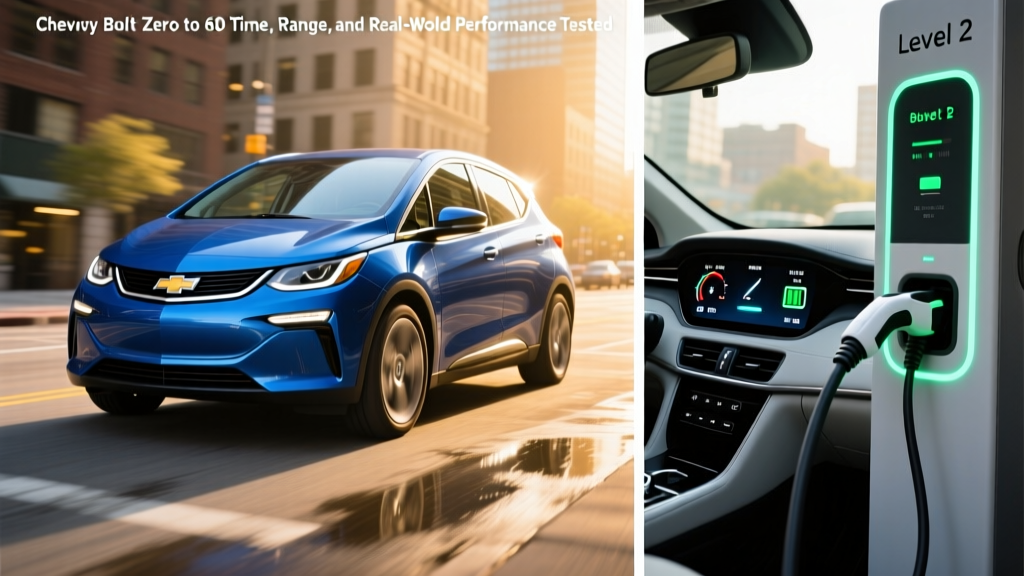
The Chevrolet Bolt EV and Bolt EUV have earned their reputation as the most affordable long-range electric vehicles on the US market. But affordability only matters if the car performs where it counts. Buyers searching for the Chevy Bolt zero to 60 time want to know whether this compact EV can merge onto a freeway with confidence, not just park cheaply in a garage. In this review, we break down the Bolt's acceleration, real-world range, charging behavior, and total ownership cost with the precision you need before signing a purchase agreement.
Range Reality Check
EPA Estimated: 259 miles (Bolt EV) / 247 miles (Bolt EUV)
Real-World Expectation: 220–240 miles in mixed driving; 180–200 miles sustained highway at 70+ mph; 150–170 miles in sub-freezing winter conditions.
Chevy Bolt Zero to 60 and Performance Numbers
The Bolt's single front-mounted permanent-magnet electric motor produces 200 horsepower and 266 lb-ft of torque. Because electric motors deliver peak torque from 0 RPM, the Bolt pulls away from stoplights with a responsiveness that belies its 3,500-pound curb weight.
The Chevy Bolt zero to 60 mph time is 6.5 seconds for the standard Bolt EV hatchback. The slightly longer and heavier Bolt EUV (Electric Utility Vehicle) clocks in at approximately 6.8 seconds. These numbers place the Bolt ahead of most compact gasoline crossovers in the 0–30 mph sprint, though it trails sportier EVs like the Hyundai Ioniq 5 (5.0 seconds RWD) and Tesla Model 3 RWD (5.8 seconds).
| Spec | Bolt EV | Bolt EUV |
|---|---|---|
| 0–60 mph | 6.5 sec | 6.8 sec |
| Horsepower | 200 hp | 200 hp |
| Torque | 266 lb-ft | 266 lb-ft |
| Drivetrain | FWD (single motor) | FWD (single motor) |
| Top Speed | ~93 mph (governed) | ~93 mph (governed) |
| Battery (usable) | 65 kWh (NMC) | 65 kWh (NMC) |
| EPA Range | 259 mi | 247 mi |
| EPA Combined MPGe | 120 MPGe | 115 MPGe |
| Efficiency | 28 kWh/100 mi | 29 kWh/100 mi |
In practice, the Bolt's FWD layout and narrow all-season tires mean torque steer is noticeable under hard acceleration from a stop. Traction control intervenes aggressively on wet pavement. This is a commuter-car powertrain tuned for efficiency and daily usability, not track performance — and at this price point, that's the right trade-off.
Real-World Range vs. EPA Estimates
The Bolt's 65 kWh (usable) lithium-ion battery pack uses NMC (nickel manganese cobalt) chemistry, supplied primarily by LG Energy Solution at the Hazel Run, Michigan joint-venture plant. NMC offers higher energy density than LFP (lithium iron phosphate), which is how GM packages 259 miles of range into a compact hatchback footprint.
The EPA combined rating of 120 MPGe (28 kWh per 100 miles) is achievable in moderate-temperature city and suburban driving, where regenerative braking recaptures energy at every stop. In our experience and consistent with fueleconomy.gov data, owners report:
- City/suburban (55°F–80°F): 250–270 miles achievable
- Highway (70 mph, moderate temps): 215–235 miles — aerodynamic drag is the Bolt's efficiency enemy
- Winter (below 32°F, cabin heat active): 155–185 miles — expect a 25–35% range penalty
- Extreme cold (below 10°F): As low as 140–155 miles without preconditioning
The Bolt uses a resistance heater rather than a heat pump for cabin warming. This is one of its few outdated engineering decisions, and it's the single biggest factor in cold-weather range loss. Preconditioning the battery and cabin while plugged in at home mitigates some of this penalty.
Charging Speed: DC Fast Charge and Home Level 2
Charging speed is the Bolt's most debated spec. The current-generation Bolt uses a CCS1 connector and is limited to a peak DC fast-charge rate of approximately 55 kW. In a market where competitors like the Hyundai Ioniq 5 peak at 240 kW and the Tesla Model 3 at 170 kW, the Bolt's fast-charging capability falls well behind.
| Charging Level | Power / Rate | Time / Miles Added |
|---|---|---|
| Level 1 (120V, 12A) | ~1.4 kW | ~4 miles per hour |
| Level 2 (240V, 32A) | 7.7 kW | ~25 miles per hour; full charge in ~9.5 hours |
| Level 2 (240V, 48A) | 11.5 kW | ~39 miles per hour; full charge in ~7 hours |
| DC Fast Charge (CCS) | 55 kW peak | 10–80% in ~55 minutes; ~100 mi in 30 min |
The 55 kW peak charge rate means the Bolt is best suited for home-centric charging routines. If you can install a Level 2 charger at home and your daily driving stays under 100 miles, you'll rarely need public fast charging. On road trips, plan for longer stops — the 10–80% charge takes roughly 55 minutes, compared to 18–25 minutes in faster-charging competitors.
The charge curve stays relatively flat between 10% and 50% SoC, then tapers progressively above 70%. GM's thermal management system keeps the pack within safe operating temperatures, but the conservative charge-rate limit is a deliberate engineering choice to protect long-term battery health.
GM has confirmed that the next-generation Bolt (announced, expected late 2025/2026 model year) will adopt the NACS (Tesla-style) connector and is expected to support significantly faster DC charging. If fast-charging speed is a priority, it may be worth waiting for the next-gen model.
Pricing, Trims, and Federal Tax Credit Eligibility
The Bolt's strongest selling point remains its price. After GM's aggressive 2024 price cut, the Bolt occupies a nearly uncontested position below $30,000.
| Trim | MSRP | Est. After §30D Credit* |
|---|---|---|
| Bolt EV 1LT | ~$26,500 | ~$19,000 |
| Bolt EV 2LT | ~$28,900 | ~$21,400 |
| Bolt EUV LT | ~$28,800 | ~$21,300 |
| Bolt EUV Premier | ~$32,400 | ~$24,900 |
*Federal tax credit estimates assume full eligibility. Actual credit depends on IRS §30D requirements.
The Bolt historically qualifies for the federal clean vehicle credit under IRS §30D, but eligibility is not automatic. Key requirements include:
- MSRP cap: Vehicle MSRP must not exceed $55,000 (sedans/hatchbacks) — the Bolt clears this easily
- Buyer income cap: Modified AGI must not exceed $150,000 (single) / $300,000 (married filing jointly)
- Battery sourcing: Critical minerals and battery components must meet phased percentage thresholds from US or FTA-partner countries — verify current-year compliance on the IRS qualified vehicles list
- Point-of-sale transfer: Eligible buyers can transfer the credit to the dealer at purchase, reducing the out-of-pocket price immediately
Battery sourcing requirements tighten annually. Always verify the Bolt's current eligibility on fueleconomy.gov or the IRS qualified vehicles list before committing to a purchase, as component sourcing can shift mid-model-year.
Interior, Cargo, and Daily Livability
The Bolt EV hatchback offers 16.3 cubic feet of cargo space behind the rear seats and 57.0 cubic feet with the rear seats folded. The Bolt EUV, built on a stretched wheelbase, provides 16.3 cubic feet cargo and 56.9 cubic feet max, but with notably more rear legroom — 39.1 inches in the EUV vs. 35.9 inches in the EV. If you regularly carry adult rear-seat passengers, the EUV's extra four inches of legroom is the more comfortable choice.
Front-seat space is generous for a subcompact: 42.1 inches of legroom and 39.7 inches of headroom. The seats are manually adjusted on lower trims; the Premier trim adds heated front seats and a heated steering wheel.
The infotainment system centers on a 10.2-inch touchscreen running Chevrolet Infotainment 3, with wireless Apple CarPlay and Android Auto. A 10.2-inch digital driver display replaces traditional gauges. The interface is responsive and straightforward, though it lacks the visual polish of Hyundai's or Tesla's systems. Built-in navigation is available on upper trims, but most buyers will rely on phone projection.
Driver-Assist Technology and Safety
SAE Automation Level: Level 2
Chevrolet's driver-assist suite is a Level 2 system — it provides steering and speed assistance but requires continuous driver supervision. Hands must remain on the wheel, and eyes must remain on the road. This is not autonomous or self-driving capability.
The Bolt comes standard with Chevy Safety Assist, which bundles:
- Automatic emergency braking with pedestrian detection
- Forward collision alert
- Lane keep assist with lane departure warning
- Following distance indicator
- IntelliBeam automatic high beams
Available upgrades on 2LT and Premier trims include adaptive cruise control, HD surround vision camera, and rear cross-traffic alert. Notably, GM's more advanced Super Cruise (hands-free highway driving on mapped roads) is not available on the Bolt — it's reserved for higher-priced GM models like the Cadillac Lyriq and Chevrolet Silverado EV.
The Bolt earned strong safety ratings, including a 5-Star Overall rating from NHTSA. The IIHS has evaluated the Bolt in prior model years; check for updated ratings on the current generation.
Battery Warranty and Long-Term Ownership
GM backs the Bolt's battery pack with an 8-year / 100,000-mile warranty (whichever comes first), guaranteeing the pack will retain at least 60% of its original capacity during that period. The broader powertrain warranty also covers 5 years / 60,000 miles, and the bumper-to-bumper limited warranty covers 3 years / 36,000 miles.
NMC battery degradation in the Bolt has proven moderate in real-world fleet data. Owners report approximately 5–8% capacity loss over the first 100,000 miles under normal use patterns. The Bolt's liquid-cooled thermal management system helps mitigate degradation, though the conservative 55 kW charge limit also plays a role in preserving pack health.
If the battery does require out-of-warranty replacement, current estimates place a full Bolt battery pack replacement at $14,000–$18,000 including labor — a significant cost, though one that most owners will never face within the vehicle's typical lifespan.
Pros, Cons, and the Verdict
Pros
- Lowest MSRP in the 250+ mile EV segment
- Strong federal tax credit eligibility (verify sourcing annually)
- Peppy 6.5-second 0–60 with instant electric torque
- Practical hatchback cargo space (57 cu ft max)
- Proven battery durability with 8-yr/100k-mi warranty
- Wireless Apple CarPlay/Android Auto standard
Cons
- Slow DC fast charging (55 kW peak; ~55 min 10–80%)
- CCS1 connector (NACS adapter or next-gen needed for Supercharger access)
- No heat pump — significant winter range loss
- FWD only; no AWD option for snow-belt buyers
- No Super Cruise availability
- Rear seat tight in standard Bolt EV (EUV recommended for families)
Who Should Buy the Chevy Bolt?
Choose the Bolt EV if: You want the cheapest new long-range EV available, you charge primarily at home, your daily commute is under 80 miles, and road trips are occasional.
Choose the Bolt EUV if: You need rear-seat legroom for kids or car seats, you want a slightly more SUV-like ride height, and the $2,000–$3,000 price premium fits your budget.
Look elsewhere if: You take frequent road trips and need fast DC charging, you need AWD for harsh winters, or you want hands-free highway driving (Super Cruise).
Chevy Bolt vs. Key Competitors
At the Bolt's price point, direct competition is sparse but growing:
- Hyundai Ioniq 5 (RWD Standard Range): Starts around $42,000, 220-mile range, but charges at up to 240 kW and offers a vastly more modern interior. The Ioniq 5 is a segment above in price and capability.
- Tesla Model 3 RWD: Starts around $39,000, ~272-mile range, 170 kW charging, and full Supercharger network access. Faster, more tech-forward, but ~$12,000 more expensive.
- Nissan LEAF (SV Plus): ~212-mile range, CHAdeMO connector (a declining standard), and a lower starting price, but less range and older platform.
None of these match the Bolt's combination of sub-$27,000 MSRP and 259-mile range. The Bolt wins on pure value; it concedes on charging speed and platform modernity.
Frequently Asked Questions
What is the Chevy Bolt zero to 60 time?
The Chevrolet Bolt EV accelerates from 0 to 60 mph in 6.5 seconds. The larger Bolt EUV does it in approximately 6.8 seconds. Both use a single 200-hp front motor with 266 lb-ft of instant torque.
What is the real-world range of the Chevy Bolt?
The EPA rates the Bolt EV at 259 miles and the EUV at 247 miles. In real-world mixed driving at moderate temperatures, expect 220–240 miles. Sustained highway driving reduces this to roughly 215–235 miles, and sub-freezing winter conditions can drop range to 155–185 miles due to the resistance-based cabin heater.
How fast does the Chevy Bolt charge?
On a DC fast charger, the Bolt peaks at approximately 55 kW, taking about 55 minutes to charge from 10% to 80%. On a home Level 2 charger (240V, 48A), it charges at up to 11.5 kW, adding about 39 miles per hour and reaching a full charge in roughly 7 hours.
Does the Chevy Bolt qualify for the federal EV tax credit?
The Bolt has historically qualified for up to $7,500 under IRS §30D, but eligibility depends on current-year battery-sourcing and critical-mineral requirements, buyer income caps ($150K single / $300K joint), and the vehicle's MSRP staying under $55,000. Always verify on the IRS qualified vehicles list before purchasing. The credit can be transferred to the dealer at point of sale.
Is the Chevy Bolt worth buying in 2026?
If your priority is the lowest possible entry price into a 250+ mile EV and you charge at home, the Bolt remains one of the best values in the market. Its main weakness is slow DC fast charging, which makes it less ideal for frequent road trippers. The upcoming next-generation Bolt with NACS and faster charging may be worth waiting for if your timeline is flexible.
Does the Bolt have a heat pump?
No. The Bolt uses a resistance-based electric heater for cabin warmth. This draws significantly more energy from the battery in cold weather compared to a heat pump system, contributing to the Bolt's pronounced winter range loss.
Can the Chevy Bolt use Tesla Superchargers?
The current-generation Bolt uses a CCS1 connector. GM has begun providing NACS adapters for CCS-equipped vehicles, which may enable access to Tesla's V2 Superchargers (with CCS support) — but this varies by adapter availability and Supercharger generation. The next-generation Bolt is expected to ship with a native NACS port.