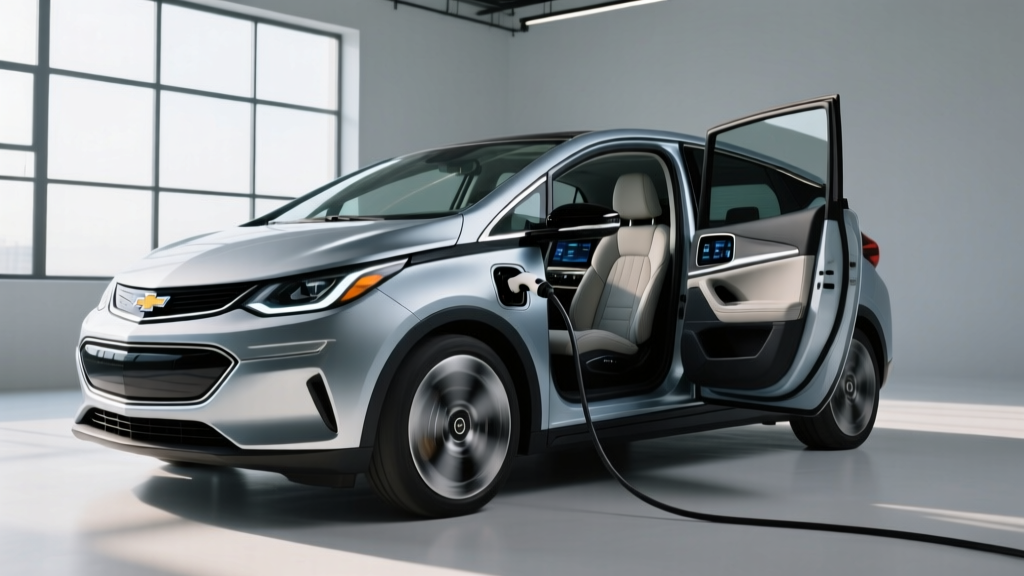
The Chevrolet Bolt EV and Bolt EUV return for 2026 with a formula that remains one of the most compelling in the sub-$30,000 electric vehicle segment: practical dimensions, competitive range, and access to the growing Tesla Supercharger network via NACS adapter. But for buyers researching Chevy Bolt size, cargo capacity, and whether this compact EV fits their daily life, the spec sheet only tells half the story. This review pairs official EPA data with real-world ownership realities — from charging-curve behavior to cold-weather range loss — so you can decide if the Bolt earns a spot in your driveway.
Quick Verdict: Who the Chevy Bolt Fits Best
The 2026 Chevy Bolt is a subcompact electric hatchback (Bolt EV) and a slightly stretched subcompact crossover (Bolt EUV). It targets urban commuters, apartment dwellers with Level 2 access, and small families who need under-300-mile road trips rather than cross-country hauling. Its strongest selling points are its low starting price, strong city efficiency, and manageable footprint for tight parking. Its weakest link remains DC fast-charging speed, which trails rivals like the Hyundai Kona Electric and Nissan Leaf by a noticeable margin on longer highway runs.
Choose the Chevy Bolt EV if: You want the lowest entry price in a new EV, primarily drive under 60 miles daily, and can charge at home overnight.
Choose the Bolt EUV if: You need rear-seat legroom for adults or teens and prefer a slightly higher ride height, but still want sub-$35,000 pricing.
Look elsewhere if: You take frequent 400+ mile road trips and need 150+ kW DC fast-charging speeds, or you need all-wheel drive for snow-belt winters.
Chevy Bolt Size and Dimensions: EV vs EUV Compared
The keyword on many buyers' minds — Chevy Bolt size — matters because this model straddles the line between subcompact hatchback and small crossover. Here is exactly what you're working with in terms of exterior footprint and interior volume.
| Dimension | 2026 Bolt EV | 2026 Bolt EUV |
|---|---|---|
| Overall Length | 163.2 in | 169.5 in |
| Wheelbase | 102.4 in | 105.1 in |
| Width (no mirrors) | 69.5 in | 69.7 in |
| Height | 62.8 in | 63.6 in |
| Front Legroom | 42.1 in | 40.9 in |
| Rear Legroom | 35.6 in | 39.1 in |
| Cargo (rear seats up) | 16.6 cu ft | 16.3 cu ft |
| Cargo (rear seats folded) | 57.0 cu ft | 56.9 cu ft |
| Curb Weight | ~3,560 lbs | ~3,680 lbs |
Real-world size takeaway: The Bolt EV's 163-inch length makes it one of the shortest EVs on the market — shorter than a Honda HR-V and far easier to parallel park than a Tesla Model Y. The EUV's 6.3-inch wheelbase stretch translates almost entirely into rear legroom, making it viable for two adults on longer drives. Cargo volume is nearly identical between the two; the EUV sacrifices a fraction of a cubic foot to its rear-seat gains. Neither offers a frunk — the front space houses power electronics.
Range, Battery, and Efficiency: The Numbers That Matter
| Spec | Bolt EV | Bolt EUV |
|---|---|---|
| Battery Capacity (usable) | 65 kWh | 65 kWh |
| Battery Chemistry | NMC (Nickel Manganese Cobalt) | NMC |
| EPA Range | 259 mi | 247 mi |
| EPA Efficiency | 120 MPGe (28 kWh/100mi) | 115 MPGe (29 kWh/100mi) |
| Motor Output | 200 hp / 266 lb-ft | 200 hp / 266 lb-ft |
| 0–60 mph | ~6.5 sec | ~6.8 sec |
| Drivetrain | FWD (single motor) | FWD (single motor) |
Real-World Range Reality Check:
EPA Sticker: 259 miles (Bolt EV) / 247 miles (Bolt EUV)
Expect in mixed driving (spring/fall): ~240–255 miles — the Bolt's efficiency shines in city and suburban regenerative-braking-heavy routes.
Expect at sustained 75 mph highway: ~200–220 miles. The Bolt's upright hatchback shape creates more drag than sleeker rivals.
Expect in freezing weather (20°F or below): ~170–195 miles. NMC chemistry combined with resistive cabin heating (no heat pump on base trims) causes a 25–35% range reduction in deep cold. Preconditioning while plugged in mitigates this partially.
Source: EPA Fuel Economy
MPGe explained: MPGe (miles per gallon equivalent) converts electrical energy into the energy equivalent of one gallon of gasoline (33.7 kWh). The Bolt EV's 120 MPGe combined means it travels about 4 miles per kWh of battery energy — competitive with the Hyundai Kona Electric (129 MPGe) but trailing the Tesla Model 3 RWD (~132 MPGe). In practical terms, a full 65 kWh charge will cost roughly $8–$12 at the national average residential electricity rate of ~$0.15/kWh.
Charging Speed: Home Level 2 and DC Fast Charging
Charging is where the Bolt's value proposition meets its biggest limitation. Understanding the difference between kW (power — how fast energy flows) and kWh (energy — how much the battery holds) is critical here.
| Charging Level | Power (kW) | Speed | Notes |
|---|---|---|---|
| Level 1 (120V household) | ~1.4 kW | ~4 mi/hr | Full charge in ~48 hours. Emergency/trickle only. |
| Level 2 (240V home) | 11.5 kW (max onboard) | ~37 mi/hr | Full charge in ~7 hours. Requires 48A circuit (60A breaker). |
| DC Fast Charge | 55 kW peak | 10–80% in ~45 min | CCS or NACS (with adapter). Tapers significantly above 80%. |
The DC fast-charging limitation, explained: At 55 kW peak, the Bolt's charging speed is the weakest link in an otherwise strong package. To put this in context, a Hyundai Kona Electric peaks at ~100 kW (10–80% in ~25 minutes), and a Tesla Model 3 peaks at 170+ kW (10–80% in ~18 minutes). On a 300-mile road trip, you'll spend roughly 45–50 minutes at each charging stop in the Bolt versus 20–25 minutes in a faster-charging competitor.
Charge curve reality: The Bolt holds near its 55 kW peak from roughly 10–55% State of Charge (SoC), then tapers to ~38 kW through 80%, and drops further to ~15 kW between 80–100%. This means charging from 80–100% can take nearly as long as 10–80%. For road trips, plan to charge to 80% and move on — it's far more time-efficient.
NACS adapter and Supercharger access: GM has completed its transition to the North American Charging Standard (NACS). New 2026 Bolts ship with a NACS port. Owners of older CCS-equipped Bolts can use a GM-approved NACS adapter to access Tesla Supercharger V2 stations (which max out around 150 kW, but the Bolt will still draw only its 55 kW max). This dramatically expands the Bolt's usable road-trip network compared to the pre-2024 era. Source: Chevrolet EV Charging
Performance and Driving Dynamics
The Bolt's single front-mounted permanent-magnet motor produces 200 horsepower and 266 lb-ft of torque. That torque is available instantly from 0 RPM — a hallmark of electric drivetrains — giving the Bolt a punchy, confident feel in city driving that belies its modest 0–60 mph time of roughly 6.5 seconds.
What it does well: Regenerative braking with one-pedal driving mode is among the best-calibrated in the segment. Lift off the accelerator and the Bolt slows decisively to a complete stop, recapturing energy efficiently. In city traffic, you'll rarely touch the brake pedal.
Where it falls short: The front-wheel-drive layout means torque steer under hard acceleration, and the all-season tires prioritize efficiency over grip. There is no AWD option — a dealbreaker for some snow-belt buyers. Highway ride quality is acceptable but firm, with noticeable road noise above 65 mph.
Pricing, Trims, and Federal Tax Credit Eligibility
| Trim | MSRP | Est. After §30D Credit* |
|---|---|---|
| Bolt EV 1LT | $27,895 | ~$20,395 |
| Bolt EV 2LT | $30,895 | ~$23,395 |
| Bolt EUV 1LT | $29,495 | ~$21,995 |
| Bolt EUV Premier | $34,795 | ~$27,295 |
*Prices shown include destination. Federal §30D credit of up to $7,500 is available at point-of-sale as a direct price reduction, but eligibility depends on multiple factors below. State/local incentives may stack on top — check your jurisdiction's official energy office.
2026 Federal §30D EV Tax Credit — Eligibility Checklist:
- MSRP Cap: Vehicle MSRP must be ≤ $55,000 for sedans/hatchbacks (all Bolt trims qualify).
- Buyer Income Cap: Adjusted gross income must not exceed $150,000 (single), $225,000 (head of household), or $300,000 (married filing jointly).
- Battery Sourcing: A percentage of critical minerals and battery components must be sourced from the US or free-trade-agreement countries. GM has worked to qualify the Bolt's Ultium-based battery — verify current-year status on IRS.gov before purchase.
- Point-of-Sale Transfer: You can transfer the credit to the dealer at purchase, reducing your out-of-pocket cost immediately — you don't need to wait for tax filing.
- Final Assembly: Vehicle must undergo final assembly in North America (Bolt is assembled in Orion Township, MI — qualifies).
Always confirm eligibility with a tax professional and the IRS's official VIN-lookup tool before signing a purchase agreement.
Tech, Safety, and Driver-Assistance Features
Every 2026 Bolt comes with an 11-inch diagonal infotainment touchscreen running Google Built-In (Google Maps, Google Assistant, Play Store). Wireless Apple CarPlay and Android Auto are standard. The driver sees a configurable 8-inch digital instrument cluster.
Chevy Safety Assist (standard on all trims) includes:
- Automatic Emergency Braking with pedestrian detection
- Forward Collision Alert
- Lane Keep Assist with Lane Departure Warning
- Following Distance Indicator
- Intellibeam automatic high beams
- Rear Vision Camera with rear cross-traffic alert (2LT/Premier)
What it does NOT have: The Bolt does not offer a hands-free driving system like GM's Super Cruise. Adaptive cruise control is available on 2LT and Premier trims, but it is a conventional SAE Level 2 system — meaning you must keep your hands on the wheel and eyes on the road at all times. There is no "self-driving" capability here.
SAE Automation Level: Level 2
The Bolt's driver-assistance features (adaptive cruise, lane centering) are SAE Level 2 — the system assists with steering and speed, but the driver must remain fully engaged and supervising at all times. This is not autonomous driving. Only Level 4 services (Waymo, Zoox) operate without a human driver in defined service areas.
Warranty and Long-Term Ownership
| Coverage | Term |
|---|---|
| Bumper-to-Bumper | 3 years / 36,000 miles |
| Powertrain | 5 years / 60,000 miles |
| Battery Pack | 8 years / 100,000 miles (retains ≥60% capacity) |
| Roadside Assistance | 5 years / 60,000 miles |
Battery longevity context: GM warrants the Bolt's NMC battery to retain at least 60% of original capacity over 8 years/100,000 miles. In practice, NMC packs with active liquid thermal management — as the Bolt uses — have shown degradation curves of roughly 8–12% over the first 100,000 miles based on fleet data from earlier-generation Bolts. That means you'd likely see 230+ miles of range at 100K miles from an originally 259-mile pack. Avoid routinely charging to 100% and storing the car at full charge in extreme heat to maximize longevity.
Out-of-warranty battery replacement cost: If the pack fails outside the warranty window, replacement currently runs $14,000–$16,000 including labor at a Chevy dealer. This is a significant sum relative to the vehicle's value and is worth factoring into long-term ownership planning beyond year eight.
How the Chevy Bolt Stacks Up Against Key Competitors
| Spec | 2026 Bolt EV | 2026 Kona Electric | 2026 Tesla Model 3 RWD |
|---|---|---|---|
| Base MSRP | $27,895 | $33,995 | $39,990 |
| EPA Range | 259 mi | 261 mi | 341 mi |
| DC Fast Charge (peak kW) | 55 kW | 100 kW | 170 kW |
| 10–80% DC Time | ~45 min | ~25 min | ~18 min |
| 0–60 mph | 6.5 sec | 6.4 sec | 5.8 sec |
| Cargo (rear up) | 16.6 cu ft | 25.8 cu ft | 23.0 cu ft |
| Drivetrain | FWD | FWD | RWD |
Competitive analysis: The Bolt's price advantage is enormous — roughly $6,000 less than the Kona Electric and $12,000 less than a Model 3 RWD before credits. If your daily commute is under 60 miles and you charge at home, the Bolt's slower DC charging is irrelevant for daily life. However, if road trips are frequent, the Model 3's 341-mile range and 170 kW charging make a compelling case for the premium. The Kona Electric splits the difference: significantly more cargo room and faster charging than the Bolt, at a mid-range price.
Pros, Cons, and Final Recommendation
✅ Pros
- Lowest new-EV starting price in the US market (~$28K)
- Strong city efficiency (120 MPGe combined)
- Compact size ideal for urban parking
- NACS port / Supercharger adapter access
- One-pedal driving is intuitive and well-calibrated
- Google Built-In infotainment is responsive
- Federal §30D credit eligible across all trims
❌ Cons
- 55 kW DC fast-charging is slowest in its class
- No AWD option
- No heat pump on base trims (cold-weather range hit)
- Cargo space trails Kona Electric and Model 3
- No frunk (front trunk) for additional storage
- Out-of-warranty battery replacement cost is high relative to vehicle value
- Adaptive cruise not available on base 1LT trim
Bottom line: The 2026 Chevy Bolt remains the value king of new EVs. If your driving profile is 80%+ city and suburban commuting with home charging access, the Bolt's 259-mile range, compact Chevy Bolt size, and sub-$21,000 effective price after the federal credit are nearly impossible to beat. Its slow DC charging is a genuine tradeoff — but one that only matters if you regularly drive beyond a single charge in a day.
Frequently Asked Questions
What is the real-world range of the Chevy Bolt EV?
The EPA rates the 2026 Bolt EV at 259 miles. In real-world mixed driving during mild weather, expect 240–255 miles. Sustained highway driving at 75 mph drops this to roughly 200–220 miles, and freezing temperatures can reduce range to 170–195 miles due to battery chemistry limitations and resistive cabin heating.
How fast does the Chevy Bolt charge at home and on DC fast chargers?
At home on a Level 2 (240V) charger, the Bolt accepts up to 11.5 kW, adding roughly 37 miles of range per hour — a full charge takes about 7 hours. On DC fast chargers, it peaks at 55 kW, taking approximately 45 minutes from 10–80%. This is significantly slower than rivals like the Kona Electric (~25 min) or Tesla Model 3 (~18 min).
How much does the Chevy Bolt cost after federal tax credits?
The base Bolt EV 1LT starts at $27,895 MSRP. If you qualify for the full $7,500 federal §30D credit (transferred at point of sale), the effective price drops to approximately $20,395. Eligibility requires meeting income caps ($150K single / $300K married), MSRP limits (all Bolts qualify), and battery-sourcing requirements. Confirm on IRS.gov before purchasing.
Does the Chevy Bolt qualify for the federal EV tax credit in 2026?
Yes — as of current 2026 rules, the Bolt is assembled in Michigan (final assembly requirement met), its MSRP is well under the $55,000 cap, and GM has worked to meet critical-mineral and battery-component sourcing thresholds. However, your personal income must fall under the §30D caps, and sourcing rules can change. Always verify with the IRS VIN-lookup tool at time of purchase.
Is the Chevy Bolt worth buying vs the Hyundai Kona Electric or Tesla Model 3?
It depends on your use case. The Bolt wins on price by $6,000–$12,000 and is ideal for budget-conscious commuters who charge at home. The Kona Electric offers nearly double the cargo space (25.8 cu ft) and twice the DC charging speed for ~$6,000 more. The Model 3 delivers 82 more miles of range and dramatically faster charging for ~$12,000 more. If road trips are rare, the Bolt's value is unmatched.
What are the biggest pros and cons of the Chevy Bolt?
The biggest pro is price-to-range value: no other new EV offers 259 miles of EPA range for under $21,000 after the federal credit. The biggest con is 55 kW DC fast-charging speed, which makes road trips meaningfully slower than in competing EVs. Secondary concerns include no AWD option and cold-weather range loss without a standard heat pump.
Does the Chevy Bolt have enough room for a family?
For a family of two adults and one or two small children, the Bolt EV works well. The EUV's extra 3.5 inches of rear legroom (39.1 in vs 35.6 in) makes it more comfortable for older kids or a rear-facing car seat. Cargo space (16.6 cu ft behind rear seats, 57 cu ft folded) handles groceries and strollers but is tight for large luggage runs. Families needing three-across seating or 300+ mile road trips should look at larger EVs.
Sources: EPA Fuel Economy – Chevrolet Bolt, Chevrolet Electric Vehicles, IRS New Clean Vehicle Credit, NHTSA