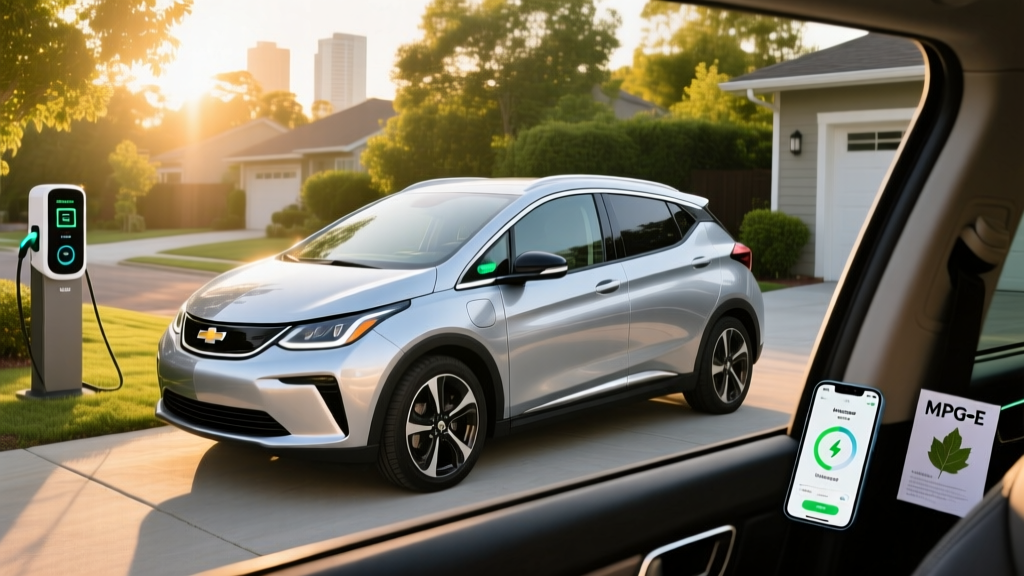
If you've been searching for Chevy Bolt miles per gallon, you're asking the right question with slightly wrong terminology. The 2026 Chevrolet Bolt EV doesn't burn a drop of gasoline, so it doesn't have an MPG rating. Instead, the EPA measures its efficiency in MPGe (miles per gallon equivalent) — a metric that converts electrical energy into the energy equivalent of one gallon of gasoline (33.7 kWh). For the 2026 Bolt EV, that number is a standout 120 MPGe combined, making it one of the most efficient electric vehicles you can buy.
But efficiency is only part of the ownership equation. The 2026 Bolt EV returns with the Ultium-based platform introduced for the refreshed generation, offering improved DC fast-charging speeds, a larger battery, and continued eligibility for the full federal tax credit. Here's everything you need to know about its range, charging, cost, and whether it still earns its reputation as the best-value EV on the market.
2026 Chevy Bolt EV: Quick Verdict
The 2026 Chevrolet Bolt EV remains the value king of the EV segment. Starting at $28,795 (before destination) for the 2LT trim, and dropping to roughly $21,295 after the $7,500 federal tax credit applied at the point of sale, it undercuts every competitor while delivering competitive range, peppy acceleration, and a practical hatchback form factor. Its biggest weakness — relatively slow DC fast charging compared to 800V rivals — matters mostly for frequent road-trippers. For daily commuters, urban drivers, and cost-conscious EV buyers, the Bolt EV is still the benchmark.
| Spec | Value |
|---|---|
| EPA Range | 259 miles |
| Battery (usable) | 65 kWh (NMC, Ultium platform) |
| Efficiency | 120 MPGe combined / 28 kWh/100 mi |
| Motor Output | 200 hp / 236 lb-ft torque |
| Drivetrain | Front-wheel drive (single motor) |
| 0–60 mph | ~6.5 seconds |
| Max DC Fast Charge | 115 kW (CCS/NACS adapter) |
| 10–80% DC Fast Charge | ~30 minutes |
| Level 2 Home Charge Rate | 11.5 kW (~41 mi/hr) |
| Base MSRP (2LT) | $28,795 |
| Battery Warranty | 8 years / 100,000 miles |
Efficiency Deep Dive: Chevy Bolt MPGe Explained
The EPA rates the 2026 Bolt EV at 120 MPGe combined, broken down as 125 MPGe city and 114 MPGe highway, according to fueleconomy.gov. To put that in perspective, one gallon of gasoline contains roughly 33.7 kWh of energy. The Bolt uses about 28 kWh per 100 miles of combined driving — meaning you're getting roughly 120 miles for the energy equivalent of one gallon.
Why does city MPGe beat highway? Regenerative braking recaptures kinetic energy in stop-and-go driving, and electric motors don't idle-waste energy like combustion engines. On the highway, aerodynamic drag dominates, and the Bolt's hatchback profile isn't as slippery as a Tesla Model 3 or Hyundai Ioniq 6 sedan.
What this means for your wallet: At the U.S. average residential electricity rate of ~$0.17/kWh (as of early 2026), driving 100 miles in the Bolt costs roughly $4.76. A comparable 30 MPG gas car at $3.30/gallon would cost $11.00 for the same distance. That's a 57% fuel-cost reduction, and the gap widens further if you charge on cheaper off-peak utility rates or have home solar.
Real-World Range vs. EPA Sticker
Real-World Expectations:
• Mild weather, mixed driving: ~240–255 miles
• Sustained 75 mph highway: ~215–230 miles
• Cold weather (below 30°F): ~175–200 miles
• Cold + highway combined: ~165–185 miles
The EPA's 259-mile figure is achievable in favorable conditions — moderate temperatures, city-heavy routes, speeds under 65 mph. But real-world range depends heavily on speed, temperature, and driving style.
Highway driving is the Bolt's efficiency weak point. At sustained 75 mph, expect range to drop to roughly 215–230 miles. The Bolt's relatively upright hatchback shape creates more aerodynamic drag than sleek sedans, and there's no heat pump standard on all trims to claw back cold-weather losses (the 2026 model includes a standard heat pump, improving over the outgoing generation).
Cold weather remains the great equalizer for all EVs. In sub-30°F conditions, lithium-ion batteries lose efficiency, cabin heating draws significant power, and regenerative braking is limited until the pack warms. Expect 175–200 miles in typical winter commuting, and as low as 165 miles on a cold highway road trip. Preconditioning the battery while plugged in — a feature accessible through the myChevrolet app — mitigates some of this loss.
For context, a 259-mile EPA range with real-world highway reduction still comfortably covers most Americans' daily driving needs. The average U.S. driver travels roughly 37 miles per day, meaning most Bolt owners will charge at home every 4–6 days.
Charging Speed: DC Fast and Home Level 2
The 2026 Bolt EV's most discussed spec — and its most common criticism — is its DC fast-charging speed. Here's the complete picture:
| Charging Level | Power | Rate | Notes |
|---|---|---|---|
| Level 1 (120V household) | ~1.4 kW | ~4 miles/hour | Emergency/trickle only |
| Level 2 (240V home) | 11.5 kW | ~41 miles/hour | Full charge in ~6 hours |
| DC Fast Charge | Peak 115 kW | 10–80% in ~30 min | CCS1 native; NACS via adapter |
DC fast charging at 115 kW peak is adequate but not class-leading. Competitors like the Hyundai Kona Electric (peak ~150 kW on 400V) and especially the Hyundai Ioniq 5 (peak 240 kW on 800V architecture) charge significantly faster. On a road trip, the Bolt's 10–80% time of roughly 30 minutes means slightly longer stops. The charge curve also tapers noticeably above 70% state of charge, which is typical but worth planning around — charge to 80% and go rather than waiting for 100%.
Chevrolet has adopted the NACS (Tesla) connector as the standard for new models, but the 2026 Bolt EV ships with a CCS1 port and includes a NACS adapter for access to Tesla Supercharger V2 and V3 stalls (with V4 native NACS compatibility expanding). This opens up the largest fast-charging network in the U.S., which is a significant practical advantage.
Home Level 2 charging at 11.5 kW is strong. With a 240V / 48-amp circuit (requiring a 60-amp breaker), you'll add about 41 miles of range per hour, fully replenishing the 65 kWh pack in roughly 6 hours. This means overnight charging easily covers even high-mileage daily drivers. Installation costs for a Level 2 home charger typically run $500–$2,000 depending on your electrical panel's capacity and distance from the panel to the charger location. A licensed electrician should evaluate whether your home needs a panel upgrade (200-amp service is standard for most modern homes and usually sufficient).
Performance and Driving Dynamics
The 2026 Bolt EV uses a single front-mounted permanent-magnet motor producing 200 horsepower and 236 lb-ft of torque. That's a meaningful bump over the previous-generation Bolt's 200 hp but now delivered through the more efficient Ultium platform. The instant torque delivery makes the Bolt feel quicker than its ~6.5-second 0–60 mph time suggests, especially in city driving where you're rarely at full throttle.
The front-wheel-drive layout is fine for commuting and daily use but means the Bolt won't match the traction or launch feel of AWD competitors like the Tesla Model Y or Hyundai Ioniq 5. In snow and rain, the low center of gravity (battery pack under the floor) helps stability, but winter tires are a smart investment in cold-climate states.
Ride quality is composed, with a slightly firm suspension tuning that prioritizes efficiency (lower rolling resistance) over plushness. Road noise is well-managed at city speeds but becomes noticeable above 70 mph — a common trait in this price segment. The one-pedal driving mode, activated via a steering-wheel paddle, provides aggressive regenerative braking that allows most drivers to rarely touch the friction brake pedal in daily driving.
Interior, Cargo, and Technology
The Bolt EV is a compact hatchback, and its interior dimensions reflect that. Front-seat passengers get 42.1 inches of legroom and a comfortable driving position with good outward visibility. Rear legroom is 35.4 inches — adequate for adults on shorter trips but tighter than a compact SUV. The rear seat folds 60/40 for cargo flexibility.
Cargo volume: 16.6 cubic feet behind the rear seats, expanding to 57.2 cubic feet with the rear seats folded. That's competitive with the Hyundai Kona Electric and significantly more usable than a sedan trunk. There is no frunk (front trunk); the space under the hood houses the motor and power electronics.
The infotainment system centers on an 11.3-inch diagonal touchscreen running Chevrolet's latest software with wireless Apple CarPlay and Android Auto. A 10.2-inch digital driver display shows range, efficiency, and navigation. The system is responsive, logically laid out, and includes native Google Built-in (Google Maps, Google Assistant, Play Store) on higher trims.
Driver assistance: The Bolt EV comes standard with Chevy Safety Assist, which includes automatic emergency braking, forward collision alert, lane keep assist, following distance indicator, and automatic high beams. Available Super Cruise (on the Premier trim) enables hands-free driving on over 750,000 miles of mapped divided highways in the U.S. — but it is an SAE Level 2 system, meaning the driver must remain attentive and the infrared camera monitors your eyes at all times. This is not autonomous driving.
Pricing, Trims, and Federal Tax Credit
| Trim | MSRP (incl. destination) | After $7,500 Federal Credit |
|---|---|---|
| 2LT | $29,590 | ~$22,090 |
| Premier | $33,390 | ~$25,890 |
The 2026 Bolt EV is available in two trims: 2LT and Premier. Both share the same 65 kWh battery and 200-hp motor. The Premier adds features like a heated steering wheel, ventilated front seats, a 360-degree camera, and available Super Cruise.
Federal tax credit eligibility (§30D): The 2026 Bolt EV qualifies for the full $7,500 federal tax credit, which can now be transferred to the dealer as a point-of-sale rebate — effectively reducing your purchase price at the dealership rather than waiting until tax filing. However, eligibility depends on several IRS requirements:
- MSRP cap: The Bolt EV's price is well under the $55,000 cap for cars (SUVs/vans have an $80,000 cap).
- Buyer income limits: Modified AGI must not exceed $150,000 (single), $225,000 (head of household), or $300,000 (married filing jointly).
- Battery sourcing: The Bolt's Ultium battery must meet critical-mineral and battery-component sourcing requirements that phase in stricter thresholds each year. For 2026, Chevrolet has confirmed Bolt EV eligibility, but always verify on fueleconomy.gov before purchasing.
- Point-of-sale transfer: You can elect to transfer the credit to the dealer at purchase. The dealer must be registered with the IRS Energy Credits Online system.
Many states also offer additional incentives (California's CVRP, Colorado's state credit, etc.), but these vary by jurisdiction — check your state's energy office or IRS.gov for current details.
Pros, Cons, and Who Should Buy
- Best-in-class value: ~$22K after federal credit
- 259 miles EPA range — enough for most lifestyles
- 120 MPGe combined — top-tier efficiency
- Strong Level 2 home charging (11.5 kW)
- Practical hatchback cargo (57.2 cu ft max)
- Standard heat pump for cold-weather efficiency
- Available Super Cruise (Level 2 hands-free)
- Full $7,500 federal tax credit eligible
- DC fast charging capped at 115 kW — slowest in class
- FWD only — no AWD option
- Rear seat legroom is compact (35.4 in)
- No frunk for additional storage
- Road noise noticeable at highway speeds
- Super Cruise only on top Premier trim
- 30-min 10–80% time trails 800V competitors
- Daily commuters driving 20–80 miles round trip who can charge at home overnight.
- Cost-conscious buyers who want a new EV for the effective price of a used gas car.
- Urban and suburban drivers who rarely take road trips over 200 miles.
- Second-car households adding an efficient EV for errands and commuting.
- Frequent road-trippers who need fast 15-minute charging stops (consider Ioniq 5 or Model Y).
- Snow-belt drivers who want AWD traction (consider the Bolt EUV or Kona Electric AWD).
- Large families who need three-across rear seating or 70+ cu ft of cargo.
2026 Bolt EV vs. Key Competitors
| Chevy Bolt EV | Hyundai Kona Electric | Tesla Model 3 RWD | Nissan Leaf | |
|---|---|---|---|---|
| Base Price | $29,590 | $34,085 | $40,240 | $29,670 |
| EPA Range | 259 mi | 261 mi | 272 mi | 212 mi (SV+) |
| MPGe (combined) | 120 | 114 | 132 | 114 |
| DC Fast Peak | 115 kW | 150 kW | 170 kW | 100 kW |
| 10–80% DC | ~30 min | ~24 min | ~25 min | ~40 min |
| Horsepower | 200 | 201 | 271 | 147 |
| AWD Option | No | No | Yes (LR) | No |
| $7,500 Credit | Yes | Yes | Yes (RWD) | No* |
*The Nissan Leaf no longer qualifies for the full federal credit due to battery-sourcing requirements as of 2025.
The Bolt EV wins on price-to-range ratio and post-credit affordability. The Kona Electric charges faster and offers a similar footprint. The Model 3 delivers superior performance, range, and charging speed but at a $10K+ premium. The Leaf, while similarly priced, offers less range, slower charging, and no federal credit — making it difficult to recommend.
Frequently Asked Questions
What is the real-world range of the 2026 Chevy Bolt EV?
The EPA rates it at 259 miles. In real-world mixed driving in mild weather, expect 240–255 miles. Sustained highway driving at 75 mph reduces that to roughly 215–230 miles. In cold weather (below 30°F), plan for 175–200 miles depending on cabin heating use and driving speed.
How fast does the Chevy Bolt charge at home and on the road?
On a 240V Level 2 home charger, the Bolt accepts up to 11.5 kW, adding roughly 41 miles of range per hour — a full charge takes about 6 hours. On DC fast chargers, it peaks at 115 kW, reaching 10–80% in approximately 30 minutes. It's adequate for road trips but slower than competitors like the Ioniq 5 or Tesla Model 3.
Does the 2026 Chevy Bolt qualify for the $7,500 federal EV tax credit?
Yes, the 2026 Bolt EV qualifies for the full $7,500 federal tax credit under IRS §30D, provided you meet the income limits ($150K single / $300K joint modified AGI) and the vehicle's battery sourcing meets 2026 thresholds. The credit can be transferred to the dealer at the point of sale, reducing your out-of-pocket cost immediately. Always verify current eligibility on fueleconomy.gov before purchasing.
Is the Chevy Bolt EV worth buying over the Tesla Model 3 or Hyundai Kona?
If your priority is lowest cost of entry with adequate range, the Bolt EV is unmatched — roughly $22,000 after the federal credit. If you need faster road-trip charging, more rear-seat room, or available AWD, the Kona Electric or Model 3 are worth the premium. For pure value and daily commuting efficiency, the Bolt EV is the smartest buy in the segment.
What are the biggest drawbacks of the 2026 Bolt EV?
The primary limitation is DC fast-charging speed at 115 kW peak — roughly 30 minutes for 10–80%, which is 5–10 minutes slower than key rivals. Other trade-offs include front-wheel drive only (no AWD), a compact rear seat, and noticeable road noise at highway speeds. None of these are dealbreakers for the target buyer, but they matter for road-trip-heavy or snow-climate drivers.
Does the Chevy Bolt have miles per gallon or use gas?
No. The Chevy Bolt EV is a battery-electric vehicle (BEV) with no gasoline engine. Instead of MPG, it's rated at 120 MPGe combined — meaning it travels 120 miles on the electrical energy equivalent of one gallon of gasoline. Its efficiency is 28 kWh per 100 miles.