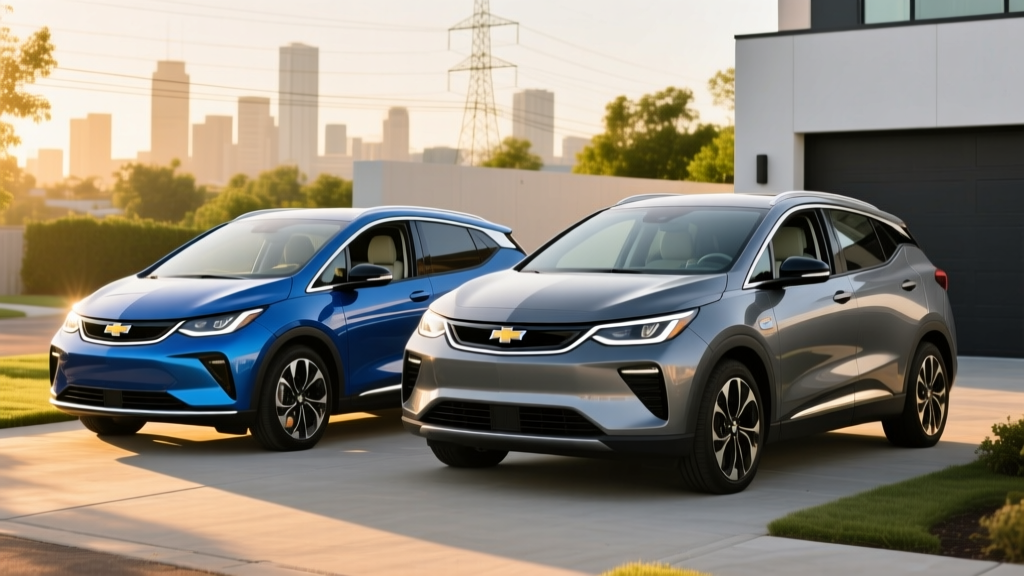
The Chevrolet Bolt EV and its slightly stretched sibling, the Bolt EUV, hold a unique position in the 2026 electric-vehicle market: they remain the least expensive way to get over 250 miles of EPA-estimated range in a new, mass-market EV. After GM retired the first-generation Bolt in late 2023, the automaker revived the nameplate on the Ultium platform for the 2025 model year, and the 2026 Chevy Bolt EV and EUV carry forward with meaningful improvements — most notably a switch to lithium iron phosphate (LFP) battery chemistry and the adoption of the North American Charging Standard (NACS) port.
But affordability always comes with trade-offs. The Bolt's DC fast-charging speed, interior material quality, and rear-seat packaging reflect its budget origins. This review breaks down exactly what you get — and what you give up — with precise specs, real-world range expectations, and ownership economics for the 2026 model year.
2026 Chevy Bolt EV & EUV: Core Specs at a Glance
| Specification | Bolt EV (Hatchback) | Bolt EUV (Crossover) |
|---|---|---|
| EPA Estimated Range | 259 miles | 247 miles |
| Battery (Usable) | ~65 kWh (LFP) | ~65 kWh (LFP) |
| Motor / Drivetrain | Single FWD, 200 hp, 266 lb-ft | Single FWD, 200 hp, 266 lb-ft |
| 0–60 mph | ~7.0 seconds | ~7.2 seconds |
| Max DC Fast Charge | ~115 kW peak | ~115 kW peak |
| 10–80% DC Fast Charge | ~30 minutes | ~30 minutes |
| Level 2 Home Charging | 11.5 kW onboard (~37 mi/hr) | 11.5 kW onboard (~37 mi/hr) |
| Efficiency (Combined) | ~120 MPGe / 28 kWh/100 mi | ~115 MPGe / 29 kWh/100 mi |
| Charging Port | NACS (native) | NACS (native) |
| Battery Warranty | 8 years / 100,000 miles | 8 years / 100,000 miles |
| Starting MSRP | ~$26,995 | ~$28,995 |
Real-World Range: What the EPA Sticker Doesn't Tell You
Real-World Highway (70–75 mph): Expect ~215–230 miles in moderate temperatures
Cold-Weather (below 32°F): Expect ~180–205 miles, depending on cabin heat usage and preconditioning
The Bolt's EPA range figures are genuinely useful for daily commuting and suburban errands, where regenerative braking and lower speeds work in the vehicle's favor. In city and mixed driving, many owners report matching or even slightly exceeding the EPA number, thanks to the efficiency advantages of stop-and-go regen capture.
Highway driving is a different story. At sustained speeds above 70 mph, aerodynamic drag — which the Bolt's relatively upright hatchback profile doesn't minimize — cuts range by roughly 12–18% compared to the EPA combined figure. On a 75°F day with no climate load, plan for about 220 usable miles from the Bolt EV before you need to find a charger.
Cold weather compounds the loss. LFP chemistry, while excellent for longevity, is somewhat more sensitive to low temperatures than NMC cells. Without preconditioning the battery (warming it before driving and before DC fast charging), range can drop to 180 miles or less in sub-freezing conditions. The Bolt's heat pump — standard on 2026 models — mitigates cabin energy draw, but the battery's internal resistance still rises in cold weather. If you live in a northern climate, budget for a 25–30% winter range reduction.
Charging Speed: The Bolt's Persistent Weakness
| Charging Level | Power (kW) | Speed (Miles Added/Hour) | Notes |
|---|---|---|---|
| Level 1 (120V household) | ~1.4 kW | ~4 mi/hr | Emergency/trickle only; ~65 hours for full charge |
| Level 2 (240V home) | 11.5 kW | ~37 mi/hr | Full charge in ~6 hours; ideal for daily use |
| DC Fast Charge | ~115 kW peak | ~180 mi/hr (peak) | 10–80% in ~30 min; tapers significantly above 80% |
DC fast charging remains the Bolt's most significant competitive limitation. While rivals like the Hyundai Ioniq 5 (peak ~240 kW on 800V architecture) and the Tesla Model 3 (peak ~250 kW) can add 150+ miles in 15 minutes, the Bolt's ~115 kW peak means road-trip charging stops will take noticeably longer. The 10–80% session takes approximately 30 minutes under ideal conditions — meaning a warm battery and a charger capable of delivering the Bolt's full requested power.
The charge curve also matters. The Bolt sustains close to peak power from roughly 10% to 50% state of charge, then begins a gradual taper. From 80% to 100%, charging slows dramatically to protect the LFP cells — expect an additional 35–45 minutes if you insist on a full charge on DC. For road trips, the practical strategy is to charge from 10% to 80%, then drive on.
Home Level 2 charging, however, is excellent. The 11.5 kW onboard charger is competitive with the best in class. On a 48-amp home charger circuit (requiring a 60-amp breaker), you'll add roughly 37 miles of range per hour, meaning a depleted battery reaches full overnight in about 6 hours. This is the Bolt's sweet spot: as a daily commuter charged at home, the charging speed limitation becomes largely irrelevant.
The switch to a native NACS port for 2026 is a major upgrade. Bolt owners now have direct access to Tesla Supercharger stations without an adapter, dramatically expanding the fast-charging network available to them — a significant advantage over CCS-only competitors as the industry converges on NACS.
Performance and Driving Impressions
The 200-horsepower, front-wheel-drive motor delivers adequate acceleration for merging and passing. The 0–60 mph time of roughly 7.0 seconds (EV) and 7.2 seconds (EUV) won't win drag races, but the instant torque delivery makes the Bolt feel quicker in urban traffic than the numbers suggest. There's no all-wheel-drive option — the Bolt remains FWD only, which limits its appeal in regions with heavy snow, though the low center of gravity from the under-floor battery pack provides competent traction.
Ride quality is where the Ultium-platform redesign shows improvement over the first-generation Bolt. The wheelbase stretch on the EUV (107.9 inches vs. the EV's 102.4 inches) translates to noticeably better rear-seat legroom — 39.1 inches in the EUV versus 35.6 inches in the EV — and a slightly more composed ride over rough pavement. The EV hatchback feels more nimble in parking lots and tight city streets.
One-pedal driving, enabled by aggressive regenerative braking, remains a Bolt hallmark and is well-calibrated for most situations. The steering is light and communicative enough for its class, though the turning radius is tighter on the EV than the longer EUV.
Interior, Cargo, and Technology
The cabin reflects the Bolt's value positioning. Hard plastics are prevalent on the door panels and lower dashboard, though the 11-inch diagonal infotainment touchscreen and 8-inch digital driver display are crisp and responsive. Wireless Apple CarPlay and Android Auto are standard across all trims. The physical volume knob is a welcome ergonomic choice.
Cargo space differentiates the two models clearly:
- Bolt EV: 16.5 cu ft behind rear seats; ~55 cu ft with seats folded
- Bolt EUV: 16.3 cu ft behind rear seats; ~56.9 cu ft with seats folded
Neither offers a front trunk (frunk), which is a missed opportunity given the compact motor packaging. Rear-seat comfort is the EUV's clear advantage — the extra 2.3 inches of wheelbase translate directly to kneeroom that makes the EUV viable for families with older children, while the EV's rear seat is best suited for kids or occasional adult passengers on short trips.
Standard driver-assistance features on the 2026 Bolt include automatic emergency braking, lane-keeping assist, following-distance indicator, and IntelliBeam auto high beams. Adaptive cruise control is available on higher trims. Notably absent: GM's Super Cruise hands-free driving system is not offered on the Bolt, keeping the vehicle in SAE Level 1 territory for driver assistance. The driver must remain fully engaged at all times.
Pricing, Trims, and Federal Tax Credit Eligibility
| Trim | Bolt EV MSRP | Bolt EUV MSRP | Est. After §30D Credit* |
|---|---|---|---|
| LT (base) | $26,995 | $28,995 | As low as $19,495 / $21,495 |
| 2LT (mid) | $29,595 | $31,595 | As low as $22,095 / $24,095 |
| Premier (top) | $32,495 | $34,495 | As low as $24,995 / $26,995 |
*Federal tax credit eligibility depends on multiple factors. The §30D credit of up to $7,500 is subject to buyer income caps ($150,000 single / $300,000 joint MAGI), MSRP caps ($55,000 for sedans/hatchbacks, $80,000 for SUVs/vans), and battery component/critical mineral sourcing requirements. The Bolt's MSRP falls well below the cap. As of 2026, the credit can be transferred to the dealer at point of sale as an immediate price reduction. Always verify current eligibility at IRS.gov and consult a tax professional.
The Bolt's pricing is its headline advantage. Even before any tax credit, the base Bolt EV undercuts virtually every EV on the market with comparable range. If you qualify for the full $7,500 federal credit (and many Bolt buyers will, given the income caps and the vehicle's price point), the effective purchase price drops into territory that competes directly with well-equipped gasoline compacts.
State and local incentives may stack on top — California's CVRP, Colorado's innovative motor vehicle credit, and various utility rebates can further reduce cost. Check fueleconomy.gov for a current incentive database.
Ownership Economics and Warranty
Chevrolet covers the Bolt's battery and powertrain for 8 years or 100,000 miles, whichever comes first. The warranty guarantees the battery will retain at least 70% of its original capacity during that period. LFP chemistry is known for exceptional cycle life — typically outlasting NMC cells in long-term degradation testing — so Bolt owners who charge to 100% regularly (which LFP tolerates well, unlike NMC) can expect minimal range loss over the warranty period.
Charging costs are where the Bolt shines economically. At the national average residential electricity rate of approximately $0.16/kWh, a full home charge costs roughly $10.40 — translating to about $0.04 per mile. Compare that to a 30 MPG gasoline car at $3.50/gallon ($0.12/mile), and the Bolt saves roughly $0.08 per mile, or about $1,200 per year at 15,000 miles annually. Over five years, fuel savings alone can exceed $6,000.
Insurance premiums for the Bolt tend to run 5–10% higher than equivalent gas-powered compacts, reflecting EV repair-cost trends. Get quotes before purchasing to factor this into your total cost of ownership.
Pros, Cons, and Who Should Buy
Pros
- Lowest MSRP for 250+ mile EPA range in 2026
- LFP battery offers excellent longevity and 100% SoC tolerance
- Strong 11.5 kW Level 2 home charging
- Native NACS port — direct Supercharger access
- Competitive efficiency (~120 MPGe combined)
- Generous 8-year/100,000-mile battery warranty
- Point-of-sale tax credit can bring effective price under $20,000
Cons
- DC fast charging limited to ~115 kW — slowest in class for road trips
- No AWD option
- Rear seat tight in EV hatchback (35.6" legroom)
- Interior materials feel budget-grade vs. competitors
- No frunk for additional cargo
- No Super Cruise or advanced hands-free driving available
- Cold-weather range loss notable with LFP chemistry
Is the 2026 Chevy Bolt EV or EUV Right for You?
Choose the Bolt EV if: You primarily commute under 60 miles round-trip, charge at home nightly, want the absolute lowest purchase price for a long-range EV, and take road trips infrequently enough that 30-minute charging stops are acceptable.
Choose the Bolt EUV if: You need the extra rear-seat legroom for family duty, prefer a crossover ride height, and don't mind sacrificing 12 miles of EPA range and ~$2,000 in additional cost for the added space.
Look elsewhere if: You frequently drive 300+ mile highway trips (the Ioniq 5 or Model 3 will save you significant charging time), you need AWD for snowy climates, or you want premium interior materials and advanced driver-assist features like hands-free highway driving.
Frequently Asked Questions
What is the real-world range of the 2026 Chevy Bolt EV?
In mixed city/highway driving at moderate temperatures, expect 230–245 miles from the Bolt EV (EPA 259). Sustained highway driving at 75 mph reduces this to roughly 215–225 miles. In freezing weather, plan for 180–205 miles unless you precondition the battery and cabin while plugged in.
How fast does the Bolt charge at home and on DC fast chargers?
On a Level 2 home charger (240V, 48A), the Bolt charges at 11.5 kW, adding about 37 miles per hour and reaching a full charge in roughly 6 hours. On DC fast chargers, it peaks at approximately 115 kW, achieving a 10–80% charge in about 30 minutes. This is the Bolt's weakest competitive metric — rivals charge 30–50% faster on DC.
Does the 2026 Chevy Bolt qualify for the $7,500 federal EV tax credit?
The Bolt's MSRP falls well under the §30D cap ($55,000 for passenger cars, $80,000 for SUVs). However, eligibility also depends on your adjusted gross income (must be under $150,000 single / $300,000 joint), and the vehicle's battery must meet critical mineral and component sourcing requirements that evolve annually. As of 2026, the credit can be transferred at the dealership for an immediate price reduction. Verify current rules at IRS.gov before purchasing.
How does the Bolt compare to the Tesla Model 3 and Hyundai Ioniq 5?
The Bolt wins on price by $10,000–$15,000. The Model 3 wins on DC charging speed (~250 kW vs. 115 kW), performance, and Supercharger network maturity. The Ioniq 5 wins on DC charging speed (~240 kW), interior quality, and available AWD. If budget is the primary constraint and you charge at home, the Bolt is hard to beat. If road-trip charging speed matters, the competitors justify their premium.
Is the LFP battery in the Bolt a concern for longevity?
LFP batteries generally outlast NMC batteries in cycle-life testing, often exceeding 3,000 charge cycles with minimal degradation. LFP also tolerates regular 100% charges without the accelerated degradation that affects NMC cells. The trade-off is slightly lower energy density (which is why the Bolt's range is modest relative to its physical size) and greater cold-weather sensitivity. For most owners, LFP is a net positive.
Can I tow with the Chevy Bolt?
Chevrolet does not rate the Bolt EV or EUV for towing. If towing is a requirement, consider the Hyundai Ioniq 5 (up to 1,650 lbs) or the Ford Mustang Mach-E (up to 2,200 lbs with the extended-range AWD configuration).