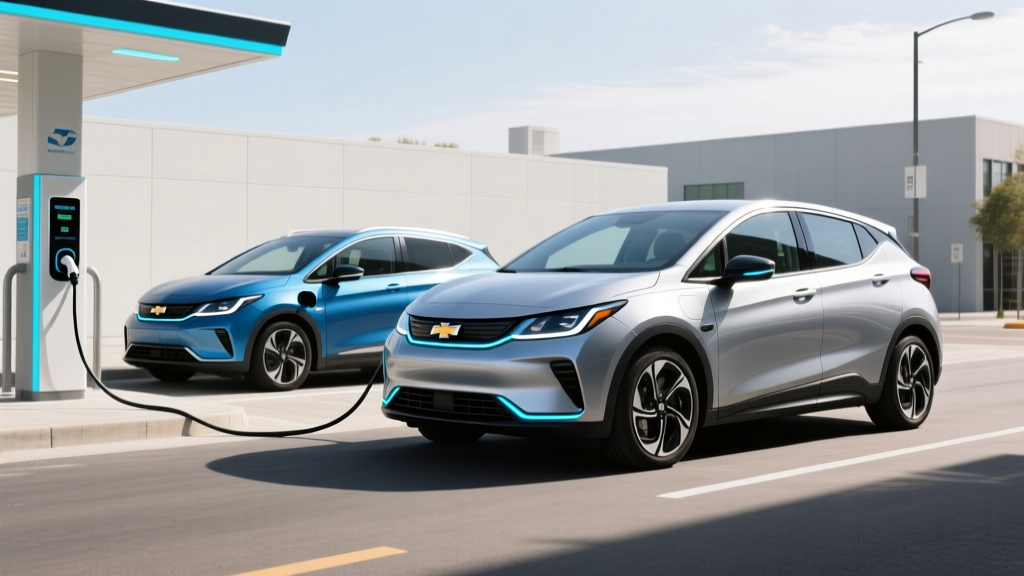
The Chevrolet Bolt EV and its longer-wheelbase sibling, the Bolt EUV, occupy a rare niche in 2026: sub-$30,000 electric vehicles with over 240 miles of EPA-estimated range. After a brief hiatus and a reintroduction for the 2026 model year with updated pricing, the Bolt remains the entry point for buyers who want a practical, commuter-friendly EV without stretching into the $40K+ territory that most competitors now occupy. But with DC fast-charging speeds that trail the latest 800-volt platforms and interior materials that reflect its budget origins, the Bolt demands a clear-eyed assessment. These reviews of the Chevy Bolt break down exactly what you get — and where it falls short.
2026 Chevy Bolt EV and EUV at a Glance
| Spec | Bolt EV | Bolt EUV |
|---|---|---|
| EPA Range | 259 mi | 247 mi |
| Battery (usable) | 65 kWh (NMC) | 65 kWh (NMC) |
| Max DC Fast Charge | 55 kW (CCS) | 55 kW (CCS) |
| 10–80% DC Time | ~55 min | ~55 min |
| Level 2 Home Charge | 11.5 kW (~39 mi/hr) | 11.5 kW (~39 mi/hr) |
| 0–60 mph | ~7.0 sec | ~7.2 sec |
| Horsepower | 200 hp / 266 lb-ft | 200 hp / 266 lb-ft |
| Drivetrain | FWD (single motor) | FWD (single motor) |
| Efficiency | 120 MPGe combined | 115 MPGe combined |
| Cargo (behind rear) | 16.3 cu ft | 16.3 cu ft |
| Rear Legroom | 36.0 in | 39.1 in |
| Base MSRP | ~$26,500 | ~$27,800 |
| Battery Warranty | 8 yr / 100,000 mi | 8 yr / 100,000 mi |
Range and Efficiency: EPA Sticker vs. Real-World Driving
The Bolt's 65 kWh (usable) nickel-manganese-cobalt (NMC) lithium-ion battery delivers strong city efficiency thanks to aggressive regenerative braking and the inherent advantage of stop-and-go driving on electric motors. According to fueleconomy.gov, the Bolt EV achieves 131 MPGe city but drops to 109 MPGe highway. That gap matters: if your commute is primarily freeway miles, expect to see closer to 3.0–3.2 miles per kWh rather than the 3.8 mi/kWh the EPA composite suggests.
Cold weather remains the Bolt's most significant range variable. Unlike premium EVs equipped with heat pumps, the Bolt uses resistive cabin heating, which can draw 3–5 kW in frigid conditions. In real-world winter testing at temperatures around 20°F, range loss of 25–35% is typical. Preconditioning the battery while plugged in at home helps mitigate this, but the Bolt lacks the sophisticated thermal preconditioning for DC fast charging that vehicles like the Hyundai Ioniq 5 offer.
Charging Speed: The Bolt's Biggest Trade-Off
| Charge Level | Power | Speed (approx.) | Notes |
|---|---|---|---|
| Level 1 (120V) | ~1.4 kW | ~4 mi/hr | Standard outlet; overnight adds ~40 mi |
| Level 2 (240V) | 11.5 kW | ~39 mi/hr | Full charge in ~6.5 hr; requires 48A circuit |
| DC Fast (CCS) | 55 kW peak | ~150 mi/hr (peak) | 10–80% in ~55 min; tapers above 80% |
The 55 kW DC fast-charging ceiling is the single most important limitation to understand before buying a Bolt. Most 2026 competitors — the Hyundai Kona Electric (100+ kW), Volkswagen ID.4 (175 kW), and Tesla Model 3 (250 kW on V3 Superchargers) — charge substantially faster on road trips. At 55 kW, the Bolt adds roughly 100 miles of range in 30 minutes under ideal conditions, and the charge curve tapers noticeably above 60% state of charge. A 10–80% session typically takes 50–60 minutes at a 50+ kW CCS station.
For daily driving, this is largely irrelevant. If you charge at home on a Level 2 wallbox, you'll wake up to a full battery every morning. The Bolt's 11.5 kW onboard charger is actually competitive — faster than some rivals — and a 240V/48-amp home setup (requiring a 60-amp breaker) will replenish the pack overnight in about 6.5 hours. The Bolt uses the CCS1 connector for DC fast charging; with the industry's ongoing shift to NACS (Tesla's connector), CCS remains widely supported at Electrify America, EVgo, and ChargePoint stations in 2026, though NACS adoption is accelerating.
Performance, Ride, and Daily Drivability
The Bolt's single front-mounted permanent-magnet motor produces 200 horsepower and 266 lb-ft of torque — delivered instantly, as with all EVs. The 0–60 mph time of roughly 7.0 seconds is brisk enough for confident highway merging and passing, though it won't win drag races against dual-motor competitors. The front-wheel-drive layout means torque steer is noticeable under hard acceleration from a stop, especially on wet pavement.
Ride quality is where the Bolt's budget roots show most clearly. The suspension tuning is firm, and road imperfections transmit more directly into the cabin than in the Volkswagen ID.4 or Nissan Ariya. Noise insulation is adequate but not class-leading — tire and wind noise become prominent above 65 mph. That said, the Bolt's compact dimensions (169.5 inches long for the EV, 169.5 for the EUV despite the longer wheelbase) make it genuinely easy to park and navigate in urban environments.
The Bolt EUV's 2.9-inch longer wheelbase translates almost entirely to rear-seat legroom: 39.1 inches versus the EV's 36.0 inches. If you regularly carry adult rear passengers or install rear-facing child seats, the EUV is the clear choice. Cargo volume is identical at 16.3 cubic feet behind the rear seats and 57.2 cubic feet with the rear seats folded.
Pricing, Trims, and Federal Tax Credit Eligibility
| Trim | MSRP (approx.) | Est. After §30D Credit |
|---|---|---|
| Bolt EV 1LT | $26,500 | ~$19,000 (if eligible) |
| Bolt EV 2LT | $29,500 | ~$22,000 (if eligible) |
| Bolt EUV LT | $27,800 | ~$20,300 (if eligible) |
| Bolt EUV Premier | $31,900 | ~$24,400 (if eligible) |
The Bolt's pricing is its most compelling attribute. At under $27,000 to start, it undercuts nearly every new EV on the market. The §30D federal tax credit can reduce the effective purchase price by up to $7,500 — and since 2024, eligible buyers can transfer the credit to the dealer at the point of sale, reducing the upfront cost rather than waiting for a tax refund.
However, eligibility is not automatic. Current §30D rules impose several requirements:
- MSRP cap: The vehicle must have an MSRP at or below $55,000 for cars (the Bolt clears this easily).
- Buyer income cap: Modified adjusted gross income must not exceed $150,000 (single), $225,000 (head of household), or $300,000 (joint filers).
- Battery sourcing: A percentage of critical minerals and battery components must be sourced from the U.S. or free-trade-agreement countries. These thresholds increase annually. Verify the Bolt's current-year compliance on the IRS qualified vehicle list.
- North American assembly: The vehicle must undergo final assembly in North America. The Bolt is assembled in Lake Orion, Michigan, satisfying this requirement.
Always confirm eligibility before purchase using the IRS qualified vehicles list and consult a tax professional — rules and sourcing compliance can shift between model years.
Technology, Safety, and Driver Assistance
The Bolt comes equipped with an 11-inch diagonal infotainment touchscreen running Chevrolet's latest infotainment software, wireless Apple CarPlay and Android Auto, and a configurable 8-inch driver information display. The interface is straightforward if not as polished as Tesla's or Hyundai's systems. Physical climate controls are retained — a practical choice that many owners prefer over touchscreen-only HVAC.
Chevy Safety Assist is standard on all trims and includes automatic emergency braking with pedestrian detection, forward collision alert, lane-keep assist with lane departure warning, following distance indicator, and IntelliBeam automatic high beams. Available upgrades include adaptive cruise control, surround-view camera, and rear cross-traffic alert.
The available Super Cruise on the Bolt EUV Premier is a genuine differentiator at this price point, offering hands-free driving on over 400,000 miles of compatible roads in North America. It's one of the most accessible implementations of Level 2 hands-free technology available in 2026.
Warranty and Long-Term Battery Outlook
Chevrolet covers the Bolt's battery and electric powertrain for 8 years or 100,000 miles, whichever comes first. The warranty guarantees the battery will retain at least 60% of its original capacity during the coverage period. In practice, NMC batteries in liquid-cooled packs like the Bolt's have shown degradation rates of roughly 8–12% over the first 100,000 miles based on fleet data from earlier-generation Bolts — well above the 60% threshold.
The bumper-to-bumper warranty covers 3 years / 36,000 miles, which is average for the segment. One consideration: the Bolt's earlier generations underwent significant battery recall campaigns related to fire risk. Chevrolet addressed this with updated battery modules and software monitoring. The 2026 Bolt uses a revised pack design, but buyers should verify that all recall-related service bulletins have been addressed on any vehicle they consider.
Pros, Cons, and the Verdict
Pros
- Lowest starting MSRP of any new EV with 250+ mi range
- Strong city efficiency and regenerative braking
- Generous rear legroom in EUV (39.1 in)
- Super Cruise availability at a budget price point (EUV)
- Competitive Level 2 home charging speed (11.5 kW)
- Qualifies for up to $7,500 federal tax credit (verify eligibility)
Cons
- 55 kW DC fast charging is slowest in class — poor road-trip vehicle
- CCS connector in a shifting-NACS market
- No heat pump — significant winter range loss
- Firm ride and noticeable road noise at highway speed
- FWD only; no AWD option for snow-belt buyers
- Interior materials reflect budget positioning
Choose the Bolt if:
- Your daily commute is under 80 miles round-trip and you can charge at home
- Budget is the top priority and you want a new EV under $20K after credits
- You rarely take road trips over 200 miles
- You want Super Cruise without paying luxury-EV prices (EUV Premier)
Look elsewhere if:
- You regularly drive 300+ mile road trips and need fast DC charging
- You live in a cold climate and need maximum winter range retention
- You need AWD or higher performance
- You tow anything — the Bolt is not rated for towing
Frequently Asked Questions
What is the real-world range of the 2026 Chevy Bolt EV?
The EPA rates the Bolt EV at 259 miles and the EUV at 247 miles. In real-world mixed driving at highway speeds, expect 220–240 miles. In cold weather (below 30°F) without preconditioning, range can drop to 180–200 miles due to resistive heating and reduced battery efficiency.
How fast does the Chevy Bolt charge at home and on DC fast chargers?
At home on a Level 2 (240V) charger, the Bolt charges at 11.5 kW, adding roughly 39 miles per hour — a full charge in about 6.5 hours. On DC fast chargers, the Bolt peaks at 55 kW, achieving a 10–80% charge in approximately 55 minutes. This is significantly slower than competitors like the Hyundai Kona Electric or Volkswagen ID.4.
How much does the 2026 Chevy Bolt cost after the federal tax credit?
The Bolt EV starts around $26,500 and the EUV around $27,800. If you qualify for the full $7,500 §30D credit (subject to income limits, MSRP caps, and battery-sourcing requirements), the effective price drops to approximately $19,000 for the base EV and $20,300 for the base EUV. Confirm eligibility on the IRS qualified vehicle list before purchasing.
Is the Chevy Bolt worth buying compared to the Hyundai Kona Electric or Nissan Leaf?
The Bolt wins on price and range-per-dollar. The Kona Electric charges faster on DC (100+ kW) and has a slightly more refined interior, but starts several thousand dollars higher. The Nissan Leaf uses the CHAdeMO connector (increasingly rare) and has less range in its base trim. If DC charging speed matters for your lifestyle, the Kona is the better pick. If budget is paramount, the Bolt is unmatched.
Does the 2026 Chevy Bolt qualify for the federal EV tax credit?
The Bolt meets the MSRP cap ($55,000 for cars), is assembled in North America (Lake Orion, MI), and has historically qualified for the credit. However, battery-sourcing and critical-mineral thresholds tighten each year under §30D. Always verify the current model year's status on the IRS qualified vehicles list and confirm your income falls within the caps ($150K single / $300K joint).
What are the biggest pros and cons of the Chevy Bolt?
The Bolt's strongest attributes are its low price, solid EPA range, and available Super Cruise. Its biggest drawbacks are slow 55 kW DC fast charging, lack of a heat pump for winter efficiency, and FWD-only drivetrain. It excels as a commuter and city car but struggles as a road-trip vehicle.