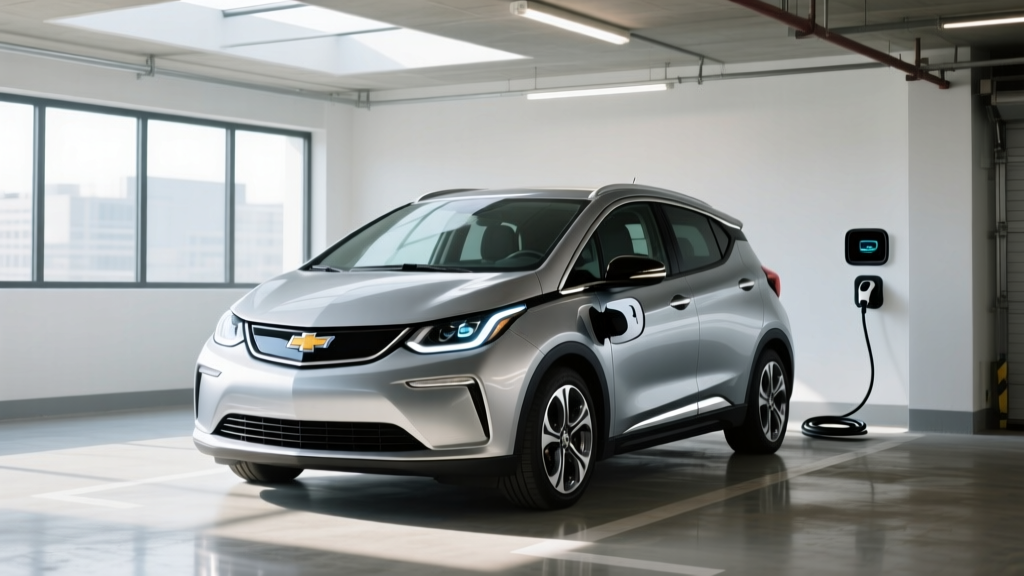
If you've been searching for chevy bolt ev deals, you've probably noticed the refreshed Bolt EV sitting at a compelling starting price. Chevrolet brought the Bolt back for the 2026 model year on the updated Ultium platform with NACS native charging, making it one of the most affordable long-range electric vehicles on the market. But a low sticker price is only the beginning of the ownership equation.
Below, we run the full numbers — purchase price after incentives, home and public charging costs, insurance premiums, maintenance savings, and five-year depreciation — so you can see exactly what a Bolt EV costs to own, not just to buy.
2026 Chevy Bolt EV: Price, Specs & What You're Getting
The 2026 Chevrolet Bolt EV launches with two trims and a significantly upgraded charging architecture compared to the pre-2024 generation. Here are the headline numbers buyers need:
| Spec | 2026 Bolt EV 2LT | 2026 Bolt EV RS |
|---|---|---|
| Base MSRP | $28,900 | $31,400 |
| EPA Range | 259 miles | 259 miles |
| Battery (usable) | 65 kWh, NMC | 65 kWh, NMC |
| DC Fast Charge (peak) | 150 kW | 150 kW |
| 10–80% DC Charge | ~28 minutes | ~28 minutes |
| Level 2 Charge Rate | 11.5 kW | 11.5 kW |
| Connector | NACS (native) | NACS (native) |
| 0–60 mph | 6.5 sec | 6.5 sec |
| Horsepower | 213 hp | 213 hp |
| MPGe (combined) | 120 MPGe | 118 MPGe |
| Battery Warranty | 8 yr / 100,000 mi | 8 yr / 100,000 mi |
Do You Qualify for the Federal EV Tax Credit on the Bolt?
The 2026 Bolt EV's eligibility for the IRS §30D Clean Vehicle Credit — up to $7,500 — depends on a stack of requirements. Chevrolet has worked to source battery minerals from FTA-partner countries, but eligibility can shift by model year and production batch. Here's the checklist:
- MSRP Cap: The Bolt EV must have an MSRP at or below $55,000 (sedans/hatchbacks). Both trims clear this easily at $28,900 and $31,400.
- Buyer Income Cap: Modified adjusted gross income (MAGI) must not exceed $150,000 (single filers), $225,000 (head of household), or $300,000 (joint filers).
- Battery Sourcing — Critical Minerals: A required percentage of critical minerals must be extracted or processed in the US or an FTA-partner country. This threshold increases annually; for 2026, it's 80%.
- Battery Sourcing — Components: A required percentage of battery components must be manufactured or assembled in North America. For 2026, this is 100%.
- Point-of-Sale Transfer: As of 2024, you can transfer the credit to the dealer at purchase, receiving the discount upfront rather than waiting to claim it on your tax return. This effectively reduces the Bolt's out-of-pocket cost at signing.
- Final Assembly: Must occur in North America. The Bolt EV is assembled in Orion Township, Michigan.
Best-case Bolt EV pricing with full credit: $28,900 MSRP − $7,500 credit = $21,400 effective purchase price for the 2LT trim. That's hatchback-gas-car territory for a 259-mile EV.
5-Year Total Cost of Ownership: Bolt EV vs. Gas Hatchback
To understand whether those Chevy Bolt EV deals actually save you money, we need to model five years of ownership against a comparably priced gas hatchback — we'll use the 2026 Honda Civic Hatchback (combined 35 MPG, ~$28,500 MSRP) as the baseline.
Assumptions: 15,000 miles/year (75,000 total), $3.50/gallon regular unleaded, $0.14/kWh average home electricity rate, 80% home / 20% public DC charging mix, state sales tax 6%.
| Cost Category (5 yr / 75k mi) | 2026 Bolt EV 2LT | 2026 Civic Hatchback |
|---|---|---|
| Purchase Price (after credit) | $21,400 | $28,500 |
| Sales Tax (6%) | $1,284 | $1,710 |
| Fuel / Electricity | $3,450 | $7,500 |
| Maintenance | $1,200 | $3,200 |
| Insurance (5 yr total) | $9,750 | $7,500 |
| Depreciation (est. 5 yr) | $10,200 | $9,800 |
| Total 5-Year Cost | $47,284 | $58,210 |
Charging vs. Gas: The Per-Mile Math
The Bolt EV's efficiency is rated at 120 MPGe combined, which translates to roughly 28 kWh per 100 miles in mixed driving. Here's how that breaks down in dollars:
| Scenario | Cost Per Mile | Cost Per 100 Miles |
|---|---|---|
| Home Level 2 charging ($0.14/kWh) | $0.039 | $3.92 |
| Public DC fast charging ($0.40/kWh avg) | $0.112 | $11.20 |
| Blended (80% home / 20% DCFC) | $0.054 | $5.38 |
| Gas car at 35 MPG, $3.50/gal | $0.100 | $10.00 |
If you charge primarily at home — which the majority of EV owners do — your fuel cost drops to roughly 4 cents per mile, less than half the cost of a 35-MPG gas car. Even with occasional DC fast charging on road trips, the blended rate stays well below gasoline.
The caveat: if you live in a region with high electricity rates (California, parts of the Northeast at $0.25–$0.30/kWh) and rely heavily on public DCFC networks ($0.35–$0.50/kWh), your per-mile cost rises to $0.08–$0.14, erasing much of the fuel savings. Home charging access is the key economic variable.
Maintenance Savings: Where the Bolt EV Wins Quietly
EVs don't eliminate maintenance, but they dramatically reduce it. Here's what the Bolt EV owner skips versus a gas-car owner over 75,000 miles:
| Maintenance Item | Gas Car (75k mi) | Bolt EV (75k mi) |
|---|---|---|
| Oil changes (8–10 over 75k mi) | $500–$800 | $0 |
| Transmission fluid | $150–$300 | $0 |
| Spark plugs | $200–$400 | $0 |
| Engine air filter | $75–$150 | $0 |
| Brake pads (regen extends life) | $400–$700 | $0–$200 |
| Cabin air filter | $100–$150 | $100–$150 |
| Tire rotation/replacement | $800–$1,200 | $900–$1,400 |
| Coolant flush | $150–$250 | $150–$200 |
| Total Estimated | $2,375–$3,950 | $1,150–$1,950 |
Regenerative braking is the unsung maintenance hero. Because the electric motor handles most deceleration, the Bolt EV's friction brakes see minimal use. Many EV owners report original brake pads at 80,000+ miles. The main maintenance cost that increases for EVs is tires — the Bolt's instant torque and added weight from the battery pack accelerate tread wear slightly compared to a lighter gas hatchback.
Insurance: The Cost EV Buyers Often Overlook
Here's where the honest math requires a clear eye: EV insurance premiums are typically 15–25% higher than equivalent gas vehicles. For the Bolt EV, expect annual premiums in the $1,700–$2,200 range depending on your state, driving record, and coverage level, versus $1,300–$1,700 for a Civic Hatchback.
Why the premium gap?
- Higher repair costs: Battery pack damage in a collision can total a vehicle that would otherwise be repairable. Insurers price this risk.
- Specialized repair networks: EV-certified body shops are still less common, and labor rates are higher.
- Vehicle replacement cost: Even at $28,900, the Bolt EV's battery represents a large single-component cost that insurers must underwrite.
That said, the Bolt EV is one of the cheapest EVs to insure because its purchase price is low. A $70,000+ EV will see far steeper insurance premiums. Shop quotes from at least three carriers — some insurers now offer specific EV discounts or bundled home-charger coverage.
Depreciation & Resale Value: What the Data Shows
EV depreciation has been volatile. The iSeeCars depreciation studies show that EVs, on average, lost value faster than gas cars in 2023–2024, driven by Tesla's aggressive price cuts, rapid battery tech improvements, and shifting consumer demand. The original Bolt EV (discontinued in 2023) saw steep depreciation partly because its CCS charging port and 55-kW DC fast-charge rate became outdated quickly.
The 2026 Bolt EV enters a stronger position:
- NACS native charging means access to Tesla Superchargers without an adapter — a significant resale-value positive.
- 150 kW peak DC charging is competitive for its class, removing the old Bolt's biggest weakness.
- Sub-$30,000 pricing means less absolute dollar depreciation even if the percentage is similar.
Expect the 2026 Bolt EV to retain roughly 50–55% of its value after 5 years / 75,000 miles, translating to approximately $14,500–$16,000 in resale for the 2LT trim. That's a depreciation cost of about $10,200–$12,000 over five years — slightly more than a Civic, but the fuel and maintenance savings more than offset it.
State, Local & Utility Incentives: Stack Your Savings
Beyond the federal §30D credit, many states, municipalities, and electric utilities offer additional rebates that can further reduce the Bolt EV's effective cost. These vary enormously by location and change frequently, so treat this as a starting point for research:
- State rebates: States like California (CVRP, up to $7,000 for income-qualified buyers), Colorado (up to $5,000), Massachusetts (up to $3,500), and New York (up to $2,000) offer direct purchase rebates. Many have income caps similar to federal rules.
- Utility rebates: Hundreds of utilities offer $250–$1,500 rebates for EV purchases, home charger installations, or enrolling in time-of-use charging programs. Check your local utility's EV page.
- HOV lane access: Several states grant single-occupant HOV lane access to EVs, a non-cash incentive worth real commute time.
- Home charging installation credits: Some states and utilities rebate 50–100% of Level 2 charger installation costs (typically $500–$2,000 for equipment and electrical work).
Should You Buy a 2026 Chevy Bolt EV? The Decision Framework
Choose the Bolt EV if:
- You qualify for the full $7,500 federal tax credit (income and sourcing requirements met)
- You have access to home Level 2 charging (garage or driveway with a 240V outlet or planned installation)
- Your daily commute is under 100 miles round-trip, with occasional 200+ mile trips
- You want the lowest-cost entry into a 250+ mile EV with NACS Supercharger access
Look elsewhere if:
- You cannot charge at home and rely entirely on public DCFC (your fuel savings shrink, and convenience drops)
- You regularly drive 300+ miles in a single day — the 150 kW charge rate and 259-mile range mean more stops than a 350-kW-capable EV
- You need AWD, towing capacity, or significant cargo space (consider the Equinox EV or a Bolt EUV successor)
- Your MAGI exceeds the §30D income caps — without the credit, the value proposition weakens considerably
Frequently Asked Questions
How much does it really cost to own a 2026 Chevy Bolt EV over 5 years?
With the full $7,500 federal tax credit, home charging, and average insurance, the 5-year total cost of ownership for the Bolt EV 2LT is approximately $47,000 over 75,000 miles. Without the credit, it rises to roughly $54,800. Both figures include purchase, tax, electricity, maintenance, insurance, and depreciation.
Does the 2026 Bolt EV qualify for the $7,500 federal tax credit?
It can, but eligibility depends on your income (MAGI caps of $150k/$225k/$300k), the vehicle's MSRP (under $55k — both trims qualify), battery component and critical-mineral sourcing compliance, and North American final assembly. Verify on the IRS site and confirm with your dealer at point of sale.
How much do I save on fuel with the Bolt EV vs. a gas car?
At 28 kWh/100 mi and $0.14/kWh home electricity, the Bolt costs about 4–5 cents per mile to fuel. A 35-MPG gas car at $3.50/gallon costs 10 cents per mile. Over 75,000 miles, that's roughly $4,000 in fuel savings, assuming mostly home charging.
Are EVs more expensive to insure than gas cars?
Yes, typically 15–25% more. For the Bolt EV, expect $1,700–$2,200 annually versus $1,300–$1,700 for a comparable gas hatchback. Higher repair costs, battery replacement risk, and specialized labor drive the premium. The Bolt's low MSRP keeps it on the affordable end of EV insurance.
How well does the 2026 Bolt EV hold its resale value?
Expect 50–55% value retention after 5 years, or roughly $14,500–$16,000 for the 2LT trim. The switch to NACS charging and 150 kW DC fast charging improves the outlook versus the previous generation, but EV resale values remain more sensitive to market shifts and policy changes than gas vehicles.
What's the real-world range of the 2026 Bolt EV?
The EPA rates it at 259 miles. In real-world highway driving at 70–75 mph, expect 220–235 miles. In freezing temperatures with cabin heat, plan for 180–200 miles. Preconditioning the battery while plugged in helps preserve range and improves DC charging speed in cold weather.