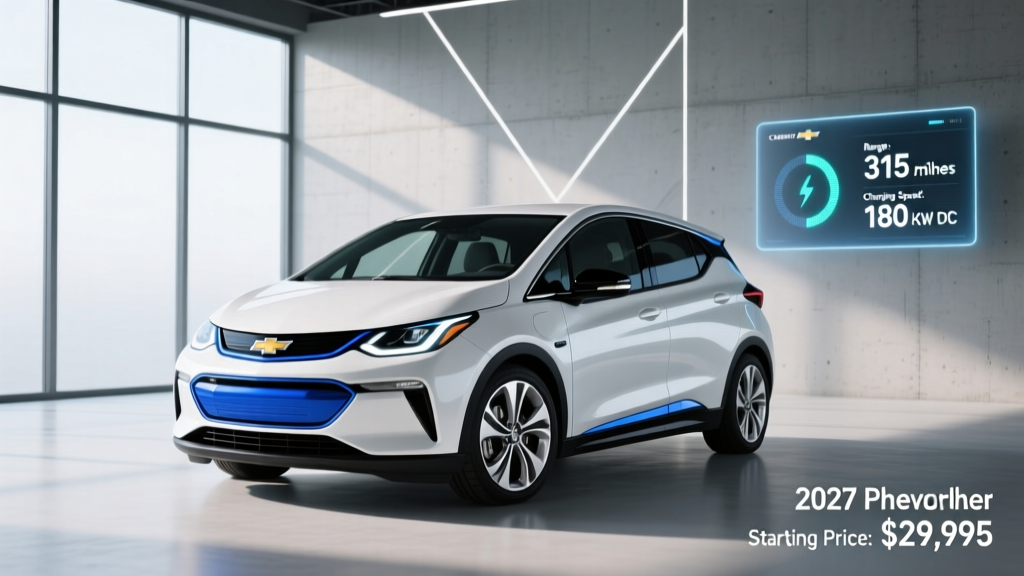
The Chevrolet Bolt EV returns for 2027 on the all-new Ultium platform, and it's a fundamentally different vehicle from the pre-2024 generation. GM has repositioned it as the entry point to its electric lineup — smaller than the Equinox EV, cheaper than the Blazer EV, and aimed squarely at budget-conscious commuters who want real range without paying a premium. But with multiple trims now available, choosing the right one requires understanding what each tier actually gets you in terms of battery, charging speed, and tech.
We've spent time with the 2027 Bolt EV across its lineup to break down the specs, the real-world range you can expect, the charging curve that matters more than peak kW numbers, and the tax-credit math that could bring the effective price well below $25,000. Here's everything you need before you configure one.
2027 Chevy Bolt EV Trim Levels at a Glance
GM offers the 2027 Bolt EV in three distinct trims, each with meaningful equipment differences that go beyond cosmetic packages. Here's how they stack up:
| Trim | Base MSRP | Battery (usable) | EPA Range | DC Fast Charge | Key Additions |
|---|---|---|---|---|---|
| 1LT | $26,995 | 65 kWh LFP | 255 mi | 150 kW peak | 11" touchscreen, wireless CarPlay/Android Auto, Chevy Safety Assist suite, heated front seats |
| 2LT | $29,995 | 65 kWh LFP | 255 mi | 150 kW peak | Adaptive cruise, 360° camera, Bose 7-speaker audio, EV route planning, leatherette upholstery, power driver seat |
| RS | $32,495 | 65 kWh LFP | 248 mi | 150 kW peak | Sport suspension, 19" wheels, blacked-out trim, unique interior accents, flat-bottom steering wheel, all 2LT features |
The RS trim's slightly lower EPA range (248 vs. 255 miles) comes from the larger 19-inch wheels and stickier all-season tires, which increase rolling resistance. It's a modest 2.7% hit — noticeable on paper, negligible on most commutes.
Range, Efficiency & Real-World Expectations
Real-World Expectation: Expect 220–240 miles in mixed highway/city driving at 70 mph. In cold weather (below 30°F), plan for 180–200 miles due to cabin heating draw and reduced battery chemistry efficiency. City driving with regenerative braking can push closer to or slightly above the EPA sticker.
The Bolt EV's 65 kWh usable lithium iron phosphate (LFP) battery pack is a deliberate choice by GM. LFP chemistry sacrifices some energy density compared to nickel-manganese-cobalt (NMC) cells — meaning the pack is physically heavier for the same capacity — but it gains substantially in cycle life, thermal stability, and cost. For a commuter-focused EV, that trade-off makes sense. LFP packs tolerate regular 100% charging without the accelerated degradation that NMC packs experience at high states of charge, which means GM actually recommends charging to 100% daily on this vehicle.
Efficiency comes in at approximately 120 MPGe combined (approximately 28 kWh/100 mi), which is competitive with the Hyundai Kona Electric and slightly behind the most efficient vehicles in this segment like the Tesla Model 3 RWD. The Bolt's taller, hatchback profile creates more aerodynamic drag at highway speeds, which is where you'll see efficiency drop most noticeably.
Charging Speed: DC Fast, Level 2 & the Curve That Matters
The biggest generational improvement in the 2027 Bolt EV is its DC fast-charging capability. The previous-generation Bolt was notoriously slow — capped at around 55 kW, making road trips painful. The Ultium-platform Bolt EV fixes this with a 150 kW peak DC fast-charge rate, though understanding the full charging curve is what actually tells you how long you'll sit at a charger.
| Charging Level | Power / Rate | Time / Speed | Connector |
|---|---|---|---|
| Level 1 (120V household) | ~1.4 kW | ~3.5 miles per hour | J1772 / NACS (with adapter) |
| Level 2 (240V home/public) | 11.5 kW max | ~32 miles per hour; 0–100% in ~6.5 hours | J1772 / NACS |
| DC Fast Charge | 150 kW peak (sustains ~120 kW to ~55%, tapers to ~60 kW by 80%) | 10–80% in ~28 minutes | CCS1 (NACS via adapter or on 2027+ native NACS vehicles) |
The 10–80% time of approximately 28 minutes is respectable for this price segment, though it trails the Hyundai Ioniq 5 and Tesla Model 3, which can achieve 10–80% in roughly 18 minutes on 350 kW-capable chargers. The Bolt's LFP chemistry charges more conservatively above 55% state of charge (SoC) to protect long-term battery health. If you're road-tripping and charging to 80%, plan on a 30-minute stop — not bad, but not class-leading.
At home on a Level 2 charger, the 11.5 kW onboard charger is a strong point. A full overnight charge from near-empty takes about 6.5 hours, which is faster than many competitors capped at 7.2 or 9.6 kW. For a daily commuter plugging in overnight, this means you'll always wake up with a full battery regardless of how depleted you came home.
Connector note: GM has transitioned to the North American Charging Standard (NACS) connector for new vehicles. The 2027 Bolt EV ships with a NACS port natively. If you need to use legacy CCS1 chargers (still common on Electrify America and some regional networks), GM includes a CCS-to-NACS adapter in the vehicle. According to Chevrolet's charging page, access to Tesla Supercharger stations (now open to GM EVs via NACS) adds over 17,000 DC fast-charging stalls to the Bolt's network.
Performance & Driving Dynamics
| Spec | Value |
|---|---|
| Drivetrain | Front-wheel drive (single motor) |
| Horsepower | 200 hp |
| Torque | 236 lb-ft |
| 0–60 mph | 6.8 seconds |
| Top Speed | ~100 mph (electronically limited) |
| Towing Capacity | Not rated for towing |
The 200 hp single-motor front-wheel-drive setup is adequate for daily driving and highway merging, though the 6.8-second 0–60 time won't thrill anyone coming from a dual-motor EV. The instant torque delivery makes the Bolt feel quicker around town than the number suggests, and the RS trim's sport-tuned suspension adds meaningful body control on twisty roads without sacrificing ride comfort.
Regenerative braking is adjustable via steering-wheel paddles, with a one-pedal driving mode that brings the car to a complete stop without touching the brake pedal. It's well-calibrated — not too aggressive, not too subtle — and works effectively in stop-and-go traffic.
Interior, Cargo & Technology
The 2027 Bolt EV rides on a stretched Ultium platform compared to its predecessor, and the extra wheelbase translates directly into rear-seat legroom and cargo volume.
| Dimension | Measurement |
|---|---|
| Front Legroom | 42.1 inches |
| Rear Legroom | 36.5 inches |
| Cargo (behind rear seats) | 21.3 cu ft |
| Cargo (rear seats folded) | 54.7 cu ft |
| Front Trunk (frunk) | Not available (FWD motor packaging) |
The 21.3 cubic feet of cargo space behind the rear seats is competitive with the Hyundai Kona Electric and meaningfully larger than the MINI Cooper SE. Fold the 60/40 split rear seats and you get a flat load floor with nearly 55 cubic feet — enough for a weekend's worth of gear for a family of four or a Costco run that would require two trips in most sedans.
On the technology front, the centerpiece is an 11-inch diagonal touchscreen running GM's latest Ultifi-based infotainment software with wireless Apple CarPlay and Android Auto standard on every trim. The 2LT and RS add built-in EV route planning, which automatically factors in charging stops, terrain, and weather when you enter a destination. The digital instrument cluster is an 8-inch display that shows range, energy flow, and regen levels clearly.
Chevy Safety Assist comes standard across all trims and includes automatic emergency braking with pedestrian detection, forward collision alert, lane keep assist with lane departure warning, following distance indicator, and IntelliBeam automatic high beams. The 2LT and RS add adaptive cruise control and a 360-degree surround-view camera — both worthwhile additions for urban parking and highway driving.
Pricing, Tax Credits & Ownership Economics
The 2027 Bolt EV's pricing positions it as one of the most affordable new EVs in the U.S. market. Here's the trim-by-trim breakdown with the federal tax credit factored in:
| Trim | Base MSRP | As-Tested (typical options) | §30D Federal Credit | Effective Price (if eligible) |
|---|---|---|---|---|
| 1LT | $26,995 | $27,890 (destination + cargo pkg) | Up to $7,500 | ~$19,495 – $20,390 |
| 2LT | $29,995 | $31,200 (destination + sunroof) | Up to $7,500 | ~$22,495 – $23,700 |
| RS | $32,495 | $34,100 (destination + tech pkg) | Up to $7,500 | ~$24,995 – $26,600 |
The IRS §30D clean vehicle credit offers up to $7,500, but eligibility depends on several requirements that buyers must verify before counting on the full amount:
- MSRP cap: The Bolt EV, classified as a passenger car (not an SUV), must have an MSRP at or below $55,000. All trims clear this easily.
- Buyer income limits: Modified adjusted gross income (MAGI) must not exceed $150,000 for single filers, $225,000 for head of household, or $300,000 for joint filers.
- Battery component sourcing: A percentage of battery components must be manufactured or assembled in North America, and critical minerals must meet sourcing thresholds. These percentages increase annually under the Inflation Reduction Act. GM has stated that the Bolt EV's Ultium battery is assembled in the U.S., but exact §30D qualification can change — verify with your tax professional and the IRS qualifying vehicle list at time of purchase.
- Point-of-sale transfer: As of 2024, eligible buyers can transfer the credit to the dealer at point of sale, reducing the purchase price directly rather than waiting to claim it on their tax return.
For buyers who qualify, a 1LT Bolt EV at roughly $20,000 effective cost becomes arguably the best value in the entire new-car market — electric or otherwise. A fully loaded RS at $26,600 after credit undercuts most competitors' base prices.
Battery Warranty & Long-Term Ownership
| Coverage | Term |
|---|---|
| Battery & EV Components | 8 years / 100,000 miles |
| Battery Capacity Retention | Guaranteed ≥70% of original capacity within warranty period |
| Bumper-to-Bumper | 3 years / 36,000 miles |
| Powertrain (motor, reduction gear) | 5 years / 60,000 miles |
| Corrosion | 6 years / 100,000 miles |
| Roadside Assistance | 5 years / 60,000 miles |
The 8-year/100,000-mile battery warranty with a 70% capacity retention floor is standard for the segment but worth noting in the context of LFP chemistry. Independent degradation data on GM's Ultium LFP packs is still accumulating given the platform's relative newness, but LFP cells are known for retaining 90%+ capacity after 2,000+ full charge cycles in laboratory testing. For a daily driver charging once per day, that translates to well over a decade of use before approaching the warranty threshold.
If a replacement is ever needed out of warranty, GM has not published exact pack pricing for the 2027 Bolt EV, but industry estimates for 60–70 kWh LFP packs currently range from $8,000 to $12,000 for the battery module alone, plus labor. That number is expected to decline as LFP manufacturing scales.
How It Compares: Bolt EV vs. Key Competitors
Choose the Bolt EV 2LT if:
- You want the lowest effective price after tax credits in the segment
- You need more than 250 miles of EPA range on a budget
- You value LFP battery longevity and daily 100% charging flexibility
- Your commute is under 100 miles round-trip and you charge at home
- You want a practical hatchback with strong cargo capacity
Look at competitors if:
- Hyundai Kona Electric: You want slightly more range (261 mi EPA) and faster DC charging (~18 min 10–80% at 150+ kW)
- Tesla Model 3 RWD: You need access to the Supercharger network natively (though Bolt now has NACS access), want a sedan with 272+ mi range, and can spend $10k+ more
- Nissan Leaf: You want an even lower starting price and accept less range (~212 mi) and CHAdeMO-only fast charging
- Chevy Equinox EV: You need more interior space, available AWD, and 300+ mi range, and can spend $33k+
The Bolt EV's strongest competitive position is price-to-range ratio. No other new EV under $30,000 (before credits) offers 255 miles of EPA range with 150 kW DC fast charging. The Kona Electric is the closest rival and edges it on charging speed, while the Model 3 is in a different price tier entirely. For buyers who've been waiting for an EV that simply makes financial sense without compromise on range, the Bolt EV occupies that sweet spot.
Who the 2027 Bolt EV Suits Best
This is a commuter-first EV. It's ideal for:
- Daily commuters with round trips under 150 miles who charge at home overnight — the Bolt's 255-mile range provides a massive buffer, and the LFP battery rewards daily full charges.
- Urban and suburban households that need a practical second car with real cargo space for groceries, kids' gear, and weekend trips.
- Budget-conscious EV adopters who want a new vehicle with warranty coverage and modern tech, not a used EV with unknown battery health.
- Rideshare drivers looking for low operating costs — electricity at ~$0.04–0.08 per mile (depending on local rates) vs. $0.12–0.18 per mile for gasoline in a comparable ICE hatchback.
It's less suited for frequent long-distance road trippers (the 28-minute 10–80% charge time adds up on cross-country drives), those who need AWD for snowy climates (FWD only), or anyone who needs to tow.
Frequently Asked Questions
What is the real-world range of the 2027 Chevy Bolt EV?
The EPA rates the 1LT and 2LT at 255 miles and the RS at 248 miles. In real-world mixed driving at highway speeds, expect 220–240 miles. In cold weather below 30°F, range drops to roughly 180–200 miles due to cabin heating demands and reduced battery efficiency. City driving with regenerative braking can match or slightly exceed the EPA number.
How fast does the 2027 Bolt EV charge?
On a DC fast charger, the Bolt EV peaks at 150 kW and charges from 10% to 80% in approximately 28 minutes. On a Level 2 home charger (240V), the 11.5 kW onboard charger adds about 32 miles of range per hour, with a full charge in roughly 6.5 hours. Level 1 (120V) adds about 3.5 miles per hour — suitable only for emergency top-ups or very low daily mileage.
Does the 2027 Bolt EV qualify for the $7,500 federal tax credit?
The Bolt EV meets the MSRP cap (well under $55,000 for a passenger car) and GM's U.S.-assembled Ultium battery is expected to meet North American sourcing requirements. However, buyer income caps apply ($150k single / $300k joint MAGI), and battery component sourcing thresholds tighten annually. Verify eligibility on the IRS qualifying vehicle list and consult a tax professional before relying on the credit. The credit can be transferred to the dealer at point of sale for an immediate price reduction.
Is the 2027 Bolt EV worth buying over the Equinox EV or Kona Electric?
If your budget is firm below $30,000 and you don't need AWD or 300+ miles of range, the Bolt EV offers the best price-to-range ratio available. The Equinox EV gives you more space, available AWD, and longer range but starts around $33,000. The Kona Electric matches the Bolt's price bracket and offers slightly faster DC charging but has marginally less cargo space. For pure value, the Bolt EV wins.
What's the battery chemistry, and can I charge to 100% daily?
The 2027 Bolt EV uses a lithium iron phosphate (LFP) battery. Unlike NMC batteries, LFP cells tolerate daily 100% charges without significant accelerated degradation. GM recommends periodic full charges to help the battery management system recalibrate state-of-charge estimates. This makes the Bolt well-suited for owners who want to maximize usable range every day.
Does the Bolt EV have a frunk (front trunk)?
No. The front-wheel-drive motor and power electronics occupy the space where a frunk would be. All cargo capacity is in the rear hatch area — 21.3 cu ft with seats up, 54.7 cu ft with seats folded.
What connector does the 2027 Bolt EV use?
The 2027 Bolt EV comes with a native NACS (North American Charging Standard) port, the same connector used by Tesla. This gives direct access to Tesla Supercharger stations. A CCS1 adapter is included for use with legacy Electrify America and other CCS-equipped networks.