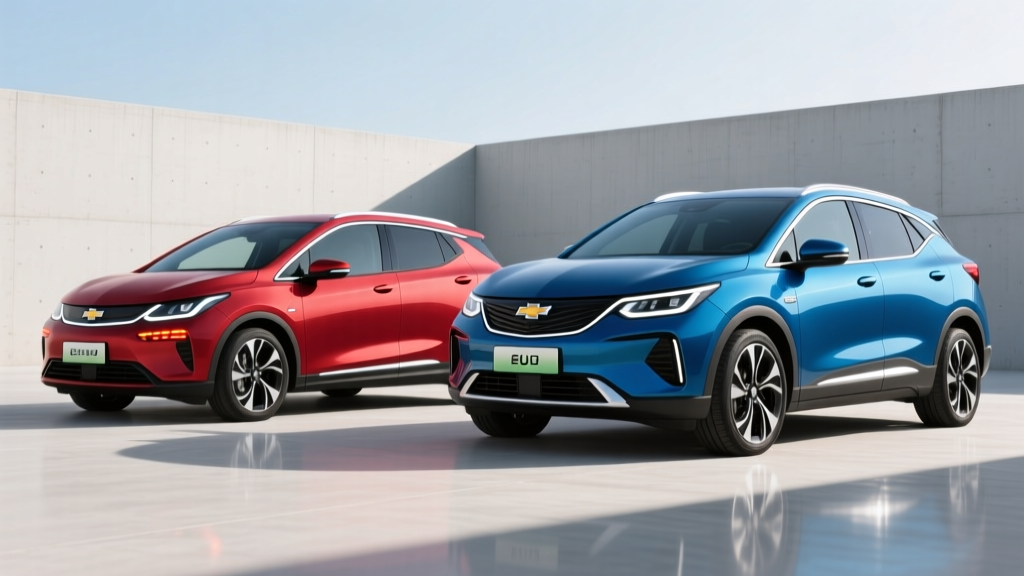
The Chevrolet Bolt returns for 2026 on GM's new Ultium-derived BEV3 platform, ditching the old CCS port for NACS, swapping in an LFP battery, and finally adding usable DC fast charging. For buyers researching Chevy Bolt colors alongside hard specs like range, charging speed, and tax-credit eligibility, this review covers everything you need to decide whether the Bolt belongs on your shortlist.
The 2026 Bolt EV is EPA-rated at 255 miles (Bolt EUV: 248 miles). In real-world highway driving at 70 mph, expect roughly 215–230 miles. In freezing temperatures (below 30°F), plan for 180–200 miles due to cabin heating and battery chemistry limits — typical for LFP packs without aggressive thermal preconditioning.
2026 Chevy Bolt Color Palette by Trim
GM streamlined the Bolt's exterior paint options for 2026. Here's the full lineup of Chevy Bolt colors available across the LT and Premier trims:
- Summit White — Available on LT & Premier (no-cost)
- Sterling Gray Metallic — Available on LT & Premier (no-cost)
- Midnight Blue Metallic — LT & Premier (no-cost)
- Habenero Orange — Premier only (+$395)
- Riptide Blue Metallic — LT & Premier (+$395)
- Cactus Green — Premier only (+$395)
- Radiant Red Tintcoat — Premier only (+$495)
- Black — Available on LT & Premier (no-cost)
Interior colorways are simpler: Jet Black cloth (LT) or Jet Black/Adrenaline Red perforated leatherette (Premier). GM dropped the two-tone gray interior from the previous generation, which some buyers will miss.
Specs at a Glance: 2026 Chevrolet Bolt EV & EUV
| Specification | Bolt EV | Bolt EUV |
|---|---|---|
| EPA Range | 255 miles | 248 miles |
| Battery (usable) | 65 kWh, LFP | 65 kWh, LFP |
| Motor / Drivetrain | 200 hp, FWD | 200 hp, FWD |
| 0–60 mph | ~6.5 sec | ~6.8 sec |
| Efficiency (combined) | 120 MPGe / 28 kWh/100mi | 116 MPGe / 29 kWh/100mi |
| DC Fast Charge (peak) | 115 kW (NACS) | 115 kW (NACS) |
| 10–80% DC Time | ~32 minutes | ~33 minutes |
| Level 2 Home Charging | 11.5 kW (~38 mi/hr) | 11.5 kW (~37 mi/hr) |
| Cargo (rear seats up) | 22.2 cu ft | 26.8 cu ft |
| Cargo (seats folded) | 54.1 cu ft | 63.4 cu ft |
| Rear Legroom | 36.0 in | 39.1 in |
| Battery Warranty | 8 yr / 100,000 mi | 8 yr / 100,000 mi |
| Base MSRP | $26,995 | $28,995 |
Charging: Finally Competitive on DC Speed
The previous-generation Bolt's biggest flaw was its painfully slow 55 kW DC fast charging. For 2026, GM addressed this directly. The new Bolt peaks at 115 kW on a NACS connector, leveraging the growing Tesla Supercharger network via native compatibility — no adapter required.
| Charging Level | Power / Rate | Time or Miles Added |
|---|---|---|
| Level 1 (120V, 12A) | ~1.4 kW | ~5 miles per hour |
| Level 2 (240V, 48A) | 11.5 kW | ~38 miles per hour / full charge in ~6.5 hr |
| DC Fast (peak) | 115 kW | 10–80% in ~32 minutes |
| DC Fast (sustained 10–60%) | ~95 kW avg | ~140 miles in 20 minutes |
Charging curve reality: The Bolt hits peak 115 kW between roughly 10% and 40% state of charge, then tapers to ~80 kW through 60%, and drops further above 80%. If you're road-tripping, plan your stops around the 10–65% window for the best time efficiency. Above 80%, the charge rate slows dramatically — a trait shared by virtually all LFP packs. Preconditioning activates automatically when a Supercharger or compatible DC station is set as your navigation destination, warming the battery to optimize charge acceptance.
Performance, Efficiency & Driving Impressions
The 2026 Bolt's single front-mounted motor produces 200 horsepower and an estimated 236 lb-ft of torque. The 0–60 mph time of ~6.5 seconds (EV) puts it in the same bracket as a Honda Civic Sport — adequate for merging and passing, if not thrilling. GM kept the Bolt front-wheel drive, which keeps weight and cost down but means no AWD option for snow-belt buyers.
Efficiency is a genuine strong point. At 120 MPGe combined (28 kWh per 100 miles), the Bolt sips electrons. In mixed suburban driving with moderate regen, owners can expect to use roughly 27–29 kWh/100mi in temperate weather. That translates to about $0.04–$0.05 per mile on average U.S. residential electricity (~$0.16/kWh), versus $0.12–$0.14/mile for a 30 MPG gas car at $3.50/gallon.
One-pedal driving returns with a dedicated mode, and the regen strength is adjustable through the infotainment screen. Ride quality is firm but composed — the BEV3 platform's lower center of gravity helps, though the torsion-beam rear axle (a cost-saving measure) transmits sharper bumps more than you'd find in an Ioniq 5 or Model 3 with independent rear suspension.
Tax Credit, Pricing & What You'll Actually Pay
The 2026 Bolt EV starts at $26,995 (LT), and the EUV at $28,995 (LT). A fully loaded Bolt EV Premier with premium paint lands around $33,000–$34,500 before incentives.
| Trim | MSRP | Est. After §30D Credit* |
|---|---|---|
| Bolt EV LT | $26,995 | ~$19,495 |
| Bolt EV Premier | $31,395 | ~$23,895 |
| Bolt EUV LT | $28,995 | ~$21,495 |
| Bolt EUV Premier | $33,395 | ~$25,895 |
*Federal §30D tax credit rules (2026): The Bolt is expected to qualify for up to $7,500, which can now be transferred to the dealer at point of sale as an instant discount under the IRA's advance-payment provision. However, eligibility depends on several conditions that you must verify:
- MSRP cap: Vehicle must be under $55,000 (sedans/hatchbacks) — Bolt clears this easily.
- Buyer income cap: AGI must not exceed $150,000 (single), $225,000 (head of household), or $300,000 (joint filers).
- Battery sourcing: Critical minerals and battery components must meet escalating domestic/free-trade-partner percentages. GM's LFP cell supply chain for the Bolt has been a question mark — confirm current-year compliance on the IRS qualified vehicles list before signing.
- Final assembly: Must be in North America — the Bolt is assembled in Lake Orion, Michigan.
Consult a tax professional and check fueleconomy.gov for the latest eligibility status. Rules can change mid-year.
Tech, Safety & Driver Assistance
The 2026 Bolt features an 11-inch diagonal infotainment touchscreen running GM's latest Google Built-In interface with native Google Maps, Google Assistant, and Play Store apps. Wireless Apple CarPlay and Android Auto remain standard. A 10.2-inch digital instrument cluster replaces the old 8-inch unit.
Chevy Safety Assist 2 is standard across all trims and includes:
- Automatic emergency braking with pedestrian detection
- Lane-keep assist with lane-departure warning
- Following-distance indicator
- Intelligent speed assist
- Blind-spot monitoring with rear cross-traffic alert (standard on Premier, optional on LT)
Super Cruise — GM's hands-free Level 2 highway driving system — is available on the Premier trim for the first time on the Bolt, covering over 750,000 miles of compatible roads. Note: this is SAE Level 2, meaning the driver must remain attentive and eyes on the road (monitored by an infrared camera). It is not autonomous driving.
Super Cruise and Chevy Safety Assist are Level 2 driver-assistance systems, not self-driving. You must keep your hands on or near the wheel (Super Cruise monitors eye gaze) and remain prepared to take over instantly. These systems do not handle construction zones, unmapped roads, severe weather, or unpredictable traffic scenarios without driver intervention.
Who Should Buy the 2026 Chevy Bolt?
The Bolt occupies a specific niche: the most affordable long-range EV in America, assuming tax-credit qualification. It's best suited for:
- Daily commuters with a home Level 2 charger who rarely exceed 100 miles round-trip.
- Budget-conscious EV buyers who want sub-$20,000 effective pricing after incentives.
- Urban and suburban drivers who value compact dimensions and easy parking over cargo volume.
- Second-car households replacing a gas commuter with an electric runabout.
It's less ideal for frequent road-trippers (the 32-minute 10–80% charge time is acceptable but not class-leading), those needing AWD, or families regularly carrying three adults in the rear seat. The EUV's extra rear legroom helps, but it's still a subcompact by volume.
Pros
- Lowest effective price in the EV market after §30D credit
- 255-mile EPA range is more than adequate for 95% of daily driving
- Native NACS — full Supercharger access without an adapter
- Excellent efficiency (120 MPGe combined)
- Compact footprint, easy to park
- 8-year/100,000-mile battery warranty
Cons
- No AWD option
- Torsion-beam rear axle — ride quality trails independent-suspension rivals
- DC fast charging (115 kW peak) is slower than Hyundai/Kia's 800V architecture
- LFP battery loses more range in extreme cold vs. NMC
- Modest rear-seat and cargo space (EV hatchback)
- Super Cruise limited to Premier trim
Competitive Landscape: Bolt vs. the Field
The Bolt's closest rival on price is the Nissan Leaf (discontinued after 2025 in the U.S., making the Bolt even more dominant in the budget-EV segment). Moving up, the Hyundai Kona Electric (~$33,000, 261-mile range, 100 kW DC charging) and Kia Niro EV (~$39,600, 239-mile range) are the nearest cross-shops, though both cost significantly more. The Tesla Model 3 RWD (~$38,990, 272-mile range, 170 kW DC) offers superior charging speed and performance but at a $12,000+ premium.
At the Bolt's price point — especially after the federal credit — there is simply nothing else that offers 255 miles of range, native Supercharger access, and a modern infotainment system. If your budget is firm at $27,000 and you want a new EV, the Bolt is currently the only serious answer.
Frequently Asked Questions
What is the real-world range of the 2026 Chevy Bolt?
The EPA rates the Bolt EV at 255 miles and the EUV at 248 miles. In real-world highway driving (70 mph, temperate weather), expect about 215–230 miles. In winter conditions below freezing, plan for 180–200 miles — LFP chemistry is more sensitive to cold than NMC. City driving with strong regen can actually exceed the EPA estimate, sometimes reaching 260+ miles in stop-and-go traffic.
How fast does the 2026 Bolt charge?
On a DC fast charger, the Bolt peaks at 115 kW (via its native NACS port), achieving a 10–80% charge in approximately 32 minutes. On a Level 2 home charger (240V, 48A), it charges at 11.5 kW, adding about 38 miles of range per hour — a full charge takes roughly 6.5 hours overnight. Level 1 (standard 120V outlet) adds about 5 miles per hour, useful for topping up but not for daily use if you drive more than 40 miles.
Does the 2026 Chevy Bolt qualify for the $7,500 federal EV tax credit?
The Bolt is expected to qualify for up to $7,500 under IRS §30D, and this can be applied as a point-of-sale discount at the dealership. However, you must meet income caps ($150K single / $300K joint), and the vehicle's battery must satisfy critical-mineral and component-sourcing requirements that change annually. Always verify on the IRS qualified vehicles list at the time of purchase.
Is the Chevy Bolt worth buying over a Tesla Model 3 or Hyundai Kona Electric?
If your priority is the lowest possible purchase price for a 250+ mile EV with Supercharger access, the Bolt is unmatched. The Model 3 offers faster charging, better performance, and a more refined ride — but costs $12,000 more. The Kona Electric is closer in size and range but starts $6,000 higher and lacks NACS. For budget-first buyers, the Bolt wins. For those prioritizing road-trip charging speed or driving dynamics, look upmarket.
What Chevy Bolt colors are available in 2026?
The 2026 Bolt is offered in eight exterior colors: Summit White, Sterling Gray Metallic, Midnight Blue Metallic, Black (all no-cost), plus Riptide Blue Metallic, Habanero Orange, Cactus Green, and Radiant Red Tintcoat (premium, $395–$495). Color availability varies by LT and Premier trim. Interior options are Jet Black cloth (LT) or Jet Black/Adrenaline Red leatherette (Premier).
How long will the Bolt's LFP battery last?
GM warranties the Bolt's battery for 8 years or 100,000 miles against defects and excessive capacity loss (typically defined as dropping below 60–70% of original capacity, per GM's warranty terms). LFP chemistry generally offers superior cycle life compared to NMC — many LFP packs are rated for 3,000+ full charge cycles before reaching 80% capacity. For a daily driver covering 12,000 miles per year, the battery should comfortably outlast the vehicle's useful life. Avoid routinely charging to 100% and leaving the car at full state of charge for extended periods to maximize longevity.