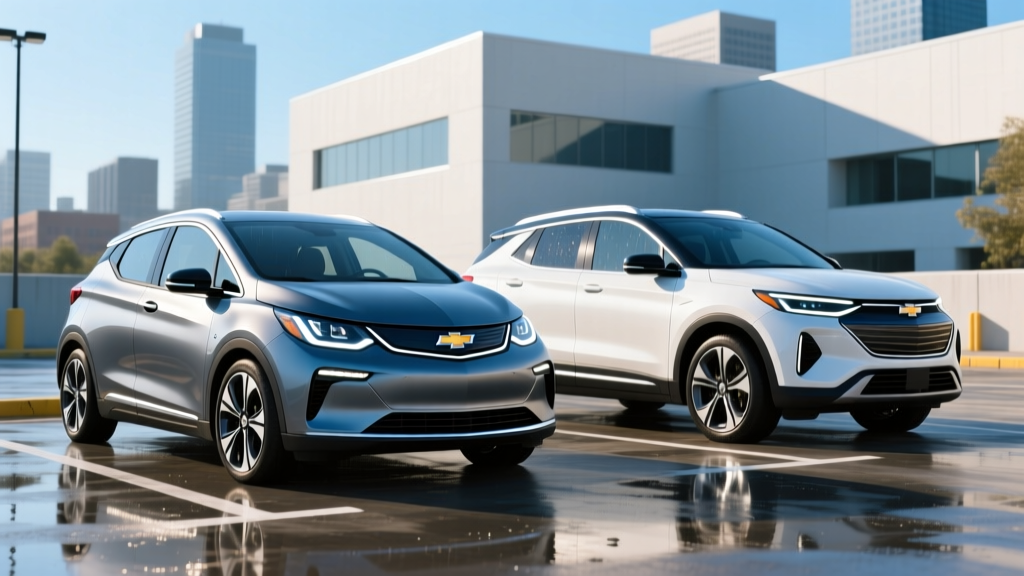
The 2024 Chevrolet Bolt EV and Bolt EUV occupy a rare position in the electric vehicle market: they are the least expensive new EVs you can buy in the United States, and they pair that affordability with competitive range. But the Bolt's age shows in one critical area — DC fast charging — that potential buyers need to understand before signing a purchase agreement. This review breaks down the real numbers, from EPA range to real-world highway expectations, charging curve behavior, and exactly what the federal tax credit looks like under current IRS §30D rules.
2024 Chevy Bolt EV and EUV: Key Specs at a Glance
| Specification | Bolt EV (Hatchback) | Bolt EUV (Crossover) |
|---|---|---|
| EPA Range | 259 miles | 247 miles |
| Battery Capacity (usable) | 65 kWh (NMC) | 65 kWh (NMC) |
| Efficiency | 120 MPGe (28 kWh/100 mi) | 115 MPGe (29 kWh/100 mi) |
| Motor Output | 200 hp / 266 lb-ft | 200 hp / 266 lb-ft |
| Drivetrain | FWD (single motor) | FWD (single motor) |
| 0–60 mph | ~6.5 seconds | ~6.8 seconds |
| Max DC Fast Charge Rate | 55 kW (CCS1) | 55 kW (CCS1) |
| 10–80% DC Charge Time | ~50 minutes | ~50 minutes |
| Level 2 Home Charging | 11.5 kW (~39 mi/hr) | 11.5 kW (~39 mi/hr) |
| Cargo Volume (rear seats up) | 16.6 cu ft | 16.3 cu ft |
| Cargo Volume (rear seats folded) | 57.0 cu ft | 56.9 cu ft |
| Rear Legroom | 35.6 in | 39.1 in |
| Base MSRP (1LT) | $26,500 | $27,800 |
| Battery/Powertrain Warranty | 8 yr / 100,000 mi | 8 yr / 100,000 mi |
Real-World Range: What the EPA Number Doesn't Tell You
EPA Estimated Range: 259 miles (Bolt EV) / 247 miles (Bolt EUV)
Real-World Expectation: Plan for approximately 210–235 miles on highway-heavy trips at 70–75 mph. In cold weather (below 30°F), expect a 20–30% reduction, bringing usable range down to roughly 170–200 miles. City and suburban driving with frequent regenerative braking opportunities will get you closest to — or even slightly above — the EPA sticker.
The Bolt's 65 kWh usable battery pack uses NMC (nickel manganese cobalt) chemistry, which offers higher energy density than LFP but is more sensitive to sustained high states of charge. For daily driving, Chevrolet recommends setting the charge limit to 80% unless you need the full range, which effectively gives you about 207 miles (EV) or 198 miles (EUV) for everyday commuting. That's still more than enough for the vast majority of daily drives — the EPA's fueleconomy.gov listing confirms the Bolt EV's combined efficiency at 120 MPGe.
The Bolt does not come equipped with a heat pump, relying instead on resistive cabin heating. This is a meaningful drawback in cold climates, as resistive heating draws significantly more energy from the traction battery than a heat pump system. If you live in the northern tier of the US, budget for that winter range penalty in your daily planning.
Charging Speed: The Bolt's Biggest Weakness
| Charging Level | Power / Rate | Miles Added per Hour | Notes |
|---|---|---|---|
| Level 1 (120V household) | ~1.2 kW | ~4 mi/hr | Emergency / overnight top-up only |
| Level 2 (240V home) | 11.5 kW | ~39 mi/hr | Full charge in ~7 hours; excellent for daily use |
| DC Fast Charge (CCS1) | 55 kW peak | ~170 mi/hr (at peak) | 10–80% in ~50 min; slow vs. modern competitors |
Here is where the 2024 Bolt's platform age becomes impossible to ignore. The 55 kW peak DC fast-charge rate was acceptable when the Bolt launched in 2017, but in 2024 it is the slowest DC charging speed among mainstream EVs. For context, the Hyundai Kona Electric charges at up to 100+ kW, and the Chevrolet Equinox EV peaks at 150 kW.
What does 55 kW mean in practice? On a road trip, you'll spend roughly 50 minutes at a DC fast charger to go from 10% to 80% state of charge. The charge curve is relatively flat — the Bolt sustains close to its peak rate through most of the session, which is a small silver lining (some EVs peak briefly then taper hard). But the total session time is still double what you'd experience in a vehicle with a 150 kW+ charge rate.
Home Level 2 charging, however, is a genuine strength. The 11.5 kW onboard charger is one of the fastest in its class, meaning a full 0–100% charge takes roughly 7 hours on a 48-amp Level 2 circuit. Most Bolt owners who charge at home overnight will never need to think about charging logistics for daily driving. A Level 2 home installation typically requires a 60-amp dedicated circuit; budget $500–$1,500 for professional installation depending on your electrical panel's proximity to the charging location.
Performance and Driving Impressions
The Bolt's single front-mounted permanent magnet motor produces 200 horsepower and 266 lb-ft of torque, available from zero RPM. The result is genuinely peppy acceleration in city and suburban driving — the 0–60 mph time of roughly 6.5 seconds (6.8 for the heavier EUV) feels quicker than the number suggests because of the instant torque delivery.
Front-wheel drive is the only configuration available; there is no AWD option. This is fine for most climates but worth noting if you regularly drive on unplowed roads. The Bolt's relatively light curb weight (~3,563 lbs for the EV, ~3,679 lbs for the EUV) contributes to its efficiency and gives it a nimble, tossable character around town.
One-pedal driving is available and well-implemented. Engage it via the steering wheel paddle or the drive mode selector, and the Bolt's regenerative braking is strong enough to bring the car to a complete stop without touching the brake pedal in most traffic situations. This reduces brake wear significantly — many Bolt owners report original brake pads lasting well past 80,000 miles.
Interior, Cargo, and Technology
The Bolt EV hatchback offers 16.6 cubic feet of cargo space behind the rear seats, expanding to 57.0 cu ft with the 60/40 split rear seats folded. The Bolt EUV, despite its longer wheelbase and more generous rear legroom (39.1 inches vs. 35.6 in the EV), offers nearly identical cargo volume at 16.3 / 56.9 cu ft. Neither vehicle has a front trunk (frunk).
The infotainment system centers on a 10.2-inch touchscreen running Chevrolet's Infotainment 3+ system with wireless Apple CarPlay and Android Auto. It's responsive and logically laid out, though it lacks the visual polish of newer GM Ultifi-based systems. A 6-speaker audio system is standard; a 7-speaker Bose system is available on the Premier (2LT) trim.
Driver-assistance features include Chevy Safety Assist as standard: automatic emergency braking, forward collision alert, lane keep assist with lane departure warning, following distance indicator, and IntelliBeam automatic high beams. The EUV offers an optional Super Cruise package on the Premier trim — GM's hands-free Level 2 highway driving system, which works on over 400,000 miles of mapped highways in the US and Canada. Note that Super Cruise is a Level 2 SAE driver-assist system; the driver must remain attentive and eyes on the road at all times.
Pricing, Trims, and Federal Tax Credit Eligibility
| Model / Trim | Base MSRP | Est. Federal Credit | Effective Price |
|---|---|---|---|
| Bolt EV 1LT | $26,500 | Up to $7,500 | As low as $19,000 |
| Bolt EV 2LT (Premier) | $30,700 | Up to $7,500 | As low as $23,200 |
| Bolt EUV 1LT | $27,800 | Up to $7,500 | As low as $20,300 |
| Bolt EUV 2LT (Premier) | $32,300 | Up to $7,500 | As low as $24,800 |
The 2024 Bolt EV starts at $26,500 (including destination) for the 1LT trim, making it the least expensive new EV available in the US market. The EUV starts at $27,800. Both models are well below the IRS §30D MSRP cap of $55,000 for SUVs, vans, and pickup trucks (the EUV qualifies as an SUV) and $25,000 for sedans and hatchbacks — wait, the Bolt EV hatchback's $26,500 MSRP exceeds the $25,000 sedan/hatchback cap. However, GM classifies the Bolt EV as eligible under the SUV/truck cap in some configurations, and the IRS clean vehicle credit manufacturer list should be consulted directly for the most current eligibility determination.
IRS §30D Federal Tax Credit Requirements (2024):
- MSRP Cap: ≤$55,000 for SUVs/pickups/vans; ≤$25,000 for other vehicles — verify Bolt EV classification on IRS.gov
- Buyer Income Cap: Modified AGI ≤$150,000 (single), ≤$225,000 (head of household), ≤$300,000 (joint)
- Battery Sourcing: Critical minerals and battery component requirements phase in annually — the Bolt's LG Energy Solution battery cells (manufactured in Michigan) have met the full $7,500 credit threshold for qualifying buyers in 2024
- Point-of-Sale Transfer: Beginning January 1, 2024, buyers can transfer the credit to the dealer for an upfront price reduction rather than waiting to claim it on their tax return
- Tax Liability: The credit is non-refundable — it can only reduce your federal tax liability to zero, not generate a refund beyond that
Consult a tax professional and the IRS clean vehicle credit page to confirm your personal eligibility before purchasing. Rules and sourcing requirements are subject to change.
Bolt EV vs. Bolt EUV: Which Should You Choose?
Choose the Bolt EV if:
- You want the maximum EPA range (259 vs. 247 miles)
- You prioritize the lowest possible purchase price ($26,500 base)
- You don't need extra rear-seat legroom
- You prefer a smaller footprint for urban parking
Choose the Bolt EUV if:
- You regularly carry rear-seat passengers (39.1 in legroom vs. 35.6 in)
- You want available Super Cruise hands-free highway driving
- You prefer a crossover ride height and styling
- The 12-mile range difference and $1,300 price premium are acceptable trade-offs
How the 2024 Bolt Compares to Key Competitors
The Bolt's closest competitors in price and segment include the Hyundai Kona Electric (from ~$32,975, 261 miles EPA), the Nissan LEAF (from ~$28,140, up to 212 miles EPA with the larger battery), and Chevrolet's own Equinox EV (from ~$33,000, up to 319 miles EPA). The Kona Electric charges faster on DC (100+ kW) and offers a more modern interior, but costs over $6,000 more. The LEAF uses the CHAdeMO DC connector (increasingly rare at new public stations) and offers less range. The Equinox EV is larger, charges at up to 150 kW, and offers more range, but starts roughly $6,500 higher and may not qualify for the full tax credit depending on trim and sourcing.
For buyers whose primary concern is minimizing upfront cost while getting 250+ miles of range, the 2024 Bolt has no direct rival. The value proposition is simply unmatched in the new-EV market.
Pros and Cons
Pros
- Lowest MSRP of any new EV in the US market
- 259-mile EPA range is competitive with vehicles costing $10,000+ more
- Excellent Level 2 home charging speed (11.5 kW)
- Peppy city acceleration with instant torque
- Strong regenerative braking enables true one-pedal driving
- Full $7,500 federal tax credit eligibility for qualifying buyers
- 8-year/100,000-mile battery warranty
Cons
- 55 kW DC fast charging is the slowest in its class — 50 min for 10–80%
- No heat pump — significant winter range penalty in cold climates
- CCS1 connector (NACS transition means future adapter dependency at Tesla Superchargers)
- Dated interior materials and platform (originally designed 2016–2017)
- No AWD option
- Modest rear-seat headroom in the hatchback
Who the 2024 Chevy Bolt Is Best For
The 2024 Bolt is ideal for: daily commuters who can charge at home and rarely road-trip more than 200 miles in a single day; budget-conscious EV buyers who want to minimize upfront cost while still getting competitive range; second-car households that need an efficient runabout for errands and school runs; and apartment or condo dwellers who may eventually install Level 2 charging and want an affordable entry into EV ownership.
It is less suited for: frequent long-distance road trippers (the 55 kW DC charge rate adds significant time to highway stops); cold-climate drivers without garage parking (the lack of a heat pump and NMC chemistry make winter range loss noticeable); and buyers who need AWD or significant towing capacity (the Bolt is rated for zero towing).
Frequently Asked Questions
What is the real-world range of the 2024 Chevy Bolt?
The EPA rates the Bolt EV at 259 miles and the EUV at 247 miles. In real-world highway driving at 70–75 mph, expect 210–235 miles. In sub-freezing temperatures, range can drop to 170–200 miles due to resistive cabin heating and battery chemistry limitations.
How fast does the 2024 Bolt charge?
On DC fast charging, the Bolt peaks at 55 kW, taking approximately 50 minutes to charge from 10% to 80%. On a Level 2 home charger (240V), it charges at 11.5 kW, adding roughly 39 miles of range per hour and completing a full charge in about 7 hours. Level 1 (120V) adds about 4 miles per hour.
Does the 2024 Chevy Bolt qualify for the $7,500 federal EV tax credit?
The Bolt EUV qualifies for the full $7,500 credit for buyers meeting IRS §30D income limits (≤$150K single / ≤$300K joint). The Bolt EV hatchback's eligibility depends on its IRS vehicle classification — check the current IRS clean vehicle credit list. Both models benefit from the point-of-sale transfer option introduced in 2024, allowing the credit to be applied as an upfront discount at the dealer.
How much does the 2024 Bolt cost after tax credits?
With the full $7,500 federal credit applied, the Bolt EV 1LT can be purchased for as low as $19,000 and the Bolt EUV 1LT for as low as $20,300. These are among the lowest effective prices for any new electric vehicle in the US market.
Is the 2024 Chevy Bolt worth buying over competitors?
If minimizing purchase price is your top priority and you primarily drive locally with home charging access, the Bolt offers the best value in the new EV market. If you road-trip frequently and need faster DC charging, the Hyundai Kona Electric or Chevrolet Equinox EV are better (but more expensive) choices. The Bolt's 55 kW charging speed is its most significant competitive disadvantage.
What is the battery warranty on the 2024 Bolt?
Chevrolet covers the Bolt's battery and electric powertrain for 8 years or 100,000 miles, whichever comes first. The warranty guarantees the battery will retain at least 60% of its original capacity during that period. Real-world data from first-generation Bolt owners suggests degradation is typically modest — most packs retain 90%+ capacity after 60,000 miles.
Can the 2024 Bolt use Tesla Superchargers?
The 2024 Bolt uses the CCS1 connector. GM has announced that Chevrolet EVs will transition to the NACS (Tesla) connector beginning with 2025 model-year vehicles. For the 2024 Bolt, GM provides a CCS-to-NACS adapter through its partnership with Tesla, allowing access to the Supercharger network — but charging speed remains limited by the Bolt's 55 kW onboard capability.