The midsize electric SUV segment is crowded, but few models try to balance family hauling, road-trip range, and genuine utility quite like the Chevrolet Blazer EV. For buyers transitioning from a gas-powered crossover, the big questions aren't just about efficiency — they're about capability. Can it tow a boat trailer? How far can it actually go on a highway run? And does the math work after federal incentives?
We've spent time with the Blazer EV across multiple trims to answer those questions with hard data, not marketing copy. Here's everything you need to know about the Chevy Blazer EV towing capacity, real-world range, charging behavior, and ownership economics before you visit a dealer.
Chevy Blazer EV Towing Capacity: What Can It Actually Pull?
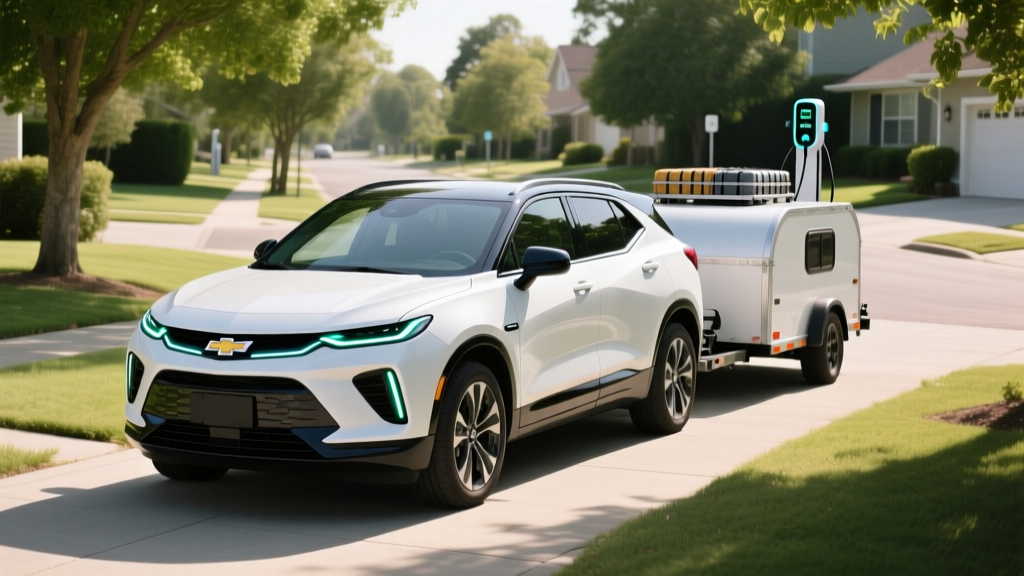
The headline number is straightforward: when equipped with the available towing package and the dual-motor AWD powertrain, the Chevy Blazer EV towing capacity reaches 4,500 pounds. That's best-in-class among midsize electric SUVs and puts it in the territory of gas-powered V6 crossovers like the Toyota Highlander or Ford Explorer.
| Trim | Drivetrain | Max Towing (lbs) | Towing Package Required? |
|---|---|---|---|
| 2LT (RWD) | Rear-Wheel Drive | 1,500 | No |
| 2LT (AWD) | Dual-Motor AWD | 4,500 | Yes |
| RS (AWD) | Dual-Motor AWD | 4,500 | Yes |
| SS (AWD) | Dual-Motor AWD (Performance) | 4,500 | Yes |
A few critical caveats for real-world towing:
- Range impact: Towing near maximum capacity will cut your effective range by roughly 40-50%. Expect 130-160 miles per charge with a loaded 4,000-lb trailer in moderate weather — plan charging stops accordingly.
- Tongue weight: Maximum tongue weight is rated at 450 lbs. Stay within this limit to preserve rear-axle integrity and stability control calibration.
- Towing package contents: The package adds a heavy-duty cooling system, integrated trailer brake controller wiring, and a hitch receiver. It's a factory-order item — confirm it's included on any dealer-lot vehicle.
- Regenerative braking while towing: Chevy's Tow/Haul mode adjusts regen aggressiveness to prevent trailer push on descents. Use it every time you're hooked up.
EPA Range, Real-World Efficiency, and the Cold-Weather Reality
EPA Estimated: Up to 324 miles (2LT RWD with 102 kWh pack)
Real-World Highway (70 mph, 72°F): ~270-290 miles
Real-World Highway (32°F, no heat pump benefit): ~220-245 miles
City/Commuter Mixed: ~295-315 miles
Note: AWD and SS trims with larger wheels reduce EPA range by 15-30 miles. The 21-inch wheels on the RS trim drop the EPA figure to approximately 293 miles.
The Blazer EV rides on GM's Ultium platform with a 102 kWh usable battery (gross capacity ~106 kWh) on the 2LT and RS trims. The battery uses NMC (nickel-manganese-cobalt) chemistry, which offers higher energy density than LFP but requires more careful long-term state-of-charge management to minimize degradation.
On the efficiency front, the 2LT RWD achieves an EPA-rated 89 MPGe combined, which translates to roughly 38 kWh per 100 miles. The AWD RS drops to about 84 MPGe combined (~40 kWh/100mi). These are competitive numbers for the segment, though the Hyundai Ioniq 5 and Tesla Model Y still hold a slight efficiency edge thanks to lighter curb weights and more aerodynamic profiles.
| Trim | Battery (kWh usable) | Drivetrain | EPA Range (mi) | MPGe Combined | kWh/100mi |
|---|---|---|---|---|---|
| 2LT | 102 | RWD | 324 | 89 | 38 |
| 2LT | 102 | AWD | 307 | 86 | 39 |
| RS | 102 | AWD | 293 | 84 | 40 |
| SS | 102 | AWD (Perf.) | 290 | 82 | 41 |
Source: fueleconomy.gov — verify trim-specific data for the current model year.
Charging Speeds: DC Fast Charging and Home Level 2
The Blazer EV's charging story is one of solid capability with a notable taper. Here's what the numbers look like across charging levels:
| Charging Level | Max Rate | Speed (Miles Added/Hour) | Notes |
|---|---|---|---|
| Level 1 (120V) | 1.4 kW | ~3-4 mi/hr | Emergency/trickle only |
| Level 2 (240V, 48A) | 11.5 kW | ~30-34 mi/hr | Full charge in ~9.5 hours |
| Level 2 (240V, 32A) | 7.7 kW | ~20-23 mi/hr | Common portable/public Level 2 |
| DC Fast Charge | 190 kW peak | ~150+ mi in 10 min (ideal) | 10-80% in ~30 min |
The 190 kW peak DC fast-charge rate is respectable but not class-leading. The Hyundai Ioniq 5 peaks at 240 kW (on 800V architecture), and the Tesla Model Y can hit 250 kW at V3 Superchargers. Where the Blazer EV matters is the charge curve:
- 10-50% SoC: The Blazer sustains close to its 190 kW peak, adding range rapidly.
- 50-80% SoC: Power tapers to roughly 100-120 kW as battery management protects cell health.
- 80-100% SoC: Significant taper to under 50 kW — don't plan road trips around charging past 80%.
Preconditioning tip: Use the Blazer EV's navigation-based battery preconditioning when routing to a DC fast charger. Arriving with a cold battery (below 60°F) can reduce peak charge rates by 30-40%. The system warms the pack en route to optimize charging speed.
The Blazer EV uses the NACS (North American Charging Standard) connector as of the 2025 model year, giving it native access to the Tesla Supercharger network — a significant advantage over CCS-equipped rivals that still require adapters.
Performance, Powertrain, and Driving Dynamics
| Trim | Horsepower | Torque (lb-ft) | 0-60 mph | Drivetrain |
|---|---|---|---|---|
| 2LT (RWD) | 340 hp | 325 | ~6.2 sec | Rear-Wheel Drive |
| 2LT (AWD) | 288 hp | 343 | ~6.5 sec | Dual-Motor AWD |
| RS (AWD) | 288 hp | 343 | ~6.5 sec | Dual-Motor AWD |
| SS (AWD) | 557 hp | 648 | ~3.9 sec | Dual-Motor AWD (Perf.) |
The 2LT and RS trims deliver confident, if not thrilling, acceleration. The dual-motor AWD system uses independent front and rear motors with torque vectoring, providing strong grip in wet and light snow conditions. The SS trim is a different animal entirely — its 557 hp makes it one of the quickest SUVs in its price bracket, rivaling performance crossovers costing twice as much.
One-pedal driving is available and well-calibrated, though not as aggressive as Tesla's or Nissan's implementation. Most owners will still use the brake pedal in stop-and-go traffic, but highway deceleration regen is smooth and predictable.
Pricing, Trims, and Federal Tax Credit Eligibility
| Trim | Base MSRP | As-Tested (Typical) | Est. After §30D Credit* |
|---|---|---|---|
| 2LT (RWD) | $44,600 | $47,200 | $37,100 - $44,600 |
| 2LT (AWD) | $47,600 | $50,800 | $40,100 - $47,600 |
| RS (AWD) | $51,400 | $55,900 | $43,900 - $51,400 |
| SS (AWD) | $60,400 | $63,500 | $52,900 - $60,400 |
*Tax credit amount depends on battery-sourcing compliance, buyer income, and point-of-sale transfer availability. See eligibility details below.
Federal §30D Tax Credit: What You Need to Know
- MSRP Cap: SUVs must have an MSRP at or below $80,000. All Blazer EV trims qualify.
- Buyer Income Cap: Modified AGI must not exceed $150,000 (single), $225,000 (head of household), or $300,000 (married filing jointly).
- Battery Sourcing: The credit splits into two halves — $3,750 for critical-mineral sourcing and $3,750 for battery-component assembly (both must meet annual thresholds set by the IRS). GM has worked to qualify for the full $7,500, but sourcing requirements tighten each year. Verify current-year eligibility at fueleconomy.gov or the IRS clean vehicle credits page.
- Point-of-Sale Transfer: You can transfer the credit to the dealer at purchase, reducing your out-of-pocket cost immediately — no need to wait for tax filing.
- VIN Verification: Confirm the specific VIN qualifies before signing paperwork. Sourcing compliance can vary by production batch.
Cargo Space, Interior, and Daily Practicality
The Blazer EV is a true midsize SUV with room that matches its exterior footprint:
- Cargo (behind rear seats): 30.3 cubic feet
- Cargo (rear seats folded): 64.1 cubic feet
- Front legroom: 42.7 inches
- Rear legroom: 38.4 inches
- Front headroom: 40.2 inches (panoramic roof reduces to 38.8)
- Frunk (front trunk): Not available — the Ultium platform in this configuration does not include a front storage compartment
The cabin material quality is a step above the Equinox EV, with soft-touch surfaces on the RS and SS trims. The 17.7-inch diagonal infotainment screen (standard on RS and SS, available on 2LT) runs Google Built-In with native Google Maps navigation, Google Assistant, and Play Store apps. Wireless Apple CarPlay and Android Auto are standard across all trims.
One practical drawback: the Blazer EV lacks a frunk. For a vehicle this size, that's a missed opportunity for secure, weatherproof storage of charging cables or small cargo. The Hyundai Ioniq 5 and Ford Mustang Mach-E both offer front trunks.
Driver Assistance, Safety, and Technology
Every Blazer EV comes equipped with Chevy Safety Assist, which bundles automatic emergency braking, forward collision alert, lane keep assist, following distance indicator, and automatic high beams.
The available Super Cruise system is a Level 2 driver-assistance system. It provides hands-free driving on over 750,000 miles of compatible highways, but the driver must remain attentive and ready to take over at all times. This is not autonomous or self-driving capability. Eye-tracking via the driver monitoring camera ensures engagement.
Super Cruise is available on the RS and standard on the SS trim. It's one of the most refined Level 2 systems on the market, with smooth lane changes, reliable mapping, and a well-designed driver-attention protocol. However, it's limited to pre-mapped divided highways — surface streets and construction zones require manual driving.
The Blazer EV earned a 5-Star Overall Safety Rating from NHTSA and performed well in IIHS moderate overlap and side-impact testing. Check current ratings at nhtsa.gov and iihs.org.
Battery Warranty, Degradation, and Long-Term Ownership
GM backs the Blazer EV's Ultium battery with an 8-year/100,000-mile warranty that guarantees the pack will retain at least 70% of its original capacity. The powertrain (motors, power electronics) carries the same 8-year/100,000-mile coverage.
For NMC chemistry, real-world degradation data from earlier Ultium-platform vehicles (GMC Hummer EV, Cadillac Lyriq) suggests approximately 5-8% capacity loss over the first 100,000 miles under normal use. To maximize longevity:
- Avoid routinely charging to 100% — set daily charge limits to 80-90%.
- Minimize consecutive DC fast-charge sessions when Level 2 is available.
- Use preconditioning in extreme temperatures.
Out-of-warranty battery replacement costs for a 102 kWh NMC pack are estimated at $15,000-$22,000 including labor, though prices are expected to decline as the Ultium platform matures and module-level repairs become more common.
Pros and Cons at a Glance
- Best-in-class 4,500-lb towing (AWD trims)
- NACS connector — native Supercharger access
- Spacious cabin with 30+ cu ft cargo
- Super Cruise hands-free highway driving
- SS trim offers supercar-level acceleration
- Strong 8-year/100,000-mi battery warranty
- No front trunk (frunk)
- 190 kW peak charge rate trails rivals
- Range drops sharply when towing (~50% loss)
- 2LT base trim is relatively bare-bones
- Heavier than Ioniq 5 / Model Y — hurts efficiency
- SS trim pushes past optimal tax-credit MSRP zone
Who Should Buy the Chevy Blazer EV?
- You need genuine towing capability (boat, utility trailer, camper) in an electric SUV
- You want native Tesla Supercharger access without an adapter
- You prefer a traditional SUV driving position and roomy cabin over a crossover's car-like feel
- Hands-free highway driving (Super Cruise) is a priority for your commute
Look elsewhere if:
- Maximum range and efficiency matter most (consider the Ioniq 5 or Model Y)
- You want a frunk for extra cargo flexibility
- You need the fastest possible DC charging for frequent long-distance road trips
- Your budget is tight — the value sweet spot is the 2LT AWD around $47,600 before credits
Frequently Asked Questions
What is the real-world range of the Chevy Blazer EV?
The EPA rates the 2LT RWD at 324 miles, but real-world highway driving at 70 mph yields approximately 270-290 miles in warm weather. In cold conditions (below freezing), expect 220-245 miles. The AWD RS trim delivers roughly 293 miles EPA and about 245-265 miles real-world highway.
How fast does the Blazer EV charge at home and on the road?
At home on a 48-amp Level 2 charger, the Blazer EV adds about 30-34 miles of range per hour, fully recharging in roughly 9.5 hours. On a DC fast charger, it peaks at 190 kW and can go from 10-80% in approximately 30 minutes under ideal conditions.
How much does the Blazer EV cost after federal tax credits?
With the full $7,500 §30D credit applied at point of sale, the 2LT RWD starts at an effective price around $37,100, and the RS AWD drops to roughly $43,900. Actual credit amount depends on battery-sourcing compliance for your specific VIN, your income, and current-year IRS rules.
Does the Chevy Blazer EV qualify for the federal EV tax credit?
The Blazer EV is expected to qualify for up to $7,500 under IRS §30D, as all trims fall under the $80,000 SUV MSRP cap. However, the exact credit depends on critical-mineral and battery-component sourcing thresholds that change annually. Verify your specific VIN at fueleconomy.gov or irs.gov before purchase.
Is the Blazer EV worth buying vs. the Hyundai Ioniq 5 or Tesla Model Y?
If towing capacity is a priority, the Blazer EV's 4,500-lb rating makes it the clear winner — neither the Ioniq 5 (2,300 lbs) nor Model Y (3,500 lbs) come close. For pure efficiency, charging speed, and cargo flexibility, the Ioniq 5 and Model Y hold advantages. The Blazer EV is the utility play in this segment.
Can I tow with the RWD Blazer EV?
Yes, but the RWD 2LT is limited to 1,500 pounds — enough for a small utility trailer or a couple of dirt bikes, but not a boat or camper. For the full 4,500-lb Chevy Blazer EV towing capacity, you need an AWD trim with the factory towing package.