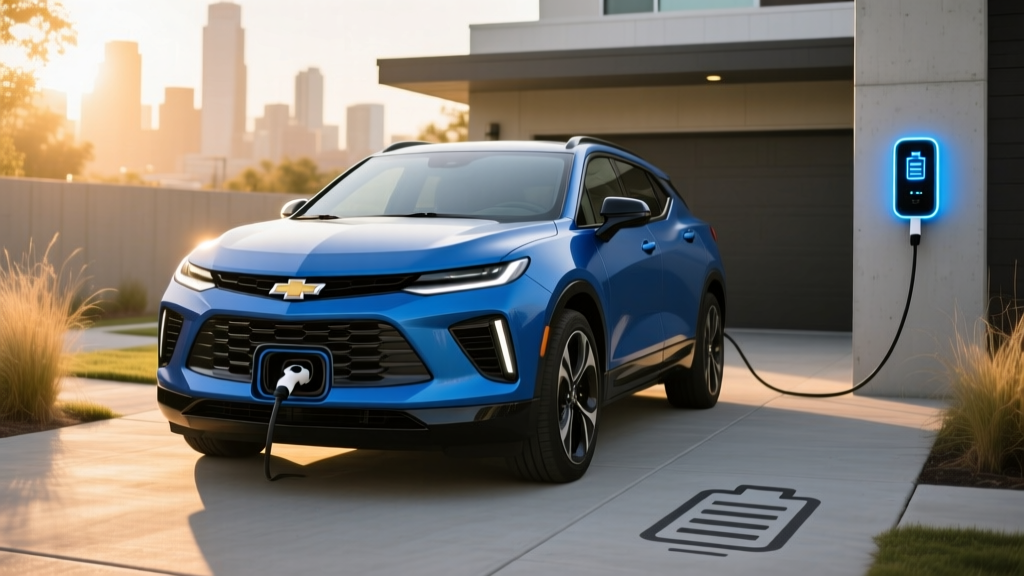
The 2026 Chevrolet Blazer EV slots into one of the most competitive midsize electric SUV segments, starting at $44,600 for the LT trim and stretching past $60,000 for the SS. For buyers running the numbers, the sticker price is only half the equation. Federal and state incentives, home charging economics, insurance premiums, and long-term depreciation all shape what this SUV actually costs over five years of ownership. Here's the complete financial picture.
2026 Blazer EV: Key Specs at a Glance
| Spec | 2LT (FWD) | RS (AWD) | SS (AWD) |
|---|---|---|---|
| Base MSRP | $44,600 | $50,300 | $61,400 |
| EPA Range | 312 mi | 279 mi | 293 mi |
| Battery (usable) | 85 kWh (NMC) | 102 kWh (NMC) | 102 kWh (NMC) |
| Peak DC Fast Charge | 190 kW | 190 kW | 190 kW |
| 10–80% DC Charge Time | ~30 min | ~33 min | ~33 min |
| Level 2 Rate | 11.5 kW | 11.5 kW | 11.5 kW |
| Horsepower | 293 hp | 355 hp | 557 hp |
| 0–60 mph | ~7.8 sec | ~5.5 sec | ~3.4 sec |
| MPGe (combined) | 92 MPGe | 86 MPGe | 84 MPGe |
| Battery/Powertrain Warranty | 8 years / 100,000 miles | ||
Federal Tax Credit: Do You Qualify for §30D?
The IRS §30D Clean Vehicle Credit offers up to $7,500 for qualifying new EVs, but the Blazer EV's eligibility is not automatic. The credit is split into two $3,750 halves — one tied to battery-critical-mineral sourcing, the other to battery-component manufacturing — and each has its own compliance threshold that tightens annually. For 2026, the critical-minerals percentage requirement is higher than in prior years, meaning some trim/battery combinations may qualify for only $3,750 or potentially $0 depending on GM's supply-chain status at the time of delivery.
- MSRP Cap: Must be ≤ $80,000 for SUVs — all Blazer EV trims qualify on price.
- Buyer Income Cap: Modified AGI must not exceed $150,000 (single), $225,000 (head of household), or $300,000 (joint filers).
- Battery Sourcing: Critical minerals and battery components must meet 2026 percentage thresholds from the U.S. or FTA partners. Check the DOE/FuelEconomy credit lookup at time of purchase — eligibility can shift mid-year.
- Final Assembly: Must occur in North America (the Blazer EV is built in Ramos Arizpe, Mexico — verify current §30D assembly list, as this has historically been a disqualifier for Mexico-built vehicles under certain interpretations).
- Point-of-Sale Transfer: Since 2024, you can transfer the credit to the dealer at purchase, reducing your out-of-pocket cost directly — even if you have no tax liability. This is a significant advantage over the old non-refundable system.
- One Credit Per Vehicle, Per Taxpayer: You can claim one new clean vehicle credit per year.
Critical caveat: The Blazer EV's Mexican assembly location has been a point of contention under §30D rules. As of early 2026, buyers should verify the vehicle's VIN on fueleconomy.gov before signing paperwork. Do not rely on dealer assurances alone — the IRS holds the buyer responsible for credit accuracy on your tax return.
State, Local, and Utility Incentives
Federal credits are uniform, but state and utility incentives vary dramatically. Always check your state's energy office and your electric utility's EV programs before purchasing.
Several states offer rebates or tax credits that stack on top of the federal §30D credit. Examples (subject to change and availability):
- Colorado: Up to $5,000 state tax credit for EVs under $80,000 MSRP (income-dependent tiers).
- California: The Clean Fuel Rebate program offers up to $1,000 for qualifying buyers; additional CVRP incentives may apply for income-qualified applicants.
- New York: Drive Clean Rebate up to $2,000, though funding pauses periodically.
- Utility rebates: Many utilities (Xcel Energy, PG&E, ConEdison, etc.) offer $500–$1,500 rebates for purchasing an EV, and additional rebates of $500–$1,000 for installing a Level 2 home charger. Check your utility's EV page directly.
These programs change frequently. Consult your state's official energy or environmental agency website for current figures rather than relying on aggregator sites that may list expired programs.
5-Year Total Cost of Ownership: The Full Math
Below is a realistic 5-year / 60,000-mile ownership projection for a 2026 Blazer EV RS (AWD) compared to a similarly equipped gas-powered midsize SUV averaging 24 MPG combined. We assume 12,000 miles driven annually, a home-charging-heavy lifestyle, and current national averages for electricity and fuel.
| Category | Blazer EV RS (AWD) | Gas SUV (24 MPG) |
|---|---|---|
| Purchase Price (MSRP) | $50,300 | $44,000 |
| Federal Tax Credit (§30D) | −$7,500* | $0 |
| Effective Purchase Price | $42,800 | $44,000 |
| Fuel / Charging (5 yr) | $3,600 | $9,375 |
| Maintenance (5 yr) | $1,200 | $3,500 |
| Insurance (5 yr) | $12,500 | $9,500 |
| Depreciation (est. 5 yr) | $22,000 | $17,600 |
| 5-Year Total Cost | $82,100 | $83,975 |
*Assumes full $7,500 §30D credit eligibility. Actual credit may be $3,750 or $0 depending on battery sourcing compliance and final assembly rules at time of purchase. State/utility incentives not included but would further reduce the EV figure.
Charging vs. Gas: Cost Per Mile
Blazer EV RS (86 MPGe, ~34 kWh/100 mi):
- Home charging at $0.16/kWh (national avg): $0.054/mile
- Public DC fast charging at $0.48/kWh: $0.163/mile
- Blended (80% home / 20% public): $0.076/mile
- $0.156/mile
5-year fuel savings (60,000 miles, blended): ~$4,800 in favor of the EV when home charging dominates. If you rely entirely on public DC fast charging, the advantage shrinks to roughly $400 over five years — a critical point for apartment dwellers without home charging access.
The Blazer EV's 190 kW peak DC charge rate means a 10–80% session takes approximately 30–33 minutes depending on battery size. However, like all EVs, the charge curve tapers significantly above 80% SoC — a full 80–100% top-up can add another 20+ minutes. For road trips, plan your stops around 10–80% increments and precondition the battery via the infotainment navigation system to hit peak charge speeds.
Maintenance: Where EVs Quietly Win
| Service Item | Blazer EV | Gas SUV |
|---|---|---|
| Oil Changes | None | $250–$500 / 5 yr |
| Transmission Fluid | None | $150–$300 |
| Brake Pads | Rarely (regen braking) | $400–$800 / 5 yr |
| Spark Plugs / Ignition | None | $200–$400 |
| Coolant Flush | At ~150k mi | $100–$200 / 5 yr |
| Cabin Air Filter | $30–$60 / 2 yr | $30–$60 / 2 yr |
| Tire Rotation | $50–$100 / yr | $50–$100 / yr |
| Est. 5-Year Total | ~$1,200 | ~$3,500 |
The Blazer EV's regenerative braking system handles most deceleration, meaning the friction brakes see minimal use. Many EV owners report original brake pads lasting well past 80,000 miles. The trade-off: EVs are heavier (the Blazer EV RS weighs roughly 5,800 lbs), which accelerates tire wear. Budget for tire replacement at 35,000–45,000 miles rather than the 50,000–60,000 typical for lighter gas SUVs.
Insurance: The Cost EV Buyers Often Overlook
EV insurance premiums run 15–30% higher than comparable gas vehicles. The Blazer EV is no exception. For a 35-year-old driver with a clean record, expect annual premiums in the $2,200–$2,800 range depending on trim, location, and coverage level — compared to $1,700–$2,100 for a gas midsize SUV.
Why the premium?
- Higher repair costs: EV battery packs and power electronics are expensive to replace after collision damage. Even minor rear-end impacts can trigger battery safety inspections costing $2,000+.
- Specialized labor: Fewer body shops have high-voltage certification, reducing competition for repair work.
- Total-loss thresholds: Insurers are more likely to declare an EV a total loss when battery damage is suspected, driving up claim payouts.
- Vehicle price: The Blazer EV's MSRP is simply higher than many gas alternatives in the segment.
Shop quotes from EV-friendly insurers (Geico, Progressive, and State Farm all have growing EV experience) before purchasing. Some insurers offer discounts for vehicles with advanced ADAS features like the Blazer EV's Super Cruise-capable hardware.
Depreciation and Resale Value
EV depreciation has been volatile. Early EVs suffered steep drops due to battery longevity fears and rapid technology obsolescence. The Blazer EV benefits from GM's 8-year/100,000-mile battery warranty (covering capacity below 70% of original), which provides a floor for used-vehicle confidence.
Current projections for the Blazer EV suggest a 5-year depreciation of approximately 42–48% — meaning a $50,300 RS might retain $26,000–$29,000 at the five-year mark. That's slightly worse than a comparable gas SUV (typically 38–42% depreciation) but has been narrowing as the used EV market matures and battery health data accumulates.
Factors that could hurt resale:
- Aggressive price cuts on new models (GM has adjusted Blazer EV pricing multiple times since launch, which depresses used values)
- Rapid charging-speed improvements in newer competitors making older models feel outdated
- Battery degradation data that falls short of warranty thresholds but still concerns buyers
Factors that help resale:
- Expansion of the NACS (Tesla Supercharger) network access — the Blazer EV uses NACS natively for 2026, opening the largest fast-charging network
- Growing consumer comfort with used EV purchases as the fleet ages
- GM's Ultium platform parts commonality, which should keep repair costs manageable long-term
Who Should Buy the Blazer EV (and Who Shouldn't)
- You qualify for the full $7,500 §30D credit (check VIN eligibility before committing)
- You can install a Level 2 home charger (essential for the cost-per-mile advantage)
- You want a midsize SUV with 280+ miles of EPA range and Super Cruise capability
- You value the NACS connector for Supercharger network access on road trips
- Your daily commute is under 100 miles and you road-trip 3–5 times per year
- You live in an apartment without charging access — public DC charging at $0.40–$0.60/kWh erases most fuel savings
- You regularly tow near the Blazer EV's 4,500-lb limit — range drops 30–40% under load
- Your state offers no additional incentives and you don't qualify for the federal credit — the price premium over gas becomes harder to justify
- You plan to own the vehicle beyond 8 years and are concerned about out-of-warranty battery replacement (est. $12,000–$18,000 for a full pack)
Frequently Asked Questions
How much does it really cost to own a 2026 Chevy Blazer EV over 5 years?
Our analysis puts the 5-year total cost for a Blazer EV RS at approximately $82,100 including purchase (after federal credit), charging, insurance, maintenance, and depreciation. That's roughly $1,800 less than a comparable gas SUV over the same period — but only if you qualify for the full §30D credit and charge primarily at home. Without the federal credit, the EV costs approximately $5,700 more over five years.
Does the Blazer EV qualify for the $7,500 federal tax credit in 2026?
It depends. The Blazer EV meets the MSRP cap (under $80,000 for SUVs) and is assembled in North America. However, the battery sourcing and critical-minerals requirements tighten each year, and the vehicle's Ramos Arizpe, Mexico assembly has raised eligibility questions. Always verify your specific VIN on fueleconomy.gov before purchase, and consult a tax professional about your income eligibility under §30D caps ($150K single / $300K joint).
How much will I save on fuel by driving the Blazer EV?
If you charge primarily at home at the national average of $0.16/kWh, you'll spend roughly $0.054 per mile — about $0.10/mile less than a 24 MPG gas SUV at $3.75/gallon. Over 60,000 miles, that's approximately $5,775 in fuel savings. However, if you rely on public DC fast charging at $0.48/kWh, your cost rises to $0.163/mile, actually exceeding the gas SUV's fuel cost.
Are EVs more expensive to insure than gas cars?
Yes — typically 15–30% more expensive. The Blazer EV's higher MSRP, costly battery repairs, and specialized labor requirements all contribute to elevated premiums. Budget $500–$800 more per year compared to a gas midsize SUV. Shop multiple insurers and ask specifically about EV discounts.
How well does the Chevy Blazer EV hold its value?
Current projections estimate 42–48% depreciation over five years, which is slightly steeper than comparable gas SUVs but improving as the used EV market matures. GM's 8-year/100,000-mile battery warranty provides some resale protection. The native NACS connector (Supercharger access) is a long-term resale positive. Aggressive new-vehicle discounting by GM has historically pressured used values, so negotiating a lower purchase price upfront helps protect your equity position.
What state and utility incentives are available beyond the federal credit?
These vary enormously by location. States like Colorado ($5,000), California (up to $1,000+), and New York (up to $2,000) offer additional rebates or credits. Many electric utilities offer $500–$1,500 for EV purchase and $500–$1,000 for Level 2 charger installation. Check your state energy office and utility EV program pages directly — these programs change frequently and may have income qualifications or funding caps.
What happens if the Blazer EV battery fails out of warranty?
GM's battery warranty covers 8 years or 100,000 miles, replacing the pack if capacity drops below 70% of original. Out-of-warranty replacement for the 102 kWh pack is estimated at $12,000–$18,000 based on current Ultium platform pricing. In practice, NMC batteries on liquid-cooled platforms like Ultium have shown 10–15% degradation over 100,000 miles in real-world fleet data — well within warranty thresholds. A full out-of-pocket replacement remains unlikely but is a financial risk to model into long-term ownership plans beyond year eight.