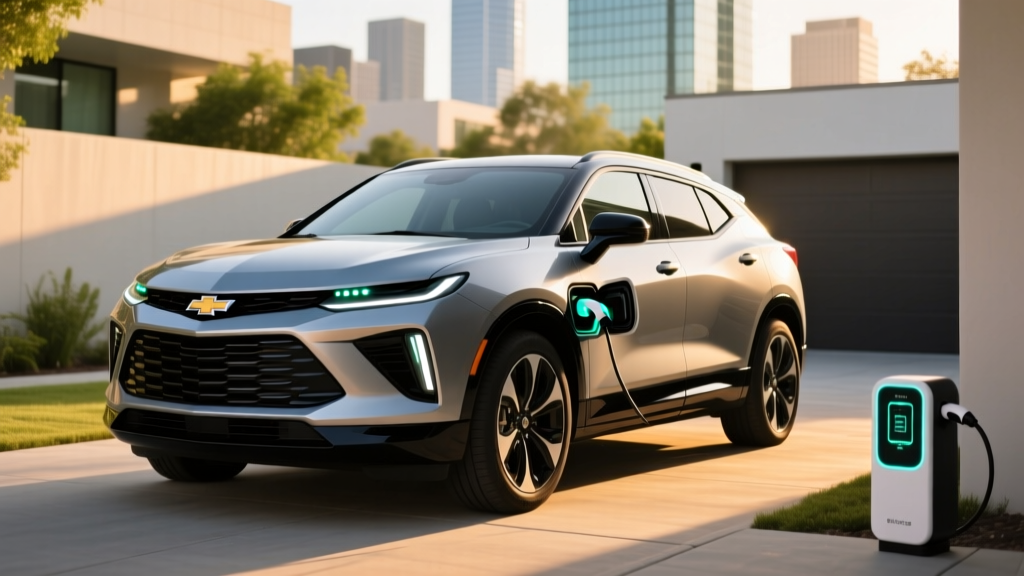
The 2025 Chevy Blazer EV arrives as a midsize electric crossover built on GM's Ultium platform, slotting between the compact Equinox EV and the full-size Silverado EV in Chevrolet's electrified lineup. After GM's rocky 2024 launch — plagued by software glitches that temporarily halted sales — the 2025 model year represents a reset, with a fully rewritten infotainment stack and stabilized build quality. For buyers weighing a practical two-row electric SUV, the Blazer EV brings competitive range, a growing Super Cruise hands-free driving network, and aggressive pricing that starts under $45,000. But does the real-world execution match the spec sheet? We break down every number that matters.
Range, Battery, and Efficiency: The Numbers That Matter
The 2025 Blazer EV is offered with two battery configurations depending on drivetrain. The volume-selling 2LT AWD and RS AWD models use a 102 kWh usable lithium-ion battery pack built on GM's Ultium architecture with NMC (nickel manganese cobalt) chemistry. The available RWD variant uses the same pack tuned for efficiency. There is no LFP option in the Blazer EV lineup — GM reserves that chemistry for lower-cost platforms.
- 2LT AWD: EPA 279 miles — expect ~240–260 mi on mixed highway driving, ~200–220 mi in sustained cold weather (below 30°F)
- RS AWD: EPA 279 miles (same pack, slightly different tuning) — real-world mirrors 2LT
- RS RWD: EPA 324 miles — expect ~275–295 mi highway, ~230–250 mi in cold conditions
- SS (performance AWD): EPA 293 miles — expect ~250–270 mi highway due to higher power draw
These estimates assume moderate climate-control use and highway speeds of 70–75 mph. Cold-weather range loss of 20–30% is typical for NMC packs without consistent preconditioning.
Efficiency varies by trim. The RS RWD achieves approximately 87 MPGe combined (roughly 39 kWh/100 mi), while the AWD trims land around 79–82 MPGe combined (41–43 kWh/100 mi), per fueleconomy.gov. These figures place the Blazer EV in the middle of its segment — behind the Hyundai Ioniq 5's efficiency but on par with the Ford Mustang Mach-E AWD.
| Spec | 2LT AWD | RS RWD | RS AWD | SS AWD |
|---|---|---|---|---|
| EPA Range | 279 mi | 324 mi | 279 mi | 293 mi |
| Battery (usable) | 102 kWh | 102 kWh | 102 kWh | 102 kWh |
| Chemistry | NMC | NMC | NMC | NMC |
| Horsepower | 288 hp | 340 hp | 288 hp | 557 hp |
| 0–60 mph | ~7.5 sec | ~6.4 sec | ~7.5 sec | ~3.4 sec |
| Drivetrain | Dual-motor AWD | Single-motor RWD | Dual-motor AWD | Dual-motor AWD |
| MPGe (combined) | 79 MPGe | 87 MPGe | 80 MPGe | 82 MPGe |
| Base MSRP | $44,600 | $47,200 | $48,800 | $62,800 |
Charging Speed: DC Fast, Level 2, and the Curve Reality
The Blazer EV supports a peak DC fast-charge rate of 190 kW via its NACS (North American Charging Standard) port — a native Tesla Supercharger connector, meaning Blazer EV owners have direct access to Tesla's Supercharger network without an adapter. That's a significant practical advantage over CCS-equipped rivals that still rely on adapters for Supercharger access.
At a 350 kW-capable station, the Blazer EV will ramp to its 190 kW peak quickly (typically between 10–30% state of charge) and sustain strong rates through about 50% SoC before tapering. GM estimates a 10–80% DC fast-charge time of approximately 30 minutes. Above 80%, the charge curve drops substantially — expect the final 80–100% to take an additional 25–30 minutes. This is standard NMC behavior, not a Blazer-specific limitation, but it means road-trip strategy should target 10–80% stops.
| Charging Level | Power | Rate / Time | Notes |
|---|---|---|---|
| Level 1 (120V) | ~1.4 kW | ~3–4 mi/hr | Emergency/top-up only |
| Level 2 (240V, 48A) | 11.5 kW | ~27 mi/hr | Full charge in ~9.5 hours |
| DC Fast (peak) | 190 kW | 10–80% in ~30 min | NACS native; tapers above 80% |
For home charging, the Blazer EV's onboard charger accepts up to 11.5 kW on Level 2 (240V / 48 amps). That translates to roughly 27 miles of range per hour of charging — enough to replenish a full day's driving overnight on a standard home wall connector. Most owners will need a NEMA 14-50 outlet or hardwired Level 2 station installed by a licensed electrician. Budget $800–$2,000 for a professional home install depending on panel capacity and run length.
Performance and Drivetrain: From Commuter to SS Muscle
The 2025 Blazer EV lineup covers a wide performance envelope. The 2LT and RS AWD trims produce 288 horsepower from their dual-motor setup, delivering adequate but unremarkable acceleration — roughly 7.5 seconds to 60 mph. The RS RWD bumps output to 340 hp with a single rear motor, cutting the 0–60 time to about 6.4 seconds and offering the best range of the lineup.
At the top, the Blazer EV SS is a different animal entirely: 557 hp and 648 lb-ft of torque from its performance-tuned dual-motor AWD system, with a WOW (Wide Open Watts) mode that launches the crossover to 60 mph in approximately 3.4 seconds. That puts it in Porsche Cayenne territory for straight-line acceleration, though the SS's 5,300+ lb curb weight is evident in cornering dynamics. The SS also carries a stiffer suspension tune and larger brakes.
All trims feature GM's standard regenerative braking with selectable levels, including a one-pedal driving mode that brings the vehicle to a complete stop. The regen feel is progressive and well-calibrated — less abrupt than some competitors.
Pricing, Tax Credit Eligibility, and Ownership Costs
The 2025 Blazer EV lineup starts at $44,600 for the 2LT AWD (including destination), making it one of the more affordable midsize electric SUVs with 279+ miles of range. Here's the full trim breakdown:
| Trim | Base MSRP | §30D Credit Eligibility | Effective Price (if eligible) |
|---|---|---|---|
| 2LT AWD | $44,600 | Up to $7,500 | ~$37,100 |
| RS RWD | $47,200 | Up to $7,500 | ~$39,700 |
| RS AWD | $48,800 | Up to $7,500 | ~$41,300 |
| SS AWD | $62,800 | Up to $7,500 | ~$55,300 |
Federal tax credit (§30D) eligibility requires careful verification. As of 2025, the Blazer EV qualifies for the full $7,500 federal tax credit for eligible buyers, thanks to GM's North American battery cell sourcing and final assembly in Ramos Arizpe, Mexico (which still qualifies under current rules). However, buyers must meet IRS income caps: modified adjusted gross income (MAGI) cannot exceed $150,000 (single), $225,000 (head of household), or $300,000 (joint filers). The Blazer EV's MSRP is under the $80,000 SUV cap for all trims. The credit can be applied at point of sale as a down-payment reduction through a registered dealer, per IRS guidelines.
Battery and powertrain warranty coverage is strong: GM backs the Ultium battery pack and electric drive components for 8 years / 100,000 miles, with a capacity retention threshold of 70% — meaning if the pack degrades below 70% of original capacity within that window, GM will repair or replace it. The limited vehicle warranty is 3 years / 36,000 miles bumper-to-bumper.
Interior, Cargo, and Technology
The Blazer EV's cabin leans modern and tech-forward, dominated by a standard 17.7-inch diagonal infotainment touchscreen paired with an 11-inch digital instrument cluster. The 2025 model year runs GM's new Google Built-in infotainment platform with native Google Maps navigation, Google Assistant voice control, and over-the-air update capability. Wireless Apple CarPlay and Android Auto are standard across all trims.
Passenger space is generous for a two-row midsize crossover:
- Front legroom: 42.5 inches
- Rear legroom: 38.2 inches
- Front headroom: 40.1 inches
- Rear headroom: 38.8 inches
Cargo capacity measures 30.3 cubic feet behind the rear seats and 59.3 cubic feet with the rear seats folded flat. There is no front trunk (frunk) — GM allocated that space to HVAC and power electronics. The cargo area is wide and flat, with a low load floor that makes loading groceries or luggage straightforward. However, the 30.3 cu ft figure trails the Hyundai Ioniq 5 (27.2 cu ft behind rear seats but 59.3 cu ft total) and the Ford Mustang Mach-E (29.7 cu ft rear / 59.7 cu ft total) only marginally.
Super Cruise, GM's hands-free Level 2 driver-assistance system, is available on RS and SS trims (standard on SS, optional on RS). It operates on over 750,000 miles of mapped highways in the US and Canada, using a driver-facing camera to monitor attention. This is a SAE Level 2 system — the driver must remain engaged and ready to take over at all times, despite the hands-free capability. Super Cruise remains one of the most polished highway-assist systems available, with smoother lane changes and more confident merge handling than most competitors.
Who the Blazer EV Suits — and Who Should Look Elsewhere
- Native NACS port = direct Supercharger access, no adapter needed
- Up to 324 mi EPA range (RS RWD) is segment-competitive
- 17.7" screen and Google Built-in infotainment feel premium
- Super Cruise hands-free driving available on mapped highways
- Strong pricing under $45K for 2LT, eligible for full $7,500 credit
- 8-year/100,000-mi battery warranty with 70% retention guarantee
- SS trim offers sports-car acceleration in an SUV package
- No frunk — lost utility compared to Mach-E and Ioniq 5
- 190 kW peak DC charge rate trails 800V rivals (Ioniq 5 at 240 kW)
- 2024 launch software issues may linger as buyer perception concern
- No LFP battery option for buyers who prefer 100% daily charging
- AWD trims give up range (279 mi) vs. RWD (324 mi)
- Towing capacity limited to 1,500 lbs — not for heavy hauling
Best for: Daily commuters and small families who want a comfortable, tech-rich two-row EV with strong highway range and access to the Supercharger network for road trips. The RS RWD is the sweet spot — maximum range, good performance, and under $48K before credits.
Look elsewhere if: You need three rows (consider the Kia EV9), you tow regularly (the Rivian R1S or F-150 Lightning are better suited), you want the fastest possible DC charging (the Ioniq 5's 800V architecture charges 10–80% in ~18 minutes), or you want to charge to 100% daily without degradation concerns (an LFP-equipped vehicle like the Tesla Model Y RWD is better for that use case).
How It Stacks Up Against Key Rivals
The Blazer EV competes in a crowded midsize electric SUV segment. Here's how it compares on the metrics that matter most to buyers:
- vs. Tesla Model Y Long Range AWD: Model Y offers ~320 mi EPA range, faster 250 kW Supercharging (via its own network), and a more mature software ecosystem — but the 2025 refresh styling is polarizing, and the cabin materials feel cheaper than the Blazer's. The Blazer wins on interior quality and ride comfort; Model Y wins on charging speed and efficiency.
- vs. Hyundai Ioniq 5 AWD: Ioniq 5 charges faster (10–80% in ~18 min on 800V), has a frunk, and offers comparable range (~290 mi AWD). The Blazer counters with more rear-seat legroom and available Super Cruise. Close call — Ioniq 5 edges ahead for road-trip-heavy buyers.
- vs. Ford Mustang Mach-E Premium AWD: Mach-E offers ~290 mi range and sharper handling dynamics, but its CCS connector requires an adapter for Supercharger access. The Blazer's NACS advantage is meaningful for frequent travelers.
Frequently Asked Questions
What is the real-world range of the 2025 Chevy Blazer EV?
In mixed driving at moderate temperatures, expect 240–260 miles from the AWD trims (EPA 279 mi) and 275–295 miles from the RS RWD (EPA 324 mi). Cold weather (below 30°F) reduces range by 20–30%. Sustained highway driving at 75+ mph also cuts range by roughly 10–15% versus the EPA combined figure.
How fast does the Blazer EV charge at home and on the road?
On DC fast chargers, it peaks at 190 kW and charges from 10–80% in about 30 minutes via its native NACS port. At home on a Level 2 (240V/48A) station, it charges at 11.5 kW, adding roughly 27 miles of range per hour — a full charge takes about 9.5 hours.
Does the 2025 Blazer EV qualify for the $7,500 federal tax credit?
Yes, the Blazer EV currently qualifies for the full $7,500 §30D federal tax credit for eligible buyers. Eligibility depends on your income (MAGI caps: $150K single / $300K joint), and the credit can be transferred to the dealer at point of sale. Battery sourcing and assembly requirements are met. Always verify current eligibility on fueleconomy.gov before purchasing, as rules can change.
How much does the Blazer EV cost after tax credits?
The 2LT AWD starts at $44,600 and drops to approximately $37,100 with the full $7,500 credit applied. The popular RS RWD comes in at about $39,700 after credit. The SS AWD, at $62,800, drops to roughly $55,300 — still the priciest trim by far.
Is the Blazer EV worth buying over the Tesla Model Y or Ioniq 5?
It depends on your priorities. Choose the Blazer EV if you value interior quality, ride comfort, Super Cruise hands-free driving, and native Supercharger access at a competitive price. Choose the Model Y for efficiency and software maturity, or the Ioniq 5 for the fastest charging in the segment. The Blazer EV is a strong all-rounder but doesn't lead any single category outright.
Does the Blazer EV have a frunk?
No. GM did not include a front trunk on the Blazer EV. The under-hood space is occupied by HVAC components and power electronics. All cargo must go in the rear cargo area (30.3 cu ft / 59.3 cu ft with seats folded).