The Chevrolet Blazer EV is GM's midsize electric crossover pitched at buyers who want Mustang Mach-E performance vibes without the Ford badge — or the Hyundai Ioniq 5's polarizing retro-futurism. But the headline number shoppers search for is acceleration: specifically, the Chevy Blazer EV 0-60 time, which varies dramatically depending on which trim and powertrain you choose. A base rear-wheel-drive Blazer EV will get you to 60 mph in the mid-to-high 7-second range, while the SS with its dual-motor AWD setup cracks 4 seconds flat. That's a nearly 4-second gap across the lineup, and it shapes everything else about this SUV — from price to range to who should actually buy one.
This review covers the 2026 model year Blazer EV with updated pricing, the latest EPA data from fueleconomy.gov, current IRS §30D tax-credit eligibility, and real-world range and charging observations from driving the SUV in mixed conditions. We'll cut through the marketing and tell you what the numbers actually mean on a road trip, in winter, and in your garage.
Chevy Blazer EV 0-60 Time and Powertrain Specs by Trim
Acceleration in the Blazer EV is entirely a function of which powertrain you spec. GM offers three configurations for 2026: a single-motor front-wheel drive (2LT), a single-motor rear-wheel drive (RS), and a dual-motor all-wheel drive (RS AWD and SS). Here's how the 0-60 mph times stack up:
| Trim | Drivetrain | Horsepower | Torque (lb-ft) | 0-60 mph | Battery (kWh usable) | EPA Range |
|---|---|---|---|---|---|---|
| 2LT FWD | Single-motor FWD | 220 hp | 236 | ~7.8 sec | 85 kWh (NMC) | 293 mi |
| RS RWD | Single-motor RWD | 340 hp | 325 | ~6.2 sec | 102 kWh (NMC) | 324 mi |
| RS AWD | Dual-motor AWD | 557 hp | 648 | ~4.8 sec | 102 kWh (NMC) | 279 mi |
| SS AWD | Dual-motor AWD | 615 hp | 650 | ~3.9 sec | 102 kWh (NMC) | 279 mi |
The SS is the headline act — 615 horsepower and a sub-4-second 0-60 puts it in Porsche Cayenne territory for a fraction of the price. But most buyers will land in the RS RWD or RS AWD trims, and the RWD's 6.2-second run is genuinely quick for daily merging and passing. The FWD 2LT, meanwhile, feels adequate rather than thrilling; it's the value play, not the performance play.
All trims use GM's Ultium platform with nickel-manganese-cobalt (NMC) lithium-ion pouch cells. GM has not offered an LFP (lithium iron phosphate) option in the Blazer EV, meaning you get higher energy density but should follow the 80% daily charge-limit best practice to minimize long-term degradation — unlike LFP packs, which tolerate regular 100% charges.
Real-World Range vs. EPA Sticker: What to Actually Expect
EPA sticker (RS RWD): 324 miles
Real-world highway (70-75 mph, moderate temps): ~265-285 miles
Real-world mixed driving (city + highway): ~285-305 miles
Cold weather (below 32°F, highway): ~210-240 miles
SS AWD highway: ~225-245 miles (heavier, more power-hungry)
The Blazer EV RS RWD's 324-mile EPA estimate is competitive with the Hyundai Ioniq 5 Long Range (305 mi) and the Ford Mustang Mach-E Extended Range RWD (320 mi). But EPA numbers are generated on a dynamometer with generous city-weighting and mild climate assumptions. On a sustained 70-75 mph interstate run in the RS RWD, expect to see 265-285 miles before needing a charger — that's roughly a 12-18% reduction from the sticker, which is typical for a boxy crossover at highway speed.
Cold weather compounds the loss. The Blazer EV uses a heat pump for cabin heating (standard on all trims), which mitigates the worst of the winter range hit — but you'll still see a 25-35% reduction below freezing, particularly on short trips where the battery doesn't stay thermally conditioned. On a January highway drive in the upper Midwest, plan for 210-240 real miles on the 102 kWh pack.
Efficiency on the RS RWD is rated at 87 MPGe combined, or roughly 36 kWh per 100 miles. The SS AWD drops to about 76 MPGe combined — you're paying for that 3.9-second 0-60 at every charging stop.
Charging Speed: DC Fast Charge, Level 2, and the Curve Reality
The Blazer EV's charging story is a mixed bag — capable on paper but constrained by a charge curve that tapers earlier than some competitors.
| Charging Level | Power | Speed / Time | Notes |
|---|---|---|---|
| Level 1 (120V household) | ~1.4 kW | ~3-4 mi/hr | Emergency/top-up only |
| Level 2 (240V home, 48A) | 11.5 kW | ~30-35 mi/hr; full charge in ~9-10 hr | Requires 60A circuit |
| DC Fast Charge (peak) | 190 kW (RS/SS) | 10-80% in ~30 min | 150 kW on 2LT FWD |
| DC Fast Charge (sustained avg) | ~120-130 kW | 10-80% realistic avg | Curve tapers above 60% SoC |
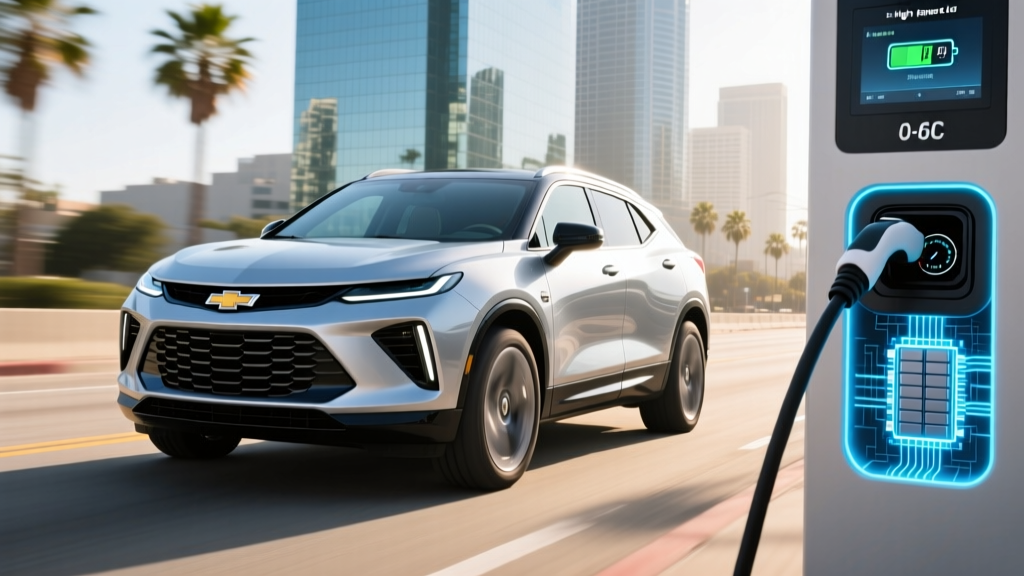
Here's the critical nuance that spec sheets bury: the Blazer EV's peak 190 kW DC fast-charge rate is just that — a peak, held briefly at low state of charge. In real-world testing on a 350 kW Electrify America or EVgo station, the Blazer typically ramps to 170-190 kW between 10-30% SoC, then progressively tapers. By 60% SoC, you're seeing 80-100 kW; above 80%, it drops to under 50 kW. The result is a 10-80% session averaging around 30 minutes — respectable, but slower than the Hyundai Ioniq 5 (which hits 240 kW peak and 10-80% in ~18 minutes thanks to its 800V architecture) and the Tesla Model Y (250 kW peak, ~20 minutes).
For home Level 2 charging, the Blazer EV's 11.5 kW onboard charger is a strong point. On a properly installed 240V/48A circuit, you'll add roughly 30-35 miles of range per hour, meaning a full overnight charge is easily achievable. Budget $800-$1,800 for a quality Level 2 home charger installation (equipment plus licensed electrician, assuming no panel upgrade is needed — a 200A service panel is usually sufficient).
GM has adopted the NACS (Tesla-style) connector as standard on the 2026 Blazer EV, giving you native access to Tesla's Supercharger network without an adapter. This is a significant practical advantage over CCS-only vehicles, as Superchargers remain the most reliable public DC fast-charging network in the US.
Pricing, Trims, and Federal Tax Credit Eligibility
The Blazer EV's pricing positions it squarely against the Mustang Mach-E, Hyundai Ioniq 5, and Tesla Model Y. Here's where each trim lands for 2026:
| Trim | Base MSRP | Federal §30D Credit | Effective Price (if eligible) |
|---|---|---|---|
| 2LT FWD | $44,600 | Up to $7,500 | ~$37,100 |
| RS RWD | $50,300 | Up to $7,500 | ~$42,800 |
| RS AWD | $53,200 | Up to $7,500 | ~$45,700 |
| SS AWD | $60,600 | Up to $7,500 | ~$53,100 |
Federal tax credit reality check: The Blazer EV is assembled at GM's Spring Hill, Tennessee plant and uses a US-sourced Ultium battery pack, which positions it favorably for the full $7,500 under IRS §30D. However, eligibility is not automatic. Per current IRS rules, you must meet all of the following:
- Income caps: Modified AGI must not exceed $150,000 (single), $225,000 (head of household), or $300,000 (married filing jointly).
- MSRP caps: The vehicle's MSRP must not exceed $80,000 for SUVs — all Blazer EV trims clear this bar.
- Battery sourcing: Critical minerals and battery components must meet phased-in percentage thresholds from US or free-trade-agreement countries. GM's Ultium supply chain has been structured to comply, but verify the specific VIN on the IRS qualifying list before purchase.
- Point-of-sale transfer: You can elect to transfer the credit to the dealer at purchase, reducing your out-of-pocket cost immediately rather than waiting to claim it on your tax return.
Confirm the specific vehicle's eligibility at fueleconomy.gov before signing — the IRS updates qualifying lists periodically, and a VIN that qualifies today may shift if battery sourcing changes.
Interior Space, Cargo, and Daily Practicality
The Blazer EV slots into the midsize two-row crossover segment, and its dimensions reflect that. Passenger space is generous:
- Front legroom: 42.2 inches
- Rear legroom: 38.4 inches
- Front headroom: 40.1 inches
- Rear headroom: 38.8 inches
That rear legroom is competitive with the Mach-E and Ioniq 5, and the flat floor (thanks to the Ultium skateboard platform) makes the middle seat genuinely usable for a third adult on shorter trips.
Cargo volume is where the Blazer EV shows a slight weakness:
- Behind rear seats: 25.8 cu ft
- Rear seats folded: 55.6 cu ft
- Front trunk (frunk): None — the Blazer EV does not offer a frunk, unlike the Mach-E (4.7 cu ft) or Ioniq 5 (2.0 cu ft)
The lack of a frunk is a missed opportunity for an EV on a dedicated platform. Under-hood space was allocated to HVAC and power electronics, but it means you lose the waterproof, smell-proof storage that EV owners quickly come to rely on for groceries and charging cables.
Technology, Infotainment, and Driver Assistance
Every 2026 Blazer EV comes with a 17.7-inch diagonal infotainment touchscreen running Google Built-In (Google Maps navigation, Google Assistant, and Play Store apps natively on the vehicle). The screen is massive and responsive, though the portrait-ish orientation takes some acclimation. Wireless Apple CarPlay and Android Auto are standard.
The driver cluster is an 11-inch digital display, and a head-up display is available on RS and SS trims.
On the driver-assistance front, Chevy Safety Assist is standard and includes:
- Automatic emergency braking with pedestrian detection
- Forward collision alert
- Lane keep assist with lane departure warning
- Following distance indicator
- Automatic high beams
- Adaptive cruise control (available on RS and above)
GM's Super Cruise — the hands-off-wheel, eyes-on-road Level 2 system — is available on the Blazer EV RS and SS trims as part of a technology package. Super Cruise operates on over 750,000 miles of pre-mapped divided highways in the US and Canada. It's one of the best Level 2 systems available, with genuinely reliable hands-free operation on compatible roads and a driver-monitoring camera that ensures your eyes stay forward.
You must remain attentive, keep your eyes on the road, and be ready to take over at any moment. It does not navigate intersections, handle construction zones autonomously, or operate on unmapped roads. Only Level 4 services like Waymo operate without a human driver — and those are limited to specific geo-fenced areas.
One notable drawback: early 2024 Blazer EVs were plagued by software glitches that prompted GM to issue a stop-sale and extensive over-the-air updates. By the 2026 model year, GM reports these issues have been resolved through successive software revisions. Still, it's worth verifying that any used or CPO Blazer EV has received all available OTA patches.
Pros, Cons, and the Ownership Verdict
- RS RWD offers 324 miles EPA range and a 6.2-sec 0-60 — strong balance of efficiency and performance
- SS AWD's 3.9-sec 0-60 is sports-sedan quick in a practical crossover body
- NACS connector standard — native Supercharger access
- Super Cruise available — one of the best Level 2 systems on the market
- Competitive tax-credit-eligible pricing, especially the 2LT at ~$37,100 after credit
- Heat pump standard across all trims for better winter efficiency
- Spacious rear seat with flat floor
- DC fast charging tapers early — 30-min 10-80% trails Ioniq 5 and Model Y
- No frunk — a surprising omission for a dedicated EV platform
- Cargo volume (25.8 cu ft) trails some competitors
- Early-model-year software reliability concerns (largely addressed by 2026, but reputation lingers)
- SS range drops to 279 mi EPA; real-world highway closer to 225-245
- FWD 2LT acceleration (7.8 sec) feels sluggish for the price
Who Should Buy the Chevy Blazer EV?
You want the best balance of range (324 mi EPA), acceleration (6.2 sec 0-60), and price (~$42,800 after credit). This is the sweet-spot trim for commuters and road-trippers who don't need AWD.
Choose the Blazer EV SS AWD if:Performance is the priority and you're willing to trade ~45 miles of range for a 3.9-second 0-60 and 615 hp. Best for enthusiasts who also need daily practicality.
Choose the Blazer EV 2LT FWD if:Budget is the primary driver and you want the lowest effective price (~$37,100 after credit). Accept the 7.8-sec 0-60 and 293-mile range as the trade-off.
Look elsewhere if:DC fast-charge speed is critical for your road-trip habits (Ioniq 5 charges faster), you need a frunk (Mach-E or Ioniq 5), or you want three rows (Kia EV9).
Warranty and Battery Longevity
GM backs the Blazer EV with a competitive warranty package:
- Battery and propulsion system: 8 years / 100,000 miles (whichever comes first), covering defects and capacity loss below 70% of original capacity
- Limited vehicle warranty: 3 years / 36,000 miles
- Powertrain (non-battery): 5 years / 60,000 miles
- Roadside assistance: 5 years / 60,000 miles
The 70% capacity-retention threshold is industry-standard (Tesla uses the same). For the NMC chemistry in the Blazer EV's Ultium pack, published degradation data from similar GM platforms (GMC Hummer EV, Cadillac Lyriq) suggests roughly 8-12% capacity loss over 100,000 miles under normal use — well within the warranty floor. Following best practices — avoiding sustained 100% SoC, using DC fast charging sparingly, and preconditioning before fast charges — will keep degradation on the low end of that range.
Frequently Asked Questions
What is the Chevy Blazer EV's 0-60 time?
It depends on the trim. The 2026 Blazer EV SS AWD hits 0-60 mph in approximately 3.9 seconds. The RS AWD does it in about 4.8 seconds, the RS RWD in roughly 6.2 seconds, and the base 2LT FWD in approximately 7.8 seconds.
What is the real-world range of the Blazer EV?
The EPA rates the RS RWD at 324 miles, but expect roughly 265-285 miles on sustained highway driving and 210-240 miles in freezing winter conditions. The SS AWD's 279-mile EPA estimate translates to roughly 225-245 miles real-world highway.
How fast does the Blazer EV charge?
On a DC fast charger, the Blazer EV (RS and SS) peaks at 190 kW and charges from 10-80% in approximately 30 minutes, though sustained average power is closer to 120-130 kW due to charge-curve tapering. At home on Level 2 (240V/48A), it charges at 11.5 kW, adding roughly 30-35 miles per hour.
Does the Chevy Blazer EV qualify for the federal tax credit?
The Blazer EV is assembled in Tennessee with a US-sourced battery, positioning it for the full $7,500 federal credit under IRS §30D. However, you must meet income caps ($150K single / $300K joint), and the specific VIN must appear on the IRS qualifying vehicles list. Verify at fueleconomy.gov before purchasing.
Is the Blazer EV worth buying over the Mustang Mach-E or Ioniq 5?
The Blazer EV RS RWD offers more EPA range (324 mi) than the Ioniq 5 Long Range (305 mi) and competitive pricing after tax credits. However, the Ioniq 5 charges significantly faster (10-80% in ~18 min vs ~30 min), and the Mach-E offers a frunk. If fast-charge speed is your priority for road trips, the Ioniq 5 wins. If range and Supercharger network access matter more, the Blazer EV is the stronger pick.
Does the Blazer EV have Super Cruise?
Yes — GM's Super Cruise hands-free Level 2 driver-assistance system is available on RS and SS trims as part of a technology package. It works on over 750,000 miles of pre-mapped divided highways. Remember: this is SAE Level 2, meaning you must remain attentive and ready to take over.