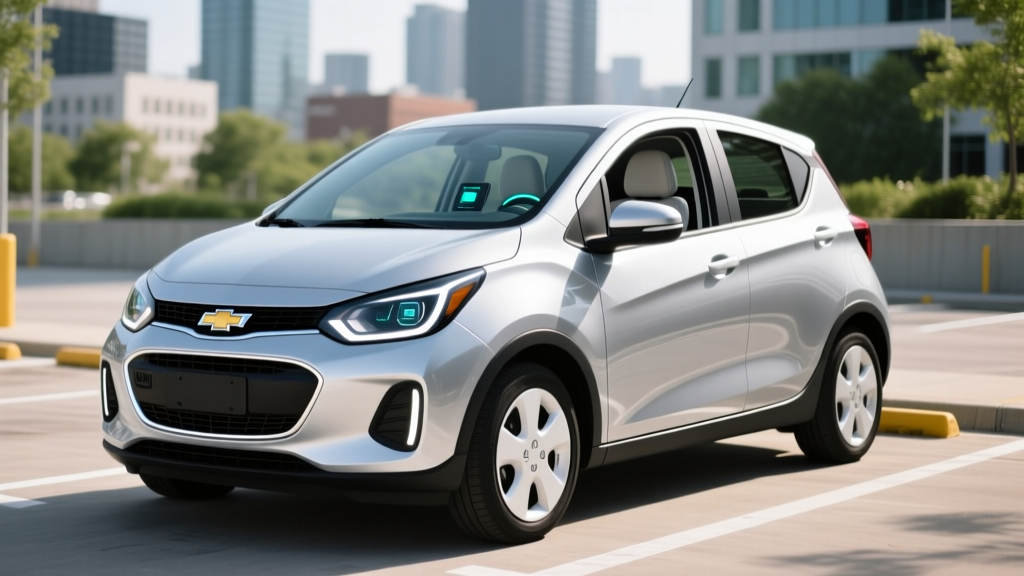
The Chevrolet Spark EV was discontinued after the 2016 model year, replaced by the Bolt EV. But with used prices hovering between $6,000 and $11,000 in 2026, it remains one of the cheapest ways to get into a battery-electric vehicle. Before you buy, though, you need to understand the real ownership math — especially Chevrolet Spark EV car insurance, which can surprise budget-conscious shoppers, and the fact that federal tax credits for this model have changed dramatically since it was new.
We've run the numbers on every cost category — insurance, charging, maintenance, depreciation, and available incentives — to give you a clear picture of what owning a used Spark EV actually costs in 2026.
Spark EV Quick Specs: What You're Working With
Understanding ownership costs starts with understanding the hardware. The 2014–2016 Spark EV is a compact, city-focused BEV with modest specs by today's standards but respectable efficiency.
| Specification | 2014–2015 Model | 2016 Model |
|---|---|---|
| Battery Capacity | 21.3 kWh (NMC) | 18.4 kWh (NMC, LG Chem) |
| EPA Range | 82 miles | 82 miles |
| EPA Efficiency | 119 MPGe (28 kWh/100mi) | 119 MPGe (28 kWh/100mi) |
| Motor Output | 114 hp / 400 lb-ft torque | 143 hp / 327 lb-ft torque |
| 0–60 mph | ~7.6 seconds | ~7.2 seconds |
| DC Fast Charge (CCS) | Up to 50 kW (SAE Combo on 2015–16) | Up to 50 kW |
| Level 2 Charge Rate | 3.3 kW (2014) / 3.6 kW (2015–16) | 3.6 kW |
| Level 2 Full Charge Time | ~7 hours (2014) | ~5–6 hours |
| Battery Warranty (Original) | 8 yr / 100,000 mi | 8 yr / 100,000 mi |
| Original MSRP | ~$26,685 (before incentives) | ~$25,995 (before incentives) |
| Typical Used Price (2026) | $6,000 – $11,000 | |
How Much Does It Really Cost to Own a Spark EV Over 5 Years?
The total cost of ownership (TCO) for a used Spark EV is remarkably low compared to most vehicles — new or used — but it's not zero, and the insurance line item deserves attention. Here's a realistic 5-year breakdown based on 12,000 miles driven annually.
| Cost Category | Annual Cost | 5-Year Total | Notes |
|---|---|---|---|
| Purchase Price (Used) | — | $8,500 (avg) | 2015–2016 model, ~50k–70k miles |
| Insurance | $1,550 | $7,750 | Full coverage; varies by state/driver |
| Home Charging (Level 2) | $430 | $2,150 | At $0.14/kWh national avg |
| Maintenance & Repairs | $350 | $1,750 | Tires, cabin filter, wipers, potential battery diagnostics |
| Depreciation | ~$400 | ~$2,000 | From $8,500 to ~$6,500 over 5 years |
| Registration & Taxes | $150 | $750 | Varies significantly by state |
| Total 5-Year Cost | ~$22,900 | Including purchase price | |
| Total Operating Cost (excl. purchase) | $2,880 | $14,400 | Insurance + energy + maintenance + depreciation + registration |
For comparison, a 2016 Honda Fit (a common cross-shop) over the same period would cost roughly $20,500 in total 5-year operating costs — higher fuel expense offset by lower insurance and slower depreciation. The Spark EV's operating advantage comes almost entirely from fuel savings, but insurance erodes a significant portion of that gain.
Chevrolet Spark EV Car Insurance: Why It Costs More Than You'd Expect
The keyword question: how much does Chevrolet Spark EV car insurance actually cost, and why is it higher than insuring a gas-powered Spark or similar subcompact?
Average annual premium: $1,400 to $1,800 for full coverage, depending on your state, driving record, age, and insurer. That's roughly 15–25% higher than insuring a comparable gas-powered subcompact like a Chevrolet Spark (gas) or Honda Fit, which typically run $1,100–$1,400 annually.
Several factors drive this EV insurance premium:
- Battery replacement risk: Even though the Spark EV's battery is small (18.4–21.3 kWh), a collision-damaged pack can cost $4,000–$8,000+ to replace. Insurers price in this exposure.
- Specialized repair requirements: High-voltage system repairs require certified EV technicians, and fewer shops have that certification — driving up labor costs in claims.
- Total-loss thresholds: With a used value of $6,000–$11,000, even a moderate accident (say, $5,000 in battery and structural damage) can push the vehicle past the total-loss threshold in many states (typically 70–80% of vehicle value).
- Limited parts availability: The Spark EV has been out of production for a decade. Sourcing OEM body panels and EV-specific components takes longer and costs more.
- Torque-related claims data: The Spark EV's instant torque (327–400 lb-ft in a 2,900-lb car) produces spirited acceleration that insurers associate with higher incident rates among certain driver demographics.
Federal Tax Credits: What Applies to a Used Spark EV in 2026?
When new, the Spark EV qualified for the full $7,500 federal tax credit under the old §30D rules. That program has changed substantially. For a used Spark EV purchase in 2026, the relevant credit is the Previously-Owned Clean Vehicle Credit (also under §25E, established by the Inflation Reduction Act).
Used EV Tax Credit (§25E) — Up to $4,000:
- Credit amount: 30% of the sale price, capped at $4,000 maximum
- Vehicle price cap: Sale price must be $25,000 or less (the Spark EV easily qualifies at $6,000–$11,000)
- Vehicle age requirement: Must be at least 2 model years old (all Spark EVs qualify)
- Buyer income limits (modified AGI): $75,000 single / $112,500 head of household / $150,000 joint
- Dealer requirement: Must be purchased from a licensed dealer (private-party sales do NOT qualify)
- Point-of-sale transfer: As of 2024+, you can transfer the credit to the dealer for an immediate price reduction at purchase
- First-time transfer rule: The vehicle must not have been transferred under §25E after August 16, 2022 (verify with the dealer)
- Battery capacity: Must have at least 7 kWh (Spark EV's 18.4–21.3 kWh qualifies)
For a Spark EV purchased at $8,500 from a qualifying dealer, the 30% calculation yields $2,550 — well under the $4,000 cap. If your income is under the thresholds and you buy from a dealer, you can apply this as a point-of-sale discount, effectively bringing your purchase price down to roughly $5,950.
Always verify current rules at IRS.gov's used clean vehicle credit page before purchasing, as income thresholds, dealer registration requirements, and transfer rules are subject to legislative and regulatory updates.
State, Local, and Utility Incentives
Incentives vary significantly by region. Some examples available in 2026 (subject to change and availability):
- California (CVRP): Up to $1,000 for used EVs purchased by income-qualified buyers (check California Energy Commission for current eligibility)
- Colorado: State tax credit of up to $3,500 for used EVs under $25,000 (income-dependent)
- Utility rebates: Many utilities offer $200–$500 rebates for used EV purchases or home Level 2 charger installation. Check your local utility's EV programs.
- HOV lane access: Several states (CA, CO, MD, VA) grant solo HOV lane access to EVs — a significant non-monetary perk for commuters.
Consult the Alternative Fuels Data Center for a state-by-state incentive database.
Charging Costs vs. Gasoline: The Spark EV's Biggest Financial Advantage
This is where the Spark EV earns its keep. With an EPA efficiency rating of 119 MPGe (28 kWh per 100 miles), it's one of the most energy-efficient EVs ever sold in the US. That small battery and light curb weight (~2,900 lbs) translate directly into low fueling costs.
| Fueling Scenario | Cost per Mile | Annual Cost (12,000 mi) | 5-Year Cost |
|---|---|---|---|
| Spark EV — Home Level 2 ($0.14/kWh) | $0.039 | $468 | $2,340 |
| Spark EV — Home Level 2 ($0.20/kWh, high-rate state) | $0.056 | $672 | $3,360 |
| Spark EV — Public DC Fast Charging ($0.40/kWh avg) | $0.112 | $1,344 | $6,720 |
| Gas Spark (1.4L turbo, 30 MPG combined, $3.30/gal) | $0.110 | $1,320 | $6,600 |
| Honda Fit (36 MPG combined, $3.30/gal) | $0.092 | $1,104 | $5,520 |
The bottom line: Charging at home at the national average electricity rate ($0.14/kWh), the Spark EV costs roughly $0.04 per mile to fuel — about one-third the cost of the gas Spark and less than half the cost of a Honda Fit. Over 5 years, that's a savings of $3,000–$4,200 compared to gasoline equivalents.
However, this advantage collapses if you rely primarily on public DC fast charging. At $0.40/kWh (a common Electrify America or EVgo rate in 2026), the Spark EV's fuel cost per mile essentially matches the gas Spark. Home charging access is critical to realizing the EV cost advantage.
Maintenance Savings: Where the Spark EV Keeps Costs Low
The Spark EV eliminates most of the recurring maintenance costs that gas-car owners accept as routine. There's no engine oil, no spark plugs, no timing belt, no transmission fluid, and no exhaust system. The electric motor has essentially one moving part.
| Maintenance Item | Gas Spark (5-Year Cost) | Spark EV (5-Year Cost) | EV Savings |
|---|---|---|---|
| Oil Changes (every 5k–7.5k mi) | $450–$600 | $0 | $450–$600 |
| Brake Pads/Rotors | $400–$700 | $0–$200 | $200–$700 |
| Transmission Fluid | $100–$200 | $0 | $100–$200 |
| Engine Air Filter | $75–$125 | $0 | $75–$125 |
| Spark Plugs | $150–$250 | $0 | $150–$250 |
| Cabin Air Filter | $75–$125 | $75–$125 | $0 |
| Tires (1–2 sets over 5 years) | $400–$800 | $400–$800 | $0 |
| Coolant Flush | $100–$150 | $100–$150 | $0 |
| Total Estimated | $1,750–$2,950 | $575–$1,275 | $975–$1,675 |
Regenerative braking is the unsung maintenance hero. Because the electric motor handles most deceleration, the friction brakes see far less use. Many Spark EV owners report original brake pads at 80,000+ miles. The trade-off: tires wear at a similar rate to gas cars (the EV's extra weight from the battery offsets the regen benefit for tires), and the EV's battery thermal management coolant does need periodic service.
Battery Degradation: The Wildcard Cost
The Spark EV's NMC lithium-ion battery will have degraded from its original capacity. A 2015 model with 60,000 miles might retain 80–88% of its original capacity, meaning 65–72 real-world miles instead of the original 82. This is normal for a 10-year-old NMC pack.
If the battery drops below 60–70% capacity (State of Health), replacement costs range from $3,500 to $7,000 depending on whether you source a refurbished or new pack. The original 8-year/100,000-mile battery warranty has expired on most 2014–2015 models. A 2016 model purchased new in late 2016 may have warranty coverage through late 2024, but by 2026, virtually all Spark EVs are out of factory battery warranty.
Before buying, request a battery health diagnostic (many dealers and independent EV shops can read the BMS State of Health percentage) or use an OBD-II reader with an app like LeafSpy-compatible EV tools to check degradation yourself.
Depreciation and Resale Value: What to Expect
The Spark EV has already taken its major depreciation hit. Originally priced around $26,000 before incentives, a 2016 model now sells for $6,000–$11,000 — a 60–75% loss from original MSRP. Most of that loss was driven by three factors:
- Discontinued model: No new Spark EVs means no price-floor support from new inventory, but also no new buyers pulling demand upward.
- Small battery / limited range: At 82 miles EPA, the Spark EV is increasingly seen as a second car or city commuter only, limiting its buyer pool.
- General early-EV depreciation: First-generation EVs from all brands (Nissan Leaf, Fiat 500e, Ford Focus Electric) have depreciated steeply as range expectations have shifted to 250+ miles.
Looking forward, expect the Spark EV to depreciate roughly $300–$500 per year from its current value — relatively gentle compared to its early years. It's approaching its value floor as a functional used EV. A well-maintained example with a healthy battery will hold $4,000–$6,000 for the foreseeable future as a commuter/second car.
The silver lining: slow depreciation means you won't lose much equity if you drive it for 3–5 years and sell. This is one of the strongest financial arguments for buying a used Spark EV versus a newer, more expensive EV that still has steep depreciation ahead.
Is the Spark EV the Right Ownership Decision for You?
Buy the Spark EV if:
- You need an ultra-low-cost commuter for a sub-40-mile daily round trip
- You have reliable home Level 2 charging access
- You want to try EV ownership with minimal financial risk
- You're buying from a dealer and qualify for the $2,550 used-EV tax credit
- You already have a longer-range vehicle for road trips
Look elsewhere if:
- Your commute exceeds 50 miles round trip (consider a used Bolt EV or Leaf instead)
- You lack home charging and would rely on public infrastructure
- You need a primary/only vehicle for a household
- You live in a region with extreme cold (the 82-mile range shrinks to ~55 miles in deep winter)
- Insurance quotes in your area exceed $2,000/year (get quotes before buying)
Frequently Asked Questions
How much does Chevrolet Spark EV car insurance cost per month?
Expect $115–$150 per month ($1,400–$1,800 annually) for full coverage, depending on your state, age, driving record, and insurer. Liability-only coverage can drop this to $50–$80 per month, but given the vehicle's low value and potential battery repair costs, full coverage is worth evaluating. Always get personalized quotes before purchasing.
Do I qualify for any tax credit buying a used Spark EV in 2026?
Yes, potentially. The §25E Previously-Owned Clean Vehicle Credit offers up to $4,000 (30% of sale price) if you buy from a licensed dealer, the sale price is under $25,000, and your modified AGI is under $75,000 (single) or $150,000 (joint). At an $8,500 purchase price, the credit would be approximately $2,550. Check IRS.gov for current eligibility rules.
How much do I save on fuel driving a Spark EV versus a gas car?
If you charge at home at $0.14/kWh, you'll spend about $470 per year on electricity for 12,000 miles of driving. A comparable gas car at 30 MPG and $3.30/gallon costs about $1,320 per year. That's roughly $850 in annual fuel savings, or $4,250 over five years. The savings shrink if you rely on expensive public charging.
Are EVs more expensive to insure than gas cars?
Generally, yes — by about 15–25%. For the Spark EV specifically, the premium is driven by battery replacement costs in collision claims, specialized repair requirements, and parts scarcity for a discontinued model. The gap narrows with competitive shopping and low-mileage discounts.
How well do Spark EVs hold their value?
The Spark EV has already absorbed most of its depreciation (60–75% from original MSRP). Current values of $6,000–$11,000 are near the vehicle's value floor. Expect slow depreciation of $300–$500 per year going forward. This gentle depreciation curve is actually a financial advantage of buying used.
What happens if the battery fails?
A full battery replacement costs $3,500–$7,000. However, catastrophic battery failure is rare. More commonly, gradual degradation reduces range over time. At 10 years old, expect 80–88% capacity retention. Before buying, have the battery State of Health checked via OBD-II diagnostic. If SoH is below 75%, factor replacement cost into your purchase decision or negotiate the price down accordingly.
Can I charge a Spark EV at home on a regular outlet?
Yes. The Spark EV comes with a Level 1 charging cord that plugs into a standard 120V outlet, adding roughly 3–4 miles of range per hour. A full charge from empty takes about 18–20 hours on Level 1. For daily use with a 30–40 mile commute, overnight Level 1 charging can be sufficient. A 240V Level 2 home station (3.3–3.6 kW) cuts full-charge time to 5–7 hours and is recommended for convenience.