The Chevrolet Silverado EV Work Truck represents General Motors' bold entry into the electric commercial pickup segment, promising fleet managers and tradespeople a zero-emission alternative to traditional work trucks without sacrificing capability. Built on GM's dedicated Ultium battery platform, the Silverado EV Work Truck (often designated as the WT trim) aims to deliver serious towing and payload numbers alongside the low operating costs that electric vehicles are known for. In this comprehensive review, we examine every aspect of the Silverado EV Work Truck — from its real-world towing performance and payload capacity to charging speed, interior technology, driving dynamics, and total cost of ownership.
If you're comparing electric trucks for your fleet or job site, you'll also want to check out our best electric pickup trucks roundup and our Ford F-150 Lightning vs. Chevrolet Silverado EV comparison for a head-to-head look at the competition.
Vehicle Overview: The Silverado EV Work Truck at a Glance
The Chevrolet Silverado EV Work Truck is the fleet-oriented, no-frills variant of the Silverado EV lineup. It is designed from the ground up as an electric vehicle, sharing the Ultium platform with the GMC Hummer EV and Cadillac Escalade IQ. Unlike a simple conversion of an existing gas truck, the Silverado EV features a skateboard-style battery pack mounted low in the chassis, giving it a lower center of gravity and more interior volume than a comparable internal-combustion truck.
The Work Truck trim comes in two primary configurations. The 3WT (fleet-oriented) targets commercial buyers with a dual-motor all-wheel-drive powertrain producing up to 510 horsepower and 615 lb-ft of torque. The 4WT offers a more powerful variant with up to 664 horsepower and over 780 lb-ft of torque when equipped with the larger battery pack. Both configurations feature a crew cab layout with a five-foot bed, and Chevrolet offers a unique Multi-Flex Midgate that can extend the effective bed length to nearly 11 feet when the rear cabin wall is folded down.
According to Chevrolet's official specifications, the Silverado EV WT is available with battery packs ranging from approximately 100 kWh to a massive 200+ kWh pack, the latter enabling an EPA-estimated range of over 400 miles on higher trims. The Work Truck prioritizes utility over luxury, featuring durable vinyl or cloth seating, rubberized flooring options, and a suite of commercial-focused technology features.
| Specification | 3WT (Standard) | 4WT (Extended Range) |
|---|---|---|
| Powertrain | Dual-Motor AWD | Dual-Motor AWD |
| Horsepower | 510 hp | 664 hp |
| Torque | 615 lb-ft | 780+ lb-ft |
| Battery Capacity | ~100 kWh | ~200 kWh |
| EPA-Estimated Range | ~240 miles | ~400+ miles |
| Max Towing Capacity | 8,000 lbs | 10,000 lbs (up to 12,500 lbs w/ max tow pkg) |
| Max Payload | ~1,200 lbs | ~1,800 lbs |
| DC Fast Charging | Up to 190 kW | Up to 350 kW |
| Bed Length | 5 ft (11 ft w/ Midgate open) | 5 ft (11 ft w/ Midgate open) |
| Onboard Power (Pro Power) | Up to 10.2 kW | Up to 10.2 kW |
| GVWR | ~9,500 lbs | ~10,500 lbs |
Towing & Payload: Can the Silverado EV WT Really Work?
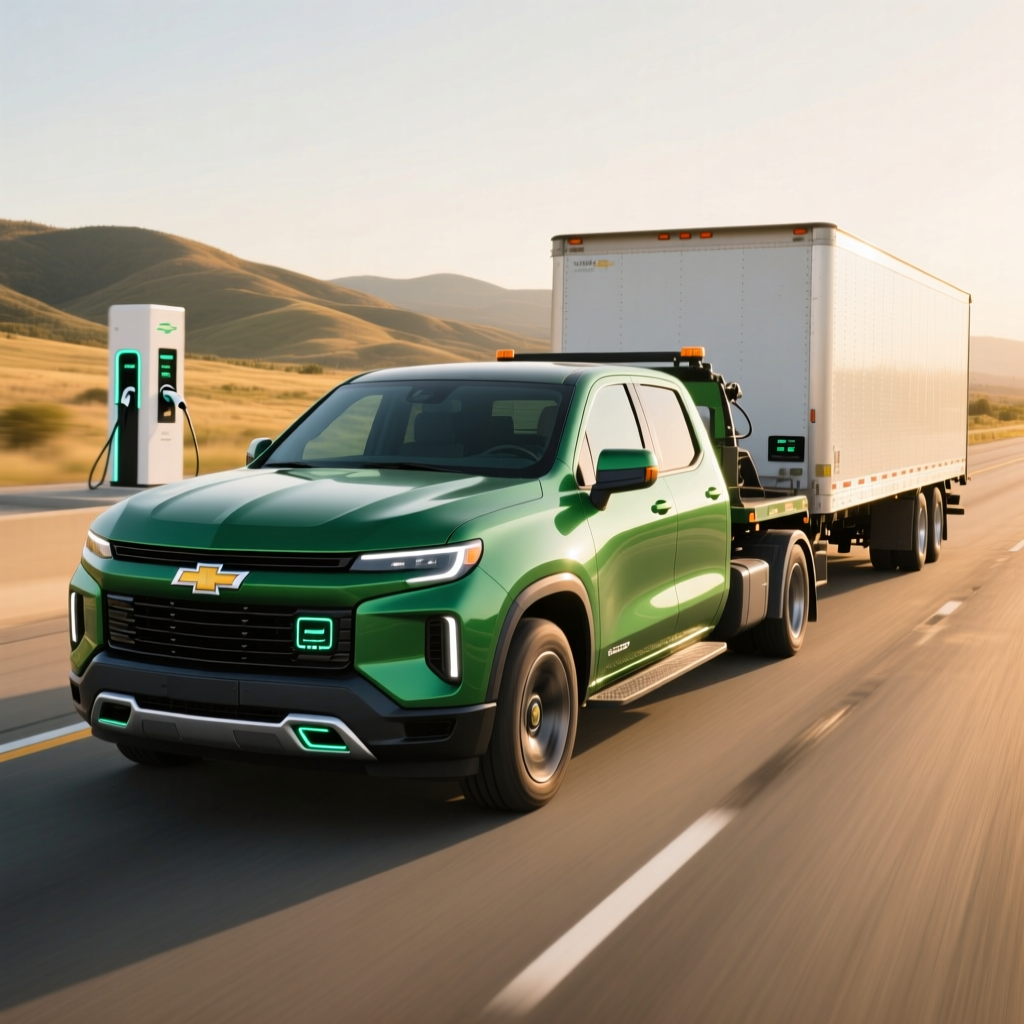
The headline question for any work truck buyer is whether the Silverado EV can handle real jobsite demands. Chevrolet rates the Silverado EV 4WT with the available Max Tow package at up to 12,500 pounds of towing capacity — a number that places it squarely in the territory of half-ton and even some three-quarter-ton gas trucks. The standard 3WT is rated for 8,000 pounds, which is sufficient for most light-duty commercial applications including utility trailers, small equipment haulers, and boat trailers.
Independent testing by Motor Trend and other automotive outlets has confirmed that the Silverado EV delivers strong real-world towing performance. Electric motors provide instant torque from zero RPM, which translates to confident acceleration even when pulling heavy loads. The low center of gravity afforded by the underfloor battery pack also contributes to impressive stability while towing, with noticeably less trailer sway than many body-on-frame competitors.
Payload capacity tells a slightly different story. The Silverado EV WT's payload ranges from approximately 1,200 to 1,800 pounds depending on configuration. While these numbers are competitive with many half-ton gas pickups, they fall short of heavy-duty trucks. The limiting factor is the vehicle's already substantial curb weight — the large battery packs add significant mass, which eats into the Gross Vehicle Weight Rating (GVWR) available for cargo. Fleet managers should carefully calculate their typical payload needs against these figures.
One standout feature for commercial users is the available onboard power system, which can supply up to 10.2 kW of electricity through multiple outlets in the bed and cabin. This is enough to power job site tools, lighting rigs, and even small welders without the need for a separate generator. For a deeper look at how this compares to the competition, see our best electric pickup trucks guide.
Real-World Range & Charging Speed
Range anxiety is the single biggest concern for fleet managers considering electric work trucks, and the Silverado EV WT addresses it with one of the largest battery options in the segment. The available ~200 kWh battery pack in the 4WT configuration delivers an EPA-estimated range exceeding 400 miles — a figure that rivals many gasoline trucks' real-world range between fill-ups. The smaller ~100 kWh pack in the 3WT provides roughly 240 miles of EPA-estimated range, which is adequate for many urban and suburban fleet routes but may require mid-day charging for longer duty cycles.
However, range decreases significantly under load. Towing a heavy trailer can reduce effective range by 30% to 50%, a challenge shared by all electric trucks. When towing near maximum capacity, expect real-world range to drop to approximately 200–280 miles on the larger battery and 120–170 miles on the smaller pack. This is a critical consideration for buyers who plan to tow frequently over long distances.
Charging performance is where the Silverado EV WT truly shines. The 4WT with the larger battery supports DC fast charging at up to 350 kW on compatible chargers. According to Chevrolet, this enables approximately 100 miles of range to be added in about 10 minutes under ideal conditions. A full charge from 10% to 80% can be accomplished in roughly 40–45 minutes at a 350 kW station. The 3WT with the smaller pack supports up to 190 kW DC fast charging, which still delivers competitive charge times.
For depot charging, the Silverado EV WT supports Level 2 AC charging at up to 19.2 kW, which is among the fastest AC charging rates available in any production electric vehicle. This means a full overnight charge is easily achievable with properly installed depot infrastructure. Fleet operators should consult our EV charging guide for fleets for more on setting up commercial charging infrastructure.
Interior & Technology: A Work-Ready Command Center
The Silverado EV Work Truck's interior reflects its commercial purpose: durable materials, practical layouts, and technology focused on productivity rather than luxury. The cabin features a large 17.7-inch diagonal infotainment touchscreen as the centerpiece, running Chevrolet's latest infotainment system with wireless Apple CarPlay and Android Auto. A secondary 11-inch digital instrument cluster provides the driver with essential vehicle information, range estimates, and towing data.
Seating is configured for five passengers in a crew cab layout, with cloth or available vinyl upholstery designed to withstand the rigors of job site use. The available rubberized floor covering with drain plugs makes cleaning easy after muddy or dirty workdays. Rear seat space is generous thanks to the EV platform's packaging advantages — there is no transmission tunnel to intrude on legroom, and the flat floor creates a more comfortable environment for rear passengers.
Technology highlights include an available trailering camera system with multiple views, a digital trailer hitch assist feature that simplifies trailer connections, and over-the-air update capability that allows Chevrolet to add features and improve performance remotely. The Work Truck also includes a suite of advanced driver assistance systems (ADAS) including automatic emergency braking, lane-keeping assist, and adaptive cruise control — all valuable features for reducing accident risk in fleet operations.
The Multi-Flex Midgate is one of the Silverado EV's most innovative features. By folding down the wall between the cabin and the bed, users can extend the effective cargo length to nearly 11 feet while still maintaining a weather-sealed enclosure when combined with the available tonneau cover. This is particularly valuable for tradespeople who need to transport long materials like lumber, conduit, or piping without resorting to a roof rack or open tailgate.
Driving Dynamics & On-Road Performance
Driving the Silverado EV Work Truck is a revelation for anyone accustomed to traditional work trucks. The instant torque delivery from the dual electric motors provides brisk acceleration that feels more like a performance SUV than a commercial pickup. The 4WT's 664 horsepower and 780+ lb-ft of torque can propel this heavy truck to 60 mph in roughly 4.5 seconds — quicker than many sports cars and dramatically faster than any comparable diesel work truck.
Ride quality benefits significantly from the independent rear suspension — a first for any Silverado — and the low-mounted battery pack that lowers the center of gravity. The result is a truck that feels planted and composed on highways, with noticeably less body roll through corners than a traditional body-on-frame pickup. The steering is precise if somewhat light, and regenerative braking offers multiple levels of intensity, including a one-pedal driving mode that can reduce brake wear substantially in stop-and-go fleet usage.
Off-road capability is adequate for most work site conditions. The Silverado EV WT offers decent ground clearance and available all-terrain tires, but it is not designed as a hardcore off-roader. The battery pack is well-protected by underbody skid plates, and the truck's traction control system manages the dual motors effectively on loose surfaces. For buyers who need serious off-road capability, our best electric pickup trucks list includes more trail-oriented options.
Noise, vibration, and harshness (NVH) levels are impressively low. Without a combustion engine, the Silverado EV WT is remarkably quiet at highway speeds, reducing driver fatigue over long workdays. Wind noise is well-managed, and the only notable sounds at speed are tire noise and the subtle hum of the electric drivetrain.
Ownership Costs & Fleet Economics
The total cost of ownership (TCO) equation is where the Silverado EV Work Truck makes its strongest case for fleet adoption. While the initial purchase price is higher than a comparable gasoline or diesel work truck, the operating cost advantages are substantial. Electricity costs per mile are typically 40% to 60% lower than gasoline or diesel, depending on local utility rates and charging infrastructure. For a fleet vehicle covering 25,000 miles annually, this can translate to thousands of dollars in annual fuel savings.
Maintenance costs are also significantly reduced. Electric vehicles eliminate the need for oil changes, transmission fluid service, exhaust system repairs, and many other routine maintenance items associated with internal combustion engines. Brake wear is dramatically reduced thanks to regenerative braking, with some fleet operators reporting brake pad life exceeding 100,000 miles. According to Edmunds and other automotive analysts, EV maintenance costs are typically 30% to 50% lower than equivalent gas vehicles over a five-year period.
Government incentives further improve the financial picture. Federal tax credits of up to $7,500 may be available for qualifying commercial EV purchases, and many states and local utilities offer additional rebates, grants, or reduced electricity rates for commercial EV charging. Fleet buyers should also investigate available DOE and EPA resources for the latest incentive information.
Depreciation remains a wildcard for electric trucks. While early data suggests strong residual values for popular EVs, the rapidly evolving nature of battery technology introduces some uncertainty. Chevrolet's battery warranty — typically 8 years or 100,000 miles — provides some protection, and the Ultium platform's modular design theoretically allows for future battery upgrades.
Pros & Cons
Pros
- Class-leading available range exceeding 400 miles EPA-estimated
- Up to 12,500 lbs towing capacity with Max Tow package
- Ultra-fast 350 kW DC charging capability
- Innovative Multi-Flex Midgate extends cargo versatility
- Up to 10.2 kW onboard power for job site use
- Significantly lower operating costs vs. gas/diesel trucks
- Independent rear suspension for superior ride quality
- Instant torque for confident towing and acceleration
Cons
- High initial purchase price compared to gas-powered work trucks
- Payload capacity limited by heavy battery packs
- Towing significantly reduces effective range
- Limited off-road capability in WT trim
- Charging infrastructure may require significant depot investment
- Smaller bed length (5 ft) without Midgate deployed
- Long-term battery degradation and residual values still uncertain
For a complete look at how the Silverado EV stacks up against its rivals, don't miss our Ford F-150 Lightning vs. Chevrolet Silverado EV comparison and our electric truck buying guide.
Frequently Asked Questions
What is the maximum towing capacity of the Chevrolet Silverado EV Work Truck?
The Chevrolet Silverado EV 4WT with the available Max Tow package is rated for up to 12,500 pounds of towing capacity. The standard 3WT configuration is rated for 8,000 pounds. These ratings are competitive with many half-ton and light three-quarter-ton internal combustion work trucks, making the Silverado EV WT suitable for a wide range of commercial towing applications including equipment trailers, boat trailers, and enclosed cargo trailers.
How much does towing reduce the Silverado EV Work Truck's range?
Towing a heavy trailer near the truck's maximum capacity can reduce effective range by approximately 30% to 50%, depending on trailer weight, aerodynamics, terrain, and driving speed. With the larger ~200 kWh battery, expect roughly 200 to 280 miles of real-world range while towing. Fleet managers planning long-distance towing routes should factor in charging stops and consider the available 350 kW fast-charging capability to minimize downtime.
Can the Silverado EV Work Truck power job site tools and equipment?
Yes. The Silverado EV WT features an available onboard power system capable of delivering up to 10.2 kW through multiple 120-volt and 240-volt outlets located in the bed and cabin. This is sufficient to power most common job site tools including circular saws, drills, compressors, lighting arrays, and even some welding equipment. This feature can eliminate the need for a separate portable generator, reducing both costs and emissions on the job site.
How long does it take to charge the Silverado EV Work Truck?
Charging times vary by method. At a 350 kW DC fast charger, the 4WT can add approximately 100 miles of range in about 10 minutes, with a 10% to 80% charge taking roughly 40 to 45 minutes. At a Level 2 depot charger rated at 19.2 kW, a full overnight charge is easily achievable in approximately 10 to 12 hours for the larger battery pack. Standard 120-volt outlet charging is available but impractically slow for daily use, adding only about 2 to 3 miles of range per hour.
Is the Chevrolet Silverado EV Work Truck a good choice for fleet buyers?
The Silverado EV Work Truck is an excellent choice for fleet buyers whose operations align with its strengths. It excels in urban and suburban routes with predictable daily mileage, depot-based charging infrastructure, and applications where its towing and payload capacities meet job requirements. The significantly lower fuel and maintenance costs can deliver compelling total cost of ownership advantages, especially when combined with available federal and state incentives. However, fleets with frequent long-distance towing needs or operations in areas with limited charging infrastructure should carefully evaluate whether the Silverado EV WT fits their specific duty cycles before committing.