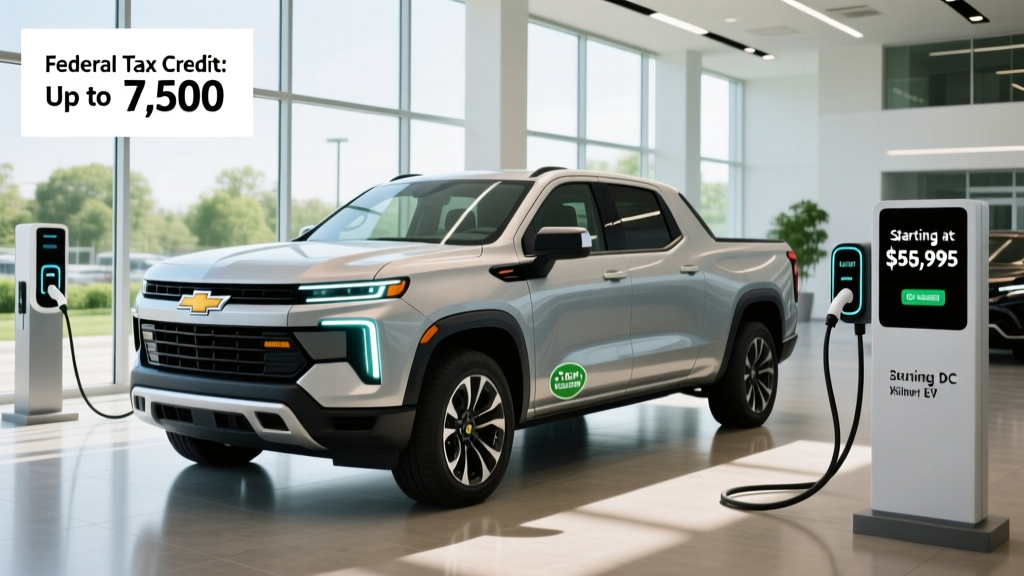
You've decided to walk into a Chevrolet Silverado EV dealer and see what all the fuss is about. Maybe you're eyeing the Work Truck (WT) for a fleet purchase, or you've got the RST First Edition in your crosshairs as a daily-driver tow rig. Before you sit down at the desk, you need the numbers that the brochure glosses over: what this truck actually costs to own over five years, whether you'll qualify for the federal tax credit, and where the hidden expenses (and savings) really live.
This guide breaks down the 2026 Chevrolet Silverado EV lineup from an ownership-cost perspective — the MSRP reality, the IRS §30D credit rules that actually apply this year, charging versus diesel fuel math, insurance premiums, depreciation trends, and the maintenance savings that partially offset the sticker shock.
2026 Silverado EV Lineup: What You'll Find on the Lot
Chevrolet has expanded the Silverado EV roster significantly since the limited RST First Edition launch. As of the 2026 model year, most dealers stock or can order the following trims. Prices reflect base MSRP before destination, dealer adjustments, or incentives.
| Trim | Base MSRP | Usable Battery (kWh) | EPA Range (mi) | Horsepower | 0-60 mph | Max DC Charge (kW) |
|---|---|---|---|---|---|---|
| 4WT Standard Range | ~$55,000 | ~180 kWh (NMC) | 240 | 510 | ~5.9 sec | 200 |
| 4WT Extended Range | ~$65,000 | ~205 kWh (NMC) | 340 | 645 | ~5.4 sec | 200 |
| LT | ~$70,000 | ~205 kWh (NMC) | 350 | 645 | ~5.2 sec | 200 |
| RST | ~$87,300 | ~215 kWh (NMC) | 440 | 754 | ~4.5 sec | 350 |
| Trail Boss | ~$75,000 | ~205 kWh (NMC) | 350 | 645 | ~5.2 sec | 200 |
Real-world range caveat: EPA estimates assume mixed driving at moderate temperatures. Expect highway-only range at 70 mph to drop 15-20% below the sticker number, and cold-weather (below 30°F) driving to shave another 15-25% depending on cabin heat usage. The 4WT Extended Range rated at 340 miles EPA will realistically deliver 260-290 miles on a highway road trip in winter conditions. The Ultium platform's thermal management helps, but physics is physics.
Charging at 200 kW (WT/LT/Trail Boss), a 10-80% session takes roughly 40-45 minutes. The RST's 350 kW peak rate can achieve 10-80% in approximately 20 minutes at a compatible V4 Supercharger or Electrify America 350 kW station — though sustained rates taper significantly above 60% state of charge, as is typical with large NMC packs.
The 5-Year Total Cost of Ownership: Silverado EV vs. Gas Silverado 1500
The headline question at any Chevrolet Silverado EV dealer is whether the electric truck saves you money over time. The honest answer: it depends heavily on your mileage, electricity rate, and whether you qualify for the federal credit. Below is a five-year projection assuming 15,000 miles/year (75,000 total), national-average electricity and fuel prices, and financing at prevailing rates.
| Cost Category | Silverado EV 4WT Ext. Range | Silverado 1500 Gas (4WD, 5.3L V8) |
|---|---|---|
| Purchase Price (MSRP) | $65,000 | $48,000 |
| Federal Tax Credit (§30D) | −$7,500 (if eligible) | $0 |
| Effective Purchase Price | $57,500 | $48,000 |
| Fuel/Energy (75,000 mi) | $7,200 (at $0.14/kWh, 2.0 mi/kWh) | $12,500 (at $3.50/gal, 21 MPG) |
| Maintenance (5 yr) | $1,800 | $4,200 |
| Insurance (5 yr) | $14,500 | $10,800 |
| Depreciation (est. 5 yr) | $28,000 | $18,000 |
| Total 5-Year Cost | ~$101,500 | ~$85,500 |
The EV doesn't win on total cost over five years in this base scenario — the higher purchase price, steeper insurance, and heavier depreciation outweigh the fuel and maintenance savings. However, the picture shifts significantly if you drive more miles annually, charge primarily on a cheap home rate (under $0.10/kWh), receive state/utility rebates, or keep the truck beyond seven years where the cumulative fuel savings compound.
Federal Tax Credit: Do You Qualify for the Full $7,500?
The IRS §30D Clean Vehicle Credit is the single biggest lever for reducing your Silverado EV's effective price — but it is far from automatic. The credit is subject to multiple interlocking requirements that change periodically. Here's the 2026 eligibility framework.
- Vehicle MSRP cap: Trucks and vans must be under $80,000 MSRP. This disqualifies the RST trim ($87,300) from the credit. The WT, LT, and Trail Boss trims fall under the cap.
- Buyer income limits: Modified adjusted gross income (MAGI) must not exceed $300,000 (joint filers), $225,000 (head of household), or $150,000 (single filers).
- Vehicle assembly: The Silverado EV is assembled at GM's Factory ZERO in Detroit-Hamtramck, Michigan — a U.S. plant, satisfying the North American final assembly requirement.
- Battery sourcing requirements: A percentage of critical minerals must be sourced from the U.S. or free-trade-agreement partners, and battery components must meet domestic-content thresholds. These percentages increase annually. The credit splits into two halves ($3,750 each) — one for critical minerals, one for battery components. GM has been working to increase domestic and allied sourcing, but verify current-year compliance at IRS.gov's qualified vehicle list before purchasing.
- Point-of-sale transfer: You can elect to transfer the credit to the dealer at the time of purchase, reducing your out-of-pocket cost or down payment by up to $7,500 at the dealership — rather than waiting to claim it on your tax return.
- One vehicle per year: You're limited to one §30D credit per four-year period for new vehicles.
Key takeaway for your dealer visit: Ask the finance desk for the current IRS compliance status of the specific trim and build date you're considering. Battery-sourcing percentages shift, and a truck built in January may have different eligibility than one built in July. Confirm at fueleconomy.gov and consult a tax professional for your specific situation.
Charging vs. Gas: The Real Cost-Per-Mile Math
The most compelling ownership argument for the Silverado EV is energy cost — but only if you can charge at home at residential rates. Here's how the math breaks down.
| Scenario | Cost per Mile | Annual Cost (15k mi) |
|---|---|---|
| Silverado EV — home charging ($0.14/kWh avg, 2.0 mi/kWh) | $0.070 | $1,050 |
| Silverado EV — home charging ($0.10/kWh, off-peak/utility rate) | $0.050 | $750 |
| Silverado EV — DC fast charging ($0.40/kWh avg public) | $0.200 | $3,000 |
| Silverado 1500 Gas — ($3.50/gal, 21 MPG combined) | $0.167 | $2,500 |
| Silverado 1500 Diesel — ($4.00/gal, 24 MPG combined) | $0.167 | $2,500 |
At a national-average residential rate of $0.14/kWh, the Silverado EV's efficiency of roughly 2.0 miles per kWh (about 50 kWh/100mi for the WT trims) yields a fuel cost of 7 cents per mile — less than half the gas truck's 16.7 cents. Over 75,000 miles in five years, that's roughly $5,300 in energy savings with home charging.
But notice the DC fast charging row. If you rely exclusively on public fast chargers at $0.35-$0.48/kWh (typical Electrify America or EVgo rates in 2026), your cost per mile actually exceeds the gas truck. Home charging is the economic linchpin. If you can't install a Level 2 charger at your residence, the Silverado EV's financial case weakens substantially.
Maintenance Savings: Where the EV Earns Back Ground
Electric drivetrains eliminate a long list of routine maintenance items. Over five years and 75,000 miles, the differences are meaningful.
| Maintenance Item | Silverado EV | Silverado 1500 Gas |
|---|---|---|
| Oil changes (every 7,500 mi) | None — $0 | ~10 changes × $75 = $750 |
| Transmission fluid service | None (single-speed reduction gear) | $250-$400 |
| Brake pads | $200-400 (regen extends life 2-3×) | $600-1,000 (two replacements likely) |
| Engine air filter | None | $100-150 |
| Spark plugs | None | $400-600 |
| Coolant service | $150 (battery thermal loop, extended interval) | $200-300 |
| Tire rotation/replacement | $1,600-2,200 (heavier truck, higher tire wear) | $1,200-1,600 |
| Estimated 5-Year Total | ~$1,800-2,500 | ~$4,000-5,000 |
The Silverado EV saves roughly $2,000-$2,500 in maintenance over five years. Regenerative braking is the biggest single factor: one-pedal driving dramatically reduces friction brake usage, often pushing pad life past 100,000 miles. However, tire costs run higher due to the truck's curb weight (the Extended Range WT tips the scales near 8,800 lbs) and the instant torque that accelerates tread wear, especially on the rear axle.
Insurance Reality: The Line Item Nobody Talks About
Insuring a Silverado EV costs more than its gas counterpart — typically 25-40% higher premiums depending on your state, driving record, and carrier. Expect annual premiums of $2,600-$3,200 for the EV versus $1,900-$2,400 for a comparably equipped gas Silverado 1500.
Why the gap? Three factors drive it:
- Repair costs: EV-specific collision repairs involve high-voltage safety protocols, specialized technician training, and expensive battery-pack diagnostics even from minor impacts. Insurers price this risk in.
- Higher vehicle value: The EV's MSRP premium means higher comprehensive and collision payouts in a total-loss scenario.
- Parts availability: Ultium-platform body panels and structural components have a shorter supply chain history than the decades-deep aftermarket for the ICE Silverado.
Shop quotes from multiple carriers before purchasing. Some insurers (notably State Farm, GEICO, and progressive EV-focused carriers) have narrowed the gap as claims data matures. Bundling with homeowners or holding a clean record for 3+ years can bring the EV premium within 15-20% of the gas truck — but plan for the higher number in your budget.
Depreciation and Resale Value: The Wildcard
EV depreciation has been volatile. According to iSeeCars and Kelley Blue Book data through 2025, electric trucks and large SUVs depreciated faster than their gas equivalents over the first three years — often losing 45-55% of value versus 35-40% for comparable ICE trucks.
Several factors are at play:
- Battery health uncertainty: Used buyers discount EVs with unknown battery state of health (SoH). GM's 8-year/100,000-mile battery warranty (covering defects and capacity below 70% of original) provides a floor, but the market still prices in risk.
- Price wars and incentives: Aggressive new-EV pricing and federal credits compress used-EV values. A new Silverado EV WT at $57,500 (after credit) undercuts a two-year-old example that originally stickered at $65,000.
- Technology obsolescence: Charging speed, range, and software features advance rapidly. A 2024 model with 200 kW charging looks dated next to a 2026 with 350 kW capability.
For the five-year cost projection above, I've estimated the Silverado EV losing roughly $28,000 in value (about 43% of its effective purchase price) versus $18,000 (38%) for the gas truck. If you plan to keep the truck 8-10 years, depreciation matters less — and the cumulative fuel and maintenance savings begin to close the total-cost gap meaningfully.
State, Local, and Utility Incentives
Beyond the federal §30D credit, many buyers qualify for additional savings that vary significantly by location:
- State rebates: States like Colorado, California, Massachusetts, and New York offer additional purchase rebates ranging from $1,000 to $5,000+ — some with their own income or MSRP caps. Check your state's energy or environmental agency.
- Utility rebates: Many electric utilities offer $500-$1,500 rebates for home Level 2 charger installation, or time-of-use (TOU) rate plans that drop overnight charging to $0.06-$0.08/kWh. Contact your utility directly.
- HOV lane access: Several states grant single-occupant HOV lane access to EVs — a significant commute-time incentive even if it doesn't appear on the balance sheet.
- Fleet/commercial credits: The separate §45W commercial clean vehicle credit (up to $7,500 for vehicles under 14,000 lbs GVWR) may apply to business purchases. Consult a tax professional.
These incentives are highly jurisdiction-specific and change frequently. Verify current programs through your state energy office and local utility before relying on them in your purchase math.
At the Dealer: What to Negotiate and Verify
Walking into a Chevrolet Silverado EV dealer with this data changes the conversation. Here's your checklist:
- Confirm §30D eligibility for the specific VIN. Ask the dealer to run the IRS VIN verification tool. Battery-sourcing compliance can vary by build date.
- Request the point-of-sale transfer paperwork. If eligible, you can apply the $7,500 credit directly to the purchase, reducing your down payment or financed amount.
- Ask about dealer-installed accessories and their impact on MSRP. The $80,000 MSRP cap for the tax credit includes factory options but not dealer-added accessories — though some dealers bundle these aggressively. Know where the line is.
- Get the window sticker's kWh/100mi figure. This is your efficiency baseline for calculating real fuel costs at your local electricity rate.
- Inquire about home charger installation partnerships. Some Chevrolet dealers partner with Qmerit or local electricians to bundle a Level 2 charger installation estimate with the purchase.
- Pull insurance quotes before signing. Get the VIN and run quotes from at least three carriers. The premium difference can be $600-$1,000/year — meaningful over a 5-year hold.
Frequently Asked Questions
How much does it really cost to own a Silverado EV over 5 years?
For a 4WT Extended Range at $65,000 MSRP, expect approximately $101,500 in total 5-year cost (purchase minus credit, fuel, maintenance, insurance, and depreciation) assuming 15,000 miles/year and national-average rates. A comparable gas Silverado 1500 comes in around $85,500. The EV closes the gap at higher annual mileage, lower electricity rates, and longer ownership horizons — typically reaching parity around year 7-8 for high-mileage drivers.
Do I qualify for the $7,500 federal tax credit on the Silverado EV?
You may, depending on your income (under $300k joint / $150k single), the trim you choose (must be under $80,000 MSRP — the RST does not qualify), and the vehicle's battery-sourcing compliance at the time of manufacture. The Silverado EV is U.S.-assembled, satisfying that requirement. Always verify the specific VIN against the IRS qualified vehicles list before purchasing.
How much do I save on fuel and maintenance with the Silverado EV?
At national-average residential electricity rates ($0.14/kWh) and 15,000 miles/year, expect roughly $1,050/year in electricity versus $2,500/year in gasoline — a savings of about $1,450/year or $7,250 over five years. Maintenance savings add another $2,000-$2,500 over the same period, primarily from eliminated oil changes, transmission service, and extended brake life from regenerative braking.
Are EVs more expensive to insure than gas trucks?
Yes, typically 25-40% higher for the Silverado EV versus a comparable gas Silverado 1500. The premium gap is driven by higher repair costs (high-voltage safety protocols, specialized technicians), higher vehicle values, and a still-maturing parts supply chain. Expect to pay $2,600-$3,200/year for the EV versus $1,900-$2,400/year for the gas truck, though shopping multiple carriers and bundling policies can narrow the gap.
How well does the Silverado EV hold its value?
EV depreciation has been steeper than ICE trucks in recent years, with electric trucks losing an estimated 45-55% of value over three years versus 35-40% for gas trucks. Factors include rapid technology advancement, new-vehicle price competition, and used-market uncertainty around battery health. GM's 8-year/100,000-mile battery warranty provides some protection, and long-term owners (8+ years) are less affected by early depreciation curves.
Can I charge the Silverado EV at home, and what does it cost to install?
Yes, and home charging is essential to the EV's economic case. A Level 2 home charger (240V, 48-amp circuit, 11.5 kW output) adds roughly 23 miles of range per hour — enough to fully replenish the Extended Range battery overnight. Professional installation typically costs $1,200-$3,500 including the charger unit ($400-$700), electrical labor, permitting, and possible panel upgrade. If your home has a 200-amp electrical panel with spare capacity, expect the lower end of that range. Older homes with 100-amp service may need a panel upgrade ($1,500-$3,000 additional). Check with your utility — many offer $500-$1,500 installation rebates.