Quick Verdict: The 2026 Chevrolet Malibu EV
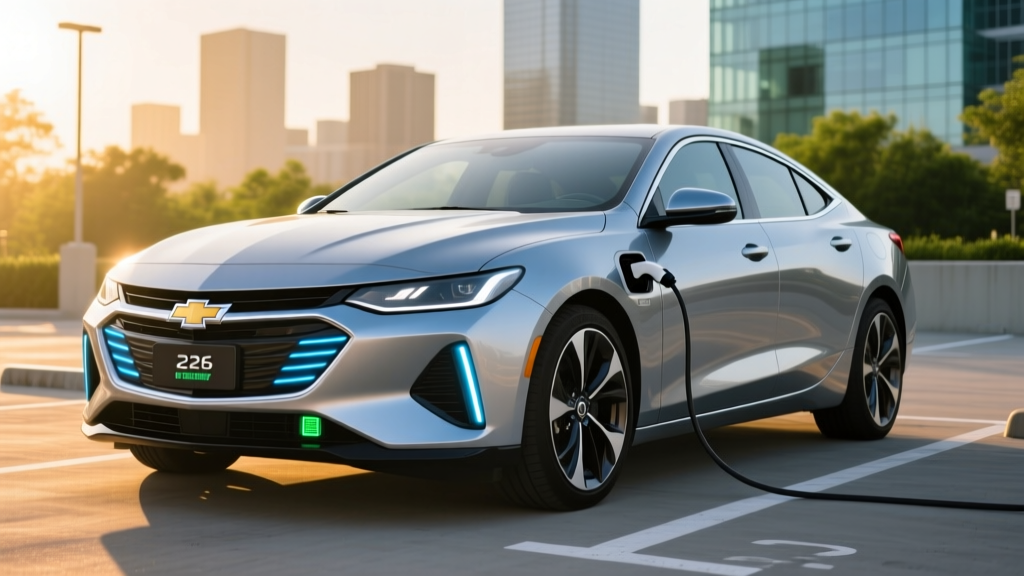
The 2026 Chevrolet Malibu EV marks the nameplate's full transition to an all-electric sedan built on GM's Ultium platform. Positioned between the compact Equinox EV and the flagship Blazer EV, the Malibu EV targets midsize sedan buyers who want competitive range, fast charging, and practical interior space. For wheel and tire shoppers, the 2026 Chevrolet Malibu EV bolt pattern is 5x115mm (5-lug, 115mm bolt circle diameter) — consistent with the broader GM midsize platform and matching the outgoing gas Malibu's bolt circle, which simplifies aftermarket wheel selection.
| Spec | LT (Base) | RS | Premier |
|---|---|---|---|
| EPA Range | 340 mi | 340 mi | 320 mi (AWD) |
| Battery (Usable) | 85 kWh (NMC) | 85 kWh (NMC) | 85 kWh (NMC) |
| Drivetrain | FWD (single motor) | FWD (single motor) | AWD (dual motor) |
| Horsepower | 290 hp | 290 hp | 365 hp |
| 0–60 mph | 6.8 sec | 6.8 sec | 5.1 sec |
| Max DC Fast Charge | 190 kW | 190 kW | 190 kW |
| 10–80% DCFC Time | ~24 min | ~24 min | ~24 min |
| Level 2 Home Rate | 11.5 kW | 11.5 kW | 11.5 kW |
| MPGe (Combined) | 122 MPGe | 120 MPGe | 112 MPGe |
| Bolt Pattern | 5x115mm | 5x115mm | 5x115mm |
| Base MSRP | $36,900 | $40,500 | $45,200 |
Range and Efficiency: EPA vs. Real-World
The FWD LT and RS trims carry an EPA-estimated 340 miles of range, while the dual-motor AWD Premier drops to 320 miles due to the added mass and friction of the second motor. These figures are competitive with the Tesla Model 3 Long Range (341 mi EPA) and the Hyundai Ioniq 6 SE Long Range (361 mi EPA), placing the Malibu EV squarely in the midsize-sedan sweet spot.
Real-World Range Expectations
EPA Sticker: 340 miles (LT/RS FWD) | 320 miles (Premier AWD)
Highway (70 mph, 75°F): Expect ~280–305 miles on the FWD trims. Aerodynamic drag at sustained highway speeds reduces efficiency by roughly 10–15% versus the combined EPA cycle.
Cold Weather (20°F, highway): Range can drop to ~230–260 miles. The Malibu EV's liquid thermal management and standard heat pump mitigate losses, but NMC chemistry still sees 20–30% reduction in freezing conditions.
City / Commuter Driving: Real-world city range often matches or slightly exceeds the EPA figure thanks to regenerative braking recapturing energy in stop-and-go traffic.
Efficiency lands at 122 MPGe combined (LT), translating to roughly 28 kWh/100 miles. That's respectable for a sedan in this size class, though the Ioniq 6's more aerodynamic teardrop shape still holds an edge at 140 MPGe.
Battery Chemistry and Longevity
GM equips the 2026 Malibu EV with an 85 kWh usable Ultium NMC (nickel manganese cobalt) battery pack. NMC chemistry delivers higher energy density than LFP (lithium iron phosphate), which is why the Malibu EV achieves 340 miles in a relatively compact underfloor package. The trade-off: NMC cells degrade slightly faster than LFP over thousands of cycles and are more sensitive to sustained 100% state-of-charge storage.
Practical ownership tip: For daily driving, set the charge limit to 80–90% and only charge to 100% before long road trips. GM's battery management system includes a top-and-bottom buffer (roughly 3–4 kWh reserved at each end) to protect against overcharge and deep discharge, but habitual 100% storage still accelerates calendar degradation in NMC packs.
GM backs the battery with an 8-year/100,000-mile warranty guaranteeing at least 70% capacity retention — in line with the industry standard set by the EPA and adopted across most manufacturers. Independent data from fueleconomy.gov and owner surveys suggest modern NMC packs typically retain 85–90% capacity at 100,000 miles under normal use.
Charging Speed: DC Fast, Level 2, and Level 1
The Malibu EV's charging hardware is one of its stronger selling points in the midsize segment. GM's Ultium platform supports up to 190 kW peak DC fast charging via the NACS (North American Charging Standard) connector — the Tesla Supercharger-compatible port now standard across GM's 2026 lineup.
| Level | Power | Connector | Speed | Notes |
|---|---|---|---|---|
| Level 1 (120V) | 1.4 kW | NACS / J1772 adapter | ~4 mi/hr | Emergency / overnight trickle only |
| Level 2 (240V) | 11.5 kW | NACS / J1772 adapter | ~38 mi/hr | Full charge in ~8.5 hours (0–100%) |
| DC Fast Charge | 190 kW (peak) | NACS | 10–80% in ~24 min | Sustained ~150 kW to 60%, tapers above 80% |
Charging curve reality check: The 190 kW peak is achieved only between roughly 10–35% state of charge. From 35–60%, the pack sustains approximately 150 kW. Above 80%, the rate tapers sharply to protect cell health — expect 50–60 kW in the 80–90% range. For road trips, the 10–80% sprint in about 24 minutes means a quick rest stop is all you need to add ~230 miles of range.
At home on a Level 2 charger (48-amp circuit, hardwired), the 11.5 kW onboard charger replenishes the full 85 kWh pack in roughly 8.5 hours. Most owners charging from 20% to 80% overnight will wake to a full daily supply in about 4.5 hours. Installation of a 240V/48A circuit typically costs $800–$2,000 depending on panel capacity and run length — consult a licensed electrician for your specific setup.
Performance and Drivetrain
The FWD LT and RS trims use a single front-mounted motor producing 290 hp and 346 lb-ft of torque. The 0–60 mph time of 6.8 seconds is adequate for merging and passing, with the instant torque delivery characteristic of electric motors making it feel quicker than the number suggests in daily driving.
Step up to the Premier AWD and you get a dual-motor configuration with 365 hp and 420 lb-ft, dropping the 0–60 time to 5.1 seconds. The AWD system uses an electronically controlled clutch on the rear motor, allowing it to decouple during steady-state cruising to preserve efficiency — a smart trade-off that keeps the AWD range penalty to just 20 miles.
Ride quality benefits from the low center of gravity inherent in the Ultium skateboard platform. GM tunes the Malibu EV's suspension for comfort over sportiness, with compliant damping that absorbs highway expansion joints without the floatiness of the outgoing gas model. Steering is light and precise, if not particularly communicative.
Interior Space, Cargo, and Technology
The Malibu EV's interior dimensions reflect its midsize-sedan positioning:
- Front legroom: 43.2 inches
- Rear legroom: 38.8 inches
- Front headroom: 39.5 inches
- Rear headroom: 37.1 inches
- Trunk volume: 16.8 cu ft (with 60/40 split-folding rear seat)
- Frunk (front trunk): 2.1 cu ft (weather-sealed, ideal for charging cables)
Compared to the Tesla Model 3 (23 cu ft rear trunk + 3.1 cu ft frunk), the Malibu EV's trunk is smaller, though its traditional sedan shape provides a more familiar cargo-loading experience and a fully enclosed rear compartment.
Infotainment: A 17.7-inch diagonal touchscreen dominates the dashboard, running GM's latest Ultifi software with native Google Built-in (Maps, Assistant, Play Store). Wireless Apple CarPlay and Android Auto are standard. The system is responsive, with minimal lag, and the Google Maps integration provides real-time charging-station routing with battery preconditioning.
Driver assistance: Every 2026 Malibu EV includes Chevy Safety Assist 2.0 as standard — adaptive cruise control, lane-keeping assist, automatic emergency braking with pedestrian detection, blind-spot monitoring, and rear cross-traffic alert. The optional Super Cruise package ($2,500) adds hands-free driving on over 750,000 miles of mapped highways in the U.S. and Canada.
SAE Automation Level: Level 2
Super Cruise is an SAE Level 2 driver-assistance system. Despite the hands-free capability on compatible highways, the driver must remain attentive. An infrared camera monitors eye gaze and will issue escalating alerts — eventually bringing the vehicle to a controlled stop — if the driver looks away for too long. This is not autonomous driving (Level 4); you are still legally responsible for the vehicle at all times.
Pricing, Trims, and Federal Tax Credit
The 2026 Malibu EV lineup spans three trims:
| Trim | Base MSRP | Destination | Total Before Credit | Est. After §30D Credit* |
|---|---|---|---|---|
| LT | $36,900 | $1,395 | $38,295 | ~$30,795 |
| RS | $40,500 | $1,395 | $41,895 | ~$34,395 |
| Premier AWD | $45,200 | $1,395 | $46,595 | ~$39,095 |
*Estimates assume full $7,500 federal credit eligibility. Actual credit depends on buyer income, vehicle MSRP cap compliance, and battery critical-mineral sourcing requirements under IRS §30D. See IRS clean vehicle credit rules for current-year eligibility details. Credit can be transferred to the dealer at point of sale as an upfront discount.
Tax credit eligibility for the 2026 Malibu EV: All three trims fall under the $55,000 MSRP cap for sedans under §30D. However, the $7,500 credit is split into two $3,750 halves — one tied to battery-critical-mineral sourcing and one to battery-component manufacturing. As of the 2026 tax year, GM has confirmed the Malibu EV qualifies for the full $7,500 for buyers meeting income thresholds ($150,000 single / $300,000 joint AGI). Confirm your personal eligibility with a tax professional before purchase, as sourcing requirements tighten annually.
Bolt Pattern and Wheel Specifications
For owners considering aftermarket wheels, winter tire setups, or replacement rims, the 2026 Chevrolet Malibu EV bolt pattern is:
- Bolt pattern: 5x115mm (5 lugs on a 115mm bolt circle diameter)
- Center bore: 70.3mm
- Lug nut thread: M12 x 1.5
- Stock wheel sizes: 18-inch (LT), 19-inch (RS), 20-inch (Premier)
- Stock tire sizes: 245/50R18 (LT), 245/45R19 (RS), 255/40R20 (Premier)
The 5x115mm pattern is shared with several GM vehicles, including the Cadillac CT5 and older Buick Regal, which opens up cross-compatible wheel options. However, always verify offset (ET), load rating, and center bore when selecting aftermarket wheels — EVs are heavier than their gas counterparts, and underspec'd wheels can compromise safety and efficiency. The Malibu EV's curb weight ranges from 4,350 lb (LT) to 4,620 lb (Premier AWD), so choose wheels rated for at least 1,250 lb per corner.
Pros, Cons, and Who Should Buy
Pros
- 340-mile EPA range is competitive for the price point
- 190 kW DC fast charging with NACS (Supercharger access)
- Spacious rear seat (38.8" legroom) for a midsize sedan
- Super Cruise hands-free highway driving available
- Heat pump standard (preserves cold-weather range)
- Full $7,500 §30D tax credit eligibility (as of 2026)
- Google Built-in infotainment with native charging navigation
Cons
- Trunk space (16.8 cu ft) trails the Tesla Model 3 and Hyundai Ioniq 6
- No LFP battery option for buyers prioritizing longevity over density
- FWD-only on base trims limits all-weather confidence vs. AWD rivals
- 20-inch Premier wheels reduce range and add road noise
- No vehicle-to-load (V2L) capability at launch
- Rear visibility compromised by thick C-pillars
Who This EV Suits Best
Daily commuters: The 340-mile range means most drivers can commute all week on a single charge, and 11.5 kW Level 2 home charging replenishes overnight effortlessly.
Highway road-trippers: Super Cruise and NACS Supercharger access make cross-country travel practical. The 24-minute 10–80% charge time keeps stops short.
Families needing rear-seat space: The 38.8-inch rear legroom accommodates rear-facing car seats better than compact EVs like the Model 3.
Not ideal for: Buyers who need maximum cargo volume (consider the Equinox EV or Blazer EV crossover) or those in extreme-cold climates who would benefit from an LFP pack's tolerance for 100% daily charging.
Warranty and Ownership Costs
GM's warranty coverage for the 2026 Malibu EV:
- Battery & drive unit: 8 years / 100,000 miles (≥70% capacity retention)
- Bumper-to-bumper: 3 years / 36,000 miles
- Powertrain (non-battery): 5 years / 60,000 miles
- Corrosion: 6 years / 100,000 miles
- Roadside assistance: 5 years / 100,000 miles
On the ownership-cost side, the Malibu EV benefits from significantly lower fueling expenses. At the U.S. average electricity rate of $0.16/kWh, charging the 85 kWh pack from empty costs roughly $13.60 — versus $45–$55 to fill a comparable gas sedan at $3.50/gallon. Over 15,000 miles annually, that translates to approximately $1,200–$1,500 in yearly fuel savings. Insurance premiums, however, tend to run 10–15% higher than the gas Malibu due to repair costs and EV-specific parts pricing. Get quotes before purchase.
Frequently Asked Questions
What is the real-world range of the 2026 Chevrolet Malibu EV?
The EPA rates the FWD trims at 340 miles and the AWD Premier at 320 miles. In real-world highway driving at 70 mph, expect 280–305 miles (FWD). In freezing temperatures, range can drop to 230–260 miles despite the standard heat pump. City driving with regenerative braking often yields results close to or slightly above the EPA number.
How fast does the Malibu EV charge at home and on the road?
At home on a Level 2 (240V, 48A) charger, the Malibu EV charges at 11.5 kW, adding roughly 38 miles of range per hour and fully replenishing in about 8.5 hours. On a DC fast charger, it peaks at 190 kW and charges from 10–80% in approximately 24 minutes via the NACS connector, which provides direct access to Tesla Supercharger stations.
How much does the 2026 Malibu EV cost after tax credits?
The base LT starts at $38,295 including destination. If you qualify for the full $7,500 federal §30D credit (subject to income caps of $150K single / $300K joint, MSRP under $55K for sedans, and battery-sourcing compliance), the effective price drops to approximately $30,795. The RS lands around $34,395 and the Premier AWD around $39,095 after the credit. The credit can be applied as a point-of-sale discount through the dealer.
Does the 2026 Malibu EV qualify for the federal EV tax credit?
As of the 2026 tax year, GM has indicated the Malibu EV qualifies for the full $7,500 under IRS §30D. All trims fall under the $55,000 sedan MSRP cap. However, eligibility depends on your adjusted gross income, and battery critical-mineral sourcing requirements tighten each year. Always verify current rules on IRS.gov and consult a tax professional before relying on the credit in your purchase decision.
What is the 2026 Chevrolet Malibu EV bolt pattern?
The bolt pattern is 5x115mm (5 lugs, 115mm bolt circle diameter) with a 70.3mm center bore and M12 x 1.5 lug nuts. This is shared with other GM midsize vehicles. Stock wheel sizes range from 18 inches (LT) to 20 inches (Premier). When selecting aftermarket wheels, ensure the load rating accommodates the Malibu EV's curb weight of 4,350–4,620 lb.
Is the Malibu EV worth buying vs. the Tesla Model 3 or Hyundai Ioniq 6?
The Malibu EV competes closely on range (340 mi vs. Model 3 LR's 341 mi) and undercuts both on price after the tax credit. Its advantages include Super Cruise availability, a more traditional sedan interior layout, and Google Built-in infotainment. The Model 3 still wins on charging speed (250 kW peak) and Supercharger-native reliability. The Ioniq 6 leads in aerodynamic efficiency (140 MPGe) and 800V ultra-fast charging (350 kW peak, 10–80% in 18 min). Choose the Malibu EV if you value GM's dealer network, Super Cruise, and competitive pricing; choose the Model 3 for the most mature charging ecosystem; choose the Ioniq 6 for maximum efficiency and fastest charging.
Does the Malibu EV have Super Cruise, and is it self-driving?
Super Cruise is available as a $2,500 option on RS and Premier trims. It enables hands-free driving on over 750,000 miles of mapped divided highways. However, it is an SAE Level 2 system — you must remain attentive and are legally responsible for the vehicle. An infrared driver-monitoring camera enforces attention. This is not Level 4 autonomous driving.
Sources: EPA fueleconomy.gov, IRS §30D Clean Vehicle Credits, Chevrolet Malibu EV specifications.