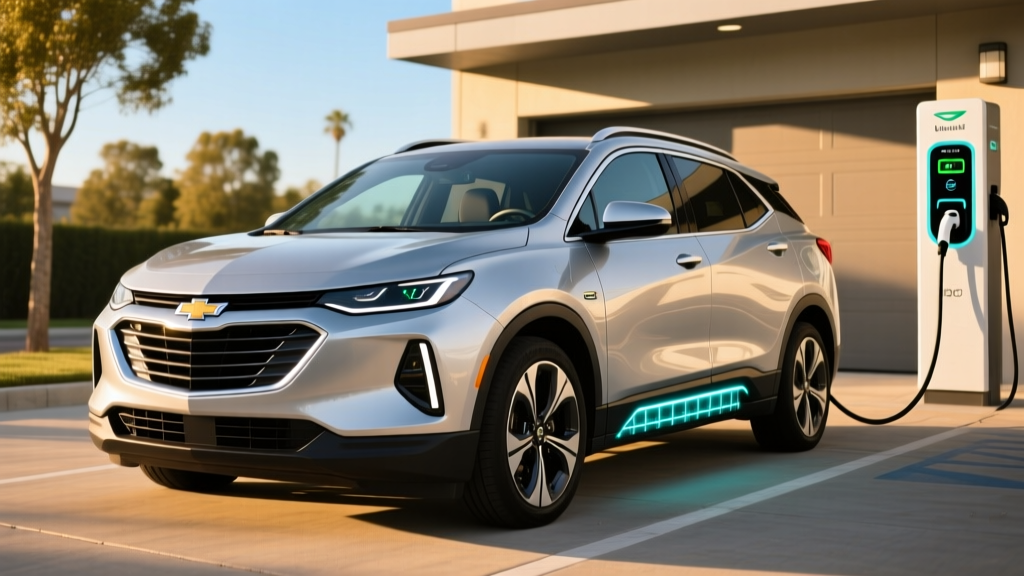
Quick Verdict: Is the Equinox EV Worth It After Incentives?
The 2026 Chevrolet Equinox EV occupies a rare spot in the market: an affordable, long-range electric crossover that undercuts most competitors on price while delivering over 300 miles of EPA-estimated range. But the sticker price is only half the story. To understand whether this EV actually saves you money, we need to walk through the full ownership equation — from the Chevrolet Equinox EV tax credit eligibility under IRS §30D to real-world charging costs, insurance premiums, and depreciation.
After running the numbers on every major cost category, the Equinox EV delivers a compelling 5-year total cost of ownership — particularly when you stack the federal point-of-sale credit with available utility rebates. But there are real trade-offs, including higher insurance costs and EV depreciation uncertainty, that buyers need to see upfront.
2026 Chevrolet Equinox EV: Key Specs at a Glance
| Spec | LT (FWD) | RS / Activ (AWD) |
|---|---|---|
| EPA Range | 319 mi | 285–307 mi |
| Battery (usable) | 85 kWh (NMC) | 85 kWh (NMC) |
| Peak DC Fast Charge | 150 kW | 150 kW |
| 10–80% DC Charge Time | ~30 min | ~30 min |
| Level 2 Charge Rate | 11.5 kW | 11.5 kW |
| Horsepower | 213 hp | 288 hp |
| 0–60 mph | ~8.4 sec | ~5.9 sec |
| Efficiency (MPGe) | 109 MPGe combined | 95–102 MPGe combined |
| Starting MSRP | ~$33,600 | ~$43,400 |
| Battery/Powertrain Warranty | 8 years / 100,000 mi | |
Federal Tax Credit: Does the Equinox EV Qualify for §30D?
The Chevrolet Equinox EV tax credit is one of the main reasons this model trends in search. For 2026, the Equinox EV qualifies for the full $7,500 federal Clean Vehicle Credit under IRS §30D — but only if you meet all eligibility requirements. The credit can now be transferred to the dealer as a point-of-sale rebate, reducing your purchase price on day one rather than waiting for tax filing.
- Vehicle MSRP cap: SUVs/crossovers must be under $80,000 — the Equinox EV passes easily.
- Buyer income cap (MAGI): $150,000 single / $225,000 head of household / $300,000 married filing jointly.
- Battery sourcing: Must meet critical-minerals and battery-component requirements (North America or FTA-partner sourcing). GM's Ultium platform is currently assembled in the U.S. with qualifying sourcing — but verify at purchase, as supply chains shift.
- Final assembly: Must occur in North America. The Equinox EV is built at GM's Spring Hill, TN plant.
- Point-of-sale transfer: You can elect to transfer the credit to the dealer, reducing your out-of-pocket cost at signing. The dealer must be IRS-registered.
- One credit per SSN per year: You cannot claim §30D more than once annually.
Source: IRS Clean Vehicle Credit. Rules are subject to legislative and regulatory changes. Confirm eligibility with a tax professional before purchase.
At a starting MSRP of ~$33,600 for the LT trim, the $7,500 point-of-sale credit effectively drops the Equinox EV's entry price to approximately $26,100 before destination fees or dealer add-ons. That puts it in direct competition with mid-trim gas crossovers — but with far lower running costs.
State, Local, and Utility Incentives
Beyond the federal credit, many states, municipalities, and utility companies offer additional EV rebates. Examples include:
- California (CVRP): Up to $2,000–$7,000 depending on income (check CARB CVRP for current availability).
- Colorado: Up to $5,000 state tax credit for new EVs under certain MSRP thresholds.
- Utility rebates: Many utilities offer $500–$1,500 for EV purchase plus $300–$800 for Level 2 home charger installation.
- HOV lane access: States like CA, CO, MD, and VA grant single-occupant HOV access for qualifying EVs.
Always check your state energy office and local utility for current programs, as these change annually and some have limited funding pools.
5-Year Total Cost of Ownership Breakdown
To answer the core question — how much does it really cost to own the Equinox EV over 5 years? — we modeled a scenario assuming 12,000 miles/year (60,000 total), 70% home Level 2 charging, 30% public DC fast charging, and the $7,500 federal credit applied at purchase.
| Cost Category | Equinox EV (after $7,500 credit) | Gas Crossover (AWD, ~$33,000) |
|---|---|---|
| Purchase Price (net) | ~$26,100 | ~$33,000 |
| Fuel / Charging (60k mi) | ~$3,960 | ~$7,560 |
| Maintenance (5 yr) | ~$1,500 | ~$3,800 |
| Insurance (5 yr avg) | ~$11,400 | ~$8,700 |
| Estimated Depreciation (5 yr) | ~$11,700 (45%) | ~$14,850 (45%) |
| 5-Year Total | ~$54,660 | ~$67,910 |
Assumptions: Electricity at $0.14/kWh avg (home) and $0.35/kWh (public DCFC); gas at $3.50/gal at 28 MPG combined. Insurance based on national EV average premiums. Depreciation percentages reflect current EV resale trends, which remain volatile. Sources: fueleconomy.gov, Kelley Blue Book, industry insurance data.
Charging Cost vs. Gas: The $/Mile Math
The Equinox EV LT FWD consumes roughly 31 kWh per 100 miles (109 MPGe combined). Your actual cost per mile depends heavily on where and how you charge.
| Scenario | Cost per Mile | Annual Cost (12,000 mi) |
|---|---|---|
| Home Level 2 ($0.14/kWh) | $0.043 | $516 |
| Public DCFC ($0.35/kWh) | $0.109 | $1,308 |
| Blended 70/30 (home/public) | $0.066 | $792 |
| Gas crossover (28 MPG, $3.50/gal) | $0.125 | $1,500 |
With predominantly home charging, the Equinox EV costs roughly one-third as much per mile as a gas equivalent. Even with a 70/30 blended mix, you save approximately $700/year on fuel alone. Over five years, that's $3,500+ back in your pocket. If your utility offers time-of-use (TOU) rates and you charge overnight at $0.08–$0.10/kWh, savings increase further.
Charging curve reality check: The Equinox EV peaks at 150 kW on DC fast chargers but tapers significantly above 60% SoC. A 10–80% charge takes approximately 30 minutes. On a road trip, plan stops around the 200-mile mark for optimal charging speed and battery health.
Maintenance Savings: Fewer Parts, Less Wear
EVs eliminate oil changes, spark plugs, timing belts, fuel filters, and exhaust system maintenance. Regenerative braking significantly reduces brake pad wear — many EV owners report original brake pads lasting 80,000+ miles.
| Service | Equinox EV | Gas Crossover |
|---|---|---|
| Oil changes | $0 | ~$600 |
| Brake pads (front/rear) | ~$0 (regen extends life) | ~$800 |
| Tire rotation & replacement | ~$900 (EV tires wear faster) | ~$750 |
| Cabin air filter | ~$150 | ~$150 |
| Coolant / fluid service | ~$150 | ~$300 |
| Transmission / drivetrain | $0 (single-speed) | ~$400 |
| Miscellaneous (wipers, etc.) | ~$300 | ~$800 |
| Total | ~$1,500 | ~$3,800 |
The main maintenance premium for EVs is tire replacement. The Equinox EV's weight (~4,700 lbs) and instant torque accelerate tire wear. Budget for a tire set replacement around year 3–4 (~$900 for a quality all-season set). Even with this, total maintenance savings exceed $2,300 over five years.
Insurance: The Cost Category Where EVs Lose
Insurance is the one area where the Equinox EV costs more than its gas counterparts. EV insurance premiums run 15–30% higher on average for several reasons:
- Higher repair costs: Battery pack damage or high-voltage system repairs require specialized technicians and OEM parts.
- Total-loss thresholds: Even minor battery damage can trigger a total-loss declaration, increasing insurer payouts.
- Vehicle price: Even after the tax credit, insurers base premiums on MSRP, not your net cost.
- Limited collision data: Newer EV models have less actuarial history, leading to conservative pricing.
Expect to pay roughly $2,200–$2,400/year for full-coverage insurance on the Equinox EV, compared to ~$1,700–$1,800/year for a comparable gas crossover. Over five years, that's an additional $2,700 in insurance costs. Shop quotes from multiple carriers — some insurers now offer EV-specific discounts that can narrow this gap.
Depreciation and Resale Value
EV depreciation has historically been steeper than gas vehicles due to rapid technology advancement, battery degradation concerns, and volatile demand. However, the landscape is shifting:
- Affordable EVs hold value better: The Equinox EV's sub-$35K MSRP positions it in a high-demand segment, which supports resale.
- Battery warranties help: GM's 8-year/100,000-mile battery warranty (covering capacity below 60%) transfers to second owners, boosting used-market confidence.
- Tax credit resets the baseline: Because the $7,500 credit lowers your effective purchase price, your dollar depreciation (not percentage) is reduced.
Current industry projections place 5-year EV depreciation at approximately 40–50% of MSRP, compared to 35–45% for mainstream gas crossovers. For the Equinox EV LT at $33,600 MSRP, expect a residual value of roughly $16,800–$20,200 after five years. But because you paid ~$26,100 net (after the credit), your actual dollar loss is approximately $6,000–$10,000 — competitive with or better than many gas vehicles bought at full MSRP.
Note: Depreciation estimates for EVs carry more uncertainty than gas vehicles. Battery health reports, evolving federal/state incentives, and new model competition can shift used EV values significantly.
Frequently Asked Questions
How much does it really cost to own a Chevrolet Equinox EV over 5 years?
Our modeled 5-year total cost of ownership for the Equinox EV LT (after the $7,500 federal credit) is approximately $54,660 for 60,000 miles of driving. That includes purchase price, charging, insurance, maintenance, and depreciation. A comparable gas crossover costs roughly $67,900 over the same period — a difference of over $13,000, driven largely by fuel and maintenance savings.
Do I qualify for the Chevrolet Equinox EV federal tax credit?
You qualify for the full $7,500 §30D credit if your modified adjusted gross income (MAGI) is under $150K (single), $225K (head of household), or $300K (married filing jointly), the vehicle MSRP is under $80K (the Equinox EV passes), and the battery meets critical-mineral and component sourcing requirements. The credit can be applied at the point of sale through an IRS-registered dealer. Always verify current rules at IRS.gov before purchasing.
How much do I save on fuel and maintenance with the Equinox EV?
With blended home and public charging, expect to spend ~$792/year on electricity vs. ~$1,500/year on gasoline for a comparable crossover — saving ~$700/year on fuel. Maintenance savings add another ~$460/year, for a combined annual savings of approximately $1,160. Over five years, that's roughly $5,800 in operating savings.
Are EVs more expensive to insure?
Yes, typically 15–30% more expensive than equivalent gas vehicles. For the Equinox EV, budget approximately $2,200–$2,400/year for full coverage, compared to ~$1,750/year for a gas crossover. Higher repair costs, specialized parts, and battery-related total-loss risk drive the premium. Compare quotes from at least three insurers, and ask about EV-specific discounts.
How well does the Chevrolet Equinox EV hold its value?
Current projections estimate 5-year depreciation of 40–50% of MSRP for mainstream EVs. However, the Equinox EV's affordable starting price and GM's 8-year/100,000-mile battery warranty provide resale support. Because the $7,500 tax credit lowers your effective purchase price, your actual dollar depreciation is more competitive than the percentage suggests. Long-term EV resale values remain less predictable than gas vehicles due to evolving technology and incentive structures.
Can I charge the Equinox EV on a Tesla Supercharger?
Yes. GM has adopted the NACS (North American Charging Standard) connector for the Equinox EV, granting access to Tesla's Supercharger network with an included or available adapter. This significantly expands public fast-charging options beyond Electrify America, EVgo, and ChargePoint networks. Always verify adapter compatibility and Supercharger site availability in your area.