Quick Verdict: The Affordable Long-Range Crossover
The Chevrolet Equinox EV occupies a rare sweet spot in the 2026 EV market: a compact crossover with over 300 miles of EPA-estimated range starting under $35,000. Built on GM's Ultium platform, it delivers practicality, competitive charging speeds, and a spacious interior that punches above its price class. For buyers who want a daily-driver EV without paying premium-SUV prices, the Equinox EV is one of the most compelling options on the market — provided you understand its real-world trade-offs.
After spending time with the Equinox EV across commuting, highway road trips, and DC fast-charging stops, the takeaway is clear: this is an EV designed for people who need range and value more than blistering performance or luxury trim. It won't outcorner a Tesla Model Y or match a Hyundai Ioniq 5's 800V charging architecture, but it will get a family of four from Chicago to Milwaukee and back without a charging stop, and it does so at a price that qualifies for the full federal tax credit.
Range, Efficiency, and the Real-World Reality Check
The headline number is what draws buyers in, but real-world range is what actually matters when you're 40 miles from a charger in February.
EPA Estimated: 319 miles (FWD LT 2RS with 85 kWh battery)
Real-World Highway (70 mph, 65°F): ~265–285 miles
Real-World Highway (32°F, winter): ~210–240 miles
City/Commuter Driving (mixed, mild weather): ~290–315 miles
Note: AWD models see a ~15–20 mile EPA range reduction. Sustained 80 mph highway speeds and aggressive acceleration further reduce range.
The Equinox EV's efficiency lands at approximately 106 MPGe combined (FWD), translating to roughly 31 kWh per 100 miles driven. That's competitive with the segment but trails the Hyundai Ioniq 5's ~114 MPGe. On the highway, expect efficiency to drop to around 34–36 kWh/100mi at 70 mph, which is where the real-world range gap widens.
Cold weather is the equalizer every EV buyer must plan for. The Equinox EV uses a standard heat pump on 2026 models, which helps mitigate cabin-heating energy draw compared to resistive heating. But lithium-ion chemistry inherently loses performance in freezing temperatures. Expect 20–30% range reduction in sustained sub-40°F driving — plan your charging stops accordingly.
Battery and Platform: Ultium Under the Skin
| Specification | Details |
|---|---|
| Battery Capacity (Usable) | ~85 kWh |
| Battery Chemistry | NMC (Nickel Manganese Cobalt) — Ultium pouch cells |
| Platform | GM BEV3 / Ultium |
| Cell Format | Pouch-type, horizontally stacked |
| Thermal Management | Active liquid cooling/heating with heat pump |
The Equinox EV rides on GM's Ultium platform, which uses large-format pouch cells with NMC chemistry. Unlike the LFP (lithium iron phosphate) batteries found in some base Tesla Model 3 variants, NMC offers higher energy density — enabling more range in a smaller physical pack — but is generally less tolerant of frequent 100% charging. GM recommends daily charging to 80% for routine use and reserving 100% charges for road trips to maximize long-term battery health.
The battery pack is integrated into the vehicle floor, contributing to a low center of gravity and a flat cabin floor. GM's wireless battery management system (wBMS) reduces wiring harness weight and complexity inside the pack.
Charging: DC Fast Charging and Home Level 2 Speeds
Charging speed is arguably the most consequential spec after range, and the Equinox EV delivers competent — though not class-leading — performance.
| Charging Level | Max Power | Speed / Time | Connector |
|---|---|---|---|
| Level 1 (120V) | ~1.4 kW | ~4 miles per hour | Standard household outlet |
| Level 2 (240V) | 11.5 kW (48A) | ~34 miles per hour; full charge in ~9.5 hours | NACS (native Tesla connector, 2025+) |
| DC Fast Charge | 150 kW peak | 10–80% in ~42 minutes | NACS (Supercharger network access) |
Understanding the DC fast-charging curve: The Equinox EV peaks at 150 kW, but like all EVs, it doesn't sustain that rate for the entire session. Expect peak power between roughly 10–40% state of charge (SoC), tapering to ~100 kW by 60% SoC, and dropping further to ~50 kW as you approach 80%. This taper is why the 10–80% time of approximately 42 minutes is a more useful metric than the peak kW figure alone.
For 2026, the Equinox EV comes equipped with the NACS (North American Charging Standard) connector natively, meaning direct access to Tesla's Supercharger network without an adapter. This is a significant practical advantage over CCS-equipped competitors still relying on adapter solutions. According to Chevrolet's EV charging resources, Equinox EV owners can use the MyChevrolet app to locate, navigate to, and initiate charging at Supercharger stations.
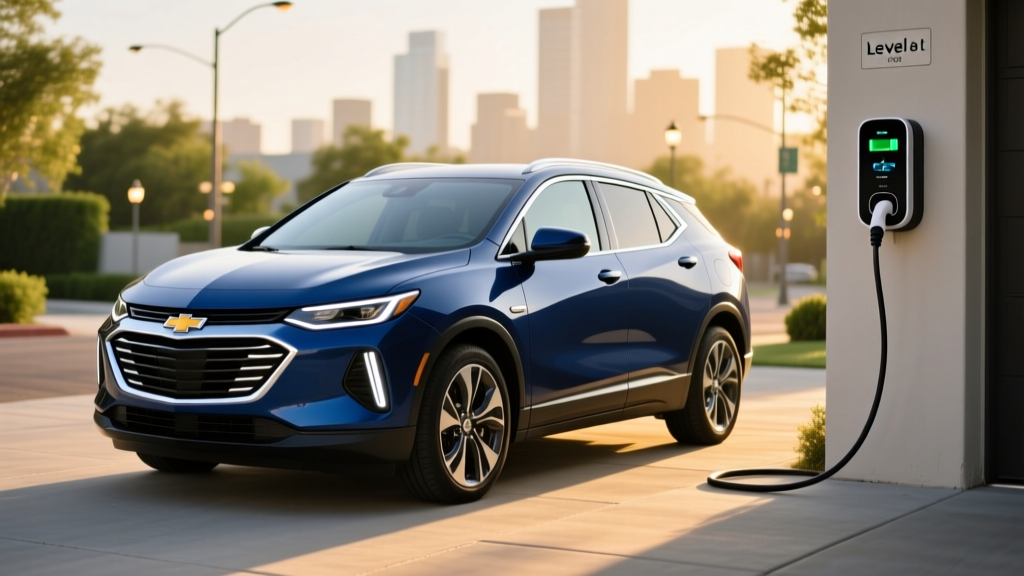
At home, the 11.5 kW onboard charger means a Level 2 wall connector (hardwired on a 60A circuit) will add roughly 34 miles of range per hour of charging — enough to fully replenish the battery overnight. A typical home Level 2 installation runs $800–$2,000 depending on electrical panel proximity and local permit costs. Always consult a licensed electrician for final installation specifications.
Performance and Drivetrain
| Metric | FWD | AWD (Dual Motor) |
|---|---|---|
| Horsepower | 213 hp | 288 hp |
| Torque | 236 lb-ft | 346 lb-ft |
| 0–60 mph | ~8.0 seconds | ~6.5 seconds |
| Drivetrain | Single motor, front-wheel drive | Dual motor, all-wheel drive |
The FWD Equinox EV is tuned for efficiency, not excitement. The 213-hp single-motor setup provides adequate acceleration for highway merging and city driving, with the instant torque characteristic of all EVs making it feel punchier than the 0–60 time suggests. Regenerative braking offers one-pedal driving capability with multiple regen levels selectable through the infotainment system.
The AWD dual-motor variant is the more engaging choice, with 288 hp providing genuinely quick off-the-line performance. The trade-off is roughly 15–20 miles of EPA range and a ~$3,000 price premium. For buyers in snow-belt states, the AWD system's traction advantage and the additional power make it the more versatile year-round choice.
Neither variant is rated for towing beyond 1,500 pounds — this is a passenger crossover, not a hauler. If you need serious towing capacity, look at the Chevrolet Blazer EV or Silverado EV instead.
Pricing, Trims, and Federal Tax Credit Eligibility
| Trim | Drivetrain | Base MSRP | Est. After §30D Credit* |
|---|---|---|---|
| LT 2LT (FWD) | FWD | $33,600 | ~$26,100 |
| LT 2LT (AWD) | AWD | $36,600 | ~$29,100 |
| RS (FWD) | FWD | $38,900 | ~$31,400 |
| RS (AWD) | AWD | $41,900 | ~$34,400 |
| Activ (AWD) | AWD | $44,800 | ~$37,300 |
*Estimated prices assume full $7,500 federal tax credit eligibility. Actual credit amount and availability depend on individual circumstances.
Federal Tax Credit (§30D) Eligibility — Key Requirements:
- MSRP Cap: The Equinox EV qualifies as an SUV under IRS guidelines, so the MSRP cap is $80,000 — all trims clear this easily.
- Buyer Income Limits: Modified adjusted gross income (MAGI) must not exceed $150,000 (single), $225,000 (head of household), or $300,000 (joint filers).
- Battery Sourcing: The full $7,500 credit requires meeting both critical minerals and battery component sourcing requirements set by the IRS under §30D. GM has worked to onshore Ultium battery supply chains, and the Equinox EV has qualified for the full credit in recent model years — but sourcing requirements tighten annually. Verify current-year eligibility on the IRS qualified vehicles list before purchase.
- Point-of-Sale Transfer: As of 2024, buyers can transfer the credit to the dealer at the point of sale, receiving it as an immediate price reduction rather than waiting to claim it on their tax return. This applies to 2026 purchases.
State and local incentives may stack on top of the federal credit. Check AFDC's incentive database for your specific jurisdiction, as these vary widely and change frequently.
Interior Space, Tech, and Daily Livability
The Equinox EV's interior is where the Ultium platform's flat floor pays dividends. With no transmission tunnel or exhaust routing, cabin space is generous for the compact crossover segment.
| Dimension | Measurement |
|---|---|
| Front Legroom | 43.1 inches |
| Rear Legroom | 37.8 inches |
| Cargo (behind 2nd row) | 26.4 cu ft |
| Cargo (2nd row folded) | 57.2 cu ft |
| Front Trunk (Frunk) | Not available |
Tech highlights:
- 17.7-inch diagonal infotainment touchscreen (Google built-in on higher trims)
- 11-inch digital driver instrument cluster
- Wireless Apple CarPlay and Android Auto
- Available Super Cruise (GM's Level 2 hands-free highway driving assist on compatible mapped roads)
- Standard Chevy Safety Assist suite: automatic emergency braking, lane-keep assist, following distance indicator, front pedestrian braking
- Available head-up display and digital rearview mirror
Notable drawbacks:
- No frunk: Unlike the Hyundai Ioniq 5 or Ford Mustang Mach-E, there's no front trunk. The space under the hood houses HVAC and power electronics.
- Material quality: Lower trims use hard plastics on door panels and the lower dashboard. The RS and Activ trims improve this, but it's not a premium interior.
- Rear visibility: The sloping rear window and thick C-pillars create blind spots — the available digital rearview camera mirror is a worthwhile upgrade.
- Charging speed gap: At 150 kW peak DC charging, the Equinox EV trails the Ioniq 5's 233 kW (800V architecture) significantly on long road trips where charging time compounds.
Warranty and Long-Term Ownership
| Coverage | Term |
|---|---|
| Battery & Propulsion (Limited) | 8 years / 100,000 miles |
| Bumper-to-Bumper | 3 years / 36,000 miles |
| Powertrain (non-battery) | 5 years / 60,000 miles |
| Corrosion | 6 years / 100,000 miles |
| Roadside Assistance | 5 years / 60,000 miles |
The battery warranty covers defects and capacity degradation below 60% of original capacity during the 8-year/100,000-mile term. This is industry-standard and matches competitors like the Hyundai Ioniq 5 and Kia EV6. For context, GM's Ultium batteries have shown promising early degradation data, though long-term (10+ year) data is still accumulating given the platform's relative newness.
EV maintenance costs are substantially lower than gas vehicles — no oil changes, no spark plugs, no transmission fluid. Expect to budget for tire rotation, cabin air filter replacement, brake fluid checks, and washer fluid. Regenerative braking significantly extends brake pad life; many EV owners report original brake pads lasting 80,000+ miles.
How It Compares: Equinox EV vs. the Competition
| Spec | Chevy Equinox EV (FWD) | Hyundai Ioniq 5 (RWD) | Tesla Model Y (LR RWD) |
|---|---|---|---|
| EPA Range | 319 mi | 303 mi | 320 mi |
| Battery (kWh) | ~85 | 77.4 | ~75 |
| DC Fast Charge (peak kW) | 150 kW | 233 kW | 250 kW |
| 10–80% DC Time | ~42 min | ~18 min | ~22 min |
| Starting MSRP | $33,600 | $42,600 | $44,990 |
| 0–60 mph | ~8.0 sec | ~7.0 sec | ~6.5 sec |
| NACS Native | Yes | Yes (2025+) | Yes |
The Equinox EV's core advantage is price. At $33,600 base (potentially ~$26,100 after the federal credit), it undercuts the Ioniq 5 and Model Y by roughly $9,000–$11,000 before incentives. That's a massive gap in effective cost.
Where it loses ground is DC fast-charging speed. On road trips requiring multiple charging stops, the Ioniq 5's 800V architecture and 233 kW peak rate save 20+ minutes per stop — a meaningful difference for frequent long-distance travelers. The Model Y remains the efficiency and charging-network benchmark, but at a premium price and with Tesla's polarizing ownership experience.
For EPA range data across all trims, fueleconomy.gov provides official government figures for direct comparison.
Who Should Buy the Chevrolet Equinox EV?
- You want 300+ miles of range at the lowest possible price point
- Your driving is primarily commuting and daily errands with occasional road trips
- You can charge at home (Level 2) and don't rely exclusively on public DC fast charging
- You qualify for the federal tax credit and want to maximize the incentive-to-price ratio
- You prefer a traditional crossover design over futuristic styling
- You take frequent long road trips and need the fastest possible DC charging (consider Ioniq 5 or Model Y)
- You need towing capacity above 1,500 lbs
- You want a frunk for additional cargo flexibility
- You prioritize premium interior materials and luxury features
- You live in extreme cold and need every possible mile of winter range (AWD helps, but consider a larger battery pack elsewhere)
Frequently Asked Questions
What is the real-world range of the Chevrolet Equinox EV?
The FWD Equinox EV carries a 319-mile EPA estimate. In real-world mixed driving at moderate temperatures, expect 270–290 miles. Highway-only driving at 70+ mph reduces this to approximately 265–285 miles in mild weather and 210–240 miles in freezing conditions. AWD models see a further 15–20 mile reduction across all scenarios.
How fast does the Equinox EV charge at home and on the road?
At home on a Level 2 (240V, 48A) charger, the Equinox EV charges at up to 11.5 kW, adding roughly 34 miles of range per hour — a full charge takes about 9.5 hours. On DC fast chargers, it peaks at 150 kW, reaching 10–80% in approximately 42 minutes. The NACS connector provides native access to Tesla Superchargers.
Does the Chevrolet Equinox EV qualify for the $7,500 federal tax credit?
The Equinox EV has qualified for the full $7,500 §30D federal tax credit in recent model years, as its MSRP is well below the $80,000 SUV cap and GM's Ultium battery sourcing has met IRS critical minerals and component requirements. However, eligibility depends on your income (MAGI under $150K single / $300K joint), the specific vehicle's battery sourcing for the model year, and current IRS rules. Verify on the IRS qualified vehicles list before purchasing. The credit can be transferred to the dealer at point of sale for an immediate price reduction.
Is the Equinox EV worth buying over the Tesla Model Y or Hyundai Ioniq 5?
It depends on your priorities. If minimizing purchase price is paramount, the Equinox EV's ~$33,600 starting MSRP (potentially ~$26,100 after the tax credit) is unbeatable in this range class. If fast DC charging for frequent road trips is your top concern, the Ioniq 5 (233 kW peak) and Model Y (250 kW peak) are substantially faster. The Model Y also leads in efficiency and software, while the Ioniq 5 offers a more distinctive design and V2L capability. For value-first buyers with home charging, the Equinox EV is the strongest pick.
What are the biggest pros and cons?
Pros: 319-mile EPA range at an entry-level price; NACS connector for Supercharger access; spacious cabin with flat floor; standard heat pump; strong safety feature suite; qualifies for federal tax credit.
Cons: 150 kW peak DC charging is slower than key rivals; no front trunk (frunk); base interior uses hard plastics; FWD acceleration is leisurely; limited towing capacity (1,500 lbs).
Does the Equinox EV have Super Cruise?
Super Cruise — GM's Level 2 hands-free driver assistance system for compatible divided highways — is available on higher trims (RS and above) as part of an option package. It is not a self-driving system. The driver must remain attentive, keep their eyes on the road (monitored by a driver-facing camera), and be prepared to take over at any time. Super Cruise operates only on pre-mapped limited-access highways, which currently cover over 750,000 miles of roads in North America.