Quick Answer: Chevrolet's 2026 electric lineup spans three core models — the Equinox EV (compact crossover, from ~$33,600, up to 319 miles EPA), the Blazer EV (midsize crossover, from ~$44,600, up to 324 miles EPA), and the Silverado EV (full-size pickup, from ~$57,900, up to 440 miles EPA). All use GM's Ultium platform with NMC lithium-ion batteries and support DC fast charging up to 190–350 kW depending on the model. Most buyers will find the Equinox EV 3LT the best value, especially when the federal §30D tax credit applies, bringing effective pricing into the low $30,000s — competitive with a well-equipped gas CR-V or RAV4.
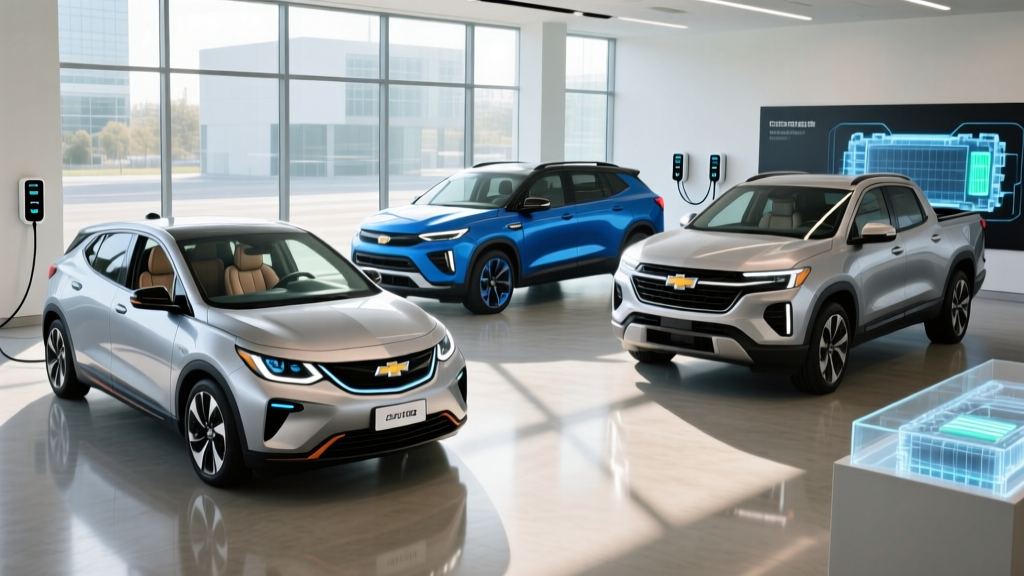
The 2026 Chevrolet Electric Lineup at a Glance
Chevrolet has committed fully to the Ultium battery platform, and by the 2026 model year the brand offers three distinct EVs targeting the highest-volume segments. The Bolt EV and Bolt EUV have been discontinued after the 2025 model year, replaced in spirit by the more spacious and faster-charging Equinox EV. Here is how the current lineup breaks down by the numbers.
| Spec | Equinox EV | Blazer EV | Silverado EV |
|---|---|---|---|
| Body Style | Compact Crossover | Midsize Crossover | Full-Size Pickup |
| EPA Range (max) | 319 mi | 324 mi | 440 mi |
| Battery (usable, kWh) | ~85 kWh (NMC) | ~102 kWh (NMC) | ~200 kWh (NMC) |
| Peak DC Fast Charge | 190 kW | 190 kW | 350 kW |
| 10–80% DCFC Time | ~24 min | ~28 min | ~20 min |
| Level 2 Charge Rate | 11.5 kW | 11.5 kW | 19.2 kW |
| 0–60 mph (AWD) | ~5.9 sec | ~4.0 sec (SS) | ~4.5 sec (RST) |
| Horsepower (AWD) | 288 hp | 557 hp (SS) | 664 hp (RST) |
| Starting MSRP | $33,600 | $44,600 | $57,900 |
| Battery Warranty | 8 yr / 100,000 mi | 8 yr / 100,000 mi | 8 yr / 100,000 mi |
Sources: fueleconomy.gov, Chevrolet.com. Range figures reflect the highest-range trim/config. Real-world highway and cold-weather range will be 15–30% lower — see the ownership section below.
Equinox EV: The Volume Play for Most Buyers
The Equinox EV is where Chevrolet's pricing becomes genuinely compelling. Starting at $33,600 for the base 2LT with front-wheel drive and stepping to $35,400 for the 3LT (which adds the larger 85 kWh battery and 319-mile EPA range), it undercuts rivals like the Hyundai Ioniq 5 and Volkswagen ID.4 while offering competitive interior space and a more conventional crossover aesthetic that appeals to first-time EV buyers.
Real-World Range Expectations
The EPA rates the Equinox EV 3LT FWD at 319 miles and the AWD 3LT at approximately 297 miles. In practice, expect roughly 250–275 miles on a highway road trip at 70–75 mph, and as low as 215–240 miles in sub-freezing temperatures. The NMC battery chemistry performs adequately in cold but not as well as LFP in long-term cycle life — though GM's 8-year/100,000-mile battery warranty (with a 70% capacity retention threshold) provides a reasonable floor.
Charging Curve Reality
The Equinox EV peaks at 190 kW on a DC fast charger, but that peak is sustained only between roughly 10–40% state of charge. Above 60%, the rate tapers to ~100 kW, and above 80% it drops to ~50 kW. A realistic 10–80% session takes about 24 minutes on a 350 kW-capable station. If you're only charging to 80% on road trips — as recommended for daily driving and battery longevity — this is competitive but not class-leading. The Hyundai Ioniq 5, with its 800V architecture, can do 10–80% in roughly 18 minutes.
Blazer EV and Silverado EV: Performance and Utility
If you need more space, power, or towing, the Blazer EV and Silverado EV fill those roles — at a cost premium.
The Blazer EV in SS trim delivers 557 hp and a 4.0-second 0–60 time, making it a legitimate performance crossover. The 2LT and RS trims are more practical for daily driving, with the RS AWD offering 292 miles EPA at $48,600. The 102 kWh battery is large, which means longer Level 2 charging sessions at home — plan for roughly 9–10 hours from near-empty on an 11.5 kW Level 2 charger.
The Silverado EV targets truck buyers who need range and capability. The 4WT (work truck) trim offers the headline 440-mile EPA range thanks to its massive ~200 kWh battery pack, while the RST First Edition at $57,900 provides 664 hp and a 4.5-second 0–60. Towing capacity reaches 10,000 lbs on the WT, though towing a heavy trailer will cut range roughly in half — a universal EV reality. The 350 kW peak DC fast charge capability means a 10–80% session in approximately 20 minutes on compatible infrastructure, which is critical for a truck this size.
Chevrolet Electric Cars vs. Gas: The Cost Breakdown
The most common question from shoppers is whether a Chevrolet EV actually saves money over a comparable gas vehicle. The answer depends on your driving volume, electricity rate, and whether you qualify for the federal tax credit. Here is a five-year comparison between the Equinox EV 3LT FWD and a comparably equipped gas Chevrolet Equinox AWD (2.0L turbo, ~26 MPG combined).
| Cost Factor (5 Years / 75,000 Miles) | Equinox EV 3LT FWD | Gas Equinox LT AWD |
|---|---|---|
| Purchase Price (MSRP) | $35,400 | $32,400 |
| Federal §30D Tax Credit | −$7,500 (if eligible)* | $0 |
| Effective Purchase Price | $27,900 | $32,400 |
| Fuel/Energy Cost (75k mi) | $3,375 (home charging @ $0.15/kWh) | $8,650 ($3.50/gal, 26 MPG) |
| Maintenance (5 yr) | ~$1,200 | ~$3,500 |
| Insurance (5 yr est.) | ~$9,500 | ~$7,800 |
| Total 5-Year Cost | $41,975 | $52,350 |
*The IRS §30D credit has income caps ($150k single / $300k joint), MSRP caps ($55k for SUVs), and battery sourcing requirements that change annually. Confirm eligibility at purchase — the credit can now be transferred at the point of sale as a discount. Source: irs.gov.
The EV wins decisively on energy and maintenance costs — electricity is roughly a third the per-mile cost of gasoline, and EVs eliminate oil changes, spark plugs, and transmission fluid. However, EV insurance premiums run 15–25% higher on average, and the upfront price before incentives is higher. If you do not qualify for the tax credit or drive fewer than 10,000 miles per year, the payback period extends significantly.
Real-World Ownership: What First-Time Buyers Must Know
Buying a Chevrolet EV is only half the equation. Living with one requires some infrastructure and expectation-setting.
Home Charging Is Non-Negotiable for Most Owners
Over 80% of EV charging happens at home. A Level 2 home charger (240V, 40–48 amp circuit) adds roughly 30–37 miles of range per hour on the Equinox EV and Blazer EV, meaning a full overnight charge from 20% to 100% takes about 7–9 hours. Installation costs typically range from $800 to $2,500 depending on your electrical panel's capacity, the distance from panel to garage, and local permit fees. If your home has a 100-amp panel, a $1,500–$3,000 panel upgrade to 200 amps may be required — factor this into your budget.
If you cannot install home charging (apartment living, street parking), public DC fast charging becomes your primary fuel source. At $0.30–$0.50/kWh on networks like Electrify America or EVgo, your per-mile energy cost roughly doubles compared to home charging, eroding much of the cost advantage over gas.
Cold Weather Range Loss Is Real
In sustained temperatures below 32°F, expect 20–30% range reduction due to battery chemistry limitations and cabin heating demands. The Equinox EV's heat pump (standard on 2026 models) mitigates this somewhat compared to resistive heating, but a 319-mile EPA rating may realistically deliver 220–250 miles on a cold January highway drive. Preconditioning the battery while plugged in — using the MyChevrolet app to warm the cabin and battery before departure — recovers some of that loss.
Charging Network Access
All 2026 Chevrolet EVs come equipped with the NACS (North American Charging Standard) connector, meaning native access to the Tesla Supercharger network — over 25,000 stalls in North America. This is a significant advantage over older CCS-equipped EVs that require adapters. You also retain access to Electrify America, EVgo, and ChargePoint networks.
Common Misconceptions About Chevrolet EVs
| Myth | Fact |
|---|---|
| "EV batteries need replacing every few years." | GM warranties the Ultium battery for 8 years/100,000 miles at 70%+ capacity. Data from earlier GM EVs shows typical degradation of 8–12% over 100,000 miles — far less than full replacement. |
| "The tax credit is $7,500 for everyone." | Eligibility depends on buyer income, vehicle MSRP, and battery critical-mineral sourcing. Many buyers qualify, but high-income filers or those buying above the MSRP cap do not. Always verify at point of sale. |
| "Charging takes too long on road trips." | A 10–80% DC fast charge on the Equinox EV takes ~24 minutes — roughly the time for a rest stop. The Silverado EV does it in ~20 minutes at 350 kW. |
| "EVs are worse in winter." | EVs start reliably in any temperature (no cold-cranking amps to worry about). Range drops, but preconditioning and seat/steering wheel heating reduce cabin energy draw significantly. |
| "I need a special charger at home." | You need a 240V outlet (like a dryer outlet) and a Level 2 EVSE unit. A licensed electrician handles the install. No proprietary equipment is required. |
Decision Framework: Which Chevrolet EV Fits You?
Choose the Equinox EV if:
- Your budget is $30,000–$40,000 (after tax credit)
- You commute 30–60 miles daily and want minimal charging stops
- You want a familiar crossover form factor without a learning curve
- Home Level 2 charging is available
Choose the Blazer EV if:
- You need more cargo space and rear-seat room than the Equinox offers
- Performance matters (the SS trim is genuinely fast)
- Your budget allows $45,000–$55,000
- You want a sportier design statement
Choose the Silverado EV if:
- You need truck capability — towing, bed utility, ground clearance
- Range is paramount (the 4WT's 440 miles is class-leading for trucks)
- You can accommodate a large vehicle in your garage/driveway
- Budget allows $55,000+ and you can confirm §30D eligibility (MSRP cap for trucks is $80,000)
Reconsider an EV entirely if:
- You cannot install home charging AND your area has sparse public DC fast chargers
- You regularly drive 400+ miles in a single day in extreme cold
- Your annual mileage is under 6,000 — the fuel savings won't offset the premium
- You are considering a Chevrolet EV solely for the tax credit but do not meet income or sourcing requirements
Frequently Asked Questions
Do Chevrolet electric cars qualify for the full $7,500 federal tax credit in 2026?
Most do, but eligibility is not universal. The IRS §30D credit requires that your modified adjusted gross income falls below $150,000 (single) or $300,000 (joint), the vehicle MSRP is under $55,000 for SUVs or $80,000 for trucks, and the battery meets critical-mineral and component sourcing thresholds that tighten each year. As of 2026, the Equinox EV and Blazer EV (non-SS trims) generally qualify. The Silverado EV qualifies under the higher truck MSRP cap. The credit can be applied as a point-of-sale discount, reducing your out-of-pocket cost immediately. Consult a tax professional for your specific situation.
How long does it take to charge a Chevrolet EV at home?
On a Level 2 home charger (240V, 48 amps / 11.5 kW), the Equinox EV charges from 0–100% in approximately 8.5 hours. The Blazer EV, with its larger 102 kWh battery, takes roughly 10 hours. The Silverado EV with its optional 19.2 kW onboard charger can do it in about 11 hours, or 17+ hours on a standard 11.5 kW unit. For most owners who plug in each evening and charge between 20–80%, a full overnight session is more than sufficient.
Is the Chevrolet EV battery warranty good enough?
GM covers the Ultium battery for 8 years or 100,000 miles, whichever comes first, against defects and excessive capacity loss (defined as dropping below 70% of original capacity). This is industry-standard — matching Ford, Hyundai, and most other mainstream brands. Real-world degradation data from earlier Ultium-based vehicles suggests most packs retain 88–92% capacity at 100,000 miles, well above the warranty threshold. Battery replacement out of warranty is expensive ($15,000–$25,000+ depending on the pack), but full replacements are rare within the first decade.
Can I tow with a Chevrolet electric truck?
The Silverado EV 4WT is rated for up to 10,000 lbs of towing. However, towing a heavy trailer at highway speeds will reduce range by approximately 40–55%. A 440-mile range truck towing a 7,000-lb trailer may realistically deliver 200–250 miles between charges. Plan your routes around DC fast charging stations and expect longer charge stops due to the large battery pack.
Should I buy or lease a Chevrolet EV?
Leasing has a distinct advantage: the $7,500 federal credit is captured by the lessor (the automaker's finance arm) and typically passed through as a lease incentive, regardless of your personal income or the vehicle's battery sourcing. This means even high-income buyers who wouldn't qualify for the purchase credit can benefit. If you plan to keep the vehicle 5+ years and qualify for the credit, purchasing (with point-of-sale transfer) usually yields a lower total cost. Lease if you want flexibility and guaranteed residual-value protection against EV depreciation uncertainty.