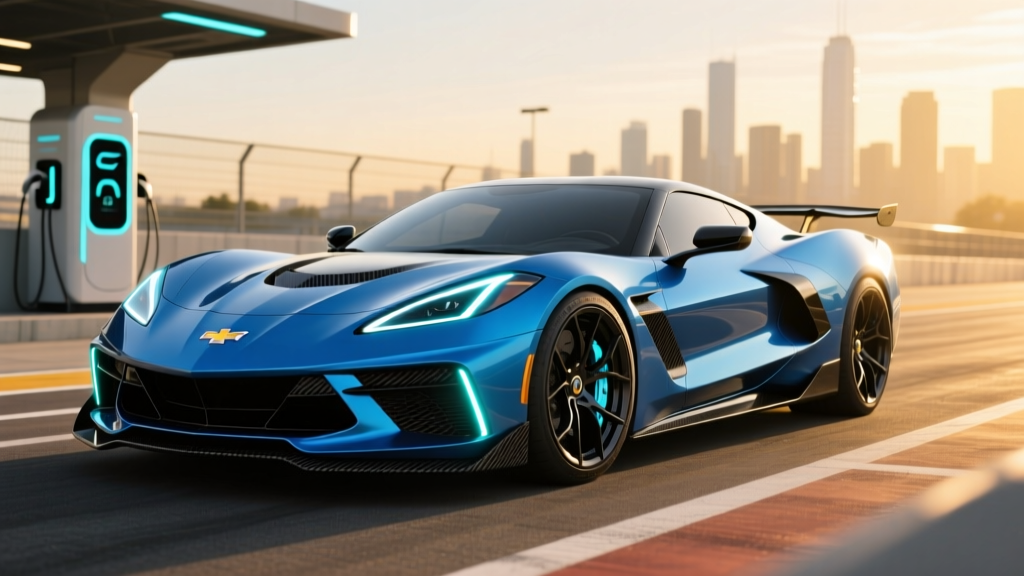
If you've been searching for the Chevrolet Corvette ZR1X electric supercar, here's the essential truth: as of mid-2026, Chevrolet has not officially announced a fully electric Corvette ZR1X. What does exist is the C8 ZR1 with its twin-turbo 5.5L LT7 V8 producing 1,064 hp, and GM's Ultium battery platform underpinning vehicles like the Silverado EV and Blazer EV. Industry speculation about an electrified or fully electric future Corvette persists, but no confirmed specs, pricing, or release date exists. This guide separates verified facts from rumors, examines what a hypothetical electric ZR1X would need to deliver, and provides a practical framework for buyers considering high-performance EVs versus the current gas-powered ZR1.
The Current State: Gas ZR1 vs. Electrified Speculation
The C8 Corvette ZR1, which began deliveries for the 2025 model year, represents the pinnacle of Chevrolet's internal-combustion performance engineering. Before we can evaluate any hypothetical electric variant, we need to anchor expectations against what's actually available and what GM has actually said about electrification in its halo car.
Quick Answer: Does a Corvette ZR1X Electric Exist?
No. As of 2026, Chevrolet has not announced a fully electric Corvette ZR1X. The current ZR1 is powered by a twin-turbocharged 5.5L V8 (LT7) producing 1,064 hp and 828 lb-ft of torque, with a starting MSRP of approximately $174,995. GM executives have hinted at electrified Corvettes in the future — potentially using the Ultium platform or a hybrid setup similar to the Corvette E-Ray — but no all-electric ZR1X has been confirmed for production. Any specifications you find online for a "ZR1X electric" are speculative or concept-based.
What a Theoretical Electric ZR1X Would Need to Compete
If Chevrolet were to build an all-electric Corvette ZR1X, it would enter a competitive set that includes the Rimac Nevera, Lotus Evija, Pininfarina Battista, and upcoming entries from Porsche and others. Based on GM's Ultium platform capabilities and competitive benchmarks, here's what realistic engineering targets would look like — keeping in mind these are estimated projections, not confirmed specifications.
| Specification | Gas C8 ZR1 (Confirmed) | Hypothetical Electric ZR1X | Rimac Nevera (Benchmark) |
|---|---|---|---|
| Powertrain | 5.5L TT V8 (LT7) | Tri-motor AWD (est.) | Quad-motor AWD |
| Horsepower | 1,064 hp | 1,200–1,500 hp (est.) | 1,914 hp |
| 0–60 mph | ~2.3 sec | ~1.8–2.0 sec (est.) | 1.85 sec |
| Battery Capacity | N/A (18.4 gal fuel tank) | 100–120 kWh (est.) | 120 kWh |
| EPA Range | ~300 mi (est. at cruising) | 200–250 mi (est.) | ~340 mi (WLTP) |
| DC Fast Charge Peak | N/A | 250–350 kW (est.) | 500 kW (peak) |
| Curb Weight | ~3,647 lbs | 4,400–4,800 lbs (est.) | 4,739 lbs |
| Starting MSRP | $174,995 | $200,000–$250,000 (est.) | ~$2,200,000 |
A few engineering realities are worth noting. First, battery weight is the fundamental challenge for any electric supercar. A 100+ kWh battery pack adds roughly 1,200–1,500 lbs compared to a fuel tank and internal combustion engine, which fundamentally changes weight distribution, tire wear, and track-session endurance. Second, sustained high-speed driving — the kind that defines a supercar on a circuit — drains batteries dramatically faster than EPA-rated cruising. A vehicle rated for 250 miles of mixed driving might deliver only 80–100 miles at sustained 120+ mph track use. Third, while electric motors deliver instant torque (giving devastating 0–60 times), top speed is often limited by battery thermal management and single-speed gear ratios.
Corvette E-Ray: GM's Actual Electrified Corvette
The closest thing to an electrified Corvette that actually exists is the Corvette E-Ray, which pairs the 6.2L LT2 V8 with a front-axle electric motor for all-wheel drive. The E-Ray produces a combined 655 hp, achieves 0–60 mph in approximately 2.5 seconds, and offers a very limited electric-only range of roughly 4–5 miles at low speeds. It is not a plug-in hybrid in the traditional sense — the 1.9 kWh battery recharges through regenerative braking and engine power, not from a wall outlet.
The E-Ray demonstrates GM's willingness to add electrification to the Corvette platform, but it also reveals the company's cautious approach: electrification is used to augment the V8, not replace it. Any future ZR1X electric would represent a far more radical departure from this philosophy.
EV vs. Gas Supercar: Ownership Cost and Practical Comparison
For buyers weighing the current gas ZR1 against the concept of an electric alternative, the ownership equation extends well beyond the sticker price. Here's how the economics break down across a 5-year ownership horizon.
| Category | Gas ZR1 (Confirmed) | Electric ZR1X (Estimated) |
|---|---|---|
| Base MSRP | $174,995 | $225,000 (est.) |
| Federal Tax Credit (§30D) | $0 | $0 (exceeds MSRP cap*) |
| Fuel/Energy (5 yr, 50k mi) | ~$14,000 (premium @ $4.50/gal, 15 MPG avg) | ~$4,500 (3.5 kWh/mi, $0.13/kWh home + DC mix) |
| Maintenance (5 yr) | ~$6,500 (oil, brakes, belts, fluids) | ~$2,500 (tires, cabin filter, brake fluid) |
| Insurance (5 yr avg) | ~$28,000 | ~$32,000 (est. higher EV replacement cost) |
| Depreciation (5 yr) | ~$70,000 (est. 40%) | ~$90,000 (est. 40%, higher basis) |
| Estimated 5-Year Total Cost | ~$293,495 | ~$354,000 |
*Under current IRS §30D rules, the new clean vehicle credit is capped at $80,000 MSRP for sedans/sports cars. A $225,000+ electric supercar would not qualify. Consult a tax professional for eligibility.
The gas ZR1 holds a substantial cost advantage, driven primarily by its lower purchase price. The electric variant would save roughly $9,500–$13,500 over five years in fuel and maintenance combined, but this doesn't come close to offsetting a $50,000+ price premium. For supercar buyers, cost-per-thrill matters more than cost-per-mile — but the data is clear that electrification at this tier adds cost rather than removing it.
Real-World Ownership Considerations for High-Performance EVs
If you're considering any electric supercar — current or hypothetical — several practical factors will define your ownership experience far more than spec-sheet numbers.
Home Charging Is Non-Negotiable
A 100+ kWh battery in a performance EV requires reliable Level 2 home charging (typically 11.5–19.2 kW on a 240V circuit) to be practical. Charging a 120 kWh pack from 10% to 80% on an 11.5 kW home charger takes approximately 7–8 hours — fine for overnight, but it means every track day requires planning. A professional Level 2 installation typically costs $1,200–$3,500 including equipment, electrician labor, and permitting, though a 200-amp panel upgrade (if needed) can add $1,500–$4,000. Without home charging, public DC fast charging at $0.35–$0.55/kWh erases most of the fuel-cost advantage and introduces significant time overhead.
Track Use Drains Batteries Fast
This is the single biggest practical limitation of electric supercars. Aggressive driving at sustained high speeds can consume energy at 3–5× the EPA-rated rate. A vehicle rated for 250 miles of mixed driving might deliver only 50–80 miles of hard track use before needing a cooldown and recharge. Thermal management systems in vehicles like the Rimac Nevera and Porsche Taycan Turbo GT are engineered specifically to mitigate this, but battery temperature remains the limiting factor for sustained performance sessions. The gas ZR1, by contrast, can refuel in 3 minutes and run session after session with only brake and tire wear to manage.
Cold-Weather Range Loss
Lithium-ion batteries lose 20–40% of their rated range in freezing temperatures, depending on whether the vehicle has a heat pump and battery preconditioning system. A hypothetical electric ZR1X rated at 250 miles EPA might deliver only 150–180 miles in sub-30°F conditions. For owners in northern climates, this is a meaningful constraint on year-round usability.
Insurance Premiums
Electric supercars typically carry higher insurance premiums than their gas counterparts due to higher repair costs, specialized parts, and elevated replacement values. Expect annual premiums of $5,500–$8,000+ for a $200,000+ electric performance vehicle, compared to $4,500–$7,000 for the gas ZR1 at its lower MSRP. Always obtain quotes before purchasing.
Common Misconceptions About the Corvette ZR1X Electric
| Myth | Fact |
|---|---|
| "Chevy is releasing an electric ZR1X in 2026" | No official announcement exists. GM has confirmed only the gas ZR1 and the hybrid E-Ray for the current C8 generation. |
| "An electric ZR1X would qualify for the $7,500 federal tax credit" | Under current IRS §30D rules, the credit caps at vehicles with an MSRP of $80,000 or less for cars. A $200K+ supercar would not qualify regardless of powertrain. |
| "Electric supercars are faster in every way" | EVs dominate 0–60 acceleration due to instant torque, but gas supercars often hold advantages in top speed, track-session endurance, and refueling speed. The C8 ZR1's ~230+ mph top speed would be extremely difficult and energy-intensive for an EV to match. |
| "GM's Ultium platform can't handle supercar performance" | Ultium underpins the 664-hp Hummer EV and the Silverado EV with 754 hp. The platform is capable of high power, but packaging a 1,000+ hp configuration into a mid-engine Corvette footprint with appropriate weight distribution is a separate engineering challenge. |
| "You'll save money going electric" | At the supercar price tier, higher purchase cost, higher insurance, and zero tax credit eligibility mean an electric variant would cost more over 5 years, not less. Fuel savings are real but modest relative to total ownership cost. |
Decision Framework: Should You Wait or Buy Now?
Given that the Chevrolet Corvette ZR1X electric supercar is not a confirmed product, here's a practical framework for how to proceed based on your priorities.
Choose the Gas ZR1 If:
- You want a confirmed, purchasable vehicle today with 1,064 hp, ~2.3-sec 0–60, and established dealer/service infrastructure.
- Track use is a priority. Gas cars refuel in minutes and sustain high-speed sessions without thermal derating.
- You value top speed. The ZR1's ~230+ mph top speed is proven; matching it in an EV requires enormous energy and advanced gearing.
- Total cost matters. At ~$175K base, the ZR1 is dramatically less expensive than any current electric supercar.
- You want collector value. The final-generation V8 Corvettes may appreciate as the industry transitions to electrification.
Consider an Electric Performance Alternative If:
- Instant torque and 0–60 supremacy are your top priorities. Current EVs like the Porsche Taycan Turbo GT (0–60 in ~2.1 sec, $230,000) or Lucid Air Sapphire (0–60 in ~1.89 sec, $249,000) deliver acceleration the gas ZR1 can't quite match.
- You have reliable home charging (Level 2, 48A+ circuit) and your daily/weekly driving stays within 150–200 miles.
- You want daily-drivable performance with minimal maintenance, quiet operation, and no premium fuel stops.
- You're willing to wait 2–4+ years on the possibility that GM announces an electric Corvette, with no guarantee it will carry the ZR1 nameplate or meet speculative performance targets.
What First-Time EV Buyers Should Know at This Tier
If you're coming from a gas performance car and considering any high-end EV — whether it's a Taycan, Lucid, or a future electric Corvette — these fundamentals will shape your experience:
kW vs. kWh matters. Kilowatts (kW) measure power — how fast you charge or how much force the motors produce. Kilowatt-hours (kWh) measure energy capacity — how much "fuel" the battery holds. A 120 kWh battery with a 350 kW peak charge rate is analogous to a large fuel tank with a high-flow pump. Confusing these units is the most common EV buyer mistake.
Peak charge rate is not sustained charge rate. A vehicle advertising "350 kW DC fast charging" will only sustain that rate for a fraction of the session, typically between 10–30% state of charge. Above 80%, charging slows dramatically to protect battery health. A realistic 10–80% session on a 350 kW-capable vehicle with a 120 kWh battery takes 20–30 minutes, not the 12 minutes that simple math might suggest.
Battery degradation is real but manageable. Modern NMC (nickel-manganese-cobalt) batteries typically retain 85–90% of original capacity after 100,000 miles. Federal regulations require manufacturers to warranty EV batteries for at least 8 years/100,000 miles at a minimum of 70% capacity retention. For a $200,000+ vehicle, out-of-warranty battery replacement could cost $25,000–$45,000 — a factor in long-term ownership planning.
Public charging infrastructure is improving but inconsistent. As of 2026, the EPA and Department of Energy continue to track charging network growth, but reliability varies significantly between networks. Tesla Superchargers (now open to NACS-equipped non-Tesla vehicles) remain the most reliable DC fast-charging network. For a supercar that may use CCS or a proprietary connector, verify compatible high-power chargers exist along your typical routes before purchase.
Frequently Asked Questions
Will Chevrolet ever make a fully electric Corvette?
GM has not confirmed a fully electric Corvette as of 2026. The company has stated it aims to go fully electric by 2035, and the Corvette brand is expected to evolve with that timeline. However, the C8 generation will likely continue with the gas ZR1 and hybrid E-Ray through at least 2028–2029 before a next-generation platform could introduce a full EV variant.
How does the Corvette E-Ray differ from a plug-in hybrid?
The E-Ray uses a small 1.9 kWh battery and front-axle electric motor to provide AWD and a brief electric-only mode (~4–5 miles at low speed). Unlike a PHEV such as the Jeep Wrangler 4xe (which has a 17.3 kWh battery and ~22 miles of electric range), the E-Ray cannot be plugged in — its battery recharges only through regenerative braking and the V8 engine. Think of it as a performance hybrid, not an efficiency hybrid.
What's the fastest production EV I can actually buy right now?
Among currently purchasable vehicles, the Lucid Air Sapphire (1,234 hp, 0–60 in ~1.89 sec, ~$249,000) and the Porsche Taycan Turbo GT (1,019 hp with Launch Control, 0–60 in ~2.1 sec, ~$230,000) represent the pinnacle of four-door electric performance. For two-door supercars, the Rimac Nevera remains the benchmark but is limited to 150 units globally at ~$2.2 million.
Would an electric Corvette be heavier than the gas version?
Significantly so. The current C8 ZR1 weighs approximately 3,647 lbs. A comparable electric variant with a 100–120 kWh battery pack would likely weigh 4,400–4,800 lbs — an increase of 800–1,200 lbs. This extra mass affects handling dynamics, tire wear, braking distances, and track-session endurance. Engineers would need to offset this with advanced suspension tuning, torque vectoring, and lightweight body materials.
Can I charge a high-performance EV on a standard household outlet?
Technically yes, but impractically. A standard 120V outlet (Level 1) delivers approximately 1.4 kW, adding roughly 3–5 miles of range per hour to a performance EV. Charging a 120 kWh battery from empty on Level 1 would take 80+ hours. Level 2 home charging (240V, 48A) at 11.5 kW is the practical minimum, delivering ~30–35 miles of range per hour and a full overnight charge.
This article reflects information available as of mid-2026. Chevrolet has not announced a Corvette ZR1X electric supercar. All projected specifications are estimates based on current GM platform capabilities and competitive benchmarks. For confirmed Corvette specifications, visit Chevrolet's official Corvette page. For federal tax credit rules, consult IRS.gov.