Quick Answer: Is There a Chevrolet Corvette EV You Can Buy Right Now?
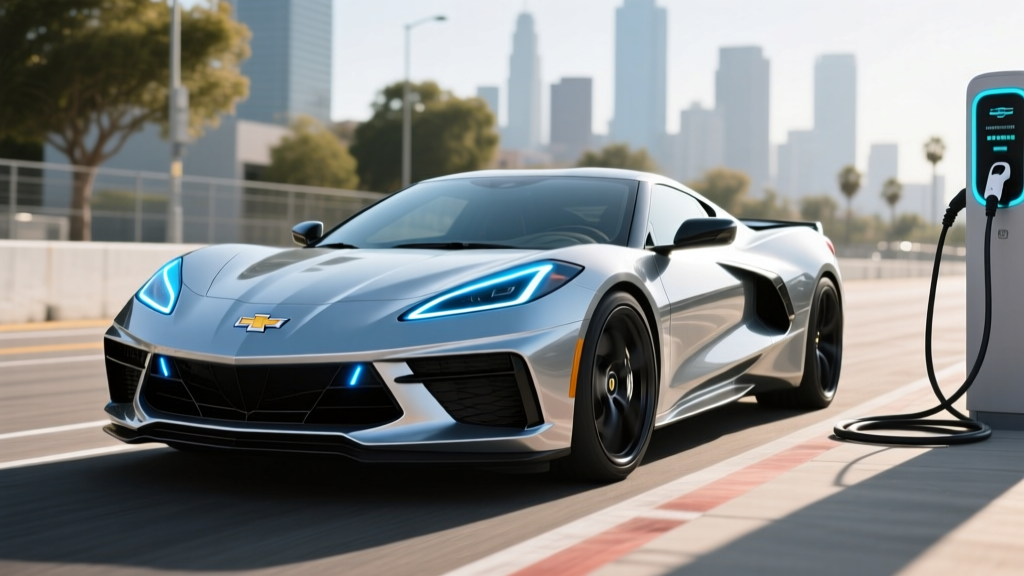
No. As of early 2026, Chevrolet has not released a production Corvette EV. GM executives — including former president Mark Reuss — have confirmed that an electric Corvette is in development on the Ultium (now branded BTX) platform, but no official on-sale date, finalized specs, or pricing have been published. What exists is a gas-powered C8 Corvette (including the hybrid E-Ray) and strong signals from GM that a fully electric variant will join the lineup, likely for the 2027 or 2028 model year. Everything below about the Corvette EV is based on confirmed platform capabilities, GM statements, and informed estimates — not final production data.
What GM Has Actually Confirmed About the Electric Corvette
General Motors has been deliberate in how it discusses an electrified Corvette. Here is what is on the record:
- E-Ray (2024–present): The C8 E-Ray pairs a 6.2L LT2 V8 with a front-axle electric motor producing 160 hp, for a combined 655 hp. It uses a small 1.9 kWh battery — this is a performance hybrid, not a plug-in. It cannot drive on electric power alone for meaningful distance. Base MSRP: ~$104,900.
- GM executive statements: Mark Reuss stated in 2022 that "there will be an electrified Corvette" and later confirmed a fully electric version is coming. Tadge Juechter, the Corvette chief engineer, has discussed how the Ultium platform's low-slung battery architecture suits a mid-engine sports car layout.
- Ultium/BTX platform: The electric Corvette will ride on GM's dedicated EV architecture, which currently underpins vehicles from the Cadillac Lyriq to the GMC Hummer EV. The platform supports 400V and (in some applications) 800V electrical systems, battery packs from roughly 50 kWh to 200+ kWh, and up to 1,000+ hp in tri-motor configurations.
What GM has not confirmed: battery capacity (kWh), motor count, EPA range, 0–60 mph time, MSRP, production location (Bowling Green is the Corvette's home and the likely candidate), or exact model year. Treat any specific numbers from non-GM sources as speculation.
Estimated Specs: What the Ultium Platform Tells Us
While we lack official Corvette EV numbers, the Ultium platform's known capabilities let us build an informed estimate. A sports car application will prioritize different parameters than a Cadillac Lyriq or Silverado EV — specifically, lower weight, higher power density, and faster charging over maximum range.
| Parameter | Estimated / Projected | Basis |
|---|---|---|
| Battery Capacity | 75–100 kWh (usable) | Weight/packaging constraints of a sports car; similar to Porsche Taycan (93.4 kWh usable) |
| Battery Chemistry | NMC (nickel manganese cobalt) | Energy density priority; LFP too heavy for a sports car application |
| Motor Configuration | Dual-motor AWD (likely) or tri-motor | E-Ray already uses front electric motor + rear engine; EV version likely front+rear motors minimum |
| Horsepower | 600–800 hp | Positioned between current Stingray (495 hp) and Z06 (670 hp); tri-motor could reach 800+ |
| 0–60 mph | 2.5–3.5 seconds | Instant electric torque; comparable to Taycan Turbo S (2.4 sec) |
| EPA Range | 250–320 miles | Sports cars trade range for performance; aggressive driving will reduce real-world to ~200–260 mi |
| Peak DC Fast Charge | 200–350 kW | Depends on 400V vs 800V architecture; 800V enables faster charging |
| 10–80% DC Charge Time | 18–25 minutes (estimated) | Typical for performance EVs with preconditioning |
| Curb Weight | 4,200–4,600 lbs (estimated) | EV battery adds mass; C8 Stingray is ~3,637 lbs |
| Estimated Base MSRP | $90,000–$120,000 | Positioned above E-Ray (~$104,900); below exotic EV competitors |
Real-world range caveat: Even if the Corvette EV achieves an EPA rating near 300 miles, expect significant reduction under performance driving. Sustained high-speed or track use can cut range by 30–50%. Cold weather (below 32°F) typically reduces EV range by 15–30% due to battery chemistry limitations and cabin heating demands. A 300-mile EPA rating could realistically deliver 210–250 miles in mixed cold-weather highway driving.
Corvette EV vs. Gas C8 vs. E-Ray Hybrid: By the Numbers
For buyers weighing their options across the Corvette lineup, here is how the current gas models compare to our projected EV specs. This is the core comparison for anyone shopping a Corvette in the next few years.
| Spec | 2026 C8 Stingray (Gas) | 2026 C8 E-Ray (Hybrid) | Corvette EV (Projected) |
|---|---|---|---|
| Powertrain | 6.2L V8, RWD | 6.2L V8 + front e-motor, AWD | Dual/Tri electric motor, AWD |
| Horsepower | 495 hp | 655 hp | 600–800 hp (est.) |
| 0–60 mph | 2.9 sec | 2.5 sec | 2.5–3.5 sec (est.) |
| Fuel / Energy | 15 city / 27 hwy MPG | 16 city / 24 hwy MPG | ~90–110 MPGe (est.) |
| Range | ~375 mi (18.5-gal tank) | ~320 mi (combined) | 250–320 mi EPA (est.) |
| "Refuel" Time | ~5 min | ~5 min (gas); no plug-in | 18–25 min DC fast (est.) |
| Annual Fuel/Energy Cost | ~$2,800 (12k mi/yr, $3.50/gal) | ~$2,600 | ~$600–$900 (home charging, $0.14/kWh) |
| Base MSRP | ~$69,995 | ~$104,900 | $90,000–$120,000 (est.) |
| Federal Tax Credit (§30D) | None | None (not a PHEV) | Eligibility TBD — depends on MSRP cap, sourcing, income |
Key takeaway: The gas C8 Stingray remains the value leader by a wide margin. The E-Ray offers the quickest 0–60 but at a $35,000 premium. The EV will likely slot between them on price while offering instant torque, lower running costs, and a different driving character — but with range and charging trade-offs that don't exist with the gas models.
Real Costs and Savings: What Corvette EV Ownership Actually Looks Like
Even as a projection, we can model the economics. Here is a 5-year cost comparison assuming 12,000 miles per year, comparing the gas Stingray to a projected Corvette EV at a $100,000 purchase price.
| Cost Category | C8 Stingray ($69,995) | Corvette EV ($100,000 est.) |
|---|---|---|
| Purchase Price | $69,995 | $100,000 |
| Federal Tax Credit | $0 | $0–$7,500 (TBD, see §30D rules) |
| Fuel/Energy (5 yrs) | $14,000 | $3,500–$4,500 |
| Maintenance (5 yrs) | $4,500 (oil, brakes, belts) | $1,500–$2,000 (tires, cabin filter, fluid top-offs) |
| Insurance (5 yrs) | $12,000 | $13,000–$15,000 (EVs typically 10–20% higher) |
| Estimated Depreciation | $28,000 | $35,000–$40,000 (EV depreciation remains steeper) |
| Total 5-Year Cost | ~$128,495 | ~$148,000–$156,000 |
The EV saves roughly $10,000–$11,500 on fuel and maintenance over five years but gives most of that back — and then some — through a higher purchase price, steeper depreciation, and potentially higher insurance premiums. The Corvette EV is unlikely to be the economical choice in the lineup. Its value proposition will be performance character, instant torque delivery, and technology — not total cost of ownership.
Home charging requirement: To realize the $600–$900/year energy cost, you need Level 2 home charging (240V, ~7.6–11.5 kW). A home Level 2 installation typically costs $800–$2,500 including equipment and electrician labor, assuming your electrical panel has capacity. If a panel upgrade from 100A to 200A is needed, add $1,500–$3,000. Relying exclusively on public DC fast charging pushes annual energy costs closer to $1,500–$2,200 — narrowing the savings gap with gas significantly.
Common Misconceptions About the Corvette EV
| Myth | Fact |
|---|---|
| "The E-Ray is an electric Corvette." | The E-Ray is a hybrid. Its 1.9 kWh battery cannot be plugged in and provides only brief electric assist. It is not a PHEV or BEV. |
| "The Corvette EV will have 500+ miles of range." | Highly unlikely for a performance sports car. Battery mass directly hurts handling. Expect 250–320 miles EPA, prioritizing power and weight distribution over range. |
| "It will qualify for the full $7,500 federal tax credit." | Unknown. The §30D credit requires the vehicle MSRP to be under $80,000 (for cars/sedans — sports car classification is TBD), the buyer to meet income caps ($150K single / $300K joint), and the battery to meet critical-mineral and component sourcing thresholds. If the Corvette EV MSRP exceeds $80,000 — which is likely — it would be ineligible. Check current IRS rules before planning around the credit. |
| "An electric Corvette can't match gas C8 performance." | On 0–60 and instantaneous torque, EVs already exceed comparable gas cars. Where gas retains advantages: sustained track performance (battery thermal limits), lighter weight, and refueling speed during road trips. |
| "I can order one now." | You cannot. No configurator, no reservation system, and no dealer orders are open for a Corvette EV as of 2026. Any third-party "reservation" site is not affiliated with GM. |
What First-Time EV Buyers Should Know Before Waiting for the Corvette EV
If the Corvette EV would be your first electric vehicle, understand these realities before positioning your next purchase around it:
Charging Infrastructure Is Uneven
The US DC fast-charging network has grown substantially — Tesla's Supercharger network now accepts NACS-equipped non-Tesla vehicles, and Electrify America, EVgo, and others continue expanding. But charging deserts remain real in rural corridors, the Mountain West, and parts of the South. A Corvette EV owner planning road trips will need to route around charger availability, just as current EV owners do. Use tools like the Alternative Fuels Data Center to map your common routes.
Cold Weather Changes Everything
Lithium-ion batteries lose efficiency in cold temperatures. Expect 15–30% range reduction below freezing, and slower DC fast charging unless the car has robust battery preconditioning. If you live in the upper Midwest or Northeast, a projected 280-mile range becomes roughly 200–230 miles in January.
Track Driving and EVs: Thermal Limits
Current production EVs — including the Taycan, Model S Plaid, and Lucid Air Sapphire — can deliver stunning single-lap performance but often throttle power after sustained track use due to battery and motor thermal limits. The gas C8, particularly the Z06 with its flat-plane crank V8, can run hot laps repeatedly. GM will need to engineer serious thermal management into the Corvette EV to match the gas car's track stamina. This is an open engineering question.
The Gas C8 Isn't Going Away Soon
GM has not announced an end date for the gas-powered Corvette. The C8 platform is expected to continue with internal combustion through at least the end of the decade, potentially with additional hybrid variants. You will not be forced into an EV Corvette — a gas option should remain available.
Decision Framework: Should You Wait for the Corvette EV?
Buy a gas C8 Stingray now if:
- You want a Corvette today and your budget is under $85,000
- You regularly drive road trips through areas with sparse charging infrastructure
- Track days are a priority and you need sustained lap-after-lap performance
- You lack reliable home charging access
Buy the E-Ray hybrid now if:
- You want maximum Corvette acceleration today (2.5 sec 0–60) with no range or charging concerns
- Budget allows $105,000+ and you value AWD all-weather capability
- You want a taste of electric torque assist without going full EV
Wait for the Corvette EV if:
- You have home Level 2 charging and your daily driving is under 200 miles
- Instant torque, low running costs, and a tech-forward powertrain excite you more than exhaust notes
- You are comfortable with a 2027–2028 timeline and an estimated $90,000–$120,000 price
- You primarily drive in moderate climates where cold-weather range loss is minimal
What to Watch For: Key Milestones Before the Corvette EV Arrives
If you are tracking the Corvette EV's development, these are the announcements that will clarify the picture:
- Official reveal event: GM typically unveils major performance models 12–18 months before production. Watch for a dedicated reveal (not just a concept at an auto show).
- EPA range and efficiency certification: Published on fueleconomy.gov once the vehicle is certified — this is the authoritative source, not manufacturer claims.
- MSRP and trim structure: This determines §30D tax credit eligibility. If base MSRP comes in under $80,000 and sourcing requirements are met, some buyers could qualify.
- Charging architecture confirmation (400V vs. 800V): This determines DC fast-charge speed. An 800V system (like the Porsche Taycan and Hyundai Ioniq 5) enables significantly faster charging.
- Production start date at Bowling Green: GM's Corvette assembly plant in Kentucky is the logical home. A production start date signals dealer orders opening within months.
Frequently Asked Questions
Is the Chevrolet Corvette EV officially confirmed by GM?
GM executives have stated that an electric Corvette is in development, but the company has not published official specs, pricing, or an on-sale date. It is confirmed as a future product direction, not as a specific model you can configure or order.
Will the Corvette EV be a plug-in hybrid or fully electric?
All GM statements point to a fully electric (BEV) Corvette built on the Ultium/BTX platform. The E-Ray already fills the hybrid role in the current lineup. A PHEV Corvette — one with meaningful electric-only range and a plug — has not been announced.
How will the Corvette EV compare to the Porsche Taycan or Tesla Roadster?
The Taycan (starting ~$92,000, up to 563 hp in GTS trim) is the closest current benchmark. The Corvette EV will likely target similar or higher power at a potentially lower price point, with Chevrolet's traditional value positioning. The Tesla Roadster (announced 2017, repeatedly delayed) remains vaporware as of 2026 — do not factor it into purchase decisions.
Can I put a deposit down on a Corvette EV?
No. Chevrolet is not accepting reservations or deposits for an electric Corvette. Any website claiming to take deposits is not authorized by GM. Monitor chevrolet.com for official announcements.
Will the Corvette EV have a manual transmission or simulate one?
EVs do not require multi-speed transmissions. Some manufacturers (Hyundai's Ioniq 5 N, for example) simulate shift feel for driver engagement. GM has not commented on whether the Corvette EV will include simulated gear shifts, but the Ioniq 5 N's approach suggests this is a direction performance EVs are exploring.