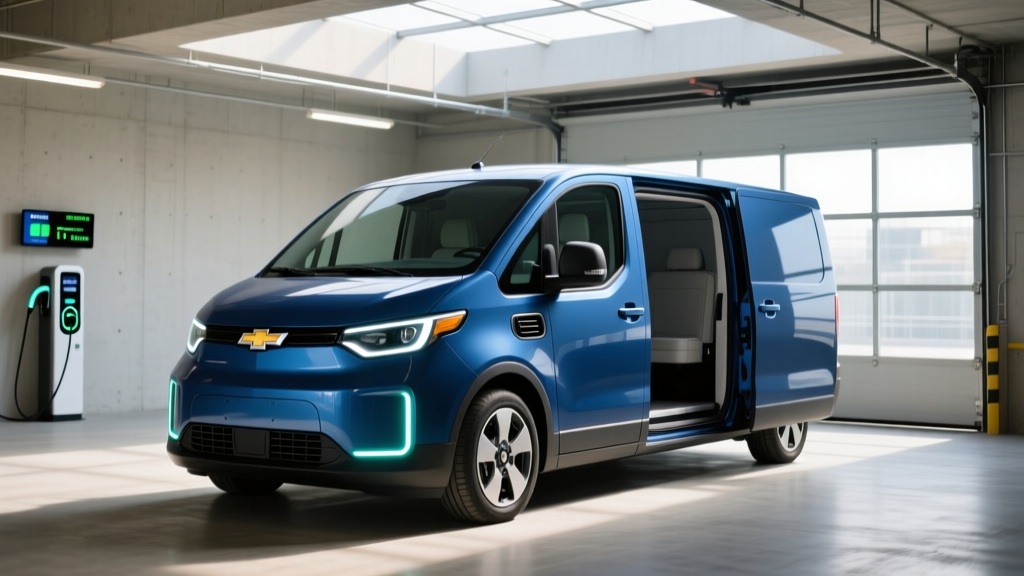
If you're researching a Chevrolet EV van in 2026, you're almost certainly looking at the BrightDrop Zevo — GM's purpose-built electric delivery van, sold primarily to commercial fleets through the BrightDrop division (formerly GM's standalone commercial-vehicle brand, now fully integrated under Chevrolet). The Zevo comes in two body styles: the Zevo 400 (≈250 cu ft cargo) and Zevo 600 (≈410 cu ft). Both share a 140-kWh usable NMC lithium-ion battery, an EPA-estimated 205 miles of range (Zevo 600) or 220 miles (Zevo 400), and a peak DC fast-charge rate of 120 kW. Base pricing starts around $74,000 before the federal §30D commercial clean vehicle credit, which can reduce the net cost by up to $7,500 depending on battery sourcing and buyer eligibility. For last-mile delivery fleets doing 80–150 miles per day with depot charging, the Zevo offers compelling per-mile economics. For operators in extreme cold, high-mileage routes, or areas without reliable depot charging access, significant limitations remain.
Quick Verdict: Who Should Buy the Chevrolet BrightDrop Zevo?
Buy it if: Your fleet runs predictable daily routes under 150 miles, has access to overnight Level 2 depot charging, and operates primarily in moderate climates. The per-mile fuel and maintenance savings over a gas Ford Transit or Ram ProMaster typically pay back the higher purchase price within 3–5 years.
Skip it if: Your routes regularly exceed 180 miles between charging opportunities, you operate in sustained sub-20°F environments without garage parking, or you lack the electrical infrastructure for depot charging and cannot invest in it.
BrightDrop Zevo Specs: Range, Battery & Performance
The Zevo platform was engineered from the ground up for parcel delivery, not adapted from a passenger vehicle. That shows in the step-in height, cargo floor flatness, and turn radius — but it also means the powertrain is tuned for low-speed urban efficiency rather than highway cruising.
| Specification | Zevo 400 | Zevo 600 |
|---|---|---|
| Battery (usable) | 140 kWh NMC | 140 kWh NMC |
| EPA Range | 220 miles | 205 miles |
| Real-World Range (mixed urban/hwy) | ~175–195 miles | ~160–180 miles |
| Cold-Weather Range (below 20°F) | ~130–155 miles | ~120–145 miles |
| Motor Output | 300 hp / 390 lb-ft | 300 hp / 390 lb-ft |
| 0–60 mph (unloaded) | ~8.2 sec | ~9.0 sec |
| Max Payload | ~2,800 lbs | ~2,200 lbs |
| Cargo Volume | ~250 cu ft | ~410 cu ft |
| Peak DC Charge Rate | 120 kW | 120 kW |
| 10–80% DC Charge Time | ~70 min | ~70 min |
| Level 2 AC Charge Rate | 11.5 kW | 11.5 kW |
| Full Level 2 Charge (0–100%) | ~12.5 hours | ~12.5 hours |
| Base MSRP (2026) | $74,000 | $82,000 |
| Battery/Powertrain Warranty | 8 yr / 100,000 mi | 8 yr / 100,000 mi |
Real-world range reality check: The EPA cycle is generous for delivery vans because it includes significant low-speed, stop-and-go driving where regenerative braking recaptures energy. In practice, fleets running mixed suburban routes with moderate HVAC use report 175–195 miles from the Zevo 400 before needing a charge. Highway-heavy routes at sustained 65–70 mph will see range drop to 140–160 miles due to the Zevo's tall, boxy aerodynamic profile. In sustained sub-20°F weather, expect 30–40% range loss unless the van is garaged and preconditioned.
Charging the Zevo: Depot Setup & Public Charging Reality
The Zevo's 120 kW peak DC charge rate is modest by 2026 passenger-EV standards (many now peak at 200–350 kW), but it's reasonable for a fleet vehicle designed to charge overnight at the depot. Here's what the charging picture looks like in practice:
| Charging Level | Power | Miles Added per Hour | Typical Use Case |
|---|---|---|---|
| Level 1 (120V) | ~1.4 kW | ~3–4 mi/hr | Emergency only — impractical for daily use |
| Level 2 (240V, 48A) | 11.5 kW | ~30–35 mi/hr | Overnight depot charging — primary method |
| DC Fast Charge | Up to 120 kW | ~150–180 mi/hr (to 50%) | Mid-day top-up; tapers significantly above 80% |
Depot charging infrastructure is the real cost. Installing commercial-grade Level 2 chargers (typically 4–10 units for a small fleet) requires 480V three-phase electrical service in most cases. Expect $15,000–$40,000 per charger installed, including trenching, conduit, chargers, and electrical panel upgrades. Many utilities offer commercial EV infrastructure rebates that offset 30–50% of this cost — check with your local utility before budgeting. A full depot charge from 10% to 100% at 11.5 kW takes approximately 11–12 hours, which aligns with overnight parking for most delivery operations.
The charge curve matters for mid-day top-ups: The Zevo sustains close to its 120 kW peak from roughly 10% to 50% State of Charge, then tapers to ~80 kW through 70%, and drops further to ~40 kW above 80%. A 10–80% session takes about 70 minutes. This means mid-day DC fast charging is viable for topping up, but you won't get a full "refuel" in 20 minutes like you might with a modern passenger EV.
Chevrolet EV Van vs. Gas Vans: 5-Year Fleet Cost Breakdown
The Zevo's purchase price is roughly 2× that of a comparable gas Ford Transit or Ram ProMaster. The economic case rests entirely on fuel and maintenance savings over time. Here's a realistic 5-year / 75,000-mile comparison for a single van running 15,000 miles/year on urban delivery routes:
| Cost Category | BrightDrop Zevo 600 | Ford Transit 350 (Gas) |
|---|---|---|
| Purchase Price (base) | $82,000 | $48,000 |
| Federal Tax Credit (§30D) | –$7,500* | $0 |
| Net Purchase | $74,500 | $48,000 |
| Fuel/Energy (5 yr / 75k mi) | $5,600** | $18,750*** |
| Maintenance (5 yr) | $2,200 | $7,500 |
| Depot Charger (amortized per van) | $6,000 | $0 |
| Insurance (5 yr est.) | $14,000 | $11,000 |
| Total 5-Year Cost | $102,300 | $85,250 |
| Cost per Mile | $1.36 | $1.14 |
*§30D commercial credit eligibility requires meeting battery sourcing and critical mineral thresholds. Consult a tax professional and verify current IRS rules.
**Assumes $0.14/kWh commercial electricity rate and 2.2 kWh/mile consumption.
***Assumes $3.75/gallon and 12 MPG combined (loaded urban delivery).
The honest math: At 5 years and 75,000 miles, the Zevo is still more expensive on a per-mile basis for most fleets. The breakeven point typically arrives between years 6–8, or around 100,000–120,000 miles, assuming stable electricity and fuel prices. Fleets that drive higher annual mileage (20,000+ miles/year) or operate in states with expensive gasoline (California, New York) reach breakeven faster. State and local incentive programs — such as California's HVIP or New York's Truck Voucher Incentive — can also shift the math dramatically by $20,000–$50,000 per vehicle.
Real-World Ownership: What Fleet Operators Actually Report
BrightDrop has been in commercial operation since 2022, with early adopters including FedEx, Walmart, and various regional delivery contractors. Here's what real-world fleet data and operator reports reveal:
What Works Well
- Driver satisfaction is high. The Zevo's low step-in height, wide-opening cargo doors, and quiet powertrain reduce driver fatigue compared to gas vans. Turnover rates for EV van drivers are measurably lower in several fleet studies.
- Maintenance is genuinely minimal. No oil changes, no transmission service, no exhaust repairs. Brake pad life extends to 80,000+ miles thanks to regenerative braking doing the majority of deceleration work.
- Energy cost per mile is predictable. Unlike diesel or gasoline, commercial electricity rates are stable under long-term utility contracts, making budget forecasting easier.
- Route optimization improves. Fleet management software paired with the Zevo's telematics allows precise range-per-route planning, reducing unnecessary charging downtime.
What Catches Owners Off Guard
- Depot electrical upgrades are expensive and slow. Permitting and utility coordination for commercial charger installation can take 6–18 months. Many fleets order vans before realizing their depot can't support the electrical load.
- Cold-weather range loss is operationally significant. A Zevo 600 in Minneapolis in January may deliver only 120–135 miles of usable range. Routes must be replanned seasonally.
- Insurance costs run 15–30% higher than equivalent gas vans, reflecting higher repair costs for EV-specific components and limited collision-repair networks for BrightDrop bodies.
- DC fast charging on the road is unreliable. The Zevo uses a CCS connector, and public DC fast chargers rated for commercial vehicles are scarce. Most operators plan routes assuming depot charging only.
Tax Credits, Incentives & Purchase Considerations for 2026
The federal tax landscape for commercial EVs in 2026 involves two primary credits:
- §30D New Clean Vehicle Credit (up to $7,500): Available for qualifying commercial vehicles. Requires meeting critical mineral and battery component sourcing thresholds that tighten annually. The Zevo's Ultium battery platform (manufactured in Michigan and Tennessee) has generally met these requirements, but verify current-year compliance with your tax advisor.
- §45W Commercial Clean Vehicle Credit (up to $7,500 for vehicles under 14,000 lbs GVWR): This is the credit most fleet buyers actually use. It's calculated as the incremental cost of the EV over a comparable gas vehicle, capped at $7,500. Because the Zevo's price premium over a gas Transit far exceeds $7,500, most buyers qualify for the full amount. You cannot claim both §30D and §45W on the same vehicle.
§45W Commercial Credit Checklist
- Vehicle must be used primarily in a trade or business
- Vehicle must be placed in service (not just ordered) in the tax year claimed
- Vehicle must be a qualifying plug-in electric or fuel cell vehicle
- Credit = lesser of $7,500 or incremental cost over comparable ICE vehicle
- Must have minimum 4 kWh battery capacity (Zevo's 140 kWh easily qualifies)
- Check IRS.gov for current-year sourcing and manufacturer qualification updates
State incentives vary widely and change frequently. California, New York, New Jersey, Massachusetts, and several other states offer additional purchase vouchers ranging from $10,000 to $60,000+ per commercial EV, plus depot-charging infrastructure rebates. These programs often have limited funding windows and application deadlines. Consult your state's clean-transportation agency or a commercial EV consultant for current availability.
Common Misconceptions About the Chevrolet EV Van
| Myth | Fact |
|---|---|
| "The Zevo has 250+ miles of range." | EPA rates the Zevo 600 at 205 miles; real-world loaded delivery routes typically yield 160–180 miles. Plan routes conservatively. |
| "It charges as fast as a Tesla." | Peak rate is 120 kW — a 10–80% charge takes ~70 minutes, not 20–30 minutes like a 250+ kW passenger EV. |
| "The federal tax credit makes it cheaper than a gas van." | Even with the full $7,500 credit, the Zevo costs ~$26,500 more upfront than a gas Transit. Savings accrue over 6–8 years of operation. |
| "I can charge at any public station." | Public CCS chargers are designed for passenger vehicles. Commercial-van-sized charging bays with adequate clearance and power are rare. Depot charging is the primary strategy. |
| "Battery replacement will cost $30,000+." | The Ultium battery pack is covered for 8 years / 100,000 miles. Replacement cost is estimated at $18,000–$25,000 out of warranty, but real-world degradation data from early fleet vehicles shows ~8–12% capacity loss at 100,000 miles — well within the 70% retention warranty threshold. |
| "EV vans don't work in cold weather." | They work, but range drops 30–40%. Fleets in cold climates succeed by reducing daily route length by ~35% in winter or investing in heated depot parking for preconditioning. |
Decision Framework: Is the BrightDrop Zevo Right for Your Fleet?
Choose the Chevrolet BrightDrop Zevo If:
- Your daily routes are predictable and under 150 miles (Zevo 600) or 175 miles (Zevo 400)
- You have — or can install — overnight Level 2 depot charging
- Your fleet operates primarily in moderate climates, or you can adjust routes seasonally
- You plan to keep vehicles 6+ years (to reach breakeven on fuel/maintenance savings)
- You qualify for state incentive programs that reduce the purchase premium
- Driver retention is a concern (EV vans significantly improve driver satisfaction)
Stick With a Gas Van (or Wait) If:
- Your routes regularly exceed 180 miles per day or are highly variable
- Your depot lacks the electrical capacity for Level 2 charging and a panel upgrade isn't feasible
- You operate in extreme cold (sustained below 10°F) and cannot modify routes seasonally
- You turn over vehicles every 3–4 years (you won't reach breakeven)
- Your operation requires frequent long-distance highway driving (the Zevo's aerodynamics and charge rate are optimized for urban delivery)
Frequently Asked Questions
Can I buy a BrightDrop Zevo as a private individual?
BrightDrop primarily sells to commercial fleets and businesses. Individual purchase is possible through some dealers but is uncommon, and you may face limited availability and less favorable pricing compared to fleet orders. Contact a BrightDrop-certified commercial dealer for options.
What connector does the Zevo use?
The Zevo uses a CCS (Combined Charging System) connector for DC fast charging and a J1772 connector for Level 2 AC charging. It does not use the Tesla NACS connector. If your depot has NACS-only chargers, you'll need an adapter or CCS-native equipment.
How long does the Ultium battery last in a delivery van?
GM warrants the battery for 8 years / 100,000 miles against dropping below 70% of original capacity. Early fleet data from FedEx and other operators suggests real-world degradation of approximately 8–12% at 100,000 miles with daily DC fast charging and overnight Level 2 charging. The battery should remain operationally viable well past 150,000 miles, though range will gradually decrease.
What does it cost to charge a Zevo per mile?
At a commercial electricity rate of $0.14/kWh and the Zevo 600's consumption of approximately 2.2 kWh/mile, the energy cost is roughly $0.31 per mile. Compare that to a gas Transit at 12 MPG with $3.75/gallon fuel: $0.31 per mile for gas — but this doesn't account for the gas van's significantly higher maintenance costs ($0.10/mile vs. ~$0.03/mile for the Zevo). Combined energy + maintenance, the Zevo saves approximately $0.07–$0.10 per mile once operational.
Does the Zevo qualify for the federal tax credit in 2026?
The Zevo has generally qualified for the §45W commercial clean vehicle credit (up to $7,500) since launch. Eligibility depends on current-year battery sourcing rules and your business's tax situation. Always verify with a tax professional and check the IRS clean vehicle credit page for the latest qualifying vehicle list before purchasing.
How does the Zevo compare to the Ford E-Transit or Ram ProMaster EV?
The Ford E-Transit offers a lower purchase price (~$55,000) but significantly less range (EPA 126 miles) due to its smaller 68 kWh battery. It works for very short urban routes but is less versatile than the Zevo. The Ram ProMaster EV (announced, limited availability) targets a similar market segment. The Zevo currently leads in range, cargo volume, and fleet telematics integration, though at a higher price point. For a detailed comparison, consult fueleconomy.gov for official EPA figures.