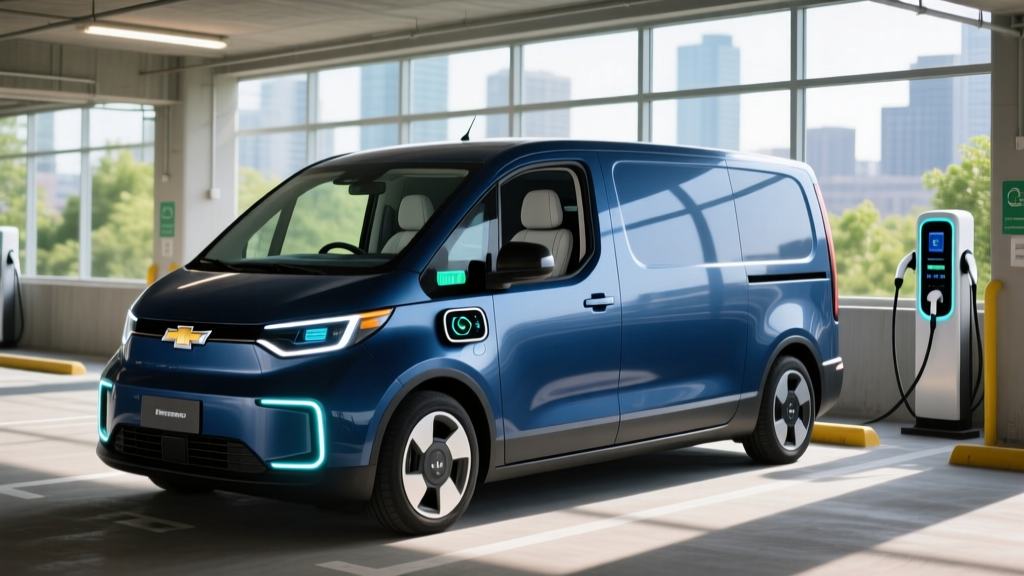
Quick Answer: The 2026 Chevrolet BrightDrop Zevo 600 is a purpose-built electric delivery van with an EPA-estimated range of up to 272 miles (Zevo 600) and 157 miles (Zevo 400), targeting last-mile commercial fleets. With peak DC fast charging at 150 kW (10–80% in approximately 45 minutes), fleet depot charging compatibility, and significantly lower per-mile operating costs versus gas equivalents like the Ford Transit or Ram ProMaster, the BrightDrop makes economic sense for routes under 200 miles/day with depot-based Level 2 charging. Upfront MSRP is higher than gas vans, but the 5-year total cost of ownership (TCO) favors electric for high-mileage urban delivery routes. Federal §30D commercial clean vehicle credits or the §45W commercial credit may offset up to $7,500 for vehicles under 14,000 lbs GVWR, though fleet buyers must verify battery sourcing and MSRP caps.
BrightDrop Lineup: Zevo 400 vs Zevo 600 at a Glance
Chevrolet's BrightDrop division (formerly under the GM BrightDrop brand before consolidating under Chevrolet in 2024) offers two primary van configurations for the 2026 model year. Both share the Ultium platform with NMC (nickel manganese cobalt) lithium-ion battery chemistry, but differ in cargo volume, wheelbase, and battery pack size. Here is the specification breakdown fleet buyers need:
| Specification | Zevo 400 | Zevo 600 |
|---|---|---|
| Cargo Volume | ~410 cu ft | ~615 cu ft |
| Battery Capacity (usable) | ~140 kWh (NMC) | ~195 kWh (NMC) |
| EPA-Estimated Range | ~157 miles | ~272 miles |
| Real-World Range (loaded, urban) | ~120–140 miles | ~210–245 miles |
| Peak DC Fast Charge Rate | 150 kW | 150 kW |
| 10–80% DC Charge Time | ~45 min | ~55 min |
| Level 2 Charge Rate (AC) | 11.5 kW | 11.5 kW |
| Level 2 Full Charge Time | ~14 hours | ~19 hours |
| Horsepower | ~300 hp (FWD) | ~300 hp (FWD) |
| Torque | ~345 lb-ft | ~345 lb-ft |
| Payload Capacity | ~2,500 lbs | ~2,800 lbs |
| Base MSRP (est.) | ~$75,000 | ~$90,000 |
| Battery Warranty | 8 yr / 100,000 mi | 8 yr / 100,000 mi |
Real-world range caveat: The EPA range figures assume mixed driving with a moderate payload. In real-world fleet operations — fully loaded, frequent stop-and-go, HVAC running in summer or winter — expect a 10–15% reduction from EPA estimates. Cold-weather operations (below 32°F) can further reduce range by 20–30% due to battery chemistry limitations and cabin/cargo heating demands. The Zevo 600's 272-mile EPA rating means a realistic 190–215 miles on a winter delivery route.
EV Van vs Gas Van: Operating Cost Breakdown
The core fleet decision hinges on total cost of ownership, not sticker price. A gas-powered Ford Transit 250 (the most direct competitor) starts around $48,000–$55,000, substantially less than the BrightDrop. But the per-mile operating cost tells a different story over a 5-year, 120,000-mile fleet lifecycle:
| Cost Category (5-Year / 120K mi) | BrightDrop Zevo 600 | Ford Transit 250 Gas |
|---|---|---|
| Purchase Price (base MSRP) | $90,000 | $52,000 |
| Federal Tax Credit (§45W commercial) | –$7,500 (est., if eligible) | $0 |
| Net Acquisition Cost | $82,500 | $52,000 |
| Fuel/Energy Cost (120K mi) | $7,200 (at $0.15/kWh depot rate) | $21,600 (at $3.60/gal, 14 MPG) |
| Maintenance (5 years) | $3,500 (est.) | $8,400 (est.) |
| Estimated Insurance (5 years) | $18,000 | $14,500 |
| 5-Year Total Cost of Ownership | ~$111,200 | ~$96,500 |
| Cost Per Mile (all-in) | ~$0.93/mi | ~$0.80/mi |
Key takeaway: At current energy and fuel prices, the BrightDrop Zevo 600 still carries a higher 5-year TCO primarily due to the upfront price gap. However, the breakeven point shifts dramatically under these conditions:
- Higher daily mileage (200+ mi/day): Fuel savings compound faster, closing the gap by year 4–5.
- Cheaper depot electricity (under $0.10/kWh via commercial solar or off-peak rates): Energy cost drops to ~$4,800 over 5 years.
- State/local incentives: California's HVIP, New York's NYTVIP, and similar programs can stack $20,000–$60,000+ in point-of-sale rebates for commercial EVs, instantly flipping the TCO in BrightDrop's favor.
- Idling elimination: Delivery vans idle extensively. Electric drivetrains don't consume energy at stops, a hidden advantage not captured in MPG comparisons.
According to fueleconomy.gov, commercial EVs consistently deliver 2.0–2.5 kWh/mile efficiency in urban delivery cycles, translating to roughly $0.06/mile at commercial depot rates versus $0.25+/mile for gas equivalents.
Charging Infrastructure: What Fleets Actually Need
The BrightDrop is designed for depot-based charging, not public DC fast charging. Here's what fleet operators must plan for:
Depot Level 2 Charging (Primary)
Each BrightDrop accepts up to 11.5 kW on AC Level 2. For a fleet of 10 vans charging overnight (10 hours), you need 10 Level 2 stations at 11.5 kW each — roughly 115 kW total electrical capacity dedicated to charging. The Zevo 600's 195 kWh battery will gain approximately 115 kWh in 10 hours, enough to replenish a typical day's 100–150 miles of urban driving. Full overnight charges are realistic for most routes.
Installation cost reality: A 10-station depot Level 2 installation typically costs $80,000–$150,000, including:
- Level 2 hardware (commercial-grade, networked): $2,000–$4,000 per unit
- Electrical infrastructure (new panels, conduit, trenching): $30,000–$80,000
- Utility service upgrade (if needed for 115+ kW additional load): $15,000–$40,000
- Permitting and engineering: $5,000–$15,000
DC Fast Charging (Supplemental / Opportunity Charging)
The 150 kW peak DC rate is modest by passenger-EV standards but adequate for commercial top-ups. On a midday opportunity charge, a Zevo 600 can recover roughly 100 miles of range in 30 minutes. However, fleet buyers should understand the charging curve taper: the BrightDrop sustains peak 150 kW only up to approximately 40% State of Charge (SoC), then progressively tapers. The 10–80% time of ~55 minutes reflects this taper — actual energy delivered averages closer to 100 kW over the full session.
Critical note: BrightDrop uses the CCS1 connector for DC fast charging. With the industry's shift to NACS (Tesla's connector standard, now adopted by most OEMs for passenger vehicles), commercial vehicles have been slower to transition. Verify your depot DC chargers support CCS1 or plan for adapter compatibility.
Real-World Fleet Ownership: Route Planning and Limitations
Based on fleet deployment data from early BrightDrop adopters (FedEx, Walmart, and various last-mile logistics companies), here are the operational realities no brochure will highlight:
Route Distance Threshold
The BrightDrop excels on routes under 150 miles/day with return-to-depot operations. Routes consistently exceeding 200 miles/day — especially in cold climates — risk range shortfall and require midday DC fast charging, adding 45–60 minutes of downtime. For these routes, a gas van or a PHEV alternative remains more practical until charging infrastructure matures further.
Cold-Weather Impact
NMC battery chemistry loses efficiency below freezing. Fleets operating in Minneapolis, Chicago, or Denver should plan for 20–30% range reduction in winter months. The BrightDrop includes battery preconditioning, which warms the pack when a charging session is scheduled — this is essential for maintaining charge speed in cold weather and should be used at every depot charging opportunity. Cargo area heating draws additional energy; preheating vans while still plugged in at the depot mitigates this.
Payload vs Range Tradeoff
Every 500 lbs of payload reduces range by approximately 5–8%. A fully loaded Zevo 600 at max payload (2,800 lbs) may see range drop to 220–230 miles EPA-basis, or 180–200 miles real-world. Fleet managers must model worst-case scenarios (full load + cold weather + highway segments) rather than best-case EPA numbers.
Insurance and Registration
Commercial EV insurance premiums run 15–30% higher than gas equivalents due to higher replacement cost, specialized repair requirements, and limited actuarial data. Budget $3,000–$4,000/year per vehicle. Registration fees in some states also include EV surcharges ($50–$200/year) to offset lost gas-tax revenue.
Tax Credits and Incentives: What Fleet Buyers Actually Qualify For
Federal incentive eligibility for commercial electric vans is more complex than consumer EVs. Here's the current framework:
- §45W Commercial Clean Vehicle Credit: Up to $7,500 for vehicles under 14,000 lbs GVWR (the BrightDrop qualifies), or up to $40,000 for heavier vehicles. This is the business-equivalent of the consumer §30D credit but is claimed differently — it's based on the incremental cost of the EV over a comparable gas vehicle. Consult your tax professional and review IRS guidance on clean vehicle credits.
- Battery sourcing requirements: Similar to §30D, the §45W credit requires increasing percentages of battery critical minerals sourced from the U.S. or FTA partners. Verify current-year compliance with your Chevrolet BrightDrop dealer before ordering.
- MSRP caps: The $7,500 credit applies to vans under the commercial vehicle MSRP threshold. Confirm the specific cap with the IRS as it updates annually.
- State incentives: California HVIP, New York NYTVIP, Colorado fleet rebates, and utility make-ready programs can stack $10,000–$60,000+ per vehicle. These vary by jurisdiction and funding availability — check your state's clean truck program directly.
- Depot charging incentives: Many utilities offer commercial EV charging rebates covering 50–100% of Level 2 installation costs. Contact your local utility's commercial EV program before beginning depot upgrades.
Decision Framework: Is the BrightDrop Right for Your Fleet?
Choose the Chevrolet BrightDrop Zevo if:
- Your daily routes are under 150 miles (Zevo 400) or under 250 miles (Zevo 600) with return-to-depot operations
- You can install depot Level 2 charging (overnight charging is your primary strategy)
- Your fleet operates in urban/suburban stop-and-go delivery patterns (maximizing regenerative braking and idle elimination)
- You qualify for state fleet EV incentives that bridge the upfront cost gap
- You plan to hold vehicles 5+ years (amortizing the higher purchase price through fuel/maintenance savings)
- Corporate sustainability mandates or customer ESG requirements favor zero-tailpipe-emission fleets
Stick with a gas van (Ford Transit / Ram ProMaster) if:
- Daily routes regularly exceed 200 miles without midday charging opportunity
- You operate in extreme cold climates (northern MN, MT, ND) without heated depot facilities
- Your depot electrical service cannot support Level 2 infrastructure without a $50,000+ utility upgrade
- You need immediate vehicle availability (BrightDrop production is limited and fleet orders may have 3–6 month lead times)
- Your fleet turns over vehicles every 3 years or fewer (insufficient time to recoup the purchase price premium)
- Towing is required (BrightDrop is not rated for significant trailer loads; gas vans offer 4,000–7,000 lb towing)
Common Misconceptions About Electric Delivery Vans
| Myth | Fact |
|---|---|
| "Electric vans can't handle a full day's deliveries." | The Zevo 600's real-world range of 210–245 miles covers the average U.S. delivery route (which runs 80–140 miles/day per DOT data). The limitation is on long-haul, not last-mile. |
| "Charging takes too long for commercial use." | Depot overnight charging (8–10 hours on Level 2) fully replenishes the battery. Vans are parked overnight anyway. Midday DC fast charging is only needed for unusually long routes. |
| "EV batteries won't survive fleet mileage." | GM warranties the Ultium battery for 8 years / 100,000 miles with a minimum 70% capacity retention threshold. Fleet data from early BrightDrop deployments shows less than 8% degradation at 80,000 miles — well within warranty. |
| "Electric vans cost more to own, period." | Higher upfront, yes. But with state incentives, cheap depot electricity, and 60% lower maintenance costs (no oil changes, fewer brake replacements due to regen, no transmission fluid), 5-year TCO can match or beat gas vans on high-mileage urban routes. |
| "You need DC fast chargers at every depot." | Most fleet operations only need Level 2. DC fast charging is a supplement for opportunity charging, not a daily requirement. Level 2 infrastructure is significantly cheaper to install. |
Frequently Asked Questions
What is the real-world range of the Chevrolet BrightDrop Zevo 600?
The EPA rates the Zevo 600 at 272 miles. In real-world fleet delivery operations with a full payload, expect 210–245 miles in moderate weather and 190–215 miles in cold weather (below 32°F). Stop-and-go urban driving actually benefits range through regenerative braking, partially offsetting the payload penalty.
How long does it take to charge a BrightDrop van at a depot?
On a Level 2 depot charger at 11.5 kW, a fully depleted Zevo 600 (195 kWh battery) takes approximately 19 hours for a full charge. However, most fleet vans use only 50–70% of their battery per day, so a typical overnight session (10 hours) easily replenishes a day's driving. DC fast charging at 150 kW recovers 10–80% in about 55 minutes for midday top-ups.
Does the BrightDrop qualify for the federal EV tax credit?
Commercial fleet buyers should look at the §45W Commercial Clean Vehicle Credit rather than the consumer §30D credit. The §45W credit can provide up to $7,500 for vehicles under 14,000 lbs GVWR (BrightDrop qualifies), calculated as the incremental cost difference between the EV and a comparable gas vehicle. Eligibility depends on battery critical-mineral sourcing requirements that tighten annually. Always verify with the IRS and a qualified tax professional before relying on credit amounts in purchase decisions.
How does the BrightDrop compare to the Ford E-Transit?
The Ford E-Transit offers approximately 126 miles of EPA range with a 68 kWh battery — significantly less than the BrightDrop Zevo 600's 272 miles. The E-Transit is lighter, cheaper (~$55,000 base), and better suited for shorter urban routes. The BrightDrop's larger battery and longer range make it better for longer suburban routes, but at a substantially higher price. For fleets running under 100 miles/day, the E-Transit's lower acquisition cost may yield a faster ROI.
What maintenance does an electric delivery van require?
Significantly less than a gas van. No oil changes, no spark plugs, no transmission fluid, no exhaust system repairs. Regenerative braking extends brake pad life by 50–70%. Primary maintenance items are tire rotation/replacement (EVs are heavier and wear tires faster), cabin air filters, windshield washer fluid, coolant system checks, and software updates. Budget approximately $700/year versus $1,500–$2,000/year for a gas van.
Can the BrightDrop handle highway driving for regional routes?
Yes, but highway driving reduces efficiency significantly. At sustained 65–70 mph, expect energy consumption to increase by 15–25% compared to urban stop-and-go driving (where regenerative braking recovers energy). A Zevo 600 on a predominantly highway route may see real-world range drop to 180–210 miles. For regional routes exceeding 200 highway miles, a gas van remains more practical today.
Fleet buyers should request a BrightDrop demo unit from their Chevrolet commercial dealer and run it on a representative route for one week before committing to a bulk order. Real-world route validation — with actual payload, weather, and driving patterns — is the only reliable way to confirm range adequacy for your specific operation.