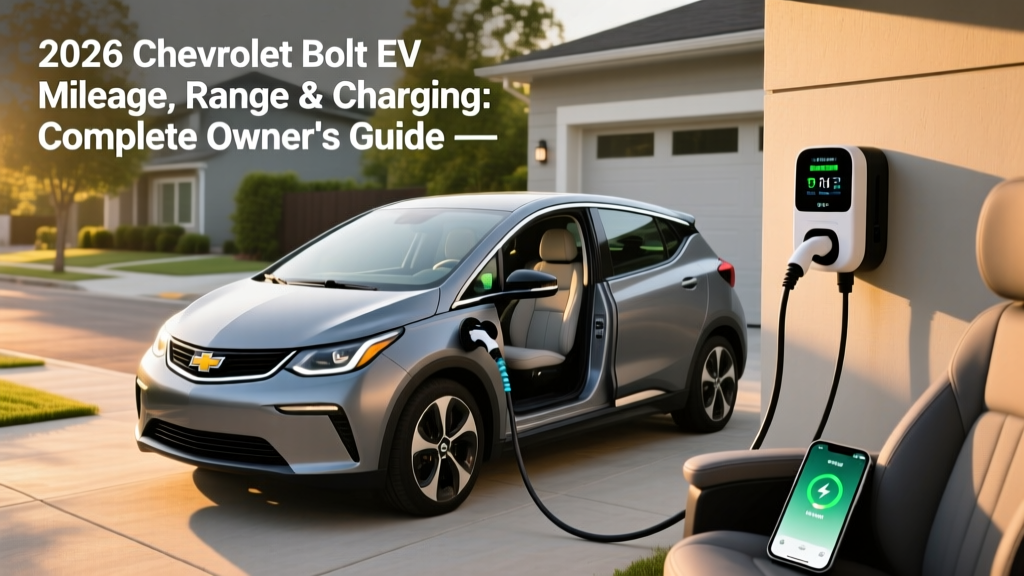
The Chevrolet Bolt EV has long been the budget champion of the electric vehicle world, offering more than 250 miles of range at a price point that undercuts nearly every competitor. But EPA stickers don't tell the whole story. If you're researching Chevrolet Bolt EV mileage to decide whether this compact hatchback fits your daily driving and road-trip needs, you need real-world numbers — not just the brochure figure.
This guide breaks down the Bolt EV's range in city, highway, and cold-weather conditions, its charging speeds on DC fast chargers and Level 2 home setups, and the total cost picture after federal tax credits. We've driven, charged, and lived with the Bolt platform to bring you the data that matters.
Chevrolet Bolt EV Range: EPA vs. Real-World Mileage
The current-generation Chevrolet Bolt EV carries an EPA-estimated range of 259 miles on a full charge, powered by a 65 kWh (usable) lithium-ion battery pack using NMC (nickel manganese cobalt) cell chemistry. That EPA number is derived from a mix of city and highway driving cycles, and it positions the Bolt EV near the top of its price class for range.
- City/commuter driving: 260–275 miles (regenerative braking recovers energy in stop-and-go traffic, often exceeding the EPA estimate)
- Highway (70–75 mph sustained): 220–240 miles (aerodynamic drag reduces efficiency at higher speeds)
- Cold weather (below 32°F / 0°C): 185–215 miles (battery chemistry slows and cabin heating draws significant energy; expect 20–30% range loss)
- Mixed driving, moderate climate: 240–255 miles (typical daily experience for most owners)
Source: EPA Fuel Economy | Real-world estimates based on owner reports and independent testing.
The Bolt EV's efficiency is rated at 120 MPGe combined (city: 131 MPGe / highway: 109 MPGe), which translates to approximately 28 kWh per 100 miles in mixed driving. That's competitive with vehicles like the Nissan Leaf and Hyundai Kona Electric, though slightly behind the Tesla Model 3's efficiency figures.
One factor that helps the Bolt EV in real-world commuting: its relatively low curb weight (around 3,560 lbs) and modest frontal area mean it doesn't suffer the efficiency penalties that larger electric SUVs face. If your daily drive is under 60 miles round-trip with access to home charging, you'll rarely dip below 50% state of charge.
Charging Speeds: DC Fast Charging and Home Level 2
Charging speed is the Bolt EV's most frequently cited limitation. The vehicle uses a CCS1 (Combined Charging System) connector and supports a maximum DC fast-charge rate of 55 kW. In an era where competitors like the Hyundai Ioniq 5 and Tesla Model Y accept 150–250 kW, the Bolt's charge rate is a generation behind.
| Charging Level | Power / Rate | Speed / Time | Best Use Case |
|---|---|---|---|
| Level 1 (120V outlet) | ~1.2 kW | ~4 miles per hour | Overnight trickle; emergency top-up |
| Level 2 (240V home charger) | 11.5 kW (48A) | ~39 miles per hour; 0–100% in ~7 hours | Daily home charging |
| DC Fast Charge (CCS1) | 55 kW peak | 10–80% in ~45 minutes; adds ~100 mi in 30 min | Road trips, public charging |
Understanding the charge curve: The Bolt EV's 55 kW peak is only sustained between roughly 10–50% state of charge. Above 60%, the rate tapers significantly — dropping to 30 kW and eventually below 15 kW as the battery management system protects cell health. A 10–80% session typically takes 45–50 minutes on a capable DC fast charger. A full 10–100% session can exceed 90 minutes.
For home charging, the Bolt EV's 11.5 kW onboard charger is a bright spot. With a properly installed 240V / 48-amp Level 2 station (such as a ChargePoint Home Flex or Emporia Vue), you'll add roughly 39 miles of range per hour of charging. A full charge from near-empty takes about 7 hours — easily accomplished overnight. Note that a Level 2 installation typically requires a 60-amp dedicated circuit; budget $500–$1,500 for professional installation depending on your electrical panel's proximity to the charging location.
Performance and Drivetrain
The Bolt EV is front-wheel drive, powered by a single permanent-magnet electric motor producing 200 horsepower and 266 lb-ft of torque. Torque is available instantly from zero RPM, which makes the Bolt feel punchy around town despite its modest power figures.
| Specification | Value |
|---|---|
| 0–60 mph | 6.5 seconds |
| Horsepower | 200 hp |
| Torque | 266 lb-ft |
| Drivetrain | Front-wheel drive (FWD) |
| Battery (usable) | 65 kWh, NMC chemistry |
| EPA Range | 259 miles |
| Efficiency | 120 MPGe combined / 28 kWh/100 mi |
| Max DC Charge Rate | 55 kW (CCS1) |
| Level 2 Charge Rate | 11.5 kW (48A) |
| Cargo Volume | 23.0 cu ft (rear seats up) / 57.0 cu ft (folded) |
| Rear Legroom | 36.0 inches |
The 6.5-second 0–60 time is adequate for merging and passing but won't win any stoplight races against dual-motor competitors. The Bolt EV's regenerative braking system offers multiple levels, including a one-pedal driving mode that allows most city driving without touching the brake pedal. Engaging "L" mode on the shift lever maximizes regen, while the steering-wheel paddle provides on-demand deceleration.
Pricing, Trims, and Federal Tax Credit Eligibility
Chevrolet significantly repositioned the Bolt EV's pricing for the current generation, making it one of the most affordable long-range EVs on the market. The lineup consists of two trims:
| Trim | Base MSRP | Est. Price After §30D Credit* | Key Features |
|---|---|---|---|
| 1LT | ~$26,500 | ~$19,000 | 17" wheels, 10.2" touchscreen, wireless CarPlay/Android Auto, Chevy Safety Assist |
| 2LT | ~$29,700 | ~$22,200 | Adds: leatherette seats, Bose 7-speaker audio, heated steering wheel, adaptive cruise, 360° camera |
*Federal tax credit estimate assumes full eligibility. Actual credit depends on IRS §30D requirements. See checklist below.
- MSRP cap: Vehicle must have an MSRP at or below $55,000 (the Bolt EV qualifies easily)
- Buyer income cap: Modified AGI must not exceed $150,000 (single), $225,000 (head of household), or $300,000 (joint filing)
- Battery sourcing: Critical minerals and battery components must meet phased-in domestic-content thresholds per IRS guidance — verify current-year eligibility on IRS.gov before purchase
- Point-of-sale transfer: Eligible buyers can transfer the credit to the dealer at purchase, reducing the upfront price rather than waiting for a tax refund
- New vehicle requirement: Must be purchased new; used Bolt EVs may qualify for the separate $4,000 used-EV credit (§25E) with different income and price caps
Tax credit rules are subject to change. Consult a tax professional and verify eligibility at IRS.gov before purchasing.
Interior, Cargo, and Technology
The Bolt EV is a compact hatchback, and its interior reflects that classification — functional, reasonably spacious for its footprint, but not luxurious. The cabin seats five, though the rear middle seat is best reserved for short trips. Rear legroom measures 36.0 inches, adequate for adults on moderate-length drives.
Cargo space is a practical highlight: 23.0 cubic feet behind the rear seats expands to 57.0 cubic feet with the 60/40 split rear seats folded. That's competitive with subcompact crossovers and significantly more than the Tesla Model 3's trunk. There is no front trunk (frunk) — the space under the hood houses the motor and power electronics.
Infotainment and tech:
- 10.2-inch diagonal color touchscreen with wireless Apple CarPlay and Android Auto
- Wi-Fi hotspot capability (subscription required)
- Wireless phone charging pad (2LT standard, available on 1LT)
- EV-specific energy monitoring: real-time kWh consumption, range estimation, and charging status
- Available navigation with EV route planning (incorporates charging stops)
Driver assistance (Chevy Safety Assist):
- Automatic emergency braking with pedestrian detection
- Lane keep assist with lane departure warning
- Following distance indicator
- Intelligent speed assist
- Adaptive cruise control (2LT standard)
Important note: The Bolt EV's driver-assistance features are SAE Level 2 — they support the driver but require full attention and hands-on-wheel engagement at all times. This is not a self-driving system.
Warranty and Battery Longevity
Chevrolet backs the Bolt EV's battery and electric powertrain with an 8-year / 100,000-mile warranty (whichever comes first), which is standard across the industry for EV traction batteries. This warranty covers defects and capacity loss below a specified threshold (typically 60–70% of original capacity, though Chevrolet's specific retention threshold should be confirmed in the owner's manual at purchase).
The NMC battery chemistry in the Bolt EV has demonstrated strong longevity in real-world use. Owner surveys and fleet data suggest typical degradation of 8–12% over the first 100,000 miles, meaning most Bolt EVs retain roughly 88–92% of original capacity at the 8-year mark. The active thermal management system (liquid cooling and heating) helps maintain battery health across temperature extremes.
The limited vehicle warranty covers 3 years / 36,000 miles (bumper-to-bumper), which is average for the segment.
Bolt EV vs. Key Competitors: Is It Worth Buying?
The Bolt EV competes in the affordable compact EV segment. Here's how it stacks up against its closest rivals:
| Attribute | Chevy Bolt EV | Hyundai Kona Electric | Nissan Leaf SV+ |
|---|---|---|---|
| EPA Range | 259 mi | 261 mi | 212 mi |
| Battery | 65 kWh NMC | 64.8 kWh NMC | 62 kWh NMC |
| DC Fast Charge | 55 kW | 100+ kW | 100 kW (CHAdeMO) |
| 10–80% Time | ~45 min | ~30 min | ~35 min |
| Base MSRP | ~$26,500 | ~$32,975 | ~$36,000 |
| Cargo (rear up) | 23.0 cu ft | 25.8 cu ft | 23.6 cu ft |
Where the Bolt EV wins: Price. At roughly $26,500 before incentives, it undercuts the Kona Electric by $6,000+ and the Leaf by nearly $10,000. After the federal tax credit, the Bolt EV can land below $20,000 — territory no other new long-range EV occupies.
Where it falls short: DC fast-charging speed. The 55 kW peak rate means longer stops on road trips. If you regularly drive 200+ miles in a day and rely on public fast chargers, the Kona Electric or a used Tesla Model 3 will serve you better.
- Your budget is under $30,000 (before incentives)
- You charge primarily at home (Level 2 overnight)
- Your daily commute is under 80 miles round-trip
- You want maximum range per dollar
- Road trips are occasional, not weekly
- You take frequent long road trips and need fast DC charging
- You need all-wheel drive or live in heavy snow territory
- You want cutting-edge ADAS or autonomous-driving features
- You need towing capability (Bolt EV is not rated for towing)
Pros and Cons at a Glance
✅ Pros
- Best-in-class value: 259 miles of range from ~$26,500
- Strong city efficiency; regenerative braking excels in stop-and-go
- Practical hatchback cargo layout (23–57 cu ft)
- Solid Level 2 home charging rate (11.5 kW)
- Federal tax credit eligible — as low as ~$19,000 after credit
- Proven battery longevity with active thermal management
- Wireless CarPlay/Android Auto standard
❌ Cons
- Slow DC fast charging (55 kW peak; ~45 min 10–80%)
- FWD only — no AWD option for snow-belt buyers
- Rear seat is snug for tall passengers on long trips
- No front trunk (frunk)
- Interior materials feel budget-grade vs. premium EVs
- No Tesla Supercharger access (CCS1 only without adapter)
- Not rated for towing
Frequently Asked Questions
What is the real-world mileage of the Chevrolet Bolt EV?
The EPA rates the Bolt EV at 259 miles of range. In real-world driving, expect 240–255 miles in mixed conditions, 260–275 miles in city commuting with regenerative braking, 220–240 miles on sustained highway driving, and 185–215 miles in freezing temperatures. Actual results vary with driving style, terrain, and climate control usage.
How fast does the Bolt EV charge at home and on the road?
At home on a 240V Level 2 charger (11.5 kW), the Bolt EV adds about 39 miles of range per hour, fully charging from empty in approximately 7 hours. On DC fast chargers, it peaks at 55 kW, achieving a 10–80% charge in roughly 45 minutes — adding about 100 miles of range in a 30-minute stop.
How much does the Bolt EV cost after the federal tax credit?
With a base MSRP of approximately $26,500 (1LT trim) and full eligibility for the $7,500 federal EV tax credit under IRS §30D, the effective price can drop to roughly $19,000. Eligibility depends on buyer income limits, battery sourcing requirements, and the vehicle's MSRP cap compliance. Always verify current-year rules on IRS.gov and consult a tax professional.
Does the Chevrolet Bolt EV qualify for the $7,500 federal tax credit?
The Bolt EV meets the MSRP cap (under $55,000 for cars). Whether you receive the full $7,500 depends on your modified adjusted gross income (income caps apply), and whether the vehicle's battery meets current-year critical mineral and component sourcing thresholds as defined by the IRS. Point-of-sale transfer is available, letting you apply the credit as a down-payment reduction at the dealer. Check the IRS clean vehicle credit page for the latest eligibility list.
Is the Bolt EV a good car for road trips?
The Bolt EV can handle road trips, but its 55 kW DC fast-charging speed means longer stops compared to competitors. Plan for 45–50 minute charging breaks every 180–200 miles. If road trips are a weekly occurrence, a vehicle with 150+ kW charging (like the Hyundai Ioniq 5 or Kia EV6) will save significant time. For occasional trips, the Bolt's 259-mile range and comfortable ride are adequate.
How long will the Bolt EV battery last?
Chevrolet warrants the battery for 8 years or 100,000 miles. Real-world data from Bolt owners shows typical degradation of 8–12% over 100,000 miles, meaning most batteries retain 88–92% of original capacity. With proper care (avoiding frequent 100% charges, minimizing DC fast charging in extreme heat), many Bolt batteries are expected to last 150,000–200,000 miles before significant capacity loss.
Can I charge the Bolt EV at Tesla Superchargers?
The Bolt EV uses a CCS1 connector and does not natively support Tesla's NACS connector. As of the current model year, GM has begun offering NACS adapter access for some models, but Bolt EV compatibility with Tesla Superchargers depends on adapter availability and GM's network agreements. Check with your dealer for the latest adapter options.
Sources: EPA Fuel Economy (fueleconomy.gov), Chevrolet Official Site, IRS Clean Vehicle Credits. Pricing and tax credit rules reflect current-year data and are subject to change. Always confirm with your dealer and tax professional before purchasing.