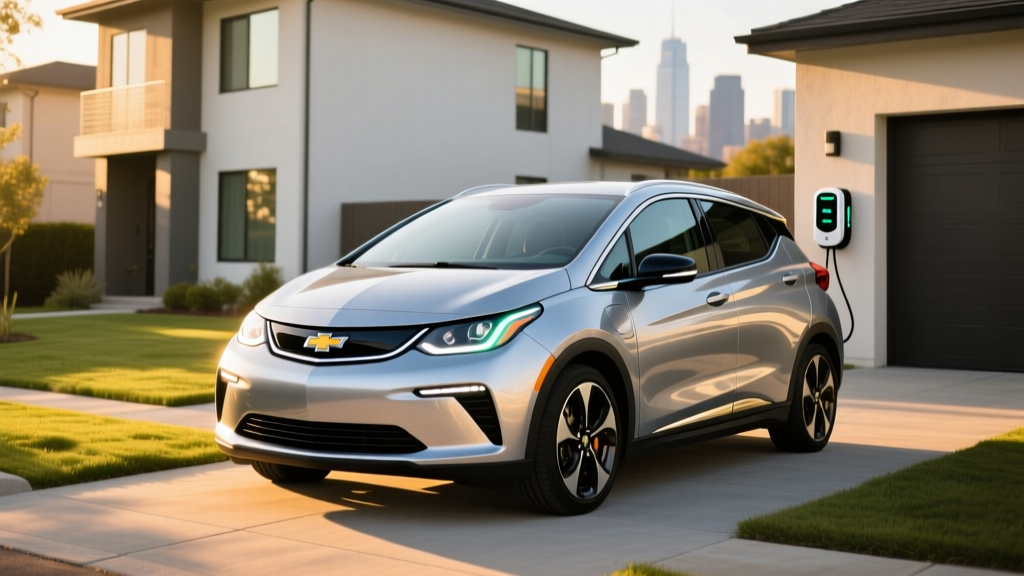
The Chevrolet Bolt EV returned for 2026 after a brief hiatus, and it remains one of the most affordable long-range electric vehicles on the market. But the sticker price is only the starting point. Between federal tax credits, state rebates, utility incentives, and ongoing costs like electricity, insurance, and maintenance, the true cost of owning a Bolt EV looks very different from its MSRP.
This guide breaks down every dollar — from the moment you sign the paperwork through five years of ownership — so you can decide whether the Bolt EV's incentives and running costs make it the smartest budget EV buy in 2026.
2026 Chevrolet Bolt EV: Key Specs at a Glance
Before we get into the financials, here's exactly what you're buying. The 2026 Bolt EV carries over the refreshed platform GM introduced with its return, featuring improved DC fast-charging capability over the original generation.
| Spec | 2026 Chevrolet Bolt EV (2LT) |
|---|---|
| EPA Range | 259 miles |
| Real-World Range (highway/cold) | ~200–230 miles |
| Battery Capacity | 65 kWh (usable), NMC lithium-ion |
| DC Fast Charge (peak) | 115 kW (10–80% in ~30 min) |
| Level 2 Charge Rate | 11.5 kW (~39 mi/hr) |
| Motor Output | 200 hp / 266 lb-ft torque |
| 0–60 mph | 6.5 seconds |
| EPA Efficiency | 120 MPGe combined (28 kWh/100 mi) |
| Base MSRP (2LT) | $28,995 (incl. destination) |
| Battery/Powertrain Warranty | 8 years / 100,000 miles |
Federal Tax Credit: Do You Qualify for §30D?
The federal EV tax credit under IRS §30D can reduce the effective price of a new Bolt EV by up to $7,500. But "up to" is doing heavy lifting. Eligibility depends on your income, the vehicle's MSRP, and where the battery materials are sourced. As of 2026, here are the rules that determine whether you get the full credit, a partial credit, or nothing at all.
- Buyer Income Cap: Modified AGI must not exceed $150,000 (single), $225,000 (head of household), or $300,000 (married filing jointly)
- Vehicle MSRP Cap: Must be $55,000 or less for cars (the Bolt EV at ~$29K clears this easily)
- Battery Component Sourcing: Battery components must be manufactured or assembled in North America (phase-in percentages increase annually through 2029)
- Critical Minerals: A percentage of critical minerals must be sourced from the U.S. or a free-trade-agreement partner (thresholds tighten each year)
- Point-of-Sale Transfer: As of 2024+, you can transfer the credit to the dealer at purchase, reducing your out-of-pocket cost immediately rather than waiting for tax filing
- One Credit Per Vehicle: The vehicle's VIN must not have been previously credited under §30D
Source: IRS.gov — Clean Vehicle Credits. Rules are subject to change; verify eligibility with a tax professional before purchase.
For the 2026 Bolt EV, GM has worked to qualify the battery supply chain under current §30D requirements. If your income falls within the caps, the Bolt EV's MSRP is well under the $55,000 ceiling, making it one of the most credit-accessible EVs available. The point-of-sale transfer is a major practical advantage: instead of waiting until April to claim $7,500 on your tax return, the dealer applies it as a down-payment reduction at signing.
Effective price after full credit: ~$21,495 before state incentives or dealer fees. That puts the Bolt EV in direct competition with well-equipped compact gas cars — but with far lower running costs.
State, Local, and Utility Incentives
Federal credits are only part of the picture. Depending on where you live, state rebates, utility company incentives, and local programs can stack on top of §30D.
- California (CVRP): Up to $2,000 rebate for income-qualified buyers on vehicles under $45K MSRP
- Colorado: State tax credit up to $5,000 for new EVs (income and price caps apply)
- New York: DRIVE Clean Rebate up to $2,000 based on income and vehicle price
- Utility Rebates: Many utilities (PG&E, ConEd, Xcel Energy, etc.) offer $250–$1,000 rebates for EV purchase or home charger installation
- HOV Lane Access: States like CA, CO, MD, and NJ offer single-occupant carpool lane access for EVs — a non-monetary perk worth thousands in commute time
Check your state energy office and local utility for current programs. These change frequently and may have funding caps.
In the best-case scenario — a buyer in Colorado earning under the income cap, with a utility rebate and the full federal credit — the effective purchase price of a Bolt EV could drop below $18,000. That's extraordinary value for a 259-mile-range EV. But this stacking is location-dependent, so use fueleconomy.gov's incentive tool to check your ZIP code.
5-Year Total Cost of Ownership: Bolt EV vs. Comparable Gas Car
To understand whether the Bolt EV actually saves money, we need to compare it against a similarly priced gas vehicle over a realistic ownership period. We'll use the 2026 Honda Civic EX (MSRP ~$28,500, EPA 33 MPG combined) as our baseline — a common cross-shop for Bolt EV buyers.
Assumptions: 15,000 miles/year, 75,000 miles over 5 years, electricity at $0.16/kWh (national average), gasoline at $3.50/gallon, and home Level 2 charging for the Bolt EV.
| Cost Category | 2026 Bolt EV (2LT) | 2026 Honda Civic EX |
|---|---|---|
| Purchase Price (MSRP) | $28,995 | $28,500 |
| Federal Tax Credit | −$7,500 | $0 |
| Effective Purchase Price | $21,495 | $28,500 |
| Fuel/Energy (5 yr / 75K mi) | $3,360 | $7,955 |
| Maintenance (5 yr) | $900 | $3,200 |
| Insurance (5 yr) | $9,500 | $7,800 |
| Estimated Depreciation (5 yr) | $11,200 | $10,700 |
| Total 5-Year Cost | $46,455 | $58,155 |
| Cost Per Mile | $0.62 | $0.78 |
Sources: EPA fueleconomy.gov, Kelley Blue Book depreciation estimates, AAA maintenance cost averages. Actual costs vary by location, driving habits, and insurance profile.
The bottom line: Over five years, the Bolt EV costs roughly $11,700 less to own than a comparable Civic — primarily thanks to the federal tax credit and dramatically lower fuel and maintenance costs. Even if the Bolt depreciates slightly faster in percentage terms, the credit-adjusted purchase price creates a wide gap that running costs only widen.
Charging Cost vs. Gas: The Per-Mile Math
This is where EV ownership gets concrete. The Bolt EV's EPA-rated efficiency is 28 kWh per 100 miles. At the national average residential electricity rate of $0.16/kWh, that translates to:
- Bolt EV (home charging): 28 kWh × $0.16 = $4.48 per 100 miles → $0.045/mile
- Bolt EV (DC fast charging, $0.40/kWh avg): 28 kWh × $0.40 = $11.20 per 100 miles → $0.112/mile
- Honda Civic (33 MPG, $3.50/gal): $3.50 ÷ 33 = $0.106/mile
Home-charged Bolt EV energy costs are roughly one-quarter the per-mile fuel cost of a comparable gas car. Even exclusive DC fast charging at public rates is cost-competitive with gasoline. Most owners do 80–90% of charging at home, so the blended real-world cost sits around $0.05–0.06/mile.
Over 15,000 annual miles, that's a fuel savings of $850–$1,000 per year compared to the Civic — and more if gas prices rise.
Maintenance Savings: Fewer Parts, Fewer Visits
EVs eliminate the maintenance items that drive gas-car service bills. The Bolt EV has no engine oil, no transmission fluid, no spark plugs, no timing belt, and no exhaust system. Regenerative braking significantly extends brake pad life — many EV owners report original brake pads at 80,000+ miles.
| Maintenance Item | Bolt EV | Gas Car (Civic) |
|---|---|---|
| Oil Changes | None | 2–3× per year ($40–$80 each) |
| Transmission Fluid | None (single-speed reduction gear) | $150–$300 at 60K mi |
| Brake Pads | 80,000+ mi (regen-assisted) | 30,000–50,000 mi ($200–$400/axle) |
| Coolant | Check at 150K mi | Flush at 60K–100K mi ($100–$150) |
| Air Filter (cabin) | Every 22,500 mi | Every 15,000–30,000 mi |
| Tire Rotation | Every 7,500 mi ($25–$50) | Every 7,500 mi ($25–$50) |
| Est. 5-Year Total | ~$900 | ~$3,200 |
The Bolt EV's maintenance schedule is essentially tire rotations, cabin air filter replacements, and occasional wiper fluid. AAA data consistently shows EV maintenance costs at roughly $0.061/mile versus $0.101/mile for gas vehicles — a 40% savings that compounds over time.
Insurance Reality: Yes, It Costs More
Here's the honest downside. EV insurance premiums are typically 15–25% higher than equivalent gas vehicles. For the Bolt EV, expect annual premiums in the $1,700–$2,100 range depending on your profile, compared to $1,400–$1,700 for a Civic.
Why the premium gap?
- Repair costs: EV battery packs and specialized components are expensive to replace after collision damage
- Specialized labor: Fewer body shops are certified for high-voltage EV repairs, increasing labor rates
- Total-loss thresholds: Battery damage that would be a minor repair on a gas car can push an EV past total-loss value
- Vehicle price: Before incentives, the Bolt EV's MSRP sets the insurer's replacement-value baseline
The insurance gap for the Bolt EV is roughly $1,700 over five years — significant, but far less than the combined fuel and maintenance savings of $6,895. Shop multiple insurers; companies like Progressive, State Farm, and Tesla-affiliated programs increasingly offer competitive EV rates.
Depreciation and Resale Value
EV depreciation has been volatile. Early-generation EVs with limited range depreciated steeply, and Tesla's 2023–2024 price cuts cascaded through used EV values industry-wide. However, the Bolt EV occupies a different segment.
At a credit-adjusted effective purchase price of ~$21,500, the Bolt EV has less room to fall. Budget EVs in the $15,000–$25,000 used market have strong demand from second and third buyers who want EV commuting without a premium price. Industry estimates project the 2026 Bolt EV retaining roughly 55–62% of its effective (post-credit) purchase price after five years — translating to a resale value around $12,000–$13,500.
Compared to the Civic's ~62% retention on a higher purchase price, the Bolt loses slightly more in percentage terms but starts from a much lower basis. The dollar-value depreciation gap is narrow — roughly $500 over five years — and is overwhelmed by operating cost savings.
Frequently Asked Questions
How much does it really cost to own a Chevrolet Bolt EV over 5 years?
After the $7,500 federal tax credit, expect roughly $46,500 in total 5-year costs including purchase, electricity, insurance, maintenance, and depreciation. That's approximately $0.62/mile — significantly less than a comparably priced gas car at $0.78/mile.
Do I qualify for the full $7,500 federal tax credit?
You qualify if your modified AGI is under $150K (single) / $300K (married), the Bolt EV's MSRP is under $55K (it is, at ~$29K), and the battery meets current-year sourcing requirements. Use the IRS Clean Vehicle Credit page to verify current rules, and ask the dealer about point-of-sale transfer to apply the credit at purchase.
How much do I save on fuel and maintenance vs. a gas car?
Combined fuel and maintenance savings run approximately $6,900 over five years (15,000 mi/yr). Fuel alone saves ~$850–$1,000/year with home charging. Maintenance savings add another $400–$500/year from eliminated oil changes, reduced brake wear, and fewer service visits.
Are EVs more expensive to insure than gas cars?
Yes, typically 15–25% more. For the Bolt EV, budget an extra $200–$350/year over a comparable gas car. The higher premiums reflect battery repair costs and specialized labor. However, the insurance gap is substantially smaller than your fuel and maintenance savings.
How well does the Bolt EV hold its value?
The Bolt EV is projected to retain 55–62% of its credit-adjusted purchase price over five years, or roughly $12,000–$13,500 in resale value. Strong demand in the used budget-EV segment supports retention, though EV depreciation remains more variable than gas cars due to rapidly evolving battery technology and market pricing shifts.
Can I charge the Bolt EV at home, and what does installation cost?
Yes. The Bolt EV supports Level 2 charging at 11.5 kW via a standard J1772/NACS connector (2026 models ship with NACS). A 240V home charger installation typically costs $800–$2,000 including equipment, electrician labor, and permits — assuming your electrical panel has sufficient capacity. Panel upgrades can add $1,500–$3,000 if needed.