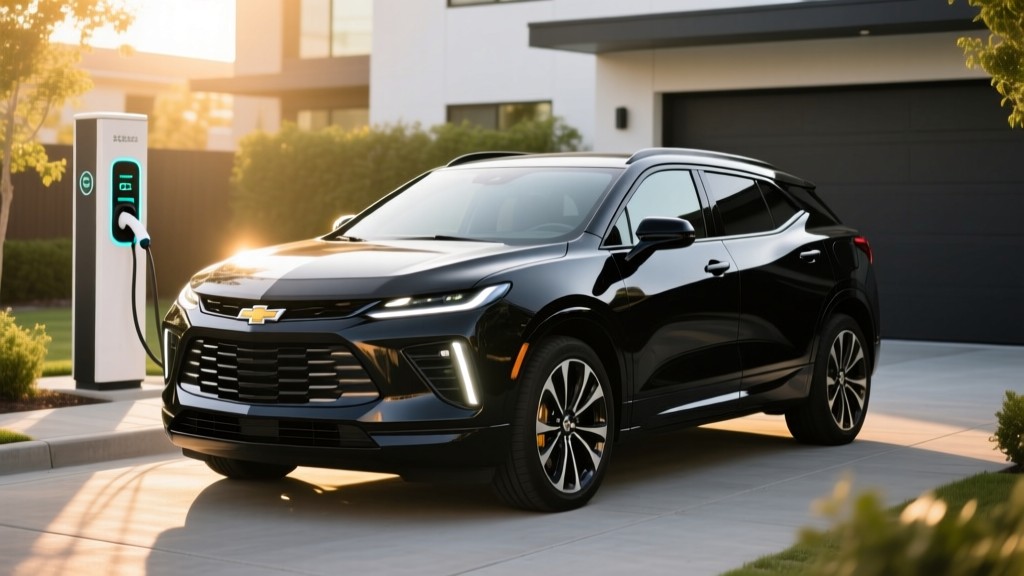
Quick Verdict: Is the Chevrolet Blazer EV Worth It?
The Chevrolet Blazer EV is a strong midsize electric SUV for buyers who prioritize range (up to 324 miles EPA on the LT trim with the largest battery), spacious cargo capacity, and access to the Tesla Supercharger network via its native NACS charge port. With a starting MSRP of $44,600 and potential eligibility for a $7,500 federal tax credit under IRS §30D rules, the effective price can drop into the mid-$30,000s. However, real-world highway range falls 10–15% below EPA estimates, DC fast charging peaks at 190 kW but tapers significantly above 80%, and home Level 2 charging requires a 48-amp circuit for best results. If you have reliable home charging access and drive mostly in moderate climates, the Blazer EV delivers compelling total cost of ownership versus the gas Blazer. If you live in a charging desert or regularly tow in cold weather, a plug-in hybrid may serve you better.
Range, Battery & Efficiency: What the Numbers Actually Mean
The 2026 Chevrolet Blazer EV offers two battery pack sizes across its trim lineup. The standard Ultium-based pack provides approximately 85 kWh of usable energy (NMC lithium-ion chemistry), while the extended pack bumps capacity to roughly 102 kWh. Both use GM's Ultium platform with wireless battery management and liquid thermal conditioning.
| Trim | Drivetrain | Battery (kWh usable) | EPA Range | MPGe (combined) | kWh/100 mi |
|---|---|---|---|---|---|
| LT (FWD, extended pack) | FWD | ~102 | 324 mi | 89 MPGe | ~34 |
| LT (AWD, standard pack) | AWD | ~85 | 279 mi | 85 MPGe | ~36 |
| RS (AWD) | AWD | ~102 | 295 mi | 87 MPGe | ~35 |
| SS (AWD, performance) | AWD | ~102 | 290 mi | 84 MPGe | ~37 |
Real-World Range vs. EPA Sticker
EPA estimates assume a mix of city and highway driving at moderate temperatures. Here is what to actually expect:
- Highway-only (70–75 mph, mild weather): Expect 270–285 miles on the 324-mi FWD LT. Aerodynamic drag at sustained highway speeds reduces efficiency by roughly 10–15%.
- Cold weather (below 30°F): Plan for 20–30% range loss depending on cabin heat usage and whether you precondition. The 324-mi trim may deliver 225–260 miles in freezing conditions.
- City/suburban mixed driving: You will often meet or slightly exceed EPA numbers thanks to regenerative braking recapturing energy in stop-and-go traffic.
The Blazer EV's heat pump (standard on all trims) mitigates some cold-weather loss compared to resistive heating systems, but physics still applies — battery chemistry slows in the cold, and cabin heating demands energy.
For reference, the EPA's fueleconomy.gov listing confirms the combined efficiency figures above. Always cross-check the specific trim you intend to buy, as AWD and larger wheels reduce range.
Charging Speeds: Home, Public & the NACS Advantage
The Blazer EV ships with a native NACS (North American Charging Standard) port, meaning it can plug directly into Tesla Superchargers without an adapter — a significant practical advantage for road trips given the Supercharger network's reliability and coverage.
| Level | Power (kW) | Connector | Miles Added per Hour | Notes |
|---|---|---|---|---|
| Level 1 (120V) | ~1.4 kW | NACS (J3400) | ~4 mi/hr | Emergency/trickle only; 70+ hours for full charge |
| Level 2 (240V, 48A) | 11.5 kW | NACS | ~34 mi/hr | Full charge in ~9–10 hours; recommended home setup |
| Level 2 (240V, 32A) | 7.7 kW | NACS | ~23 mi/hr | Common portable charger speed; 14+ hours for full |
| DC Fast Charge | Peak 190 kW | NACS | ~70 mi in 10 min (peak) | 10–80% in ~30 min; tapers sharply above 80% |
Understanding the charge curve: The Blazer EV's peak 190 kW DC fast-charge rate only applies at low states of charge (roughly 10–30% SoC) and optimal battery temperature. Above 50% SoC, the rate drops to approximately 120–130 kW, and above 80% it slows dramatically to protect battery health. A 10–80% session takes roughly 30 minutes at a capable 200+ kW charger, but plan for 40–45 minutes at 150 kW stations.
Home charging setup: The onboard charger accepts up to 11.5 kW on Level 2. To get this speed, you need a hardwired wall connector on a 60-amp circuit (which delivers 48 continuous amps). A typical NEMA 14-50 outlet on a 50-amp circuit provides 40 continuous amps (~9.6 kW) — still adequate for overnight charging but slightly slower.
EV vs. Gas Blazer: Cost Comparison Over 5 Years
How does the Blazer EV stack up against the gasoline Chevrolet Blazer in real ownership costs? Let's compare using a 15,000-mile/year driving pattern, $0.14/kWh home electricity, and $3.40/gallon regular unleaded.
| Category | Blazer EV RS (AWD) | Gas Blazer 2LT (AWD) |
|---|---|---|
| Base MSRP | $52,600 | $44,400 |
| Federal Tax Credit (§30D) | –$7,500 (if eligible) | $0 |
| Effective Purchase Price | $45,100 | $44,400 |
| Fuel/Energy (5 yrs, 75k mi) | $3,675 (home charging) | $11,050 (22 MPG avg) |
| Maintenance (5 yrs) | ~$1,500 | ~$3,800 |
| Insurance (5 yrs, est.) | ~$9,500 | ~$7,800 |
| Estimated Depreciation | ~$18,000 | ~$16,500 |
| Total 5-Year Cost | $83,550 |
Key takeaways:
- The Blazer EV saves roughly $5,775 over five years if you qualify for the full tax credit and charge primarily at home.
- Energy savings are dramatic: $7,375 less spent on "fuel" over 75,000 miles when charging at $0.14/kWh.
- Maintenance savings add ~$2,300 — no oil changes, fewer brake replacements (regen braking reduces pad wear), and no transmission fluid.
- Insurance runs 15–25% higher on the EV, partially offsetting savings. Get quotes before buying.
- Without the tax credit, the EV costs roughly $1,825 more over five years. Credit eligibility is critical to the value proposition.
Tax credit caveat: Under current IRS §30D rules, the $7,500 credit requires the buyer to meet income caps ($150,000 single / $300,000 joint AGI), the vehicle MSRP must not exceed $80,000 (SUVs), and battery components and critical minerals must meet domestic-sourcing thresholds that tighten annually. The Blazer EV is assembled at the Ramos Arizpe plant in Mexico, and its battery sourcing compliance must be verified at point of sale. The credit can now be transferred to the dealer as a point-of-sale discount. Always confirm eligibility with your tax professional before relying on it.
Performance & Driving: What the SS Trim Actually Delivers
The Blazer EV lineup spans practical commuter territory to genuine performance:
- LT/RS (FWD): 220 hp, 0–60 mph in ~7.8 seconds. Adequate for merging and passing, not thrilling.
- LT/RS (AWD): 295 hp, 0–60 mph in ~5.9 seconds. Confident acceleration with dual-motor grip.
- SS (AWD): 557 hp, 0–60 mph in under 4.0 seconds. This is supercar territory in a midsize SUV — and it shows in the price ($60,000+).
All trims feature one-pedal driving capability with adjustable regenerative braking, and the Ultium platform's low center of gravity gives the Blazer EV composed handling for its 5,800+ lb curb weight. Ride quality is firm but well-damped; road noise is well-isolated at highway speeds.
First-Time EV Buyer: What You Must Know Before Purchasing
| Myth | Fact |
|---|---|
| "The battery will need replacing in 5 years." | GM warrants the Ultium battery for 8 years/100,000 miles against capacity loss below 70%. Industry data shows NMC packs typically retain 85–90% capacity at 100,000 miles with normal use. |
| "I can't road-trip in an EV." | The Blazer EV's native NACS port accesses 20,000+ Tesla Superchargers plus Electrify America and EVgo networks. Plan 30-minute stops every 250 miles. |
| "Public charging is always broken." | Tesla Superchargers maintain 99%+ uptime. CCS networks (EA, EVgo) have improved but still show ~85–90% uptime. The Blazer EV's NACS port gives you the best of both. |
| "EVs are worse in winter." | Range drops 20–30% in sub-freezing temps (real), but preconditioning while plugged in, using seat heaters over cabin heat, and the standard heat pump mitigate the loss. Traction is excellent with AWD and low center of gravity. |
| "Home charging installation is always expensive." | If your panel has capacity, a NEMA 14-50 install typically costs $500–$1,500. A hardwired 60A circuit runs $1,000–$2,500. Panel upgrades (to 200A) can add $2,000–$4,000 but aren't always needed. |
Home Charging Access: The Deciding Factor
If you can install a Level 2 charger at home (garage, carport, or dedicated outdoor pad), the Blazer EV integrates seamlessly into daily life — plug in at night, wake up to 300+ miles every morning. If you rely solely on public charging, factor in 30–45 minutes of weekly charging time and higher per-kWh costs ($0.30–$0.55/kWh at DC fast chargers vs. $0.14 at home). Apartment dwellers without workplace charging should seriously weigh whether a PHEV or hybrid better fits their lifestyle.
Decision Framework: Should You Buy the Blazer EV?
Choose the Chevrolet Blazer EV If:
- You have home Level 2 charging access (or can install it)
- Your daily commute is under 100 miles round-trip
- You take 1–3 road trips per year and value Supercharger access
- You qualify for the §30D tax credit (income and sourcing requirements met)
- You want a quiet, low-maintenance daily driver with strong cargo space (27.5 cu ft rear, 58.5 cu ft folded)
- You live in a moderate climate or can precondition in cold weather
Look Elsewhere If:
- You cannot charge at home and lack reliable workplace/public Level 2 access
- You regularly tow heavy loads in cold weather (towing cuts range 30–50%)
- You need the lowest possible upfront cost and don't qualify for the tax credit
- You drive 400+ miles in a single day frequently — the 30-minute charge stops will add up
- You want proven long-term reliability data — the Blazer EV launched for the 2024 model year with early software issues that GM has addressed via OTA updates, but long-term durability is still being established
Consider a PHEV Instead If:
- You want electric commuting (30–40 mi) with gas-engine range security for road trips
- You live in an extreme cold climate and regularly exceed 250 miles per day
- Your household has one vehicle and no charging infrastructure
Battery Longevity & Warranty
GM covers the Blazer EV's Ultium battery pack with an 8-year/100,000-mile warranty against defects and capacity loss below 70% of original capacity. The powertrain (motors, power electronics) carries the same coverage. The rest of the vehicle is covered by a 3-year/36,000-mile bumper-to-bumper warranty and 5-year/60,000-mile powertrain warranty (for non-battery components).
For context, a battery replacement outside warranty currently runs $15,000–$22,000 depending on pack size, though GM's modular Ultium design may allow partial pack repairs rather than full replacement. Industry degradation data for NMC packs with active thermal management shows typical capacity retention of 88–92% at 100,000 miles — well above the warranty threshold.
Frequently Asked Questions
Does the Chevrolet Blazer EV qualify for the $7,500 federal tax credit?
Eligibility depends on three factors: your adjusted gross income (must be under $150,000 single / $300,000 joint), the vehicle's MSRP (must be under $80,000 — all Blazer EV trims qualify), and battery component/critical-mineral sourcing thresholds that tighten each year. Because the Blazer EV is assembled in Mexico, its §30D eligibility hinges on battery sourcing compliance, which changes annually. Verify with the fueleconomy.gov tax credit tool and a tax professional before purchasing.
How long does it take to charge the Blazer EV at home?
On a 48-amp Level 2 circuit (11.5 kW), the 102 kWh extended pack charges from empty to full in roughly 9–10 hours. On a 32-amp circuit (7.7 kW), expect 13–14 hours. Most owners charge from 20–80% overnight in 5–6 hours, which is more than enough for daily driving.
Can I use Tesla Superchargers with the Blazer EV?
Yes. The Blazer EV has a native NACS charge port, so it plugs directly into Tesla Superchargers without an adapter. GM has enabled this access for Blazer EV owners through the myChevrolet app, which locates stalls, initiates sessions, and handles billing.
What is the Blazer EV's towing capacity?
The Blazer EV is rated to tow up to 1,500 lbs when properly equipped — adequate for a small utility trailer or a pair of dirt bikes, but not for boats or campers. Towing also reduces range by 30–50% depending on weight, speed, and terrain.
Is the Blazer EV reliable?
The 2024 launch year saw software glitches (infotainment freezes, charging handshake issues) that GM addressed through over-the-air updates and a brief production pause. The 2025 and 2026 model years have shown improved software stability. Long-term mechanical reliability of the Ultium platform is still being established, but the 8-year battery warranty provides coverage. Check NHTSA for any active recalls before purchasing.
How does the Blazer EV compare to the Hyundai Ioniq 5 or Tesla Model Y?
The Blazer EV offers more cargo space than the Ioniq 5 and a more traditional SUV driving position than the Model Y. The Ioniq 5 charges faster (peak 240 kW, 10–80% in ~18 min vs. the Blazer's ~30 min). The Model Y has broader Supercharger optimization and slightly better efficiency. The Blazer EV's advantage is its NACS port, GM warranty backing, and availability of a lower-priced FWD trim with 324 miles of range. Cross-shop all three based on your charging access and space needs.