Quick Verdict: An EV Built for the Beat
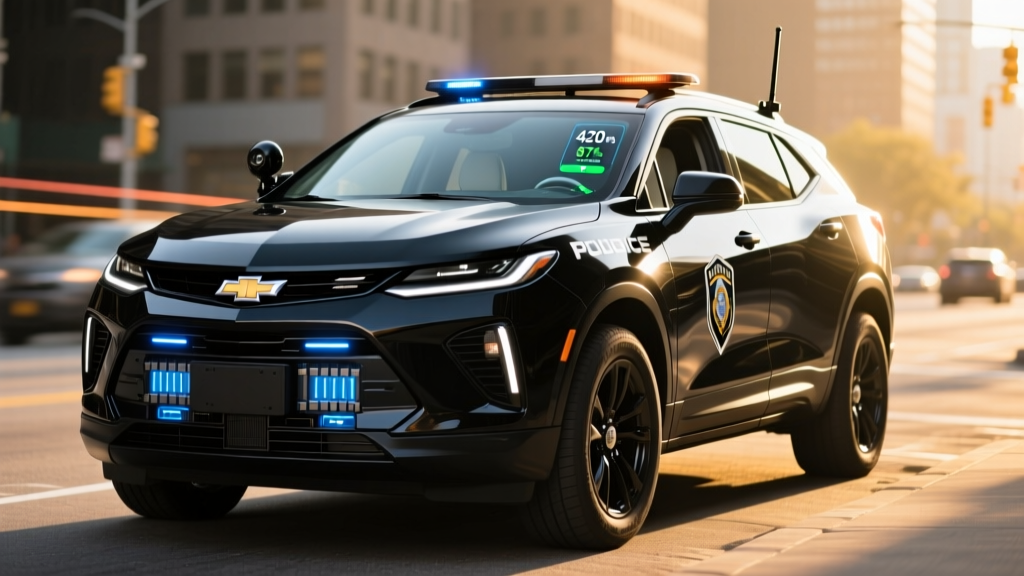
The 2026 Chevrolet Blazer EV Police Pursuit Vehicle (PPV) is General Motors' most serious attempt at electrifying law enforcement fleets. Built on the Ultium platform and adapted from the civilian Blazer EV SS, this purpose-built SUV targets agencies looking to cut idle fuel costs, reduce maintenance downtime, and meet municipal sustainability mandates — without sacrificing the performance officers need during pursuits and emergency responses.
With a dual-motor AWD powertrain producing an estimated 615 horsepower, a 102 kWh usable battery, and EPA-estimated range of 279 miles, the Blazer EV PPV occupies a unique niche: it's the first mass-produced, fully electric police pursuit-rated SUV available to North American law enforcement agencies. But fleet procurement isn't an impulse buy. Let's break down the exact numbers, real-world limitations, and total-cost-of-ownership math that fleet managers and municipal procurement officers need before writing a purchase order.
Range, Battery & Real-World Patrol Expectations
The Blazer EV PPV uses GM's Ultium battery architecture with a 102 kWh usable capacity (approximately 115 kWh gross). The pack uses NMC (nickel manganese cobalt) chemistry, chosen for its higher energy density compared to LFP — critical for a vehicle that must carry heavy upfit equipment (light bars, cages, radios, weapon racks) without sacrificing range.
| Specification | Value |
|---|---|
| Battery Chemistry | NMC (Nickel Manganese Cobalt) |
| Gross Battery Capacity | ~115 kWh |
| Usable Battery Capacity | 102 kWh |
| EPA Estimated Range | 279 miles |
| EPA Efficiency | 87 MPGe combined / 39 kWh/100 mi |
The 279-mile EPA estimate assumes mixed city/highway driving at moderate temperatures. In actual patrol duty — which involves frequent stop-and-go, long idle-equivalent periods with HVAC and electronics running, and high-speed pursuits — expect effective range to drop to 180–220 miles per shift. Cold-weather operations (below 32°F) can reduce range by an additional 20–30%, bringing winter patrol range to approximately 140–175 miles before requiring a charge. Agencies in northern climates should plan for mid-shift top-ups or staggered fleet rotations.
For context, a typical urban patrol shift covers 80–120 miles, making the Blazer EV PPV viable for a single shift without charging in temperate conditions. Highway-heavy rural or state police applications will see better range efficiency due to more consistent speeds, but pursuit driving at sustained high speeds will consume energy rapidly.
Charging Speed: DC Fast Charge & Depot Level 2
Fleet charging infrastructure is the make-or-break factor for any EV police deployment. The Blazer EV PPV supports a maximum DC fast-charge rate of 190 kW via its CCS1 connector (NACS adapter available for Tesla Supercharger network access in future deployments).
| Charging Level | Power / Rate | Time / Miles Added |
|---|---|---|
| Level 1 (120V) | ~1.4 kW | ~3 mi/hr — not practical for fleet use |
| Level 2 (240V, 48A) | 11.5 kW | ~28 mi/hr; full charge in ~9.5 hours |
| Level 2 (240V, 80A) | 19.2 kW | ~46 mi/hr; full charge in ~5.5 hours |
| DC Fast Charge (peak) | 190 kW | 10–80% in ~30 minutes |
| DC Fast Charge (sustained) | ~120 kW avg | 80–100% tapers significantly; adds ~15 min |
Most police depot installations will use 80A Level 2 chargers, enabling overnight charging between shifts. A full fleet rotation — vehicle returns at end of shift, charges overnight, deploys next morning — works seamlessly with Level 2 infrastructure. The 30-minute 10–80% DC fast-charge window is practical for mid-shift top-ups at public stations or dedicated fleet DC chargers, though agencies should budget for the charge-curve taper: charging from 80–100% on DC adds roughly 15 additional minutes as the battery management system reduces current to protect cell health.
Fleet managers should note that consistent DC fast-charging above 150 kW will accelerate battery degradation over time. GM recommends predominantly Level 2 charging for optimal long-term State of Health (SoH), reserving DC fast-charging for operational necessity.
Performance: Pursuit-Rated Powertrain & Drivetrain
The Blazer EV PPV is not a detuned civilian SUV with a light bar bolted on. GM engineers calibrated the dual-motor AWD system for pursuit-rated performance, drawing heavily from the Blazer EV SS platform.
| Metric | Specification |
|---|---|
| Powertrain | Dual-motor AWD (front + rear permanent magnet motors) |
| Horsepower | 615 hp (est.) |
| Torque | 650 lb-ft (est.) |
| 0–60 mph | ~3.9 seconds |
| Top Speed | Electronically limited to ~130 mph (pursuit calibration) |
| Drivetrain | AWD with torque vectoring rear axle |
| Towing Capacity | Not rated for towing (PPV configuration) |
The instant torque delivery of the dual-motor setup gives the Blazer EV PPV a decisive advantage in initial-acceleration scenarios — merging onto highways, clearing intersections during Code 3 responses, and closing gaps in urban pursuit scenarios. The 3.9-second 0–60 time outpaces most current ICE pursuit vehicles (the Ford Police Interceptor Utility Hybrid, for comparison, runs 0–60 in approximately 5.5 seconds).
The low center of gravity from the floor-mounted battery pack improves handling dynamics during high-speed cornering, though the added weight of the battery (~1,500 lbs more than an equivalent ICE platform) increases braking distances and tire wear. GM has equipped the PPV with heavy-duty Brembo brakes and pursuit-rated all-season tires to compensate.
Pricing, Fleet Procurement & Tax Credit Eligibility
The Blazer EV PPV is sold exclusively through GM's fleet/commercial channel and is not available at retail dealerships. Pricing reflects the upfit package — including integrated emergency lighting, siren controller, prisoner transport partition, heavy-duty suspension, and police-specific software calibration.
| Item | Estimated Cost |
|---|---|
| Base Fleet MSRP (before upfit) | ~$57,000 |
| PPV Upfit Package | ~$12,000–$18,000 (varies by agency spec) |
| Total Estimated Acquisition Cost | ~$69,000–$75,000 |
| Federal §30D Tax Credit | Up to $7,500 (see eligibility notes) |
| Commercial Clean Vehicle Credit (§45W) | Up to $7,500 for qualified commercial/fleet purchases |
Municipal and government fleet purchases typically use the Commercial Clean Vehicle Credit (§45W) rather than the consumer §30D credit. Under §45W, qualified commercial vehicles with a GVWR under 14,000 lbs can receive up to $7,500. Critical requirements include:
• Vehicle must be manufactured by a qualified OEM (GM qualifies)
• Battery components and critical minerals must meet phased domestic-content thresholds (increasing annually through 2029)
• The vehicle cannot be transferred via point-of-sale to a dealer — fleets claim the credit on their tax return
• Tax-exempt entities (many municipalities) can receive the credit as a direct payment from the IRS under the elective pay provision
Always verify current-year sourcing requirements on IRS.gov and consult a municipal tax advisor before procurement. Rules are subject to legislative change.
Interior, Cargo & Police-Specific Technology
The Blazer EV PPV's cabin is configured for duty use. The civilian 17.7-inch diagonal infotainment screen is retained but runs GM's police-specific software layer, integrating with mobile data terminals (MDTs), CAD (Computer-Aided Dispatch) systems, and ALPR (Automatic License Plate Recognition) camera feeds.
| Dimension | Specification |
|---|---|
| Front Legroom | 42.4 inches |
| Rear Legroom | 38.9 inches (reduced with partition installed) |
| Cargo Volume (behind rear seats) | 36.5 cu ft |
| Cargo Volume (rear seats folded) | 68.2 cu ft |
| Front Trunk (Frunk) | Not available (occupied by PPV electronics) |
The rear cargo area accommodates standard police equipment loadouts: evidence storage boxes, traffic cone kits, spare tire assemblies, and tactical equipment. The absence of a frunk (the space is occupied by the PPV-specific electrical distribution module and siren amplifier) is a trade-off unique to the pursuit variant.
Standout technology features include:
- GM Super Cruise (SAE Level 2) for highway patrol segments — enables hands-off driving on pre-mapped divided highways with driver monitoring. This is NOT autonomous driving; the officer must remain attentive and ready to take control instantly.
- Vehicle-to-Everything (V2X) communication capability for intersection preemption and signal priority
- Regenerative braking calibration optimized for pursuit and city patrol — allows near one-pedal driving in stop-and-go scenarios, reducing brake wear
- Bi-directional charging (V2L) — the Blazer EV PPV can export up to 3.6 kW of power to run scene lighting, command post equipment, or emergency shelter power during disaster response
- Over-the-air (OTA) updates for police software, pursuit calibration tuning, and cybersecurity patches
Notable drawbacks:
- No frunk reduces secure front storage for sensitive equipment
- Added battery weight increases tire replacement frequency (budget for 25,000–30,000 mile tire cycles vs 40,000+ on ICE equivalents)
- Cold-weather range reduction requires operational planning in northern states
- Depot charging infrastructure investment is significant upfront ($15,000–$40,000 per Level 2 stall including electrical upgrades)
- Repair and collision turnaround times may be longer due to specialized high-voltage technician requirements
Battery Warranty & Long-Term Fleet Durability
GM provides an 8-year / 100,000-mile battery and powertrain warranty for the Blazer EV PPV, consistent with its civilian Ultium-platform vehicles. The warranty covers battery capacity degradation below 70% of original capacity — a threshold that, based on current Ultium fleet data, most packs won't reach within the warranty period under normal charging practices.
| Component | Coverage |
|---|---|
| Battery Pack | 8 years / 100,000 miles (70% capacity retention threshold) |
| Powertrain (motors, inverter) | 8 years / 100,000 miles |
| Bumper-to-Bumper | 3 years / 36,000 miles |
| Corrosion | 6 years / 100,000 miles |
| PPV Upfit Equipment | Varies by upfitter (typically 2–3 years) |
For fleet lifecycle planning, GM estimates the Ultium battery pack should retain approximately 85–90% capacity after 100,000 miles based on internal testing and early fleet data from commercial Ultium deployments. Police use patterns — frequent partial charges, high accessory loads, and occasional DC fast-charging — may result in slightly faster degradation than consumer averages. Budget-conscious agencies should plan for a battery health assessment at the 7-year mark and consider extended warranty options for vehicles expected to exceed 100,000 miles in service.
Who Should Buy the Blazer EV PPV?
• Urban and suburban police departments with predictable shift patterns (8–12 hour shifts, 80–120 miles per shift)
• Municipalities with sustainability mandates requiring fleet electrification targets by 2028–2030
• Agencies with depot charging capability or budget to install Level 2 infrastructure
• Campus police and airport authority fleets with controlled geographic boundaries
• Community-oriented patrol divisions where quiet, zero-local-emission operation improves neighborhood relations
• Your agency operates in extreme cold climates with no mid-shift charging infrastructure
• You require rural or highway patrol vehicles covering 200+ miles per shift without reliable DC fast-charge access
• Your fleet lacks electrical infrastructure for depot charging and has no budget for upgrades
• You need towing capability for trailers or boats (the PPV is not tow-rated)
• Your agency requires immediate nationwide parts/service availability — EV police service networks are still expanding
Competitive Comparison: Blazer EV PPV vs. Alternatives
| Specification | Chevy Blazer EV PPV | Ford PI Utility Hybrid | Tesla Model Y (aftermarket upfit) |
|---|---|---|---|
| Powertrain | Dual-motor AWD EV | 3.3L V6 Hybrid AWD | Dual-motor AWD EV |
| Horsepower | 615 hp | 318 hp (combined) | |
| 0–60 mph | ~3.9 sec | ~5.5 sec | |
| Range / Fuel | 279 mi EPA | 24 mpg combined | |
| Fuel/Charge Cost per 100 mi | ~$5.50 (electricity) | ~$13.50 (gasoline) | |
| Pursuit Rated | Yes (OEM) | Yes (OEM) | |
| OEM Police Upfit | Yes | Yes | |
| V2L Capability | Yes (3.6 kW) | No |
The Ford Police Interceptor Utility Hybrid remains the dominant pursuit vehicle in North America due to its proven track record, established service network, and no-range-limitation operation. The Blazer EV PPV's advantages are in operating cost (roughly 60% lower per-mile energy cost), reduced maintenance (no oil changes, fewer brake replacements due to regen, no transmission fluid), and V2L capability for scene power. The Tesla Model Y, while popular with some departments for non-pursuit patrol, lacks OEM pursuit rating and factory-integrated emergency equipment.
Frequently Asked Questions
What is the real-world range of the Blazer EV PPV during patrol duty?
While the EPA estimates 279 miles, real-world patrol operations — with HVAC running continuously, emergency electronics drawing power, and aggressive acceleration during responses — reduce effective range to approximately 180–220 miles in temperate weather. In sub-freezing conditions, plan for 140–175 miles. Most urban shifts (80–120 miles) fall well within a single charge.
How fast does the Blazer EV PPV charge at the depot and on DC fast chargers?
On an 80A Level 2 depot charger (19.2 kW), a full charge takes approximately 5.5 hours — ideal for overnight between-shift charging. On a DC fast charger at peak rate (190 kW), the battery charges from 10–80% in about 30 minutes, though the charge curve tapers significantly above 80%, adding roughly 15 minutes for a full 10–100% session.
How much does the Blazer EV PPV cost after federal tax incentives?
Total acquisition cost including the PPV upfit package is estimated at $69,000–$75,000. Tax-exempt municipal agencies can claim the §45W Commercial Clean Vehicle Credit (up to $7,500) as a direct payment from the IRS under the elective pay provision, bringing net cost to approximately $61,500–$67,500. Verify current-year battery sourcing requirements at IRS.gov before procurement.
Is the Blazer EV PPV worth buying vs. the Ford Police Interceptor Utility Hybrid?
It depends on your agency's operational profile. The Blazer EV PPV offers superior acceleration (3.9s vs 5.5s 0–60), roughly 60% lower per-mile energy costs, dramatically reduced routine maintenance, V2L scene power, and zero tailpipe emissions. The Ford PI Utility Hybrid wins on unlimited range (refuel in 5 minutes anywhere), established nationwide service infrastructure, and lower upfront cost. Agencies with depot charging and shift-based operations will find the Blazer EV PPV's total cost of ownership compelling over a 5-year lifecycle.
What are the biggest pros and cons of the Blazer EV PPV?
Pros: Pursuit-rated 615 hp acceleration, 60% lower fuel cost per mile, minimal routine maintenance, V2L scene power, quiet operation for community policing, OTA software updates, Super Cruise Level 2 highway assist, 8-year/100,000-mile battery warranty.
Cons: Higher upfront acquisition cost, depot charging infrastructure investment required, cold-weather range reduction (20–30%), no towing capability, no frunk, heavier weight increases tire wear, EV collision repair requires specialized technicians, limited long-term police-specific service data.
Does the Blazer EV PPV qualify for the federal EV tax credit?
Yes, through the §45W Commercial Clean Vehicle Credit (up to $7,500) for fleet and government purchases. Tax-exempt municipal entities can receive this as a direct payment from the IRS. Eligibility depends on the vehicle meeting current-year battery component and critical mineral domestic-content thresholds, which increase annually. The Blazer EV PPV is manufactured at GM's Spring Hill, Tennessee facility with Ultium battery cells from the Ultium Cells joint-venture plants in Ohio and Tennessee, positioning it favorably for sourcing compliance. Always confirm current-year rules with a municipal tax advisor.
Sources: EPA Fuel Economy, IRS Clean Vehicle Credits, Chevrolet Fleet