If you want a Tesla without spending Long Range money, the entry-level Rear-Wheel Drive trim is the cheapest Model 3 you can buy new in 2026. It undercuts the Long Range AWD by roughly $8,000 while retaining the same interior, software stack, and Supercharger access. The trade-offs are range, acceleration, and a smaller battery — but for commuters and urban drivers who can charge at home, the value proposition is strong.
Below we break down the exact specs, real-world range expectations, charging behavior, and 2026 federal tax credit rules so you can decide whether the base Model 3 is the right EV for your daily driving.
Cheapest Model 3: 2026 Specs at a Glance
| Spec | Value |
|---|---|
| EPA Estimated Range | 272 miles |
| Battery Capacity (Usable) | ~60 kWh |
| Battery Chemistry | LFP (Lithium Iron Phosphate) |
| Drivetrain | Rear-Wheel Drive (Single Motor) |
| Horsepower | 283 hp |
| 0–60 mph | 5.8 seconds |
| Max DC Fast Charge Rate | 170 kW (peak) |
| 10–80% DC Fast Charge Time | ~25 minutes |
| Level 2 Home Charging | 11.5 kW (~44 mi/hr) |
| Efficiency (Combined) | 132 MPGe / 25 kWh/100 mi |
| Cargo Volume | 23 cu ft (rear seats up), 64 cu ft (folded) |
| Rear Legroom | 35.2 inches |
| Base MSRP | $38,990 (before destination) |
| Battery & Drive Unit Warranty | 8 years / 100,000 miles (min 70% retention) |
Real-World Range: What 272 EPA Miles Actually Means
Real-World Highway (70 mph, mild weather): ~235–250 miles
Real-World City / Mixed: ~255–270 miles
Cold Weather (below 32°F): ~185–215 miles (20–30% loss typical for LFP)
The EPA combined cycle blends city and highway driving, but most road-trip range anxiety happens at sustained highway speeds. In our experience and consistent with third-party testing, expect roughly 235 to 250 miles at 70 mph in moderate temperatures. The Model 3 RWD's efficiency — around 25 kWh per 100 miles — is among the best in its class, which helps stretch the smaller pack.
Cold weather hits LFP batteries harder than NMC in terms of immediate range loss, partly because LFP cells have higher internal resistance at low temperatures. Tesla's heat pump and battery preconditioning mitigate this, but if you live in the upper Midwest or Northeast, plan for 185–215 miles of usable range on a freezing winter day. Preconditioning the battery while still plugged in at home is the single most effective way to preserve winter range.
For context, the average American drives roughly 37 miles per day according to FHWA data. Even with cold-weather losses, the cheapest Model 3 covers a week of commuting on a single charge for most drivers.
Charging Speed: DC Fast Charging and Home Setup
| Charging Level | Power (kW) | Miles Added per Hour | Notes |
|---|---|---|---|
| Level 1 (120V household) | ~1.4 kW | ~3–4 mi/hr | Emergency / trickle only |
| Level 2 (240V, 48A) | 11.5 kW | ~44 mi/hr | Full charge in ~6 hours |
| DC Fast Charge (peak) | 170 kW | ~600+ mi/hr (at peak) | 10–80% in ~25 min |
The Model 3 RWD peaks at 170 kW on a DC fast charger, but like all EVs, it does not sustain that rate for the entire session. The charge curve is aggressive from 10% to about 40% State of Charge (SoC), then tapers progressively. Expect the 10–80% session to take roughly 25 minutes at a V3 Supercharger or equivalent 250 kW station. Above 80%, charging slows dramatically to protect the LFP cells — a 10–90% session will take closer to 35–40 minutes.
One LFP-specific advantage: Tesla recommends charging to 100% regularly (at least once per week) to keep the battery management system calibrated. Unlike NMC batteries, which degrade faster when held at full SoC, LFP chemistry tolerates daily 100% charges well. This means you can actually use the full 272 EPA miles more often than you could with a Long Range model.
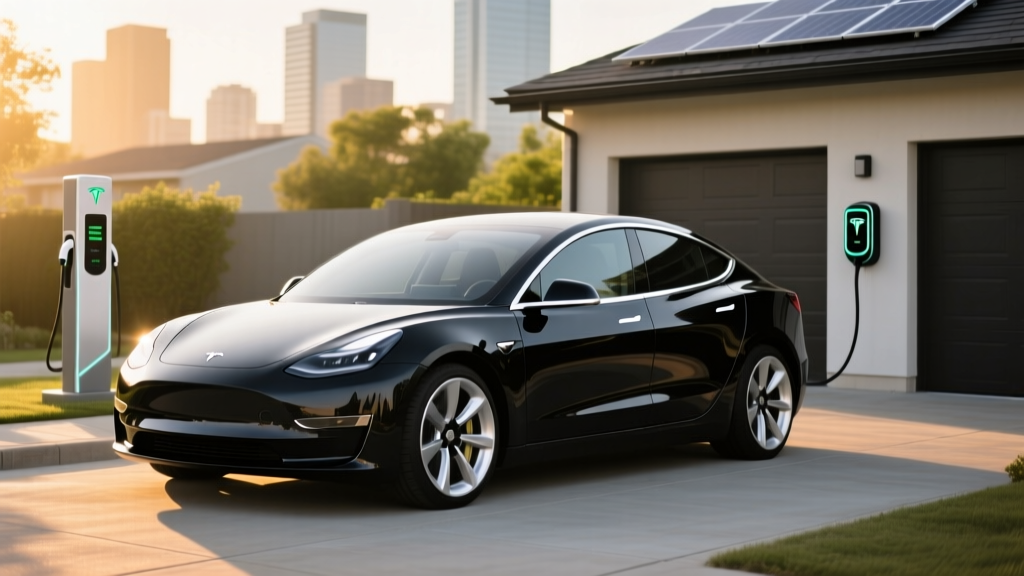
At home on a 48-amp Level 2 charger (requiring a 60-amp circuit), the Model 3 adds about 44 miles of range per hour. A full 10–100% charge takes roughly 6 hours, easily accomplished overnight. If your home electrical panel is older or maxed out, a licensed electrician may need to upgrade your service or install a sub-panel — budget $500–$2,000 for the install depending on your setup.
Performance, Ride, and Interior
The single rear motor produces 283 horsepower and launches the Model 3 RWD to 60 mph in 5.8 seconds. That's brisk by any sedan standard and quicker than most gas-powered competitors in this price range. The instant torque delivery makes it feel even faster in stoplight-to-stoplight city driving. However, the RWD model lacks the all-weather traction of the dual-motor Long Range or Performance variants — if you deal with heavy snow, winter tires are strongly recommended.
Inside, the refreshed Model 3 (sometimes called the "Highland" refresh) features ventilated front seats, ambient lighting, a rear 8-inch touchscreen for passengers, and improved sound insulation over the pre-2024 models. The minimalist interior still polarizes — there are no physical stalks (turn signals are on the steering wheel rim) and no instrument cluster. Everything routes through the 15.4-inch center display.
Cargo space is generous for a compact sedan: 23 cubic feet behind the rear seats, expanding to 64 cubic feet with the 60/40 split folded. The front trunk (frunk) adds additional storage for charging cables or a small bag. Rear legroom at 35.2 inches is adequate for adults but tighter than a Hyundai Ioniq 6 or Toyota Camry.
Tech, Driver Assistance, and Autopilot
Every Model 3 comes with Tesla's Basic Autopilot, which includes Traffic-Aware Cruise Control and Autosteer (lane centering). This is an SAE Level 2 driver-assistance system — you must keep your hands on the wheel and eyes on the road at all times. It is not self-driving.
Tesla Autopilot and FSD (Supervised) are Level 2 systems. The driver is fully responsible for vehicle operation at all times. Level 4 (true driverless) is currently limited to geofenced robotaxi services like Waymo in select cities.
Full Self-Driving (Supervised) remains an optional upgrade (~$8,000 or $99/month as of early 2026) and adds automatic lane changes, traffic light/stop sign recognition, and city street navigation. Despite the name, FSD still requires active driver supervision. For most buyers, the included Basic Autopilot is sufficient for highway commuting.
The infotainment system is among the most responsive in the industry, with built-in navigation, streaming apps, and over-the-air updates that regularly add features. However, there is no Apple CarPlay or Android Auto — a dealbreaker for some buyers who prefer phone projection.
Pricing, Trims, and Federal Tax Credit Eligibility
| Trim | Base MSRP | Est. After §30D Credit | Drivetrain |
|---|---|---|---|
| Rear-Wheel Drive | $38,990 | ~$31,490* | RWD |
| Long Range AWD | $46,990 | ~$39,490* | Dual Motor AWD |
| Performance | $52,990 | ~$45,490* | Dual Motor AWD |
*Estimated prices assume full $7,500 federal tax credit eligibility. Actual credit depends on your tax liability, income, and vehicle battery sourcing compliance. See IRS rules below.
The cheapest Model 3 — the Rear-Wheel Drive at $38,990 — is well under the IRS §30D MSRP cap of $55,000 for sedans. However, qualifying for the full $7,500 credit involves several requirements:
- Buyer Income Caps: Modified AGI must not exceed $150,000 (single), $225,000 (head of household), or $300,000 (joint filers)
- MSRP Cap: Vehicle MSRP must be ≤ $55,000 for sedans (all Model 3 trims qualify)
- Battery Component Sourcing: A percentage of battery components must be manufactured or assembled in North America (threshold increases yearly)
- Critical Minerals: A percentage of critical minerals must be sourced from the US or a free-trade-agreement country
- Point-of-Sale Transfer: As of 2024+, you can transfer the credit to the dealer at purchase, reducing your out-of-pocket cost immediately (even if you have no tax liability, the dealer receives it as a payment)
Tesla's battery sourcing compliance changes periodically. Always verify current eligibility on fueleconomy.gov before purchasing, as the credit amount can shift between $3,750 and $7,500 depending on whether the vehicle meets one or both sourcing requirements.
How the Cheapest Model 3 Compares to Rivals
The base Model 3 RWD competes primarily with the Hyundai Ioniq 6 SE Standard Range (~$37,500, 240 mi EPA), the Chevrolet Equinox EV (~$33,000, 319 mi EPA on higher trims), and the Polestar 2 Standard Range (~$40,900, 276 mi EPA). Here's how the value breaks down:
- vs. Ioniq 6 SE: The Hyundai is slightly cheaper and offers 800V ultra-fast charging (10–80% in ~18 min), but has less range (240 mi) and a smaller Supercharger-equivalent network. The Model 3 wins on charging infrastructure and software.
- vs. Equinox EV: The Chevy offers more range per dollar on paper, but real-world charging speeds are slower (~150 kW peak) and the driving dynamics are less engaging. The Model 3 is the driver's choice.
- vs. Polestar 2: The Polestar has a more traditional interior with physical controls and Google built-in, but costs more and charges slower. The Model 3 wins on price and efficiency.
- You charge primarily at home and drive under 200 miles daily
- You want Supercharger network access for road trips
- You value performance and software over traditional interior layouts
- You live in a mild-to-moderate climate (or will buy winter tires)
- You regularly drive 250+ miles between charges
- You need all-wheel drive for snow/ice
- You want the faster 4.2-second 0–60 time
Pros and Cons of the Base Model 3
- Best-in-class efficiency (25 kWh/100 mi)
- Access to 60,000+ Tesla Superchargers globally
- LFP battery tolerates daily 100% charging
- Strong performance (5.8s 0–60) for the price
- Excellent over-the-air update track record
- Qualifies for up to $7,500 federal credit
- 272-mile range is limiting for long road trips
- RWD only — poor snow traction without winter tires
- No Apple CarPlay / Android Auto
- Turn signals on steering wheel rim take adaptation
- LFP range loss in extreme cold is significant
- 170 kW peak charge rate is slower than 800V rivals
Frequently Asked Questions
What is the real-world range of the cheapest Model 3?
The EPA rates it at 272 miles combined. In real-world highway driving at 70 mph, expect 235–250 miles. In freezing temperatures, plan for 185–215 miles. For daily commuting under 100 miles round-trip, the range is more than adequate year-round.
How fast does the base Model 3 charge at home and on the road?
On a 48-amp Level 2 home charger, it adds ~44 miles per hour and fully charges in about 6 hours. On a DC fast charger, it peaks at 170 kW and charges from 10–80% in roughly 25 minutes. Above 80%, the charge rate tapers significantly.
How much does the cheapest Model 3 cost after tax credits?
The base MSRP is $38,990. If you qualify for the full $7,500 federal §30D credit (via point-of-sale transfer), the effective price drops to approximately $31,490. Eligibility depends on your income, the vehicle's battery sourcing compliance, and MSRP caps. Verify current eligibility on fueleconomy.gov before purchase.
Is the base Model 3 worth buying vs. competitors?
For drivers who prioritize charging infrastructure, software, and driving dynamics, the Model 3 RWD is the strongest value in its segment. If you need more range, consider the Long Range AWD or the Chevrolet Equinox EV. If you prefer ultra-fast 800V charging, look at the Hyundai Ioniq 6.
Does the cheapest Model 3 qualify for the federal EV tax credit?
The Model 3 RWD is under the $55,000 sedan MSRP cap and has historically qualified for either $3,750 or the full $7,500 depending on battery component and critical mineral sourcing thresholds. Buyer income caps also apply ($150K single / $300K joint). Always check the latest IRS guidance and fueleconomy.gov for the current credit amount before purchasing.
What is the battery warranty on the Model 3 RWD?
Tesla covers the battery and drive unit for 8 years or 100,000 miles, whichever comes first, with a minimum 70% capacity retention guarantee. LFP batteries have shown strong long-term durability in fleet data, often exceeding 200,000 miles with minimal degradation when charged to 100% regularly as Tesla recommends.