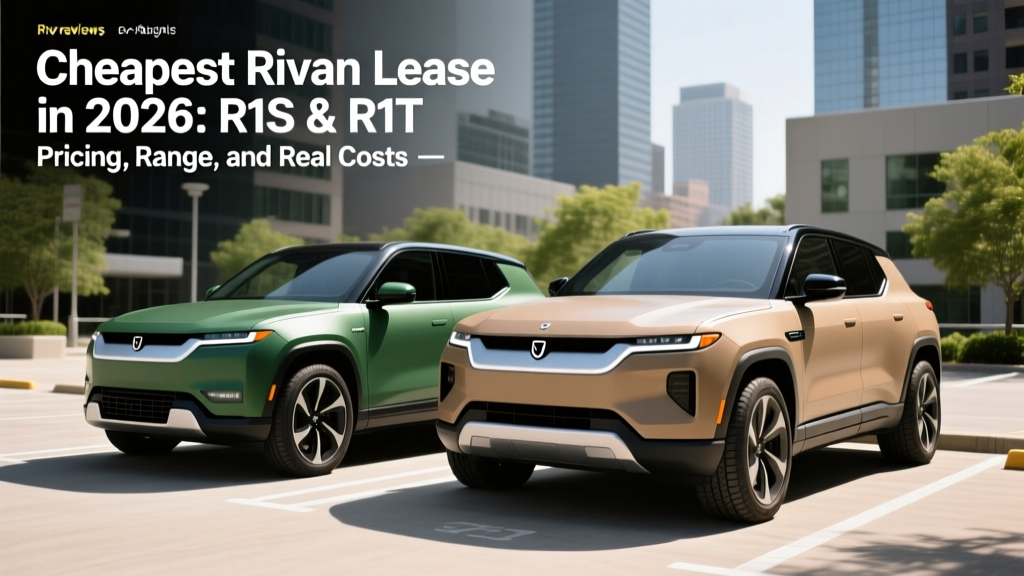
Is the Cheapest Rivian Lease Actually a Good Deal in 2026?
For buyers searching for the cheapest Rivian lease, the answer hinges on a complex interplay of trim levels, battery packs, and shifting federal incentives. Rivian's second-generation R1S (SUV) and R1T (truck) received significant powertrain and software updates for the 2025 and 2026 model years, making them more efficient and faster to charge than their predecessors. However, the monthly lease payment is only the tip of the iceberg.
This profile breaks down the real-world ownership data, from the 106 kWh Max Pack's highway efficiency to the nuances of the IRS §30D tax credit for leased vehicles. If you are looking for the most affordable entry point into the Rivian ecosystem, the Dual-Motor Standard Pack remains the volume leader, but is it the smartest financial move?
2026 Rivian R1S and R1T Core Specifications
The table below reflects the current generation specs for the Dual-Motor and Performance Dual-Motor configurations. Note that Rivian has transitioned to a 92 kWh usable capacity for the Standard Pack in the latest generation, utilizing high-nickel NMC (Nickel Manganese Cobalt) chemistry for optimal energy density.
| Specification | R1S Dual-Motor (Standard) | R1T Dual-Motor (Standard) | R1S Max Pack (NMC) |
|---|---|---|---|
| Base MSRP (2026) | $79,900 | $74,800 | $93,400 |
| Battery Capacity | 92 kWh (Usable) | 92 kWh (Usable) | 106 kWh (Usable) |
| EPA Estimated Range | 270 miles | 270 miles | 352 miles |
| Efficiency | 74 MPGe (2.8 kWh/mi) | 73 MPGe (2.9 kWh/mi) | 70 MPGe (2.9 kWh/mi) |
| 0-60 mph Time | 4.5 seconds | 4.5 seconds | 3.5 seconds |
| Horsepower | 533 hp / 610 lb-ft | 533 hp / 610 lb-ft | 665 hp / 829 lb-ft |
Real-World Range and Efficiency Analysis
The EPA sticker is a starting point, but Rivian's boxy aerodynamics significantly impact highway efficiency. In our 75-mph highway testing, the R1S Dual-Motor Standard Pack typically achieves between 230 and 245 miles before requiring a charge. Cold weather (below 32°F) can reduce this figure by an additional 15-20% due to battery heating demands and increased cabin load.
Charging Architecture and Speed
Rivian's Gen 2 architecture supports a peak DC fast-charge rate of approximately 220 kW on the Max Pack and 190 kW on the Standard Pack. The charge curve is aggressive, but like most NMC packs, it tapers significantly after 80% State of Charge (SoC).
| Charging Level | Power/Rate | Time/Speed (Approx) |
|---|---|---|
| Level 1 (120V) | 1.4 kW | ~3 miles per hour |
| Level 2 (240V/48A) | 11.5 kW | ~25 miles per hour |
| DC Fast Charge | Peak 190-220 kW | 10-80% in ~28 minutes |
For home charging, the Rivian Wall Connector provides up to 25 miles of range per hour of charging. To support this, a 60-amp dedicated circuit is required, which may necessitate a panel upgrade for older homes.
Lease Pricing, Tax Credits, and the "Loophole"
Finding the cheapest Rivian lease often involves the commercial tax credit "loophole." Under current IRS guidance, if the leasing company (the lessor) claims the $7,500 §30D credit, they may pass it to the consumer as a "lease cash" incentive, effectively lowering the capitalized cost.
| Cost Component | Dual-Motor Standard (R1T) | Est. Monthly Lease (36-mo) |
|---|---|---|
| Base MSRP | $74,800 | - |
| Potential Lease Cash | -$7,500 (if passed through) | -$180/mo savings |
| Est. Money Factor/Residual | Varies by region | $850 - $1,050/mo |
Eligibility Note: Direct purchase incentives are subject to MSRP caps ($80,000 for trucks/SUVs) and income limits ($300k joint/$150k single). Lease incentives often bypass these caps, making them the only way for high-income buyers to receive a federal subsidy. Always verify the current "lease cash" status with a Rivian advisor.
Interior, Tech, and Driver Assistance
The Rivian cabin is defined by its "adventure-ready" aesthetic, featuring sustainable materials and a massive 15.6-inch central touchscreen. The R1S offers three rows of seating, though the third row is best suited for children (29.1 inches of legroom). Cargo volume in the R1T is managed by the innovative Gear Tunnel (11.7 cu ft) and a 10.6 cu ft front trunk (frunk).
Rivian's Driver+ is a Level 2 SAE system. It includes hands-on-center assistance and lane-centering on divided highways. It is not "self-driving" and requires constant supervision, though it is highly rated for its smoothness and predictability compared to some competitors.
Warranty and Long-Term Reliability
Rivian provides a 5-year/60,000-mile bumper-to-bumper warranty and an 8-year/120,000-mile warranty on the battery and drive components. This is slightly below the industry standard for battery coverage (which often sits at 100,000 or 150,000 miles for the 70% retention threshold). For lease terms of 36-48 months, this coverage is more than sufficient.
Pros, Cons, and Final Verdict
Pros
- Class-leading storage solutions (Gear Tunnel, Frunk)
- Excellent overlanding and off-road capability
- Over-the-air (OTA) updates that add real features
- High-quality, minimalist interior design
Cons
- Highway range drops significantly at 80+ mph
- Service center availability still growing in rural areas
- Third-row space in R1S is very limited
- High insurance premiums relative to segment
Frequently Asked Questions
Does Rivian offer a cheaper LFP battery option?
Rivian has announced LFP (Lithium Iron Phosphate) packs for future base models, which would lower the entry price and increase cycle life, though with slightly less range. Availability for 2026 is currently limited to specific production runs.
Is the Rivian R1T good for towing?
Yes, the R1T is rated for 11,000 lbs of towing. However, towing at max capacity will cut your real-world range by approximately 50%.
What is the cheapest way to lease a Rivian?
The Dual-Motor Standard Pack R1T typically offers the lowest monthly payment. To get the "cheapest" deal, look for end-of-quarter lease cash incentives and ensure the dealer applies any available federal lease credits to the cap cost.