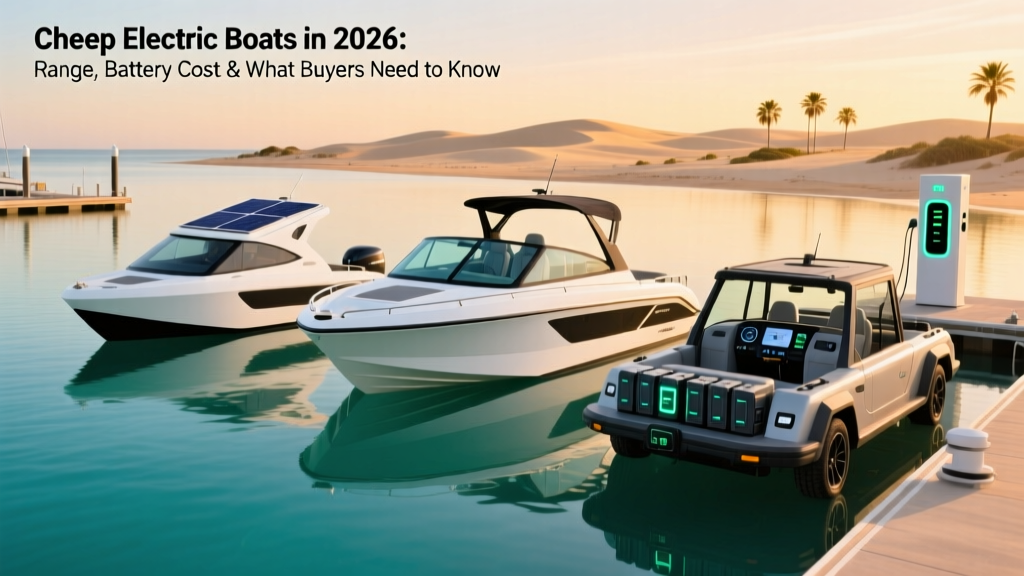
Quick Answer: True "cheap" electric boats — defined as under $15,000 for the full package (hull + motor + battery) — remain extremely limited in 2026. The most affordable options are small electric pontoons, kayaks, and dinghies with 2–5 kWh battery packs offering 10–30 miles of range at 3–5 mph. Mid-range electric runabouts from brands like Flux Marine, X Shore, and Candela start between $45,000 and $90,000. For most recreational boaters, electric propulsion makes financial sense only if you boat under 20 miles per outing, have dockside Level 2 charging access, and can avoid the premium pricing of current marine battery systems.
At a Glance: Cheap Electric Boats Reality Check
- Cheapest viable electric boat (2026): Small pontoon/dinghy with 3 kWh pack — ~$8,000–$14,000
- Mid-range electric runabout: $45,000–$90,000 (X Shore, Flux Marine, Candela)
- Typical range (budget tier): 10–30 miles at trolling speeds (3–5 mph)
- Charge time (Level 2, 240V/30A): 2–6 hours depending on pack size
- Federal tax credit: §30D does NOT apply to boats — marine EVs are excluded from the clean vehicle credit
Why Cheap Electric Boats Are Still Rare in 2026
The core challenge is energy density. Marine propulsion demands far more energy per mile than land vehicles. A 2,000-lb electric car might use 0.25 kWh/mile on the highway. A 2,500-lb planing-hull boat pushing through water resistance can consume 1.5–3.0 kWh/mile at cruising speed — roughly 6–12x the energy per mile. That means a boat needs a massive, heavy, expensive battery pack to achieve even modest range.
Lithium iron phosphate (LFP) marine batteries, the most common chemistry in budget electric boats due to their thermal stability and cycle life, cost approximately $120–$180 per kWh at the pack level in 2026. A 10 kWh usable pack — enough for perhaps 15 miles at 5 mph in a small displacement hull — adds $1,200–$1,800 in battery cost alone, before the motor, controller, hull, and marine-grade waterproofing.
This is why genuinely cheap electric boats are limited to low-speed, short-range applications: fishing kayaks with trolling motors, small sailboat auxiliary power, and compact pontoon boats used on calm lakes with dockside charging.
Electric Boat vs. Gas Outboard: Real Cost Comparison
Let's compare a realistic budget scenario: a 14-foot aluminum fishing boat used for lake fishing, 30 outings per year, averaging 8 miles per trip.
| Cost Factor | Electric (10 kWh LFP + 6 kW motor) | Gas (25 HP 4-stroke outboard) |
|---|---|---|
| Upfront powertrain cost | $5,500–$7,500 | $3,200–$4,000 |
| Fuel/energy per outing (8 mi) | $0.80–$1.50 (at $0.14/kWh) | $4.00–$6.00 (at $3.80/gal) |
| Annual fuel/energy (30 trips) | $24–$45 | $120–$180 |
| Annual maintenance | $0–$50 (no oil, impeller, lower unit) | $150–$300 (oil, gear lube, impeller, winterization) |
| 5-year total operating cost | $120–$475 | $1,350–$2,400 |
| Battery/motor replacement (year 10+) | $2,500–$4,000 (pack swap) | $3,200–$4,000 (new outboard) |
The electric setup breaks even on operating costs within 3–4 years for this use case. But the higher upfront cost and the range limitation (you cannot make a 40-mile round trip at speed) are the trade-offs. If your boating pattern involves long runs across large reservoirs or coastal waters, gas remains the practical choice.
Battery, Range, and Charging: The Numbers That Matter
Marine battery packs operate under the same physics as EV traction batteries, but with additional constraints: saltwater corrosion resistance, IP67+ waterproofing, vibration tolerance, and weight distribution in a hull. Here's what budget-tier electric boat specs look like in 2026:
| Spec | Budget Pontoon (10 kWh) | Mid-Range Runabout (40 kWh) | Premium Foiling (69 kWh) |
|---|---|---|---|
| Battery chemistry | LFP | NMC 811 | NMC / structural pack |
| Usable capacity | 9.5 kWh | 38 kWh | 69 kWh |
| Range at 5 mph (displacement) | 18–25 mi | 50–70 mi | 55–65 mi |
| Range at planing speed | N/A (cannot plane) | 18–25 mi | 40–50 mi (foiling) |
| Peak motor output | 6 kW (~8 HP equiv) | 55 kW (~74 HP equiv) | 220 kW (~295 HP equiv) |
| Level 2 charge (240V) | 3–4 hours (3.3 kW onboard) | 4–6 hours (7.2 kW onboard) | 3–4 hours (22 kW onboard) |
| DC fast charge capable | No | Optional (25 kW) | Yes (up to 75 kW) |
| Approx. package price | $10,000–$14,000 | $49,000–$65,000 | $85,000–$130,000+ |
A critical nuance: range depends entirely on speed. A displacement hull at 4–5 mph might achieve 2.5 miles per kWh. Push that same hull to 15 mph and consumption can spike to 0.4 miles per kWh — cutting range by 80% or more. This is the marine equivalent of highway vs. city EV driving, but far more extreme. Foiling hulls (like the Candela C-8) mitigate this by lifting above the water at speed, reducing drag dramatically.
Charging Infrastructure for Boats: Dock Power Reality
Home charging is even more critical for electric boats than for electric cars, because public marine charging infrastructure barely exists in 2026. Here's what you need:
- Dock-side 120V outlet (Level 1): Adds roughly 1–1.5 kW. A 10 kWh pack takes 8–10 hours. Fine for overnight charging if your marina permits it.
- Dock-side 240V/30A circuit (Level 2): Delivers up to 7.2 kW. Charges a 10 kWh pack in ~1.5 hours, a 40 kWh pack in ~6 hours. Requires marina approval and a marine-grade, GFCI-protected shore power connection.
- Public marinas with EV-style chargers: Extremely rare. A handful of marinas in California, Florida, and Scandinavia have installed marine-specific charging, but there is no national network comparable to Electrify America or Tesla Superchargers for cars.
If you trailer your boat and store it at home, a standard Level 2 home charger (the same unit you'd use for an EV) can charge the boat in your driveway. This is the most practical ownership model for budget electric boats.
Federal Tax Credits and Incentives: What Applies to Electric Boats?
This is where many buyers get confused. The IRS §30D Clean Vehicle Credit — up to $7,500 for qualifying EVs — applies exclusively to highway-capable vehicles with four wheels and a gross vehicle weight rating under 14,000 lbs. Boats do not qualify.
However, some state and local programs offer incentives:
- Certain California air-quality districts have offered rebates for zero-emission marine equipment, particularly in the San Joaquin Valley and South Coast AQMD.
- The EPA's Ports Initiative and some state environmental agencies fund zero-emission commercial marine conversions, but these target workboats, not recreational craft.
- Electric outboard motors used as replacements for gas outboards may qualify under some utility company equipment-rebate programs — check with your local electric provider.
Always verify current incentive availability with your state environmental agency and local utility. Rules change annually and funding pools deplete.
Decision Framework: Is a Cheap Electric Boat Right for You?
Choose an Electric Boat If:
- You boat exclusively on small-to-medium lakes (under 5 miles across)
- Your typical outing is under 15–20 miles total
- You have dockside or trailer-at-home charging access (120V or 240V)
- You value silent operation (fishing, wildlife observation, conversation)
- You want near-zero maintenance (no winterization, oil changes, or fuel system issues)
- You boat in areas with noise restrictions or emission-controlled waterways
Stick with Gas (or Wait) If:
- You need to plane and cruise at 20+ mph regularly
- Your outings exceed 25–30 miles round trip
- You boat on large reservoirs, rivers with current, or coastal waters
- You lack reliable shore power at your dock or storage location
- You need to tow water skiers, wakeboarders, or heavy loads
- Your budget is under $8,000 total (boat + motor + battery)
Common Misconceptions About Electric Boats
| Myth | Fact |
|---|---|
| "Electric boats are all slow." | Displacement hulls are slow (5–7 mph max), but planing electric boats like the Flux Marine MX reach 25+ mph, and the Candela C-8 foils at 27 mph. Speed costs range and money. |
| "You can charge from solar panels on the boat." | A 400W marine solar panel adds roughly 1.5–2 kWh per day in ideal sun — enough for 2–4 miles of range. Useful as a trickle maintainer, not a primary charging source. |
| "Electric outboards are maintenance-free forever." | The motor itself has minimal maintenance, but battery packs degrade. Expect 70–80% capacity retention after 2,000–3,000 charge cycles (LFP). Budget for a pack replacement at year 10–15 depending on use. |
| "You'll get a $7,500 federal tax credit." | §30D applies to road vehicles only. Boats are excluded. Do not factor this credit into your marine purchase budget. |
| "Saltwater destroys electric motors." | Modern marine electric outboards use sealed, IP67+ rated motors and corrosion-resistant materials. The real saltwater risk is to connectors, shore-power inlets, and battery terminals — all of which require marine-grade maintenance. |
Ownership Costs Over 5 Years: Electric vs. Gas Boat
Assuming a 14-foot lake boat, 30 outings/year, 8 miles per outing, and home charging at $0.14/kWh:
| Category | Electric (10 kWh LFP) | Gas (25 HP outboard) |
|---|---|---|
| Purchase (powertrain only) | $6,500 | $3,600 |
| 5-year energy/fuel | $150 | $750 |
| 5-year maintenance | $100 | $1,100 |
| 5-year insurance delta | +$200–$400 (higher replacement cost) | Baseline |
| 5-year total cost of ownership | $6,950–$7,150 | $5,450 |
| Cost per outing | $2.32 | $1.82 |
The electric boat does not fully close the cost gap over 5 years at this usage level due to the higher upfront powertrain price. At 50+ outings per year or higher fuel prices, the break-even shifts in electric's favor. The intangible benefits — silence, no exhaust fumes, instant torque, no winterization — often tip the decision for lake-home owners who use their boats frequently for short, leisurely trips.
Frequently Asked Questions
What is the cheapest electric boat I can buy in 2026?
The lowest-cost options are electric kayaks and canoe-style craft with integrated trolling motors and 1–2 kWh batteries, starting around $2,500–$5,000. For a proper small boat (pontoon or aluminum hull) with a dedicated electric outboard and 5–10 kWh battery pack, expect $8,000–$14,000. Brands like Elco, Flux Marine (entry-level), and Torqeedo offer the most accessible price points.
How far can a cheap electric boat go on a single charge?
At displacement speeds (4–5 mph), a 10 kWh pack delivers roughly 18–25 miles of range. At any speed above hull speed, range drops dramatically. Always plan your outing around 60–70% of the manufacturer's stated range to account for wind, current, passenger load, and battery age.
Can I use my EV home charger to charge an electric boat?
Yes, if your boat uses a standard shore-power inlet and an onboard charger compatible with 240V Level 2 supply. Many electric boats use marine-specific connectors (Marinco, Hubbell) rather than J1772/NACS, so you may need an adapter or a dedicated marine shore-power cord. Consult your boat manufacturer and a licensed marine electrician for safe setup.
Do electric boat batteries degrade like EV batteries?
Yes, and the degradation profile is similar. LFP packs (most common in budget boats) retain roughly 80% capacity after 3,000 full charge cycles. NMC packs retain 80% after 1,000–2,000 cycles. Marine batteries face additional stress from vibration, temperature swings, and moisture. Most marine battery manufacturers warrant 70–80% capacity for 3–5 years. Replacement pack costs run $2,500–$6,000 depending on capacity.
Are there any federal tax credits for buying an electric boat?
No. The IRS §30D Clean Vehicle Credit applies only to qualifying road vehicles. Electric boats, personal watercraft, and marine vessels are not eligible. Some state air-quality districts and utility companies offer limited rebates for zero-emission marine equipment — check with your local agencies. The IRS clean vehicle credit page details eligible vehicle categories.
Is an electric outboard motor powerful enough to replace my gas engine?
For trolling, displacement cruising, and auxiliary sailboat power — yes, readily available electric outboards from 3 kW to 15 kW (roughly 4–20 HP equivalent) handle these tasks well. For planing, water sports, or offshore use, current electric outboards above 20 HP equivalent are expensive ($15,000–$40,000+ for the motor alone) and require large battery banks. The technology is improving but has not yet reached price parity with mid-range gas outboards for high-power applications.