If you own a Tesla—or are about to buy one—you've almost certainly typed "charge Tesla to 100" into a search bar. The answer isn't a simple yes or no. It depends entirely on which battery chemistry your specific Model 3 or Model Y carries, how you drive, and what your daily mileage looks like. Tesla's shift toward lithium iron phosphate (LFP) batteries in its standard-range vehicles fundamentally changed the "never charge to 100%" rule that early EV owners learned by heart.
This guide uses the current-generation Tesla Model 3 (the refreshed "Highland" platform sold through 2025-2026) to walk through exactly when charging to 100% makes sense, what it does to your battery, and how the Model 3 stacks up in range, charging speed, cost, and daily usability against its closest rivals.
The Short Answer: When to Charge Tesla to 100%
Tesla's official guidance, found in the owner's manual and the vehicle's charging menu, splits into two camps based on battery chemistry:
- LFP batteries (Model 3 Rear-Wheel Drive): Tesla recommends charging to 100% at least once per week. LFP chemistry tolerates full state-of-charge (SoC) far better than nickel-based cells, and regularly hitting 100% actually helps the battery management system (BMS) recalibrate, giving you a more accurate range estimate.
- NMC/NCA batteries (Model 3 Long Range and Performance): Tesla recommends a daily charge limit of 80%, reserving 100% for road trips or days when you genuinely need the full EPA range. Sustained high SoC accelerates degradation in nickel-manganese-cobalt and nickel-cobalt-aluminum chemistries.
2025 Tesla Model 3: Range, Battery, and Real-World Expectations
| Spec | RWD (Standard Range) | Long Range RWD | Long Range AWD | Performance AWD |
|---|---|---|---|---|
| EPA Range | 272 mi | 363 mi | 341 mi | 315 mi |
| Battery (usable) | ~60 kWh (LFP) | ~79 kWh (NMC) | ~79 kWh (NMC) | ~79 kWh (NMC) |
| Horsepower | 271 hp | 346 hp | 346 hp | 510 hp |
| 0-60 mph | 5.8 sec | 4.9 sec | 4.2 sec | 2.9 sec |
| Drivetrain | RWD | RWD | AWD (Dual Motor) | AWD (Dual Motor) |
| MPGe (combined) | 132 MPGe | 132 MPGe | 119 MPGe | 113 MPGe |
| Efficiency (kWh/100mi) | 25 | 25 | 28 | 29 |
| Base MSRP | $38,990 | $42,490 | $47,490 | $54,990 |
Source: EPA / fueleconomy.gov and Tesla.com. Prices exclude destination fee.
The EPA numbers above assume a mix of city and highway driving at moderate temperatures. In real-world testing, expect the following:
• Highway-only at 70-75 mph: Subtract 10-15%. A 272-mile RWD Model 3 delivers roughly 230-245 miles on a long interstate run.
• Cold weather (below 32°F / 0°C): Subtract 20-30% due to battery resistance and cabin heating. That same 272-mile RWD drops to 190-215 miles.
• City / moderate climate: You'll meet or slightly exceed EPA figures thanks to regenerative braking and lower average speeds.
The Model 3 Highland's heat pump (standard on all trims) mitigates some cold-weather loss compared to older EVs without thermal management, but physics still wins in sub-freezing conditions.
Charging Speed: DC Fast, Level 2, and the 100% Question
Charging speed is where kW (power—the rate of energy flow) and kWh (energy—the battery's total capacity) matter most. Here's what the 2025 Model 3 delivers across all three charging levels:
| Charging Level | Power / Rate | Speed (miles added) | Notes |
|---|---|---|---|
| Level 1 (120V household) | ~1.4 kW | ~3-5 mi/hr | Emergency/top-up only; 272 mi takes 55+ hours |
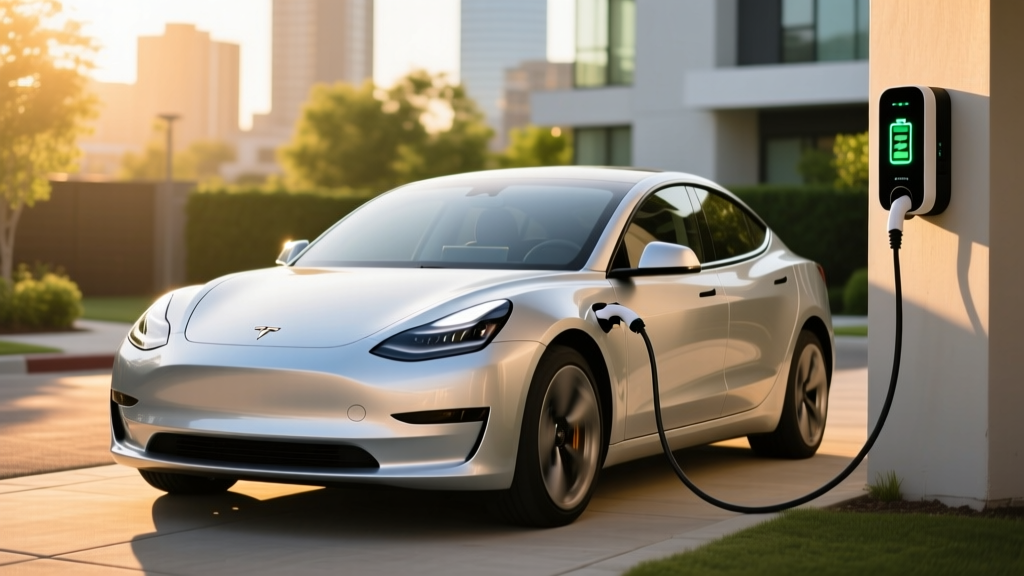
| Level 2 (240V home / destination) | 11.5 kW (48A) | ~44 mi/hr | Full charge overnight in ~6-8 hours depending on trim |
| DC Fast Charge (Supercharger V3/V4) | Peak 170 kW (RWD) / 250 kW (LR & Perf) | Up to 175 mi in 15 min (LR) | 10-80% in ~25 min (RWD) / ~18 min (LR) |
The Charging Curve: Why 80-100% Takes So Long
This is the part most "charge Tesla to 100" searches miss. DC fast charging doesn't deliver peak kW for the entire session. The Model 3 Long Range peaks at 250 kW between roughly 10-40% SoC, then tapers progressively. By 80%, charge speed drops to around 50-60 kW. The final 80-100% can add another 20-25 minutes to your session—nearly doubling the time spent at the charger.
On a road trip, the fastest strategy is to charge from 10% to 80%, drive on, and charge again, rather than waiting for 100%. You'll reach your destination faster despite the extra stop. Reserve 100% charging for:
- Overnight Level 2 charging at home or a hotel
- The final charging stop before reaching your destination
- LFP battery weekly recalibration sessions
Supercharger Access and NACS Connector
All Tesla Model 3 vehicles use the North American Charging Standard (NACS) connector natively. Tesla's Supercharger network includes over 20,000 V3 (250 kW) and V4 stalls across North America as of early 2026. Non-Tesla EVs with NACS ports (Ford, GM, Rivian, and others that transitioned starting in 2025) now share these stalls, though Tesla owners retain priority pricing and built-in navigation integration.
Pricing, Tax Credits, and True Cost of Ownership
| Trim | Base MSRP | Est. §30D Credit | Effective Price | Credit Eligible? |
|---|---|---|---|---|
| RWD (LFP) | $38,990 | Up to $7,500 | ~$31,490 | Yes — under $55K MSRP cap |
| Long Range RWD | $42,490 | Up to $7,500 | ~$34,990 | Yes — under $55K MSRP cap |
| Long Range AWD | $47,490 | Up to $7,500 | ~$39,990 | Yes — under $55K MSRP cap |
| Performance AWD | $54,990 | $0 | $54,990 | No — exceeds $55K MSRP cap |
Source: IRS.gov §30D Clean Vehicle Credit. Credit amounts depend on battery component and critical mineral sourcing requirements, buyer income limits ($150K single / $300K joint AGI), and MSRP caps ($55,000 for sedans). Point-of-sale transfer available at participating dealers. Verify eligibility at purchase time — rules are subject to legislative change.
Battery Sourcing: The Hidden Credit Variable
The full $7,500 credit splits into two halves: $3,750 for battery components manufactured in North America and $3,750 for critical minerals sourced from the US or free-trade-agreement partners. Tesla has worked aggressively to localize its supply chain, but the LFP cells in the RWD model have historically sourced from CATL in China, which can affect the critical-minerals half. As of 2025, most Model 3 Long Range variants (NMC cells from Panasonic at the Nevada Gigafactory) qualify for the full $7,500. The RWD may qualify for $3,750 or $7,500 depending on the specific production batch. Always confirm via the VIN at the point of sale or through the IRS portal.
Interior, Cargo, and Technology
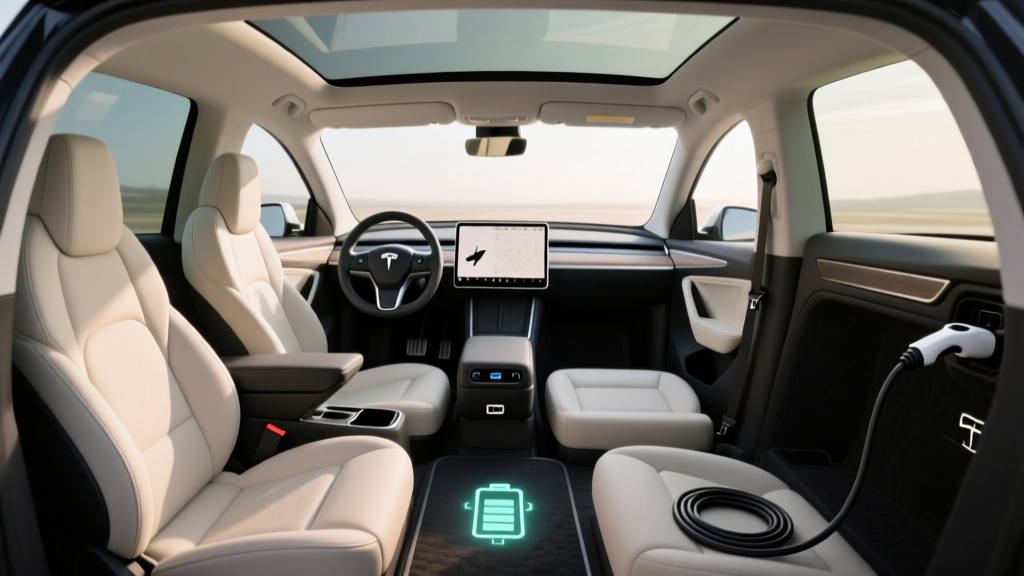
The Model 3 Highland refresh brought meaningful improvements over the pre-2024 model. Tesla added acoustic glass, ventilated front seats, ambient lighting, rear-seat ventilation, and a rear touchscreen for climate and entertainment control.
- Front headroom: 40.3 inches
- Front legroom: 42.7 inches
- Rear legroom: 35.2 inches — adequate for adults on shorter trips; tight for tall passengers on long hauls
- Cargo (trunk): 21.0 cu ft
- Frunk (front trunk): 3.1 cu ft — fits a charging cable bag or small backpack
- Total cargo: 24.1 cu ft (seats up)
The minimalist interior means almost everything routes through the 15.4-inch center touchscreen: climate controls, glovebox release, mirror adjustment, and even the speedometer (no instrument cluster behind the steering wheel). Most owners adapt within a week, but it's a dealbreaker for some traditional car buyers.
Driver Assistance: Autopilot and FSD (Supervised)
Tesla Autopilot (standard) and Full Self-Driving Supervised ($8,000 option or $99/month) are Level 2 driver-assistance systems. They provide adaptive cruise control, lane centering, automatic lane changes, and traffic-light recognition, but the driver must remain fully attentive with hands on the wheel and eyes on the road at all times. This is not autonomous driving. Tesla's camera-only vision system performs well on marked highways but can struggle in construction zones, heavy rain, and faded lane markings.
Warranty Coverage
| Coverage | Duration |
|---|---|
| Basic Vehicle Limited Warranty | 4 years / 50,000 miles |
| Battery & Drive Unit (RWD) | 8 years / 100,000 miles (70% minimum retention) |
| Battery & Drive Unit (LR & Performance) | 8 years / 120,000 miles (70% minimum retention) |
Tesla's 70% capacity retention threshold is standard for the industry but means a battery that degrades to 69% would technically qualify for warranty replacement. In practice, Tesla's batteries have shown strong longevity: data aggregated from fleet reports suggests average degradation of 8-12% over 100,000 miles for NMC packs and slightly less for LFP, which is inherently more cycle-durable.
How the Model 3 Compares: Pros, Cons, and Alternatives
- Class-leading efficiency (25 kWh/100mi on RWD)
- Supercharger network access (20,000+ stalls)
- Over-the-air updates continuously add features
- LFP battery allows routine 100% charging
- Strong resale value relative to EV peers
- Low running cost: ~$0.04-0.06/mile on home charging
- No instrument cluster — screen-only interface
- Rear seat space tighter than Hyundai Ioniq 6 or BMW i4
- FSD ($8,000) remains Level 2 despite the name
- Panel gaps and build consistency still occasionally criticized
- Performance trim exceeds $55K tax credit cap
- No Apple CarPlay / Android Auto
Key Competitors at a Glance
- Hyundai Ioniq 6 SE (Long Range): 361 mi EPA, ~$42,500, CCS charging (240 kW peak). More rear legroom, but no Supercharger access and fewer public fast-charging options.
- BMW i4 eDrive40: 301 mi EPA, ~$57,000 (above credit cap). Premium interior and traditional controls, but significantly higher price.
- Polestar 2 (Long Range Single Motor): 320 mi EPA, ~$49,900. Google-based infotainment with CarPlay, but slower DC charging (~150 kW peak) and smaller service network.
Who Should Buy the Tesla Model 3?
- Commuters (20-60 miles round trip): The RWD at 272 mi EPA is more than sufficient. Charge at home overnight on Level 2, wake up to a full "tank" every morning. The LFP battery's tolerance for daily 100% charging makes this effortless.
- Tech-forward buyers: OTA updates, the Tesla app, Sentry Mode, and Supercharger integration create an ownership experience that legacy automakers still haven't matched.
- Cost-conscious EV shoppers: At ~$31,490 after the federal credit, the RWD Model 3 is one of the most affordable ways into a 270+ mile EV with DC fast charging.
- You regularly carry rear-seat adults (the Ioniq 6 or Model Y offer more space)
- You need Apple CarPlay or a traditional gauge cluster
- You tow — the Model 3 is not rated for towing
Frequently Asked Questions
Is it bad to charge Tesla to 100% every day?
For LFP batteries (Model 3 RWD): No — Tesla actively recommends charging to 100% at least weekly to keep the BMS calibrated. Daily 100% is fine for LFP chemistry. For NMC batteries (Long Range, Performance): Yes, daily 100% accelerates long-term degradation. Set your daily limit to 80% and only charge to 100% when you need the full range for a trip.
How long does it take to charge a Tesla Model 3 from 0 to 100% at home?
On a 48-amp Level 2 home charger (11.5 kW), a full 0-100% charge takes approximately 6 hours for the RWD (60 kWh battery) and 8 hours for the Long Range (79 kWh battery). Most owners never charge from 0% — plugging in at 20-30% SoC overnight is the norm.
Does charging to 100% void my Tesla battery warranty?
No. Following Tesla's own charging recommendations (100% for LFP, 80% daily for NMC) does not affect your warranty. The warranty covers defects and capacity loss below 70% over 8 years / 100,000-120,000 miles regardless of your charging habits, though extreme abuse (like repeatedly leaving the car at 100% in extreme heat for days) could theoretically be flagged.
Should I charge my Tesla to 100% before a road trip?
Yes — for both LFP and NMC batteries, charging to 100% before a long drive is recommended. Set the charge limit to 100% the night before and plan to depart shortly after charging completes. Avoid letting the car sit at 100% SoC for extended periods (more than a few hours) in hot weather.
Does the Model 3 qualify for the $7,500 federal EV tax credit?
The RWD, Long Range RWD, and Long Range AWD all fall under the $55,000 MSRP cap for sedans under IRS §30D rules and are generally eligible for up to $7,500, subject to buyer income limits ($150K single / $300K joint modified AGI) and battery sourcing requirements. The Performance trim at $54,990 base can exceed the cap once destination fees and options are added. Always verify your specific VIN's eligibility at the point of sale. Check current rules at IRS.gov.