Quick Answer: Yes, You Can Charge an EV in the Rain
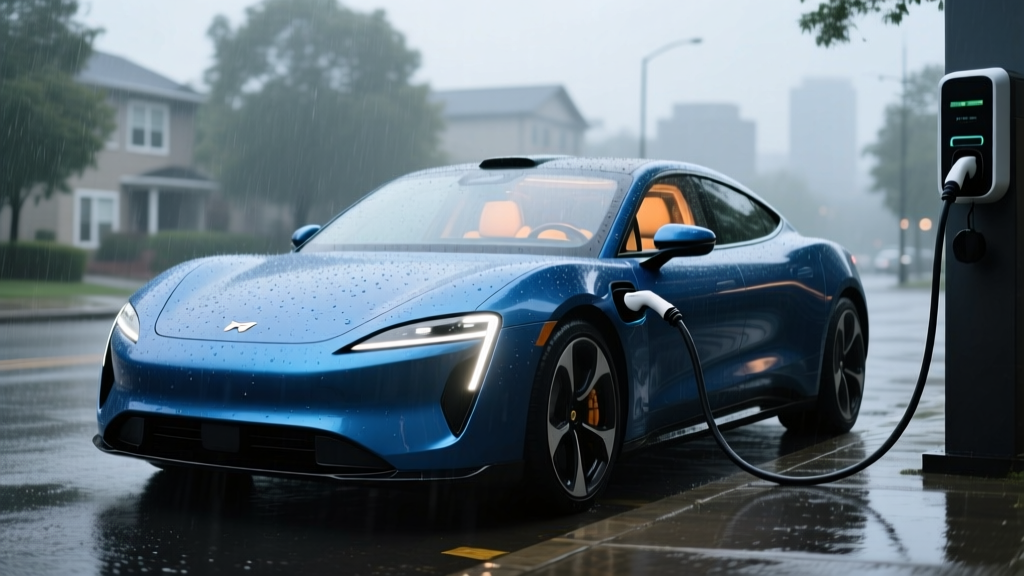
You can safely charge an electric vehicle in the rain, snow, or wet conditions. Every EV charging connector and port sold in the U.S. carries an IP54 or higher ingress-protection rating, meaning it is sealed against water splashes from any direction. The charging system will not energize until a secure, watertight connection is confirmed between the plug and the vehicle port. There is no risk of electrocution from plugging in during a downpour.
Water and electricity feel like a dangerous combination, and that instinct is healthy — but EV charging systems are engineered specifically to handle it. Whether you are at a public DC fast charger on a rainy highway stop or plugging into your home Level 2 unit during a thunderstorm, the hardware is designed, tested, and certified to operate safely in wet weather. This guide breaks down the engineering behind that safety, debunks the most common myths, and puts EV charging costs and ownership realities in perspective for 2026 buyers.
How EV Charging Hardware Keeps Water Out
The safety of charging in rain comes down to two engineering standards: IP (Ingress Protection) ratings and a handshake protocol that prevents current flow until a sealed connection is confirmed.
IP Ratings Explained
Every EV charger, cable, and vehicle port is rated under the IEC 60529 standard. The two digits after "IP" tell you dust protection (first digit) and water protection (second digit):
- IP54 — Protected against water splashes from any direction. This is the minimum rating for most EV connectors (CCS1, NACS, J1772).
- IP55 — Protected against low-pressure water jets. Common on outdoor-rated Level 2 wall connectors.
- IP67 — Protected against temporary submersion. Found on the sealed internal components of some charge ports.
For context, your smartphone likely carries an IP68 rating. The EV connector in your hand during a rainstorm is engineered to similar or better water-sealing standards.
The Handshake Protocol: No Power Until Sealed
When you plug a charging cable into your EV, electricity does not begin flowing immediately. The charger and the vehicle's onboard computer perform a digital handshake — verifying the connection is secure, the pins are fully seated, and the seal is intact. Only after this confirmation does the contactor close and current begin to flow. If you were to yank the plug out mid-charge, the system detects the break in milliseconds and cuts power before any arcing can occur.
This is fundamentally different from, say, plugging a lamp into a wall outlet, where the circuit is live the moment the prongs make contact. EV charging is a managed power delivery system, not a passive one.
Myths vs. Facts: EV Charging in Wet Weather
Misinformation about EV charging safety circulates widely on social media. Here are the most common claims, tested against engineering reality:
| Myth | Fact |
|---|---|
| "You'll get electrocuted if you charge in the rain" | False. IP54+ rated connectors and the handshake protocol prevent any current flow until a sealed connection is made. No documented cases of electrocution from EV charging in rain exist in NHTSA or NTSB records. |
| "Lightning can travel through the charger into your car" | Misleading. Modern EV chargers include surge protection. Your vehicle's chassis acts as a Faraday cage. The risk is no greater than being near any grounded electrical equipment during a storm — but avoid charging during an active lightning event as a general precaution, just as you would avoid refueling a gas car. |
| "Water in the charge port will short-circuit the battery" | False. The charge port is sealed and drained. Even if water enters the port cavity, drainage channels route it away from electrical contacts. The system will not energize if moisture is detected on the pins. |
| "You can't use an extension cord to charge in the rain" | Partially true. You should never use a standard household extension cord for EV charging — not because of rain, but because most household cords are not rated for sustained 12–40A loads and can overheat. Use only the OEM-supplied mobile connector or a purpose-built EV cable. |
| "Public chargers are unsafe in wet weather" | False. Public DC fast chargers from Electrify America, EVgo, and ChargePoint are rated for outdoor, all-weather use. The connector holster is designed to keep the plug clean and dry when not in use. |
Practical Tips for Charging in Rain and Storms
While the hardware is safe, a few practical habits make wet-weather charging even more straightforward:
- Shake off excess water from the connector before inserting it. While the seal handles moisture, keeping standing water out of the port cavity extends component life.
- Point the cable downward after plugging in so rain runs off the cable rather than pooling at the connector junction.
- Close the charge-port door fully when done. Most EVs have a motorized or spring-loaded port door with a rubber gasket — make sure it seats completely.
- Inspect the connector at public stations. If the plug is visibly cracked, the pins are corroded, or the cable sheath is damaged, choose a different stall. Report damaged equipment through the network's app.
- During severe thunderstorms with lightning, treat it like you would a gas pump — if you can wait 15–20 minutes for the cell to pass, do so. This is a general electrical-safety precaution, not an EV-specific vulnerability.
EV Charging Costs vs. Gas Fueling: The Real Numbers
Beyond the safety question, most prospective EV owners want to know whether charging — rain or shine — actually saves money. Here is a 2026 cost comparison based on a mid-size crossover driven 12,000 miles per year:
| Category | EV (e.g., 2026 Hyundai Ioniq 5, 310 mi EPA, 3.6 mi/kWh) | Gas (e.g., 2026 Toyota RAV4, 30 MPG combined) |
|---|---|---|
| Energy/Fuel Cost per Unit | Home: $0.16/kWh avg (U.S.) · Public DCFC: $0.35–$0.55/kWh | $3.45/gal avg (U.S., early 2026) |
| Units per 12,000 mi/yr | ~3,333 kWh | ~400 gallons |
| Annual Fueling Cost (home charging) | ~$533 | ~$1,380 |
| Annual Fueling Cost (100% public DCFC) | ~$1,500 | $1,380 |
| Annual Maintenance | ~$300 (cabin filter, tire rotation, wiper fluid) | ~$900 (oil changes, filters, brakes) |
| 5-Year Fuel + Maintenance Total | ~$4,165 (home charging) | ~$11,400 |
The savings are substantial — roughly $7,200 over five years — but only if you charge at home most of the time. If you rely entirely on public DC fast charging at $0.45/kWh, your "fuel" cost actually exceeds that of a 30 MPG gas car. This is the single most important economic reality of EV ownership: home charging access is the difference between saving money and spending more.
Level 2 Home Charger Installation: What It Actually Costs
A Level 2 home charger (240V, 32–48A) delivers 7.7–11.5 kW — enough to add 25–44 miles of range per hour of charging. For a 77 kWh battery (Ioniq 5 Long Range), a 10–80% charge takes about 5–6 hours on a 48A unit. Here is a realistic installation cost breakdown:
| Item | Cost Range |
|---|---|
| Level 2 charger hardware (ChargePoint Home Flex, Emporia Vue, Tesla Wall Connector) | $400–$700 |
| Electrician labor (240V/50A circuit, ~20–40 ft run) | $800–$2,000 |
| Permit and inspection | $100–$300 |
| Electrical panel upgrade (if needed, 100A → 200A) | $1,500–$3,500 |
| Total (no panel upgrade) | $1,300–$3,000 |
| Total (with panel upgrade) | $2,800–$6,500 |
Most homes built after 1990 with a 200A panel will not need an upgrade. If your home has a 100A panel — common in older construction — budget for the upgrade or ask your electrician about a load-management device ($200–$400) that lets the charger share capacity with other circuits, potentially avoiding a full panel swap.
What First-Time EV Buyers Should Know About Weather and Charging
Rain is the easy weather scenario. The conditions that actually affect EV charging and ownership are cold temperatures and charging-infrastructure availability. Here is what matters:
Cold Weather: The Real Range Killer
Rain has essentially zero effect on EV range. Cold air does not. At 20°F, expect 20–30% range reduction compared to the EPA sticker due to battery chemistry slowing down and cabin heating demand. A 310-mile EPA-rated EV may deliver 220–250 real-world miles in deep winter. Vehicles equipped with a heat pump (standard on most 2026 Hyundai, Kia, and Tesla models) recover 5–10% of that loss compared to resistive heating.
Preconditioning — warming the battery while still plugged in — is critical for winter DC fast charging. A cold battery may accept only 30–50 kW at a 350 kW charger until it warms up. Most EVs precondition automatically when you navigate to a charger; confirm this feature is enabled in your vehicle's settings.
Charging Access: Plan Before You Buy
Before purchasing an EV, answer these questions honestly:
- Do I have a garage, carport, or driveway with outlet access? If yes, a Level 2 home charger makes daily charging effortless and cheap. If you park on the street or in a shared lot with no charging access, an EV will be significantly less convenient and more expensive to fuel.
- Are there reliable DC fast chargers within 5 miles of my home or along my commute? Use the Alternative Fuels Data Center station locator to map your area.
- Do I regularly drive more than 200 miles one-way? If yes, prioritize an EV with 300+ miles of EPA range and 200+ kW DC fast charging capability, or consider a PHEV as a bridge.
Federal Tax Credit: Current §30D Rules for 2026
The federal EV tax credit under IRS §30D can reduce the effective purchase price by up to $7,500, but eligibility depends on several factors that change frequently:
- MSRP caps: Vans, SUVs, and pickups must be under $80,000; sedans and other body styles under $55,000.
- Buyer income caps: Adjusted gross income must not exceed $150,000 (single), $225,000 (head of household), or $300,000 (joint).
- Battery sourcing requirements: Critical minerals and battery components must meet escalating domestic/free-trade-agreement sourcing percentages each year. Many popular models lose partial or full credit eligibility as these thresholds tighten.
- Point-of-sale transfer: Since 2024, buyers can transfer the credit to the dealer at purchase, reducing the sale price directly rather than waiting for a tax refund.
Always verify current eligibility on the fueleconomy.gov tax credit page before making a purchase decision. Rules are subject to legislative and regulatory changes, and a model that qualifies in January may not qualify by December.
Decision Framework: Is an EV Right for Your Situation?
Choose a Battery EV (BEV) If:
- You have home or workplace Level 2 charging access
- Your daily driving is under 80 miles round-trip
- You want the lowest per-mile energy cost (~$0.04–$0.05/mi at home)
- You qualify for the §30D credit or a state incentive
- You are comfortable planning DC fast-charger stops on road trips
Choose a Plug-In Hybrid (PHEV) If:
- You lack reliable home charging but want some electric driving
- You frequently drive 200+ miles one-way where charging infrastructure is sparse
- You want electric commuting (20–40 miles) with gas-engine range for road trips
- You are not ready to fully commit to battery-only driving
Stick With a Gas or Standard Hybrid (HEV) If:
- You park on the street or in a garage with no electrical access
- Your budget cannot absorb the higher upfront cost of an EV or PHEV, even after incentives
- You live in an area with minimal public charging infrastructure and extreme cold winters
Frequently Asked Questions
Can I charge my EV during a thunderstorm with lightning?
Technically, the hardware is rated for it. However, as a general electrical-safety practice, avoid initiating a charge during active lightning in your immediate area. If your car is already charging when a storm rolls in, the surge protection in modern chargers and your vehicle's onboard systems will handle typical grid fluctuations. The risk is low but not zero — the same logic applies to gas pumps during lightning.
Will rain reduce my EV's charging speed?
No. Rain and ambient moisture have no measurable effect on charging speed. What does reduce DC fast-charging speed is cold battery temperature (below ~50°F / 10°C) and charging above 80% state of charge, where the charge curve tapers to protect the battery. A cold battery at a 350 kW charger might accept only 50–80 kW until preconditioning warms it up.
Is it safe to leave my EV plugged in overnight in the rain?
Yes. Millions of EV owners do this nightly. The connector seal is designed for sustained outdoor exposure. If your outdoor outlet or Level 2 charger is properly installed by a licensed electrician with a weatherproof cover (NEMA 3R or 4 rated enclosure), leaving it connected overnight in rain is standard practice.
Can water damage the charging port on my EV?
Under normal conditions, no. The charge port is sealed, drained, and tested to withstand car-wash pressure jets and driving rain. However, if the port door gasket is damaged or missing, or if you live in an area with heavy road-salt spray, periodic inspection and cleaning of the port area is wise. Most manufacturers cover the charge port under the 8-year/100,000-mile EV powertrain warranty.
Do I need a covered charger or carport to charge safely?
No, a cover is not required for safety. However, a carport or garage does protect the charging hardware from UV degradation, ice buildup, and physical damage over time, potentially extending the life of your Level 2 unit. If installing outdoors, choose a charger with a NEMA 4 (watertight) enclosure rating.