The Short Answer: How to Charge an EV at Home
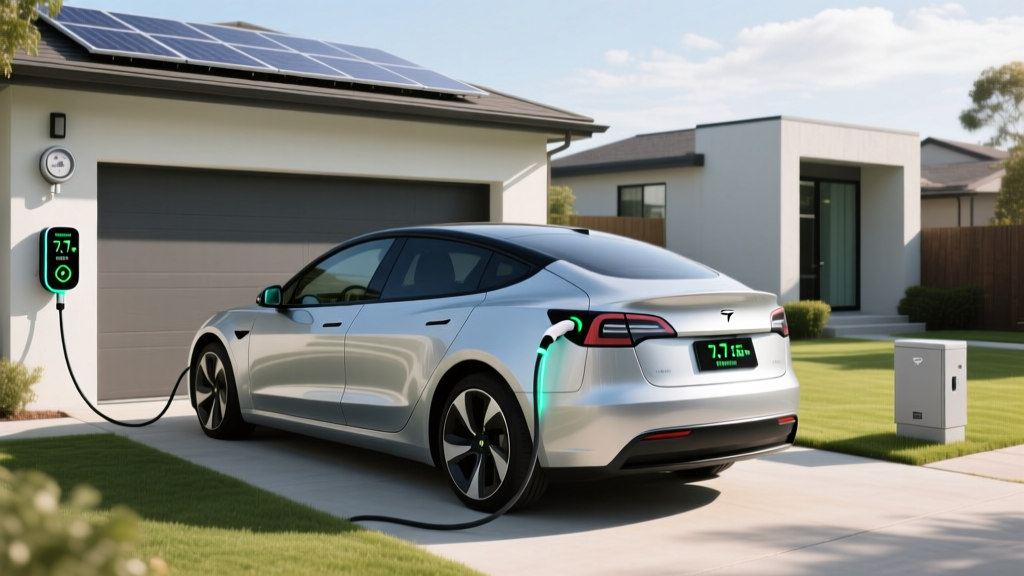
You can charge any electric vehicle at home using a standard 120V outlet (Level 1, adding 3–5 miles of range per hour) or by installing a 240V circuit with a dedicated wall connector (Level 2, adding 25–44 miles per hour). Most EV owners who charge at home install a Level 2 charger, which costs between $500 and $2,500 fully installed depending on your electrical panel and wiring run. A full overnight charge on Level 2 typically costs $4–$12 depending on your local electricity rate — roughly 60–70% less per mile than fueling a comparable gas car.
Level 1 vs Level 2: Which Home Charging Setup Do You Actually Need?
The decision between Level 1 and Level 2 home charging comes down to your daily mileage, battery size, and whether you can install a 240V circuit. Here's the physics: a Level 1 outlet delivers about 1.4 kW of power to your car's onboard charger. A Level 2 circuit delivers anywhere from 3.3 kW to 19.2 kW depending on the amperage of the circuit and the vehicle's onboard charger limit.
| Charging Level | Voltage | Power (kW) | Miles Added/Hour | Full Charge Time (75 kWh Battery) | Equipment Cost |
|---|---|---|---|---|---|
| Level 1 (standard outlet) | 120V | 1.4 kW | 3–5 mi | ~54 hours | $0 (included cord) |
| Level 2 (240V, 24A circuit) | 240V | 5.8 kW | 16–20 mi | ~13 hours | $300–$500 |
| Level 2 (240V, 48A circuit) | 240V | 11.5 kW | 30–44 mi | ~6.5 hours | $400–$750 |
Real-world context: If your daily round-trip commute is under 40 miles and your EV has a 250+ mile EPA range, Level 1 charging overnight will replenish what you use — but just barely. A 40-mile commute consumes roughly 12–15 kWh; Level 1 delivers about 12 kWh over 8–9 hours. Any deviation (detours, cold weather increasing consumption, a longer weekend trip) leaves you short. Level 2 is the practical standard for most EV households because it provides a comfortable buffer and recovers from a near-empty battery in a single night.
What Does Home EV Charger Installation Actually Cost?
The total cost to install a Level 2 home charger varies widely. The charger unit itself is a relatively small piece of the equation — the real variable is your home's electrical infrastructure.
| Component | Low-End Cost | High-End Cost | Notes |
|---|---|---|---|
| Level 2 charger unit (hardwired or NEMA 14-50 plug) | $300 | $750 | Brands: ChargePoint Home Flex, Emporia Level 2, Tesla Wall Connector, Grizzl-E |
| Electrical panel capacity (200A service sufficient?) | $0 | $2,000–$4,000 | Panel upgrade required if existing panel is 100A or near capacity |
| Wiring run (electrician labor + materials) | $200 | $1,500 | Short run from adjacent panel: ~$200. Long run through walls/attic: $1,000+ |
| Permit and inspection | $50 | $300 | Required in most jurisdictions; varies by municipality |
| Total installed cost | $550 | $6,550 | Most homeowners with 200A service and short runs: $800–$1,500 |
Panel upgrade gotcha: Many older homes have 100-amp electrical panels that are already near capacity. Adding a 48-amp EV charger circuit (which draws up to 11.5 kW continuously) may require upgrading to a 200-amp panel. This is the single largest cost variable — $2,000 to $4,000 in most markets. Some utilities offer rebates that offset panel upgrades; check with your local provider. An increasingly popular alternative is a smart panel-level load management device (like the Emporia Smart Panel or Span Drive) that dynamically limits EV charging when other household loads spike, avoiding a panel upgrade entirely.
As a reference point, the U.S. Department of Energy estimates that 80% of EV charging happens at home, making this investment central to the ownership experience.
Charging at Home vs Fueling a Gas Car: The Real Cost Breakdown
This is where home charging economics become compelling — but the numbers depend heavily on your local electricity rate and the vehicle you're comparing against.
| Metric | EV (Home Charging) | Gas Car (28 MPG Combined) | Hybrid (52 MPG Combined) |
|---|---|---|---|
| Energy/fuel cost per unit | $0.16/kWh (U.S. avg) | $3.30/gallon | $3.30/gallon |
| Consumption per 100 miles | 30 kWh | 3.57 gallons | 1.92 gallons |
| Cost per 100 miles | $4.80 | $11.78 | $6.34 |
| Annual fuel/energy (12,000 mi) | $576 | $1,414 | $761 |
| Annual savings vs gas | $838 | — | $653 |
| 5-year fuel/energy total | $2,880 | $7,070 | $3,805 |
Based on the U.S. average residential electricity rate of approximately $0.16/kWh (per EIA data) and a national average gasoline price of ~$3.30/gallon, a typical EV charged at home saves roughly $800–$850 per year in energy costs compared to a 28 MPG gas car. Against a 52 MPG hybrid like the Toyota Prius, the savings narrow to about $185/year — which is meaningful but changes the payback math on your charger installation.
Time-of-use rates matter: Many utilities offer off-peak electricity rates between 10 PM and 6 AM that drop to $0.06–$0.10/kWh. If you schedule charging overnight using your car's built-in timer or your charger's app, your cost per 100 miles can fall to $1.80–$3.00 — less than a quarter of what gasoline costs.
What First-Time EV Buyers Must Know Before Plugging In
Home charging is straightforward once set up, but several nuances catch new owners off guard.
kW vs kWh — the critical distinction: Kilowatts (kW) measure power — how fast energy flows. Kilowatt-hours (kWh) measure energy — how much your battery holds. A 75 kWh battery charged at 11.5 kW takes roughly 6.5 hours from empty to full (75 ÷ 11.5 ≈ 6.5). Your car's dashboard and your charger's app will display both; knowing the difference prevents costly confusion.
Your car's onboard charger is the bottleneck: Even if you install a 48-amp (11.5 kW) circuit, your car may only accept 7.7 kW or 11.5 kW depending on its onboard charger. The Tesla Model Y accepts up to 11.5 kW on AC. The Hyundai Ioniq 5 accepts 10.9 kW. The Chevrolet Equinox EV accepts 11.5 kW. If your car maxes out at 7.7 kW, a 48-amp circuit won't charge it any faster than a 32-amp circuit — save money on a smaller circuit.
Cold weather increases consumption: In freezing temperatures, expect your EV to use 20–35% more energy per mile due to battery heating demands and cabin heating. A car rated at 30 kWh/100mi in mild weather may consume 38–40 kWh/100mi at 20°F. This means your Level 2 charger needs to work harder in winter to replenish the same commute. Preconditioning your car while it's still plugged in (using grid power to warm the battery and cabin before you leave) is the single most impactful efficiency habit for cold-climate EV owners.
NACS vs CCS connector compatibility: As of 2026, the North American Charging Standard (NACS, Tesla's connector) has been adopted by Ford, GM, Rivian, Volvo, BMW, and others. Hyundai/Kia still use CCS on some models but are transitioning. Your home charger should match your car's port — or you'll need an adapter. Most major charger manufacturers now offer NACS-terminated cables alongside J1772/CCS options.
Common Home EV Charging Myths — Fact-Checked
| Myth | Fact |
|---|---|
| "You need a special electrical upgrade for every home" | If you have a 200A panel with spare capacity and your garage or driveway is near the panel, installation can cost under $800. Many homes need only a new 240V circuit breaker and a short wire run. |
| "Level 1 charging is useless" | For plug-in hybrids with 25–45 miles of electric range and small batteries (10–18 kWh), Level 1 fully recharges overnight. It's also a viable fallback for low-mileage BEV drivers who charge opportunistically. |
| "Home charging degrades the battery faster" | Slow AC charging (Level 1 or 2) generates far less heat than DC fast charging and is actually the gentlest way to charge. Battery degradation is driven primarily by sustained high states of charge and extreme temperatures — not by charging speed at home. |
| "You'll need to charge every single night" | With EPA ranges now commonly 250–340 miles, most drivers charging at home only need to top up 2–3 times per week. Set a charge limit to 80% for daily use to prolong battery health. |
| "Solar panels are required to save money" | Grid electricity at $0.16/kWh already delivers a per-mile cost 60% below gasoline. Solar reduces costs further but is not necessary for EV ownership to be economical. |
Should You Charge an EV at Home, or Is a Hybrid Better for Your Situation?
Actionable Decision Framework
Choose a BEV with home Level 2 charging if:
- You have a garage, carport, or driveway where a 240V circuit can be installed
- Your daily driving is under 80 miles round-trip (well within overnight replenishment)
- Your household has or can upgrade to 200A electrical service
- You want the lowest per-mile energy cost and minimal maintenance (no oil changes, fewer brake replacements due to regenerative braking)
- You qualify for the federal §30D tax credit (up to $7,500, subject to MSRP caps, buyer income limits, and battery-sourcing requirements — verify current eligibility at IRS.gov)
Choose a plug-in hybrid (PHEV) with Level 1 home charging if:
- You rent or cannot install a 240V circuit
- Your daily commute is under 35 miles (within PHEV electric-only range of 25–45 miles)
- You regularly take 300+ mile road trips and lack access to reliable DC fast charging along your routes
- Your household electrical panel is 100A with no upgrade budget
Rethink full EV ownership (for now) if:
- You live in an apartment or condo with no charging access and no workplace charging
- Your area has frequent multi-day winter storms with sub-zero temperatures and unreliable power (extreme cold + outage = no mobility)
- You tow heavy loads regularly — towing can reduce EV range by 40–50%, making even 300-mile EVs impractical for long hauls
Home Charging Equipment: What to Buy in 2026
The home charger market has matured significantly. Here's what to look for based on your circuit capacity and vehicle:
For a 32-amp circuit (7.7 kW): Ideal if your car's onboard charger caps at 7.7 kW or your panel can't support a larger circuit. The Emporia Level 2 ($399) and Grizzl-E Smart ($449) are reliable, UL-listed options with Wi-Fi scheduling.
For a 48-amp circuit (11.5 kW): The ChargePoint Home Flex ($549), Tesla Wall Connector ($450, NACS native), and Emporia Level 2 with 48A capability ($449) are top picks. Hardwired installation is preferred for 48A circuits — NEMA 14-50 receptacles are rated for 50A but continuous EV loads should be limited to 80% of circuit capacity, making 40A the safe max on a 50A outlet.
Smart features worth paying for: Wi-Fi connectivity for scheduling (to take advantage of time-of-use rates), energy monitoring to track your charging costs, and load-sharing capability if you plan to add a second EV to the same circuit in the future.
Frequently Asked Questions
Can I charge my EV from a regular household outlet?
Yes — every EV ships with a Level 1 charging cord that plugs into a standard 120V NEMA 5-15 outlet. It delivers approximately 1.4 kW, adding 3–5 miles of range per hour. This is sufficient for plug-in hybrids and low-mileage BEV drivers but impractical as a primary charging method for long-range electric vehicles with 75+ kWh batteries.
How much will my electric bill increase with an EV?
Driving 12,000 miles per year in an EV averaging 30 kWh/100mi adds approximately 3,600 kWh annually to your electricity usage. At the U.S. average rate of $0.16/kWh, that's roughly $576 per year or $48 per month. If you were spending $150/month on gasoline, your net savings would be about $102/month even without time-of-use rate optimization.
Do I need a permit to install a home EV charger?
In most U.S. jurisdictions, yes — a 240V circuit installation requires an electrical permit and inspection. Permit fees typically range from $50 to $300. Skipping the permit can void your homeowner's insurance coverage for electrical fires and may cause issues during a future home sale. Always use a licensed electrician.
Is it safe to charge an EV in the rain or in an unheated garage?
Yes. All UL-listed EV chargers and vehicle charge ports are rated for outdoor use and sealed against moisture. Charging in rain, snow, or freezing temperatures is safe. In extreme cold (below 0°F), your car's battery management system will warm the battery before accepting a full charge rate, which may slow the initial charging phase — this is normal and protective.
Can I use a dryer outlet to charge my EV?
Some EV owners use a NEMA 14-30 (dryer) outlet with an adapter cord. While technically feasible (delivering up to 5.8 kW at 24A), this is only advisable if the outlet is in excellent condition, dedicated to EV use during charging sessions, and you use a quality adapter. Shared outlets that are frequently unplugged and replugged develop loose connections over time, creating a fire risk. A dedicated circuit installed by a licensed electrician is the safer approach.
What happens to home charging if I lose power?
Your EV charger won't function during a grid outage unless you have a home battery system (like a Tesla Powerwall) or a generator with a transfer switch. Some newer EVs with V2H (vehicle-to-home) capability — like the Ford F-150 Lightning with the Ford Charge Station Pro and home integration system — can actually power your home during an outage using the truck's large battery. This requires specific bidirectional charging equipment and electrical integration.