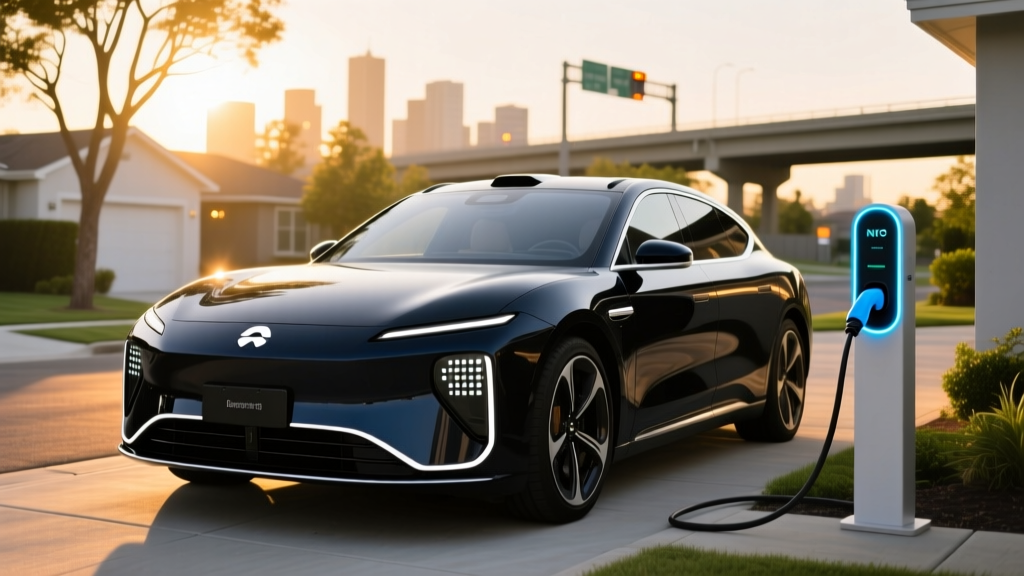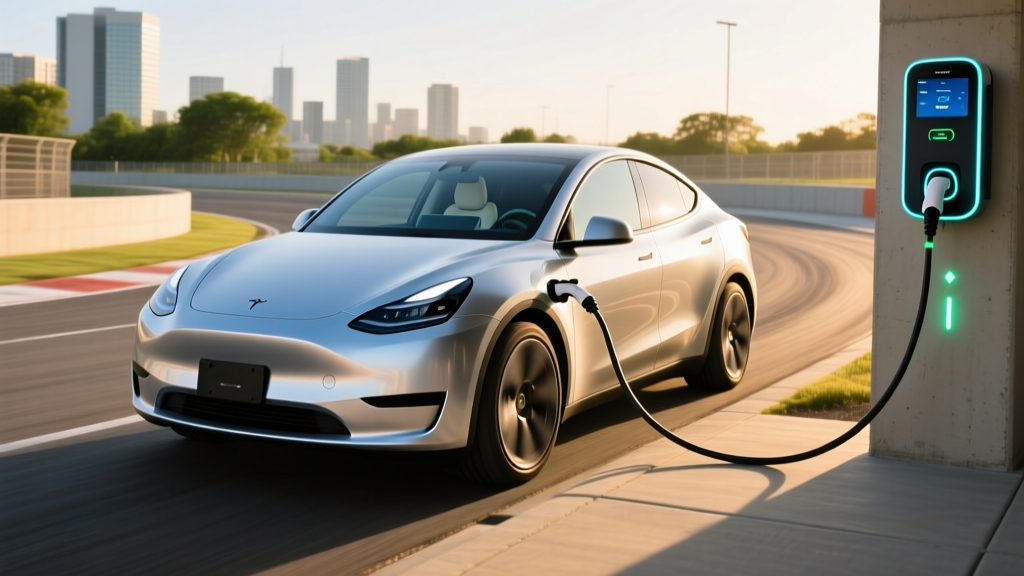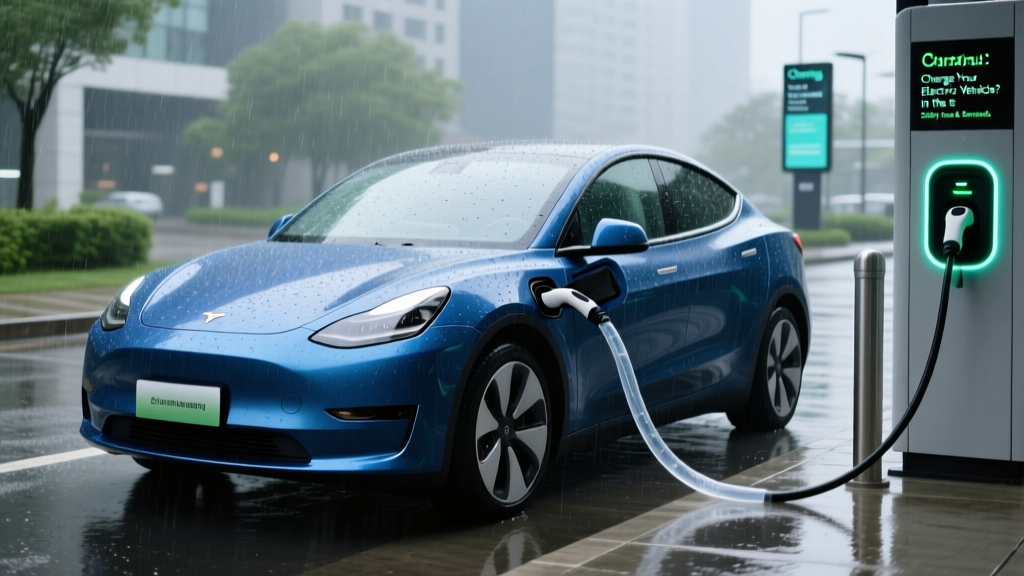
If you've ever stood in a drizzle at a public charging station, cable in hand, wondering whether plugging in during a downpour will fry your car's electronics — you're not alone. It's one of the most-searched questions among new EV buyers, and the answer is straightforward.
Quick Answer: Can You Charge Your Electric Vehicle in the Rain?
Yes, you can safely charge an EV in the rain. Every EV charging connector and inlet sold in the U.S. is engineered and tested to withstand water exposure. The J1772 connector (Level 2), CCS1 (DC fast charging), and NACS (Tesla and now most major brands) are rated to at least IP54 — meaning they resist water splashes from any direction. The vehicle and charger communicate to ensure no current flows until a sealed, safe connection is confirmed. You will not be electrocuted, and your car will not short-circuit.
But the short answer doesn't tell the whole story. There are practical considerations — connector handling, charging-cable maintenance, flooded-station risks, and the difference between rain and submersion — that every EV owner should understand. Below, we break down the engineering, address the myths, and put EV charging safety into the broader context of real-world ownership costs and decisions.
How EV Charging Connectors Are Engineered for Wet Weather
EV charging hardware is designed from the ground up for outdoor use in all weather. Here's the engineering that makes it safe:
- Ingress Protection (IP) ratings: The J1772 connector standard requires a minimum of IP54 (splash-proof). Most Level 2 and DC fast-charging connectors meet IP55 or higher. The vehicle-side inlet is similarly sealed. For reference, IP55 protects against low-pressure water jets — far beyond what rain produces.
- Proximity and control pilot signals: Before any current flows, the charger and vehicle exchange a digital handshake via the control pilot wire. The connector must be fully seated and locked before the contactors close. If water creates a fault, the system detects it within milliseconds and cuts power.
- Drainage channels: Both the connector and the vehicle inlet have drainage paths so that any water entering during insertion drains away from the electrical contacts.
- Ground-fault protection: All EVSE (Electric Vehicle Supply Equipment) installed to NEC Article 625 standards includes ground-fault circuit interrupter (GFCI) protection, which trips at 4–6 milliamps — well below any dangerous threshold.
This isn't theoretical. According to NHTSA incident databases, there are no documented cases of electrocution from charging an EV in the rain in the United States. The engineering margins are substantial.
Myth vs. Fact: EV Charging Safety Misconceptions
Despite robust engineering, misinformation persists. Let's address the most common claims:
| Myth | Fact |
|---|---|
| "Water and electricity don't mix — you'll get shocked." | True for exposed live circuits. EV connectors carry no voltage until the digital handshake confirms a sealed connection. The pins are recessed and shielded. |
| "Lightning makes outdoor charging deadly." | Lightning risk is about being outdoors generally, not specific to EV charging. Your car acts as a Faraday cage. However, avoid charging during active lightning storms as you would avoid any outdoor activity. |
| "Rain reduces charging speed." | No. Charging speed depends on battery temperature, state of charge, and charger capacity — not ambient moisture. A cold battery charges slower, but that's a thermal issue, not a rain issue. |
| "You can't use a Level 2 home charger installed outdoors." | Outdoor-rated EVSE units (like the ChargePoint Home Flex or Emporia Level 2) are NEMA 4-rated enclosures designed for permanent outdoor installation in all weather. |
| "Tesla says not to charge in rain." | Tesla's owner's manuals do not prohibit charging in rain. They advise keeping the connector and inlet clean and free of debris — applicable in any weather. |
Practical Tips for Charging Your EV in Wet Conditions
While the hardware is safe, a few practical habits reduce wear and prevent rare edge-case problems:
- Inspect the connector before plugging in. At public stations, glance inside the connector for standing water, debris, or visible damage. A quick shake clears pooled rainwater. If you see corroded pins or a cracked housing, use a different stall.
- Keep the connector pointed downward when moving it. This prevents rain from pooling inside the connector before you insert it into the vehicle inlet.
- Don't charge in standing water or floods. If the charging station base is submerged — even a few inches — do not approach it. Submersion is a fundamentally different risk from rain. Wait for water to recede.
- Close the charge-port door promptly. After unplugging, close the vehicle's charge-port door immediately to prevent water from collecting in the inlet between sessions.
- Use a drip loop for outdoor home chargers. Ensure the cable hangs below the connector before rising to the car's inlet, so water drips off the low point rather than running into the connector.
EV Ownership Cost Context: Charging vs. Fueling
Whether you're plugging in during a drizzle or under clear skies, the economics of EV charging remain one of the strongest arguments for going electric. Here's how the numbers stack up in 2026:
| Cost Factor | EV (e.g., 2026 Hyundai Ioniq 6 SE) | Gas Car (e.g., 2026 Honda Accord 1.5T) | Hybrid (e.g., 2026 Toyota Camry LE Hybrid) |
|---|---|---|---|
| MSRP (base) | $38,650 | $29,690 | $30,045 |
| Fuel/Energy Cost per Mile | $0.042 (home L2, $0.14/kWh avg) | $0.143 (30 MPG combined, $3.50/gal) | $0.076 (51 MPG combined, $3.50/gal) |
| Annual Fuel/Energy (12,000 mi) | $504 | $1,716 | $912 |
| Maintenance (annual avg) | $350 (no oil, fewer brakes) | $850 | $700 |
| 5-Year Fuel + Maintenance | $4,270 | $12,830 | $8,060 |
| Federal Tax Credit (§30D) | Up to $7,500 (if eligible*) | $0 | $0 (HEV) |
| Estimated Insurance (annual) | $1,950 | $1,520 | $1,600 |
*The §30D federal tax credit has income caps ($150K single / $300K joint), MSRP caps ($55K sedans / $80K SUVs/trucks), and battery-sourcing requirements that change annually. Check current rules at IRS.gov or consult a tax professional. Point-of-sale transfer is available at participating dealers.
The data is clear: even with higher insurance premiums (a real EV ownership cost often overlooked), the Ioniq 6 saves roughly $8,560 over five years in fuel and maintenance compared to the Accord, and $3,790 vs. the Camry Hybrid. Pair that with a potential $7,500 tax credit, and the EV's higher upfront cost disappears within 2–3 years for most buyers.
Real-World Ownership Considerations: Beyond the Rain Question
If you're researching whether you can charge in the rain, you're likely evaluating EV ownership more broadly. Here are the factors that actually determine whether an EV fits your life:
Home Charging Access
This is the single biggest predictor of EV satisfaction. If you can install a Level 2 (240V) charger at home, you'll do 90%+ of your charging there — and rain becomes a non-issue. A typical home Level 2 install costs:
| Component | Cost Range |
|---|---|
| Level 2 EVSE (hardware) | $300 – $700 |
| Electrician labor (50-amp circuit, 40-ft run) | $800 – $2,000 |
| Permit and inspection | $100 – $300 |
| Panel upgrade (if needed, 200A service) | $1,500 – $3,500 |
| Total (no panel upgrade) | $1,200 – $3,000 |
| Total (with panel upgrade) | $2,700 – $6,500 |
If you live in an apartment or lack dedicated parking, public charging becomes your primary option. In that case, evaluate your local DC fast-charging infrastructure — Electrify America, EVgo, and Tesla Superchargers (now open to NACS-equipped non-Tesla EVs) — before buying.
Climate and Range
Rain itself has negligible effect on range. Cold temperatures, however, reduce range by 15–30% due to battery chemistry and cabin heating demands. A 2026 Ioniq 6 SE with an EPA-rated 361 miles of range may deliver 250–280 real-world miles in freezing conditions at highway speeds. In moderate rain at 65°F, expect minimal deviation from the EPA sticker.
Driving Patterns
EVs excel in stop-and-go city driving (regenerative braking recovers energy) and struggle less than gas cars with short trips (no cold-start fuel enrichment). If your daily commute is under 60 miles round-trip, virtually any current EV handles it with range to spare — rain or shine.
Decision Framework: Should You Buy an EV, Hybrid, or Stick With Gas?
Choose a Battery Electric Vehicle (BEV) If:
- You have reliable home Level 2 charging access (garage, driveway, or workplace)
- Your daily driving is under 200 miles, with occasional road trips under 350 miles between stops
- You want the lowest per-mile energy cost ($0.03–$0.05/mi at home)
- You qualify for the §30D tax credit, reducing effective purchase price by up to $7,500
- You want minimal maintenance (no oil changes, reduced brake wear, no exhaust system)
Choose a Plug-In Hybrid (PHEV) If:
- You have home charging but frequently take long road trips (>400 miles)
- You want 25–45 miles of electric-only range for commuting, with a gas engine for longer trips
- You're not ready to rely on public DC fast-charging infrastructure
- Example: 2026 Toyota RAV4 Prime — 42 miles EV-only, 38 MPG combined on gas, $43,690 MSRP
Choose a Standard Hybrid (HEV) If:
- You have no access to home or workplace charging
- You want better fuel economy without changing your fueling habits
- You drive in extreme cold regularly and want zero range-degradation risk
- Example: 2026 Toyota Camry LE Hybrid — 51 MPG combined, $30,045 MSRP
Stick With Gas If:
- You live in a charging desert with no planned infrastructure
- You tow heavy loads frequently (>5,000 lbs) where EV range drops 40–50%
- Your budget is under $25,000 and the used EV market in your area is thin
Frequently Asked Questions
Can water get into the EV charge port and damage the battery?
No. The charge port inlet is sealed and includes drainage channels. Water that enters during insertion or rain drains away from the electrical contacts. The high-voltage battery pack itself is sealed to IP67 or IP6K9K standards — it can withstand temporary submersion (up to 1 meter for 30 minutes in most designs). Driving through a rainstorm poses no risk to the battery.
Is it safe to charge an EV during a thunderstorm?
The electrical risk is low — your EVSE has surge protection and GFCI protection. The real risk is personal: you're standing outdoors during a lightning storm. The same common sense that says "don't golf in a thunderstorm" applies here. If lightning is active, wait inside until it passes, then plug in.
Does charging in the rain void my EV's warranty?
No. No manufacturer warranty excludes charging in rain. EV warranties cover battery capacity retention (typically 8 years / 100,000 miles with a 70% minimum capacity threshold per federal mandate) and powertrain components. Weather exposure during normal charging use is not a warranty exclusion.
What about charging an EV in snow or ice?
Safe, with one practical caveat: ice can accumulate on the connector or inside the charge-port door, making insertion difficult. Keep a small brush or de-icer spray handy in winter. Some EVs (Tesla, Rivian, Hyundai/Kia E-GMP models) offer charge-port heating to prevent ice buildup. Charging speed may be slower in extreme cold until the battery warms via preconditioning.
Can I use an extension cord to charge my EV outdoors?
For Level 1 (120V) trickle charging, manufacturers recommend against extension cords due to voltage drop and overheating risk on long runs. If you must use one, it should be a heavy-duty 12-gauge outdoor-rated cord no longer than 25 feet. For Level 2 (240V), never use an extension cord — hire a licensed electrician to install a properly rated outlet or hardwired EVSE at the correct distance.
How does public DC fast-charging work in the rain?
The CCS1 and NACS connectors used at DC fast-charging stations (50–350 kW) are rated for outdoor use and have the same IP protections as Level 2 connectors. The heavier cables can be harder to manage one-handed in wind and rain, but the safety systems are identical. Expect peak charge rates of 150–250 kW on modern EVs, adding 10–80% in roughly 18–25 minutes depending on the vehicle and station. The charge curve tapers above 80% SoC regardless of weather.
The bottom line: rain is not a reason to hesitate on EV ownership. The connectors, vehicles, and charging stations are engineered with significant safety margins for exactly this scenario. Your real decision points are home charging access, daily driving distance, and whether the total cost of ownership — factoring in energy savings, maintenance reduction, tax credits, and higher insurance — works in your favor. For most buyers with home charging, the math clearly favors electric.